Civic duty

This past week Israel held municipal elections around the country. We had a government-endorsed vacation day to encourage voting. Businesses that stayed open were required to pay employees 200% (as if they worked on a holiday).

I went to my neighborhood polling station and found about 10 people outside promoting their candidates. They completely ignored me as I walked by. Did I project an aura of “I’ve already made up my mind, so don’t even”?

I expected to have to wait to vote. But there was not another voter in the whole building. It was just me at 1 o’clock in the afternoon doing my civic duty.

People often take pictures of themselves voting and post them on Facebook. Taking pictures of the voting process is perfectly fine. But I didn’t do it because the voting system is frankly a bit ridiculous.

In Jerusalem, you vote for a party list and you have a separate vote for the mayor. You don’t mark a ballot or vote on any particular issues.  Personally, I feel like a kindergartner voting for class president.

When you walk in, you give the registrar your ID card and you receive two envelopes: a yellow one for the mayor, a white one for the party. You walk behind a cardboard partition and you’re faced with a divided tray filled with slips of paper. There are 21 parties each with their own letter (that may or may not obviously relate to the party name) and 5 mayoral candidates. You can also write in candidates.

Votingscreengrab source

One slip of paper in each envelope, seal them, and drop them into the locked cardboard box.

Pick up your ID and go on your merry way having completed your civic duty.

Seriously, Jerusalem? WTF?

The next morning we find that we will have a run-off election because no mayoral candidate passed the 40% majority threshold.

Not among the two left standing is the candidate who was endorsed by the outgoing mayor, the prime minister, the Likud party, and other candidates who stepped out of the running. Well, there was a report that he had loan guarantees provided by quite a few Russian oligarchs.  And there was a weird text message campaign against him. I kept receiving anonymous messages saying that Gargamel doesn’t love the Smurfs and he doesn’t love Jerusalem either.

The young, secular guy who is left in the race was not endorsed by any major players and hasn’t raised as much money – although there is a rumor that he has money coming in that doesn’t have to be reported. On the down side, he has no management experience, he hasn’t worked with the Knesset, and he has a reputation for not getting along with colleagues.

But the worst thing is that even though there was a campaign to increase voter turnout and it was a holiday, Jerusalem’s voter turnout went DOWN from the last election. Last time it was 39% and this time it was 35%.

As I was walking to the voting station, I overheard a conversation:

“Are you going to vote?”

“Nah. I don’t like any of the candidates.”

You might think that Jerusalem was any old village in a far-flung corner of Nowheresville, not the home of 3 monotheistic religions, the crossroads of 3 continents, a flashpoint of the Palestinian-Israeli conflict, the Center of the Universe, and the capital of the State of Israel.

Palestinians in East Jerusalem are encouraged to boycott the elections (as a method of not recognizing Israel), so you can understand why they didn’t vote. But all of the 65% of eligible voters who didn’t vote pretty much thumbed their noses at the future of this city with a hearty “Whatever, losers!” and went to the beach.

The run-off is on November 13 and it’s not a holiday. I have a sinking feeling that Apathy will be the winner on that day too.

A sore thumb in Abilene

I ran across an article this week about the Abilene Paradox, which admittedly sounds like the title of a Big Bang Theory episode. Apparently it is a social phenomenon in which a group of people come to a decision that none of them wants. The back story is that four people decide to go to dinner in Abilene and have a terrible time only to find out later that none of them actually wanted to go.

The author stated that this would never happen in Israel because everyone is so vocal about their opinion and that this sounded like a phenomenon “in a society of very polite gentiles.”

The point of the article was not a comment on society, but rather how to encourage teens to follow their own hearts and not bow to peer pressure.

In that moment, I was transported to my childhood – I grew up in a small town in the US, in those days “a society of very polite gentiles.”

My best friend – a Mormon, who was probably my best friend because there were no other kids our age in the neighborhood – told me that she was worried about me. Apparently she had spoken to her mother about my weird behaviors: walking out of music class when it was time for Christmas carols, skipping the Christmas pageant, being altogether different.

Her mother’s sage advice, which my friend shared with me, was: “If she wants to stick out like a sore thumb, then let her.”

Me? A sore thumb?

Listen, without being too full of myself, I was adorable and everyone liked me. Even if they thought my immortal soul was going straight to hell because I was Jewish, they wholeheartedly prayed for me and hoped that I would see the light because it would be such a shame for a sweetie like me to rot in hell for eternity. But a sore thumb? I don’t think so.

It was one of those transformative moments in life that you only recognize in retrospect. I could have been sad that I was a sore anything and was different. But the truth is that your hand functions best with a thumb, sore or not. And if I’m going to be a thumb, then by golly, I’m going to be a great one!

So with all due respect to Abilene, I’m not going. But if you want to go, I’m not going to stop you.

motivation-721822_1920
Even stock photos agree: Thumbs are Awesome!

The Rule of Law

One of the big headlines in Israel this week is that the Supreme Court of Israel ruled to allow a student to enter the country to attend Hebrew University in a Master’s program even though this student has a history of supporting the Boycott, Divestment, Sanctions movement against Israel. It was among the first test cases of the anti-BDS entry law that Israel passed last year blocking entry to Israel of people who actively advocate BDS and act against Israel. (*Note: this is not the law that allows suing for damages if Israel is harmed by BDS activism. That was a different test case.)

Crash course on Israel’s governmental structure

Israel is not at all like the US system and is much more similar to the UK system. The Prime Minister is the head of the party that wins the election (thus the executive branch and legislative branch are combined). The President of Israel is a ceremonial position and is filled by a person elected by the Knesset, usually after a long career in politics. The President appoints the 15-member Supreme Court based on the recommendations of a judicial committee. Judges on the Supreme Court may serve until the age of 70 unless they resign for other reasons.

The Supreme Court in Israel serves two functions. Like the US Supreme Court, it is the final court of appeal. But unlike the US Supreme Court, the Supreme Court in Israel – operating as the High Court of Justice – may also hear petitions to rule on the legality of laws or other issues that would not normally be heard in a court of law. Since Israel doesn’t have a constitution, the Court uses the Basic Laws of Israel as its guide.

In 2017, a law was passed in the Knesset that said that a non-citizen who actively uses a public forum to call for a boycott of Israel and has a reasonable expectation of causing a boycott to occur, can be barred from entering Israel. This more-or-less applies to leaders of organizations, not someone who supports BDS on Facebook.

scales-145464_1280

It’s pretty divisive issue in Israel. The Left says that the law and its application violates freedom of speech and that Israel has nothing to hide. The Right points out that the democratically elected members of Knesset are acting on behalf of the will of the people and defending Israel at the border against enemy agents trying to destroy Israel from within.

Other BDS activists/supporters have been turned away at the airport, but the student in question here decided to take it to court.

The Court ruled that the law itself was in accordance with the Basic Laws, but that it did not apply in the student’s case. She claimed not to be involved in BDS for the last year and a half and was not planning to be a BDS activist while in Israel. So she’ll be starting at Hebrew U. next week.

Two comments

Academia the world over tends to lean to the left and it’s the case in Israel too. There are a good number of Israeli academics who support the BDS movement – even if it sometimes backfires and they themselves are uninvited to conferences or blackballed in publications. So while it seems on the face of it that the student wanting to attend Hebrew University, and who was backed in court by Hebrew U., is not supportive of BDS, I’m not so sure that it is quite so clear-cut. I guess we’ll see what this student does while she’s here.

This court case is a microcosm of the existential question of what kind of state Israel will be. Will Israel be a state of wide-ranging freedom for all or a repressive state that only allows opinions that agree with the majority?

And that’s where the Court comes in. It should not be a question of political Left or Right, but a question of what is just, not only legal. When the Court took upon itself the responsibility of protecting human rights, the Right called it an “activist court.” And when the Court allows a law to stand that the Left feels is repressive, the Left calls the Court a “rubber stamp.” The truth, of course, is somewhere in between. The Court must act to stop tyranny of the majority, but they must also allow the state to act on behalf of the safety and security of its citizens. The principle is simple, the application is complicated.

“Justice, justice shall you pursue.” – Deuteronomy 16:20

palace-of-justice-1088522_1920

Palace of Justice, Jerusalem

Something to make me smile – Ethiopian Women Bus Drivers

In some ways, Israel is quite progressive in gender equality. And in many other ways, Israel is still in the Dark Ages.

Bus driver was one of those jobs in Israel that was always done by a man. Ethnicity didn’t seem to matter, but it was always a man. I don’t know if it’s related, but bus drivers are notoriously aggressive drivers. I was once on a bus – a double-length bus with an accordion middle junction – on a two-lane street. The car ahead of this bus was annoying the driver and in spite of the bumper-to-bumper traffic, the bus somehow passed the car. There may have been some popping up on the curb and shouting back and forth, but I cannot really explain how it was physically possible for a double-length bus filled with people to maneuver in traffic like a two-seat roadster.

Egged

A few years ago, I noticed that things were starting to change. I saw more Arab drivers, still men though. And then I saw a woman driver.  And then I noticed more women drivers, even Arab women drivers. Women drivers are still pretty rare to see, but I get very happy when I see them. Is our sexist country finally starting to change a little bit?

I have to say that I’m happiest when I see an Ethiopian woman driver.

When you examine the social strata of Israel, I think the group with the most obstacles facing them is Ethiopian women.

They face blatant racism. There are plenty of rabbis in the rabbanut (the religious authority in Israel) who do not accept Ethiopians as properly Jewish and require that they go through a formal, Orthodox conversion.

The Ethiopian struggle to come to Israel is awe-inspiring. Some were brought in emergency airlifts having never seen a plane before. Some walked the whole way facing hunger, thirst, natural dangers, and human dangers. They faced unimaginable odds and obstacles at every turn. And many thousands died along the way.

Some Ethiopians face a cultural gap – in some cases a chasm as wide as the Grand Canyon. Can you imagine living in an African village, more or less self-sufficient in your community, and then you arrive in a place that is technologically a hundred years more advanced? Once you didn’t need to read and write, and then suddenly everyone is asking you to fill out a form in a foreign language?

It’s a sad fact that some older Ethiopian men haven’t adjusted to life in Israel very well. They come to Israel and because they don’t succeed in society, they feel emasculated. And their frustration gets taken out on their families, especially wives.

But then you see her, a petite Ethiopian woman – the steering wheel of the bus is nearly the entire length of her arm – and she’s maneuvering this monster vehicle in the crazy traffic of rush hour Jerusalem and dealing with impatient, hot, frustrated passengers.

Imagine a two-lane road with cars parked with two wheels on the sidewalk (yep, that’s legal parking) along both sides and both lanes are bumper-to-bumper. Now you have some idiot who parked their car badly and it’s sticking out in the street blocking part of the lane. You’re the bus driver who has to get this huge vehicle through an even smaller space than usual.

It just so happened that in the opposite lane was a bus from a bus-driving school with an instructor and a student driver. As our Ethiopian woman driver perfectly executed the right moves to get the bus through the narrow gap left to her without touching any other cars, she got cheers and fist pumps from the instructor and student in the other bus and a murmur of approval from the passengers who could see what was going on.

And in that moment, she was on top based on her own skill, her own merits, and her own grit in getting things done. It was a beautiful thing to see!

(And I was much more forgiving when she nearly missed my stop, which was right after this little drama.)


Book review: The All-Girl Filling Station’s Last Reunion

Actually, I listened to it. I’m a huge fan of audiobooks and am a proud member of Audible.com. Audiobooks allow you to get stuff done while enjoying a story, a lecture, or listening to advice. My first book was Beautiful Ruins by Jess Walter, performed by the incomparable Edoardo Ballerini. I use the word performed because readers don’t just drone along in a monotone (like I probably do when I read aloud), they do the voices and they bring the story to life. When it’s really good, in all honesty, you can’t do anything else but listen.

After that, I was hooked.

I recently finished The All-Girl Filling Station’s Last Reunion by Fannie Flagg. You might remember the movie Fried Green Tomatoes, which is based on another one of Fannie Flagg’s books. The main characters have a few things in common, I think.

The best scene from Fried Green Tomatoes: “Face it, girls. I’m older and I have more insurance.” Nobody does it better than Kathy Bates.

Fanny Flagg performed her own book and it was nice to hear her lightly southern-accented voice tell the story while bringing out other characters – like the ones from Wisconsin with their own completely different accent.

Short review: It’s excellent. Give it a listen!

Long review: Below the picture. Watch out for spoilers.

Cover

We meet Mrs. Earle Poole Jr. Her first name is Sookie, but it seems that she has no identity except in relation to other people – wife, mother, daughter, sister. She feels like she’s never been good enough or smart enough. Well, in comparison to her narcissistic, drama-inspiring, southern belle mother, she’s pretty tame.

Until the letter arrives. At the age of 60, she finds out she’s adopted!

The story splits and we stay with Sookie trying to figure out her place in the world and also hear the story of her biological mother – a Polish Catholic girl from Wisconsin who flew airplanes in World War II!

I loved the movie Fried Green Tomatoes and its message of empowerment. Here again Fannie Flagg reminds us that women are amazing just by doing whatever it is that makes them happy and fulfilled.

It was a bit sad to listen to the history of the Women Airforce Service Pilots (WASPs). They were just as good as the men and when they were needed, they were tolerated, but when they started to threaten the jobs of men who didn’t want to be foot soldiers, they were shoved out and forgotten. Only recently were these brave, inspiring women recognized and remembered.

By the end of the book, Sookie learns that she’s wonderful just the way she is. She has her own talents and she has grown into who she is all on her own. She has her southern roots in the family that raised her, but she also has her roots in the DNA that was passed down to her. Now, she’s learned to be proud of the life she’s lived – she was not “just a housewife”– and to use her talents to the fullest. It’s a good message for women and frankly anyone.


“Won’t you be my neighbor?”

“Mom, can I go visit with Mr. Rogers?”

Taking her 5-year-old’s request very seriously, she asked, “Well, how long will you be gone?”

“Oh, about a half an hour.”

“Ok. Have a good time.”

And I plunked myself down in front of the television and had an undisturbed visit with Mr. Rogers.

***

This Google Doodle is only in the United States and I know Mister Rogers is more or less an American phenomenon. I wish it was global.

There is only one person in the whole world like you, and people can like you just because you’re you.”

A great message to give to children.

You are special and so is everyone else in this world.”

A reminder that we should not only value ourselves, but that each person has value.

“Childhood lies at the very heart of who we are and who we become.”

Our childhoods don’t have to be perfect, but if we are allowed to use the tools to learn and grow from our experiences, then we can make ourselves and the world around us better.

***

All of Mr. Rogers’ messages fit in with the Jewish value of choosing life.

And where there is life, there is hope.

Perhaps this Google Doodle will remind people, especially people in power, of a few simple truths:

“I feel that those of us in television are chosen to be servants. It doesn’t matter what our particular job, we are chosen to help meet the deeper needs of those who watch and listen – day and night!”

“I’d like to be remembered for being a compassionate human being who happened to be fortunate enough to be born at a time when there was a fabulous thing called television that could allow me to use all the talents that I had been given.”

So now, in the New Year, and a day before my birthday (my own new year), I wish you all a life of purpose and meaning, doing the things that you love that make you, your families, and the world around you better.

And if you need a little inspiration, go have a visit with Mr. Rogers. It is surely time well spent.

A Thought about Yom Kippur

When I worked at the University of Washington, I asked to take Yom Kippur off.

“Will you be going to synagogue?”

“No.”

“Will you be fasting?”

“I don’t know. I haven’t decided yet.”

“Then why are you taking it off?”

**what?**

I hated that conversation. And I love the fact that I’ve never had to have that conversation in Israel.

I usually go to the Kotel (Western Wall) for Yom Kippur, but I live further away now and it’s probably going to be hot, even in the morning. I don’t know if I want to walk 2 hours round trip to have a few words with God. God is everywhere, right? So I should be able to stay home.

And that is the beauty of living in Israel. No one will question what I choose to do on Yom Kippur and no matter what I do, I don’t feel any less Jewish.

light-1670175_1920.jpg

In the US, there’s a lot of effort that goes into maintaining a connection with Judaism. You have to plan ahead to coordinate holidays; if you want a community, you have to join a synagogue or community center (often paying dues and fees); if you want to be more religious, you have to shop at certain stores, live in certain neighborhoods, reorder your life slightly out of step with the surrounding community. It’s hard.

Here in Israel, I can effortlessly connect to my Jewish heritage. The nation functions on the Jewish calendar, I can walk into any synagogue at any time or never walk into any synagogue ever, I’m in-step with everyone and everything around me. I don’t have to try so hard.

I sound lazy, I’m sure. But it feels to me like my soul is planted in the fertile soil that it needs so that I can grow in other directions.

My dad had a pin that he liked a lot. He probably got it from Chabad. It said: “We never lost it.” I asked him what it meant and he said that we never lost the answers. I was about seven, so it didn’t make a lot of sense to me. Now I can see that even if you never lost a thing, sometimes it doesn’t always fit properly. But once it’s in its rightful place, everything else seems to realign itself.

I never lost my Judaism, I just didn’t have a way to make it fit properly for me in the US. Now that I’m in Israel, I feel that everything is in its rightful place no matter what I do on Yom Kippur.

***

I’m sorry if my posts offended anyone. I’m sorry that some posts got a bit too long. I’m sorry if I misrepresented something or someone my writing. I hope you can forgive me. I will try to do better next year.

Wishing everyone a Gmar Chatima Tova!
May you be written and sealed in the Book of Life!
May you have a meaningful fast (if you’re fasting)!

***

Traditional Yom Kippur posts: 2015 | 2016 | 2017

A Cultural Interlude – Happy New Year!

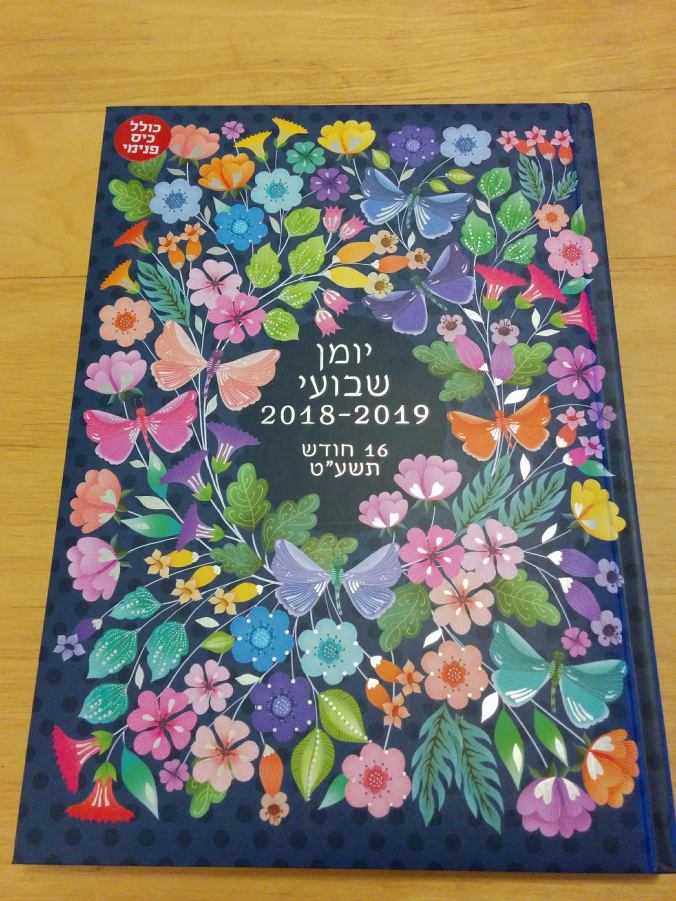
It’s the New Year and I need a new day planner!

Sounds weird in September, but the Jewish New Year comes in autumn. It’s early this year, which is why it snuck up on me and I suddenly had to get a new day planner.

IMG_20180908_081219

The shelves were pretty empty so I feel quite lucky that I managed to find this snazzy one.

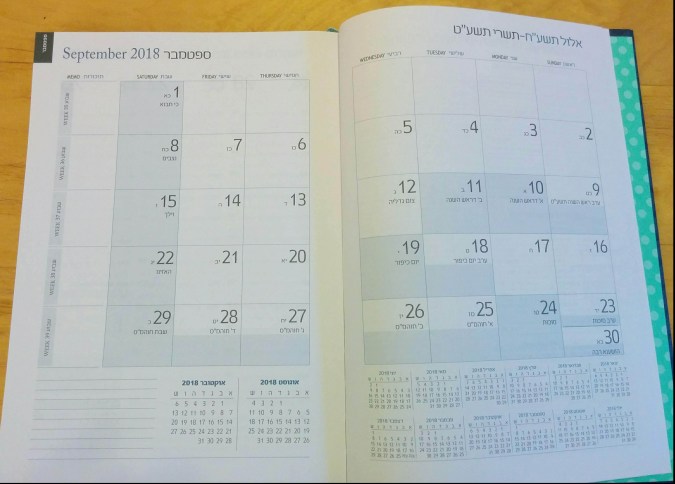
Notice anything odd?

img_20180908_081246.jpg

How about now?

IMG_20180908_081408

No filters. No flipping. Everything indeed goes from right to left.

Hebrew is written from right to left, so office supplies cater to the right to left flow of language.

NOTE TO LEFT-HANDED PEOPLE: Come to Israel for your office supply needs! I have known left-handed Americans who stock up on notebooks when visiting Israel because it’s just so comfortable for them.

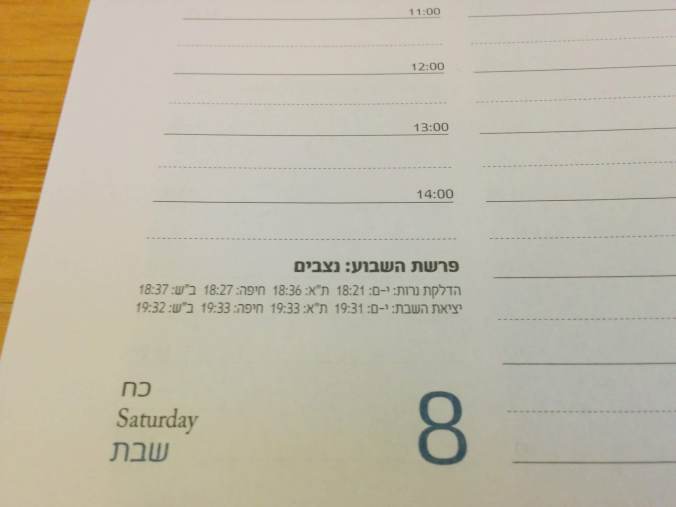
One feature of an Israeli calendar is that candle-lighting times are noted every week (20 minutes before sunset usually) and the Torah portion of the week is noted.

IMG_20180908_081438

The first line in bold is the Torah portion: Nitzavim. (The Torah – or the Five Books – is divided into weekly portions that are named after the first word of the reading.)

You can see on the second line Friday night candle lighting times for Jerusalem (18:21, yes that’s a 24-hour clock), then Tel Aviv, Haifa and Beersheva.

The second line is when Shabbat ends. That’s about a half an hour after sunset. Then you can get back to your regularly scheduled activities.

A LITTLE HEBREW LESSON: The days of the week are not named, they’re numbered.

Sunday = Yom Rishon (First Day) | Monday = Yom Sheni (Second Day) | etc.

But Saturday is Shabbat or the Sabbath.

A LITTLE CULTURAL LESSON: A “day” starts in the evening because when God created the world, it was evening and then it was morning, the first day …

You might also note that holidays are colored blue in this calendar. Notice anything in this picture?

IMG_20180908_081537

January 1. Not a holiday. That’s what it means to have Jewish rhythms of life.

This week we are starting a month of holidays to start the new Jewish year 5779. More on this in future posts.

Let me take this opportunity to say Thank You to everyone who reads this blog!

Wishing you all a Shana Tova u’Metuka!

A year of much happiness, good health,

and great success!

(Did you think we’d get away from the Chinese theme? Not likely! A short video for the New Year about not giving up. May you all be inspired this year!)


Monday Morning at the Movies – The Bookshop

I confess. I went to the movies on a Monday morning.

The Jerusalem Cinemateque is the home of several film festivals and is a place for movie lovers to gather and enjoy film. One of the major differences between the Cinemateque and a regular movie theater is that you will be shushed and chastised if you don’t observe proper movie-watching etiquette (they only recently allowed food in the theaters!).

You can buy a yearly membership and go to as many movies as you like throughout the year and get discounts on festival entrance fees. They have lectures and special screenings. Once I saw a new John Turturro movie followed by a Q&A with John Turturro. They screened The Karate Kid on a big screen on the lawn. I sat through all three Matrix movies in one night (ok, that was a mistake on my part)

This summer, on Monday mornings, they are screening several different movies and this week was The Bookshop. It was 10 NIS and I had missed the last showings at other theaters. It just so happened that I could arrange my schedule that morning, so at 11am I was in the theater.

The Bookshop stars Emily Mortimer, Bill Nighy, and Patricia Clarkson, and is rather gray and melancholy. It’s well-cast, well-acted, and well-done. But if you are not in the right mood, you won’t appreciate the small village Britishness of it.

Short review: Cautious thumbs up. Be in the right mood.

Long review: Below the trailer. Some spoilers.


“It is not incumbent upon you to finish the task. Yet, you are not free to desist from it.”

Ethics of the Fathers (Pirkei Avot) 2:21

A British movie in the middle of the day brought out many British people and a variety of other English-speakers. The theater was surprisingly full. I heard English from all corners. But the interesting thing was that after the movie, it was the Hebrew-speakers congregating in the foyer to discuss the film.

“Such courage!”

“How could she stand up against the whole town?”

The grande dame of the village was a horrible, petty woman. She decided that there would be no bookstore in that old house and that was it. A younger woman decides to stand up for her right to have a bookstore. And the widower on the hill who rarely steps out of his house is re-inspired.

All the makings of a Hollywood Hero’s Journey. And this movie is definitely not that.

And yet.

I was reminded of the line from Ethics of the Fathers. Emily Mortimer’s character begins the work. She decides to try to open the closed minds of the villagers. Cue Sisyphus.

And it is the child who carries on the work – I won’t give away the ending (you probably won’t guess the final act).

From there to here, we see a lot of the dirty underbelly of an English village: gossip, us versus you, the smile to your face while stabbing you in the back, and power plays.

Like the Hero’s Journey, this too is a universal story, except that it’s not one that we like to tell; it’s a little too close to real life, and frankly, it’s sad. But that’s why that last moment in the film reminds you that you have to start the task even if you don’t finish it in your lifetime. Someone else will continue it in the next generation.

I’m a huge Anglophile and I love all the actors. I’m glad I saw it. But this is not a movie for everyone.