Tai Chi in Israel

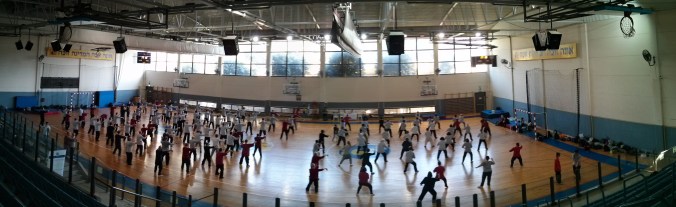
While the world raged around us, about 200 people met in a high school gymnasium in Ramat Gan that served as an oasis of calm.  This week I attended Gashko, the national meeting of all the practitioners of Cheng Ming style Tai Chi.  In June every year, the main teacher of this style comes from Taiwan to work with all of us to help perfect our form.

logo-text

To me, Tai Chi is a form of moving meditation.  The movements are slow, deliberate, and precise.  There are many styles of Tai Chi and it is considered a martial art.  The movements do have real world applications, but the purpose of the practice is not to spar or compete with your fellow practitioners.  Rather it is to learn and practice the principles and implement them in your own life.

I haven’t been to a Gashko for a long time, but since I had just finished learning the 100-movement form, I was prepared to work on minor adjustments and corrections of my form.

IMG_20160629_172054

Pass me a big slice of Humble Pie!  Yum!

On the first day, I started practicing with everyone and I quickly came to the realization that while I thought I knew the form, it turns out that every single movement could use some adjustments.  Now under normal circumstances, when you find out that you actually don’t know nearly as much as you thought you did, you might face some embarrassment, frustration, or any of a variety of negative emotions.  No so at Gashko.

One of the principles is to be both self-confident and humble – not an easy task.  So I was confident in knowing the order of the movements, but I humbly looked for correction.  I heard one person say, “I’ve been practicing for 25 years and I learned something new today!”  Well, I’ve been practicing for 2.5 years and I learned so much my brain got overloaded!

The nicest people in Israel

If everyone in Israel practiced Tai Chi, Israel would become the nicest country in the world.  Really!

IMG_20160629_171908

The teachers are so kind and supportive and meet you wherever you are in your life and in your practice.  While they are teaching you the movements of the form, they are somehow also uplifting you to be a better, stronger person without actually saying a word.  Honestly, it can’t be described; it can only be experienced.

Cheng Ming in Israel

One of the hallmarks of this style of Tai Chi in Israel is that it is gender separated.  While I’m not a fan of gender separation in most things, I do appreciate it in sports.  Also, when you practice martial arts with only women, the energy is quite different.

Apparently, the founder of this style in Israel, who learned from the master in Taiwan, returned to Israel and became religious.  So in Israel this style of Tai Chi is, for the general classes, philosophically neutral, gender separated, and at Gashko we have a men’s side and a women’s side of the gym.  Many practitioners are clearly religious and very comfortable with this style of Tai Chi.  The more advanced classes, though, are not gender separated.  (In other countries where this style is practiced, there is no gender separation, as far as I know.)
PANO_20160629_171920

The slower the better

One of the most amazing experiences for me at Gashko was the hour-long form.  When I practice at home or in class, the form takes about 20–25 minutes.  So just imagine about 200 people in a gym moving at a third of the speed that they normally do, all of us totally focused on the form, filled with self-confidence and humility, and radiating with calm, soothing energy.

Even if you don’t know Tai Chi, do something at a third of the normal speed – wash dishes, walk down your hallway, drink tea, whatever.  Then you truly get a taste of what “being in the moment” actually feels like.

Working with the master

In working on some real-world applications of Tai Chi, we were doing pair work and I had a few questions.  Just at that moment Master Wang appeared and showed me and my partner how to do an arm twist to the back followed by a knee to the butt.  It was a little unusual for him to be working with the women – he did bring a woman Master with him as well.  But here we were, Master Wang twisted my arm and kneed me in the butt.  Twice!  Quite an honor, I must say!  (Interestingly, I did go flying, but it didn’t hurt at all.)

IMG_20160630_202903

Master Wang

Tired. Not tired.

After the first day of about six hours of Tai Chi and a four-hour commute, I collapsed at home.  How on earth I would get through two more days?  But the next morning I woke up and I felt . . . good.  So I did it again.  Less collapsing on the evening of the second day.  And the morning of the third day, I still felt . . . good.  I have no soreness at all and physically, I feel sort of energized.  My brain, on the other hand, is massively overloaded with new things, corrections to the form, and memories of an amazing experience called Gashko.

(If you’re curious to learn more, here’s a link to the US site:  http://www.chengmingusa.com/home. The Israeli site is in Hebrew: http://www.taichi.co.il/.)

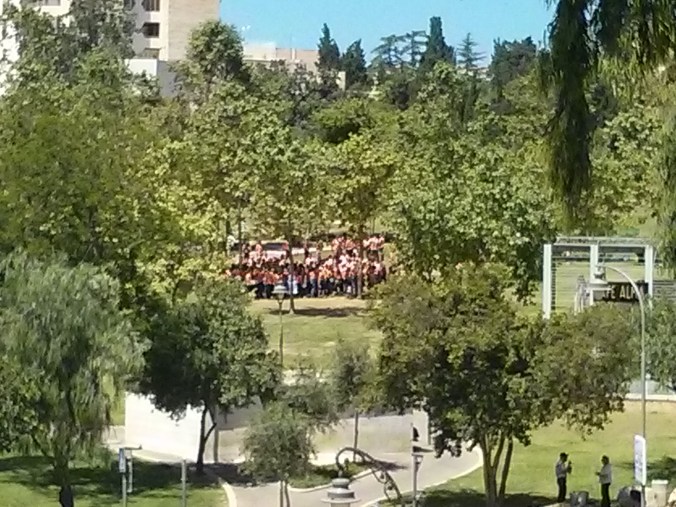
A few blurry images from the closing ceremony

Haikus for Solstice

sun-29249_1280

Heavy themes, long posts

Time to change it up a bit

Haikus for Solstice


Hot. So very hot.

Brain fog, sticky naps, TV

Oops. It’s 2 AM.

lavender-1117275_1280

Sage and lavender

Roasting in the summer heat

Jerusalem scents


lemonade-932199_1280

Hot days and cool nights

Summer in Jerusalem

Lemonade with mint


River down my back

Solving the water shortage

Single-handedly


thermometer-789898_1280

Fahrenheit versus

Celsius. 14 years here

And I still convert.


Solstice and full moon

Longest day and crazy night

That explains a lot


Brexit, Trump, and guns

Maybe move to Israel?

It’s so much calmer.

“It’s better to light one candle than curse the darkness”

JD east of edenMy favorite James Dean movie is East of Eden.  The story moved me so much that I decided to read the book by John Steinbeck.  I had the pleasure of visiting the National Steinbeck Center in Salinas, CA, where I learned that Steinbeck considered East of Eden the culmination of his life’s work.  He struggled with it all his life because he wanted to truly understand the fundamental ability to choose light or darkness.


God said to Cain, “If you do well, shall you not be accepted? But if you do not do well, sin is crouching at the door. It desires to dominate you, but you must rule over it.” (Genesis 4:7)  Steinbeck’s East of Eden tells us that no matter what happens, you always have a choice.

The power to choose

There’s so much awful news: Tel Aviv, Orlando, the Stanford rape case, a British MP gunned down, and plenty more that I don’t know about.  In each case someone made a choice to do evil; they chose darkness.

Debates are raging right now about why these tragedies happened. I’m not qualified to give an opinion about changes that need to be made in society and I’m not going to try.  This post is about the power to choose.

Choosing compassion

The family of a police officer saw someone running from the scene of the Tel Aviv terror attack.  He was badly shaken and could hardly speak.  They brought him in and gave him water.  The officer ran to the scene and when he saw that the detained shooter was dressed exactly like the man in his house, he rushed back, fearing the worst.  Indeed, the family had sheltered the second shooter.  The officer arrested him in the living room.

This family chose to help someone who looked to be in shock.  Without a doubt, the situation could have ended tragically, but instead we have an example of what compassion to one’s neighbors looks like.

Unsung heroes

At Stanford, two Swedish graduate students pulled the rapist off of his victim and held him down until police arrived.  The victim was completely unconscious, could not defend herself, and likely would not have been able to remember the events of what happened in order to bring her attacker to justice.

It was late at night.  The two students could have passed by and done nothing.  Instead, they chose to protect a young woman in a horrible situation.

Choosing to stand together

Sometimes you can’t save the person in danger, but you can stand beside the mourners.  Two stories I came across – and surely there are many more – remind us that it’s fine to “Je suis …” and change your profile pictures, but actions are so much more powerful.

A rabbi brought members of his congregation to grieve with mourners of the Orlando terror attack.  Just showing up was enough.

A flight crew found out that a passenger was on her way to her grandson’s funeral.  He was one of the victims in Orlando.  All the passengers wrote notes and when they deplaned, every person stopped to personally give their condolences.

Shavuot in Israel – Standing together

This week also marked Shavuot in Israel.  Shavuot is the fiftieth day after Passover and marks the date that the Israelites received the Ten Commandments at Sinai.  It’s a pilgrimage holiday meaning that when the Temple stood, people came to offer sacrifices.  Today, we aren’t offering sacrifices, but we still stand together, raise our voices in song, and choose life.

IMG_20160612_052607


Here’s a video I took while watching the sunrise on Shavuot at the Western Wall

From a single candle, thousands can be lit

When I watch the sun rise over the people and hear them singing, I know that the world is going to be okay.  Some people choose to do evil.  This is a fact and we see plenty of evidence of it.  But more people choose to do good.  More people choose light.  Sure, there may be moments .of regret, but every day we have a choice.  We can choose light and keep choosing it until we break down the power of darkness.

Wishing all the fathers a Happy Father’s Day!

And remembering my Dad z’’l

Does the Messiah like techno music?

I couldn’t imagine how I would piece together the events of this week in Israel.  On Sunday we celebrated the reunification of Jerusalem and there was a fabulous flag-waving parade on my street.  Sunday evening was also the eve of Ramadan and, in spite of some friction caused by the parade marchers, it seemed that we might have that elusive “quiet” that everyone is always talking about.  Then on Wednesday, 4 people were brutally gunned down and 16 people injured in a terrorist attack in a café in Tel Aviv.  This act was applauded by Hamas and celebrated with joy in the streets of Hebron.  How does a week like that even make sense?

I walked to the shuk today and in the middle of the Friday afternoon chaos, I heard the thumping bass and upbeat tunes of the NaNaNachmans.  (Ok.  They aren’t really called NaNaNachmans, but that’s what a few of my friends called them and for me the name stuck.)  And then I knew what to write about.

Who are the NaNaNachmans?

I would define them as modern-day mystics.  They are followers of Rabbi Nachman of Breslov (1772–1810).  They pray for the redemption of the world and the coming of the messiah.  What marks them in the streets of Israel are the slow-moving vans playing techno religious music while the NaNaNachmans dance in the street.  They often wear white beanies with the phrase Na Nach Nachma Nachman M’Uman on them.

Na Nach Nachma Nachman M’Uman to my ear sounds a little like a mantra.  The full words at the end can be translated as Nachman from Uman (his burial site) or Nachman the Believed.  All over Israel this phrase is very common graffiti; I suppose because it’s meant to be a song of redemption and will hasten the arrival of the messiah.

What do the NaNaNachmans have to do with anything?!?

Several vans were part of the parade.  I don’t know what it is but the NaNaNachmans tend to have the strongest, clearest, highest quality speakers.  Their music is heard near and far, possibly reaching the heavens.

Here’s my video of two NaNaNachman scenes that I happened to catch on video.

It’s the second song that caught my attention.  Not just because it’s got a great techno beat and a repetitive chorus.  It was the words of the chorus.  Here’s my translation.

There’s hope

If we sing together

There is faith stronger than all the fear

We won’t fall, we won’t tremble

Because we are not alone

We have Hashem the One.

Here’s a link to Benny Friedman’s official video.  The guy singing is not the guy you might imagine putting together a techno song, but he is a guy who looks like he’s praying for the coming of the messiah.

And that’s it.  Benny nailed it.  We’re all in this together.  We stand up and sing with faith and without fear.  Whether you are religious or not, you, me, and all of us are not alone.

So we’re going to celebrate life and march proudly as Israelis.  And when our citizens are cut down in violence and hate, we’re going to pick ourselves up and go on – with justice, not vengeance.

I know. It’s not so simple … but maybe it should be.

This is a holiday weekend; we’re going to go the Western Wall and watch the sunrise on Shavuot (Saturday to Sunday) to commemorate receiving the Torah on Mt. Sinai.  So here’s a good opportunity to remember the message of the Torah as passed down from Rabbi Hillel – short enough for a tweet, even before Twitter:

Do not do to your neighbor what is hateful to you.  That is the whole Torah; the rest is commentary.

Observation:  The streets of Jerusalem

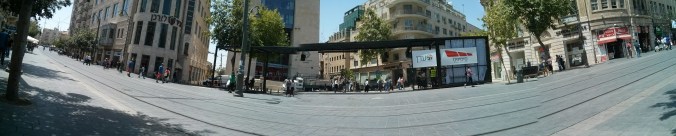
I wanted to try something a little different this week. I sat in a few different squares in downtown Jerusalem and watched people.  What I saw and heard was a symphony.

PANO_20160602_112653

Panorama of Zion Square

Laughter

I saw a Korean Catholic couple, a priest and a nun, walking on Jaffa Street completely engrossed in conversation.  I wondered if they hadn’t taken vows, would they be dating?  Perhaps they were so happy simply because they were here in the holy city of Jerusalem.

The Chorus

The gaggles of girls, who appear to be religious and often roam in groups of five, are a phenomenon.  They tend to have long, dark, curly hair, skirts that come down to their knees, and blouses that cover their shoulders.  The phrase “same, same, but different” comes to mind.

Two-Part Harmony

Guys travel in pairs.  They tend to complement one another.  A tall guy has a short friend.  A guy with long hair will have a friend with a buzz cut.

Duets

I saw many couples on the street.  Older ones came to town together to run errands.  Young couples – either just friends or hoping for more – came to sit together under a tree for an hour.  The young religious marrieds have their own formula.  They walk along with what appears to be their first child in a stroller and it’s always the dad pushing it.  The mom sometimes seems nervous about it, but she’s genuinely happy that he’s taking a role.

Soloists

Cello

There are a lot of street sweepers in Jerusalem because the municipality is committed to keeping the streets clean.  They are dressed in blue coveralls and always wear yellow Day-Glo vests. They push around a green plastic garbage bin that is about 4 feet tall and work with a broom and long-handled dustpan.

This particular street sweeper caught my eye, I think, because of his rimless glasses.  He wore his collar stylishly up, was unshaven (I don’t know if it was scruff for style or just the 24-hour beard cycle), and the hair on his head matched the length of his beard.  He was intensely conscientious in his work, with quick and purposeful movements, but appeared to be deep in thought.  I wondered if after his morning shift cleaning streets he went home to write his manifesto, “On the Social Aspects of the Dirtiness of the Street,” or a play called “To Clean or Not to Clean,” or something cheerful like “The Unbearable Lightness of Cigarette Butts.”

Electric Guitar

Another often-seen pair are the security forces on a motorcycle.  It was explained to me once that the front guy is the driver and the guy on the back is the shooter, which allows them to act quickly in case of an emergency.  They ride on powerful BMW motorcycles with noise-reducing mufflers and wear black helmets, black motorcycle jackets, and black cargo pants (which seems crazy in the 90+ degree heat).

The pair that I saw were riding back and forth on Jaffa Street.  They were chatting through the headsets in their helmets, but keeping an eye on everything around them.  The guy in front was focused on driving and the guy in back had a rifle slung across his chest and visible in the back was a silver pistol tucked into his waistband.  Later, I saw them stop for lunch at a burger place, because of course that’s what they would eat.

And so many more

The albino girl, the street musician, the Russian tourist chatting up a bottle-blond who also happened to speak Russian, the wanna-be punk who looked like he probably played bass in a band that played small venues, the odd, smiley religious guy who was hot strolling down the street so he rolled up his pant legs above his knees to show off scrawny white legs, or the worker setting up the stalls for the evening market who measured the spaces down to the last inch.

Jerusalem is a symphony, we just have take a moment to listen.

Legends of the Ari: Truth and faith

This story has many versions, but the basic outline is generally the same.

There once was a rabbi in Tzfat (Safed) who gave a sermon about the loaves of bread in the tabernacle.  A baker was so inspired by this that he went home and baked additional loaves of Shabbat challah and put them in the Aron Kodesh (the cupboard where the Torah scrolls are kept) as a gift to God.

challah-bread-1215013_1280

A poor man who helped clean the synagogue came to sweep after prayers and stood before the Aron Kodesh and prayed to God for help to feed his family for Shabbat.  He opened the Aron Kodesh and found the bread inside.  It was a miracle!

The next morning when the Aron Kodesh was opened at services, the baker saw that the loaves had been taken and he was overjoyed.  God accepted his gift!

This went on week after week for many years.

Finally, the rabbi saw the baker put the loaves in the Aron Kodesh and shouted at him: “Why are you putting bread in there?”  The baker answered, “I’ve been doing this for many years and God accepts my gift every week.”  “You’re an idiot!  Do you think God eats challah?”  The baker was embarrassed, but they decided to hide and see what happened.

The poor man came to clean and then stood before the Aron Kodesh praying.  He opened it and took the loaves.  The rabbi popped out and said, “Aha!  What are you doing?”  The poor man said, “I’m taking the challah that God has provided for me.”  “You’re an idiot!  Do you think God bakes?”

The Ari heard the story and gave his ruling:  The rabbi was in the wrong.  The two men did what they did with pure and loving faith and the rabbi destroyed it.  He asked the two men to continue the tradition – the baker would provide the bread to honor God and the poor man would accept it with gratitude to God.  The rabbi had been ill at the time of his original sermon, but had been given a reprieve because he had inspired such faith in the two men.  Now that he had broken their faith, his illness was returned to him.

Usually this story is told to inspire faith, to suggest divine intervention, and to reveal the wisdom of the Ari.  I’m going to turn that interpretation sideways to link this story with last week’s post.

We need to have facts and objective truths (the rabbi), otherwise “history” becomes story, legend, or myth (the two men’s narratives of weekly miracles).  External recorded facts (the bread was provided by the baker and taken by the poor man) provide the framework to question or confirm our narratives and this eventually brings us to a deeper and more profound understanding (our paths cross for a reason and we should continue to do good even if the reason is human and not divine).  Then we can truly learn from history and will not be doomed to repeat it.

Why bring up the Ari this week?

This week we celebrated Lag B’Omer.  Most Israelis don’t really know the history of the holiday, but what they do know is that one of the traditions is to light bonfires and celebrate into the night.

fire-432478_1280

Hundreds of thousands of people travel to Mt. Meron near Tzfat to participate in a huge bonfire at the grave of Rabbi Shimon Bar Yochai, the author of the Zohar.  The Zohar is the primary text for the study of the Kabbalah.  The Ari (the Lion) is the nickname for Rabbi Isaac Luria, one of the greatest Kabbalist scholars of all time.

The Truth about History

When I was in university many years ago, I studied history.  I didn’t learn a linear collection of facts, I learned feminist history (also known as her-story), varieties of narratives, and that history is complicated.  I was happy to learn history this way and I still believe that it’s valuable and necessary.  The world IS complicated.  Many people have a lot to add to the commonly known facts.  But I think we’ve come to a crisis about history and what is true.

In a short little essay, it’s impossible to deeply explore this idea, so this is no more than a brief consideration about a few things that struck me this week.

I like being in Israel in the springtime and I like the spiritual journey that Israel as a country and as a people takes to get to Independence Day.  It’s no secret that I consider myself a Zionist.  But right around Independence Day there is another commemoration day called Nakba Day.  Nakba is the Arabic word for “catastrophe.”  On May 15, the Palestinian population marks the catastrophe of a Jewish state being created that at the same time created a refugee crisis.

I think people today consider history to be a story that is told about the past.  There are heroes and villains.  It’s not a gigantic leap to suspect that each nation is the hero in its own story.  Even if we accept that not all heroes are perfect and not all villains are totally evil (a common theme in today’s storytelling), we still kind of need to see a cohesive storyline about the events of the past.  We find comfort in cause and effect.  It’s sensible and logical.  Otherwise, it’s all just chaos and nothing matters.  So when we tell ourselves stories about our past, we don’t simply recite facts in chronological order.  We want to be entertained.

are-you-not-entertained-w-text-720x396

Wikipedia says that postmodernism is “typically defined by an attitude of skepticism or distrust toward grand narratives, ideologies, and various tenets of Enlightenment rationality, including the existence of objective reality and absolute truth, as well as notions of rationality, human nature, and progress.”  We are also told that this is where the idea of relativism comes from, which includes the idea that truth is relative, both yours and mine.

So we circle back to Israel.  According to postmodern history, Independence Day and Nakba Day are two equally true truths.  From the point of view of Israel, its narrative is that five Arab armies attacked and Israel fought a war to give birth to the state.  From the Palestinian point of view, they got kicked out of their homes and a new state was created that had no place for them.  Postmodern theory tells us that with these two equally true truths – and the understanding that there may be more equally true truths – here we have a full picture of history.

The problem for me is that without the idea of an objective truth – tangible evidence and a series of provable facts – to balance each narrative against, then what exactly is true about any narrative?  It’s true to you and therefore it’s true to everyone?  I believe there is a place for narrative, but there also has to be a place to measure that narrative against facts and evidence.  Additionally, if two narratives exist in parallel, do they even have to intertwine or can they stand alone and still be true?

Pulling all these thoughts together, I’m led to a spine-chilling fear.  History is a story.  Our narrative is true.  We are heroes in our own stories. Today, we need to tell our stories in 144 characters or less.  So the one with the shortest, most compelling, most entertaining, most memorable slogans wins history?  After all, the most often repeated narrative becomes the first among equally true truths. I hope that this is not what we have come to.

This short essay is not an attempt to debate the truth of the Nakba or the truth of Independence Day.  There are large sections of many libraries doing that without my input.  The point of this essay is to suggest that all of us have a responsibility to remember that there are many voices that add to our understanding of the past and we should rejoice in the complexity of the world, but if we allow that all truth is relative and subjective, then everything and nothing is true.  Somewhere there is a middle ground where we can have all the voices and a measure of truth.

Soldiers Remembrance Day (Yom HaZikaron)—Independence Day (Yom HaAtzmaut)

After Passover, Israel marks Holocaust Remembrance Day, remembering and honoring victims of the Holocaust.  The following week, the nation remembers fallen soldiers and victims of terror attacks.  Immediately afterwards, the streets are filled with joy for Independence Day.

It took a while for me to connect to this rhythm of honoring the memory of the dead and celebrating the birth of a country.  But I think the bottom line is that Israel loves life while not rejecting or denying the sacrifices made by others.

Maagan Michael 2001

The first time I experienced the 5-minute limbo between Yom HaZikaron and Yom HaAtzmaut, I was emotionally confused.  At Maagan Michael, these days are taken very seriously.  The kibbutz was around in some form or another since before the birth of the state, so their cemetery held soldiers from every war.  There were ceremonies.  The cemetery was cleaned and decorated.  People told stories, they honored the fallen, and they remembered.

Maagan Michael’s cemetery

And then as we gathered together to solemnly close the day together, we said a few final words, and then we stopped.  Five quiet minutes passed.  And then fireworks.  Now it was time to be happy.  Hoorah!  Independence Day!  Time to party!  BBQ tomorrow!

Honestly, it felt a little manic-depressive, but the other way around—solemn sadness and then within 5 minutes, joy and elation.  But I get it now.  Life is short and you cannot linger in the sadness forever.  Similarly, people continue to live their lives even in the shadow of terrorist violence, even when we were in the dark days of suicide bombings.

And now, it even makes sense to me:  it is important to remember and honor the soldiers who sacrificed their lives defending the state, and also to remember and honor the innocent civilians who were victims of terror; and the best way to do that is to live, to be joyful, to be courageous, and to celebrate.  But it’s also important to keep those days separate so that the commemoration and memory don’t turn into a celebration.  I think often of Memorial Day in the US.  If you don’t know any soldiers, it’s just a 3-day weekend to kick off summer with a BBQ or buy a mattress because there’s a big sale on.  Not here.

Tradition!

This is a little clip (19 seconds) from The West Wing describing how Israel remembers their soldiers.  I have one tiny little issue with it, though I understand why it was phrased that way.  Leo McGarry says that it happens on May 13, the day before Israeli Independence Day.  Well, in 19 seconds, it’s a little hard to explain that the date changes because Independence Day is celebrated according to the Jewish calendar, so Remembrance Day on the 4th of Iyar, whenever that happens to be on the Gregorian calendar.

And he’s right.  Here are a few snapshots of my television screen this year.  There was soft Israeli music playing in the background, not sad music exactly, but definitely mellow and understated.  As I watched the names change, I realized that every single name represented a family that lost someone.  This year, the number of fallen stands at 23,447.

Major Levy Feigenbaum z”l 1 July 1974

Staff Sargent Avraham “Bomi” Schwartz z”l 23 September 1974

On Yom HaZikaron, there are two national sirens, one at 8:00pm to signify the start of Remembrance Day for one minute, and one at 11:00am the next morning for two minutes.  The same behaviors apply as they do for Yom HaShoah:  everyone stops, people stand, and we do it all together.

For Independence Day, Jerusalem allows parties all night.  I didn’t go – I’ve been there and done that, and it’s usually a wild, drunken scene.  Still, I could hear the partying in the street from home and I had a perfect view of the fireworks.  On offer was a city-sanctioned “rave” downtown, folk dancing at the square by city hall, and many of the bars had some kind of Independence Day party theme.

Seriously, I didn’t even go outside for these.

The next day, the park was filled with youth groups, buses dropped off thousands of tourists in the area, and I happened to see a March of the Living group from Argentina.  (March of the Living groups usually visit concentration camps in Europe and commemorate Yom HaShoah there and then come to Israel for Yom HaZikaron and Yom HaAtzmaut.)

IMG_20160512_111151

The spring holiday cycle

So now this year’s journey is complete:  we began as slaves in Egypt and took 40 years of wandering to become a nation; we faced near-annihilation in the Holocaust; we built a state and to protect it and its citizens, soldiers sacrificed their lives and civilians lost their lives in terror attacks; and now we have arrived at Independence Day, when we celebrate the last line in the national anthem, “to be a free people in our land, the land of Zion and Jerusalem.”

Holocaust Remembrance Day (5 May 2016) – Yom HaShoah

Every year we stop everything and stand for two-minute national siren to remember six million Jews who perished in the Holocaust.  For 24 hours television stations broadcast Holocaust stories and interviews.  Radio stations play somber music.  Restaurants and entertainment venues are closed.  During the siren, drivers pull over to the side of the road and get out of their cars.  Busses stop and often passengers get off to stand for the siren.  Walkers stop in the street.  It is a national pause to take the time to remember.

A video from this year taken on Highway 1 between Jerusalem and Tel Aviv.

In Israel, national and religious holidays start at sunset the evening before.  On the eve of Holocaust Remembrance Day, I witnessed an incredible sunset.  It was so stunning not only for the colors in the sky, but it seemed to change the quality of the air.  The air seemed to be infused with pink and gold and so full of magic that you might even be able to scoop some into a jar to save for later.

This slideshow requires JavaScript.

In all the years I’ve been in Israel, I’ve never had the chance to be in a public street for the siren.  The siren is at 10am and usually people are at work.  If no official ceremony is held, people will stand up at their desks.  Places where there are official gatherings, people will stand together and often will have a short remembrance ceremony.   I’ve experienced both.  But this year, I happened to be out in the street.  I didn’t take a video or photos because I wanted to participate, not observe from behind the safety of a lens.

Still, I saw some things:

  • A few minutes before 10am, I could feel people start to slow down and start to gather in the square.  They knew what was coming.
  • A woman brought her own package of Kleenex and was prepared for her emotional response.  She shared her Kleenex afterwards with someone who hadn’t expected to have such an emotional reaction.
  • Of the 50–60 people that I could see in the square, everyone stopped what they were doing and stood, except 3 people who continued walking.  Two were a Muslim couple and what I guess to be an Arab man.
  • Several Muslim women (marked by their headcoverings) stopped and stood solemnly with everyone else.
  • Time stands still.  And then when the siren ends, the world starts moving again as if released from a pause.

What I notice in myself is that at first the two-minute siren seems so incredibly long.  And then if I think about it in depth, how could it possibly be long enough?

I feel mixed emotions.  First, I’m sad because this is a remembrance for the light of six million human beings snuffed out due to hatred, along with millions of others who were also crushed under the wave of fear, ignorance, and hatred.  But then, incongruously, I’m happy.  All of us in this square, and actually the whole country, are standing together on this day to honor the memory of the fallen.  “Never Forget!” is not just a phrase, but is an active choice made by every person who stops, stands, and remembers.  I remember not only for myself, but for the people standing next to me, and they remember not only for themselves, but also for me and their neighbors.  During this powerful two minutes, Israel stands together.  Not just in theory or with words, but with an active choice to pause and stand together.

***

There are those who say that Israel exists because of guilt over the Holocaust.  The UN vote on 29 November 1947 was a short two years after the end of the World War II, so there may be some truth to that.  Whatever guilt there may have been, it still required a lot of political campaigning to get the votes.  The result was not a foregone conclusion.

But can we or should we say that Israel has to exist so that a Holocaust will never happen again?  A Jewish homeland has to exist so that if Jews are suddenly unsafe or expelled, they will at least have a place to go?  There is, of course, a grain of truth to that.  The flip side of that logic is that if Jews are safe in the world, then there is no need for Israel to exist.

Rather than focus on the Holocaust as the reason for Israel to exist, which leads to a victim mentality, it is far more positive and a source of strength to say that Israel exists due to an historic connection to the land itself, the place in the world where the Jews as a nation trace their history.  The Holocaust must always be remembered, but it should not be the defining point of Jewish history or Israeli history.  The memory of the victims must always be honored, but it was the survivors who built the modern state of Israel.

From Passover, we move to Holocaust Remembrance Day, then we will go to Soldier’s Remembrance Day, and then Independence Day.  It is a symbolic journey from slavery, to near annihilation, to fighting for the land, and finally to freedom.

“Next Year in Jerusalem!”

next year in jlemFor Passover in 2001, I was in Israel volunteering at Kibbutz Maagan Michael and I had an invitation to a Passover Seder in Jerusalem.  I think for most people, they just say “Next Year in Jerusalem!” at the end of the Seder as part of tradition with no intention whatsoever of being in Jerusalem the next year.  For me, it had long been my secret wish to have Passover in Jerusalem.  It was less a Zionist imperative and more “I’ve been saying it for years and now I’m going to do it!”  And wouldn’t it be amazing to fulfill that dream?

So here it is April 2001 and I am actually going to be in Jerusalem for the Seder.  This is it!  Dream fulfilled!  I came to Jerusalem for the Shabbat before Passover – known as Shabbat HaGadol (the Great Shabbat).  On Saturday, I had lunch in the home of a religious family who lived in the Old City.  The family spoke very little English and my friend and I were there only there to meet the son (a friend of my friend, both of them were named Yair, which was a little confusing) who was going to walk with us around the Jewish quarter and take us to the Western Wall.  We hadn’t actually planned to have lunch, but our timing was a little off and they were just sitting down, so they invited us to join them.  So with my extremely limited knowledge of Hebrew, I listened to the conversation and the prayers and found that I could pick out a few words.  One of the phrases I remember hearing is Shabbat HaGadol.

There were at least eight of us at the lunch.  The food was excellent and filling.  The conversation flowed in Hebrew, and the two Yairs filled in some of the gaps for me.  And then it happened.  The idea of fulfilling my secret wish, actually being at the center of Judaism here in the Old City, and sitting at a Shabbat lunch surrounded by Hebrew simply overwhelmed me.  My eyes welled with tears.  And then one slipped out and rolled down my cheek.  I was embarrassed, but after the first one, there’s really no stopping them.  I wasn’t crying exactly.  It was really more like my emotional cup was overflowing and it came out of eyes in salty tears.

The family and my friends sitting around the table let it happen like it was the most normal thing in the world, as if everyone who comes to Shabbat lunch on Shabbat HaGadol leaks tears all over the table.  The embarrassment was my own, but it only lasted a short while, because no one seemed to mind.  They noticed, but saw that it was because I was washed over with emotion, not because I was sad.  I did explain afterwards through translation that it was because sitting there in that moment represented a secret wish fulfilled.  It was next year and I was in Jerusalem!

The story of my tears became sort of a legend in the family.  I spent other holidays with them – without all the tears.  But they always remembered that I was the one who cried at their table and by the next Passover, I had turned my life inside out and upside down and moved to Israel.