Festival of Freedom

One of the names of Passover is the Festival of Freedom (Chag Herut).  This is no surprise since the main story of Passover is how the Jews left slavery in Egypt.  But if you take the meaning a bit deeper, it can be

Political freedom

Personal freedom

Spiritual freedom

Emotional freedom

Freedom to choose

Freedom from fear

Emancipate yourself from mental slavery,
None but ourselves can free our mind.
– Bob Marley, “Redemption Song”

The list goes on and on.

The story of Passover ends with the crossing of the Red Sea, but that’s where the real story of freedom begins.  The Jews gather under Mt. Sinai and, after the golden cow incident, they agree to a covenant with God.  They go to the land God promised Abraham and send spies to report on the situation.  The spies lie and the former slaves get scared, start complaining, and start making plans to go back to Egypt – “it would have been better to die in Egypt!”  God gets annoyed – no surprise there – but Moses talks Him out of killing everyone as it would be really bad press to kill the people you promised the land to.  God agrees, but says that they have to wander for 40 years.

freedom-2053281_1280

In the Bible the explanation ends there.  However, if we analyze it a bit, we can see that 40 years is about 2 generations, so the people who will inherit the land will be the grandchildren or great-grandchildren of the slaves.  This generation will have lived in freedom their whole lives with a faith in God who provided them manna every day.  They will have never known what it feels like to have a master and even the stories of their grandparents will be far removed from their experience.  This is the generation that will be strong enough and confident enough to have their own country in their own land.

Passover and Politics

A lot of crazy stuff is happening in the world.  Just this morning I woke up to news of US Tomahawk missiles fired on Syria after Syria attacked its own people with chemical weapons.  Syria has been in a civil war for the past 6 years with hundreds of thousands of dead and probably millions of refugees.

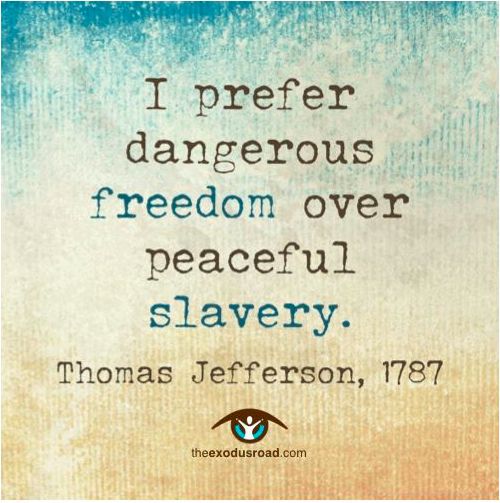
T Jefferson

I wonder if the story of the Festival of Freedom could inspire the people of Syria.  They need to continue to struggle to be free of tyranny and fear.  But it won’t be an instant change.  Like the Israelites, they will need practice living in freedom, making choices, and learning how to be responsible for their own nation.  It’s going to be tough, but ultimately it will be worthwhile.

There were those who saw the parallels of the breakup of the Soviet Union with the story of the Jews in the desert for 40 years.  A people who had known only a tzar with total authority moved to a system with a Politburo with total authority to a dictator with total authority.  After the breakup of the Soviet Union in 1991, there were people who wished for the return of Stalin – and they were the ones who remembered Stalin! – at least they would know what to expect and how to maneuver around the system.  This is a perfect example of slave mentality.  So far it’s only been 26 years.  Let’s check back in 2031.

Pharrell Williams’ music video “Freedom” reminds us that all human beings deserve to be free.  Happy Passover!


Stop the Violins, Visualize Whirled Peas

whirled peas

I always liked that bumper sticker.  It sounds right, but the definitions don’t fit – and sometimes that is exactly what the problem is.

So let’s talk about peace.

Merriam-Webster’s Dictionary has a lot of definitions for peace including: a state of tranquility or quiet, harmony in personal relations, a state or period of mutual concord between governments, an agreement to end a war.  I think when English-speakers contemplate peace, they tend to think that all is well with the world and it is good.

Semitic languages work on a 3-or-4-letter root system.  When new immigrants learn Hebrew in Israel, we’re taught that words with the same roots may not exactly have the same meaning, but once we know the root we can figure out the meaning based on context.

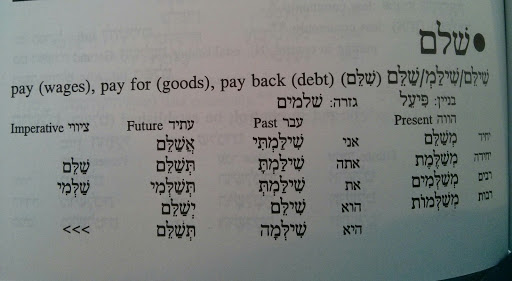
IMG_20170324_172412s l m
Pages from the Hebrew book of roots.

In Hebrew, peace is shalom based on the root Shin-Lamed-Mem (שלם).  Other words with שלם include: l’shalem to pay a bill, mushlam complete or perfect, hishtalmut advanced training, shalem whole.

So here’s a philosophical question:  Does the English definition of peace match any of the definitions in the family of meanings for Shin-Lamed-Mem?

Let me add another quote.  Israel has often been criticized for the “cold peace” with Egypt.  The common wisdom in Israel is “better a cold peace than a hot war.”

Harmony, tranquility, and agreement don’t pay bills, complete anything, or provide advanced training.  However, if you see peace as a state of balance, then it all fits together.  Balance doesn’t necessarily mean that everyone is happily floating around on clouds playing harps, but it does mean that what you put in, you will get in return.  Everyone is at the same level.

And what about that advanced training?  When you learn more, you become more whole as a person.

To continue the philosophical conversation, let’s turn to Arabic, another Semitic language.  I should say at the outset that in several places I read that words with the same Arabic root are not meant to be understood as being part of the same family of meanings.  Also, being a Semitic language doesn’t mean that all words with similar roots have similar meanings.  However, I’m not a linguist; I’m just positing a few ideas about language in a philosophical way.

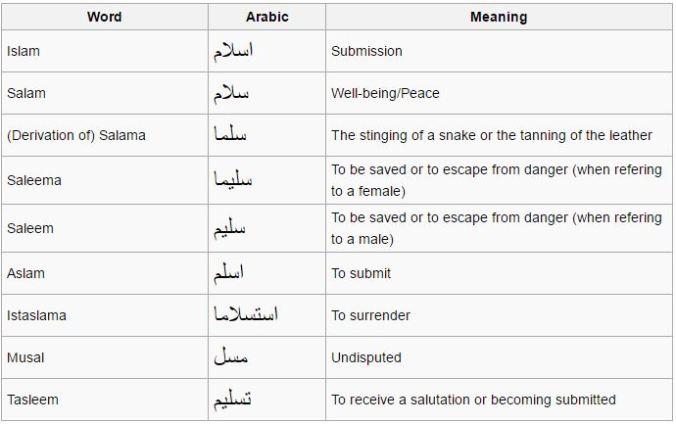
Peace in Arabic is salaam, with an S-L-M root.  Other words with a similar root include:

Wiki graph
Source: https://wikiislam.net/wiki/Islam

The article is careful to note that Islam – while appearing with the same root – is not to be equated with peace, but rather submission (to Allah).  But as I said above, this is a philosophical musing.

In the family of words with the S-L-M root, many of them relate to submission and surrender.  Merriam-Webster tells us that submission can be an act of humility and surrender can be to giving yourself over to the power of another.  Tanning leather could fit because the animal skin needs to be shaped into the form chosen by the tanner.  The other meaning is to be saved from danger.  And if you look from the point of view of the snake, it is saving itself from danger by attacking.

Now let’s bring our English speakers, Hebrew speakers, and Arabic speakers into the same room and talk about peace, shalom, and salaam.  Or perhaps we should try to be more accurate:  the English speakers are talking about harmony and agreement, the Hebrew speakers are talking about balance and equality, and the Arabic speakers are talking about submission and safety.

It’s really no wonder that all the talking and not understanding results in more violins and less whirled peas.

Spring in the North

On Friday, I missed the Jerusalem Marathon – on of my favorite days of the year – because I was travelling in the north of Israel.  Now I’m back and happy to share with you the glory of spring in the north.

One hill, many blooms

IMG_20170316_160347

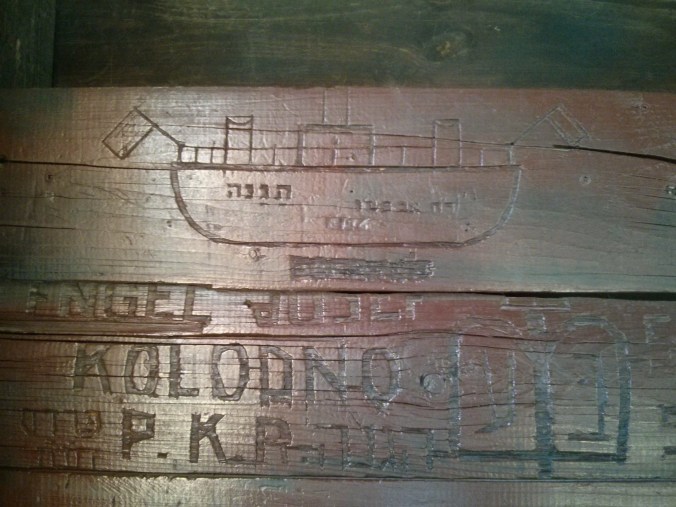
Atlit Detention Camp, carving in one of the huts – When Jews were trying to enter Israel illegally before Israel was a state, the British arrested them and put them in a detention camp just south of Haifa.  Even though it was a camp, which had scary connotations for many, the people were just so happy to finally be out of Europe and in Israel.  I have to say, my aliyah was a lot easier.

IMG_20170316_165949

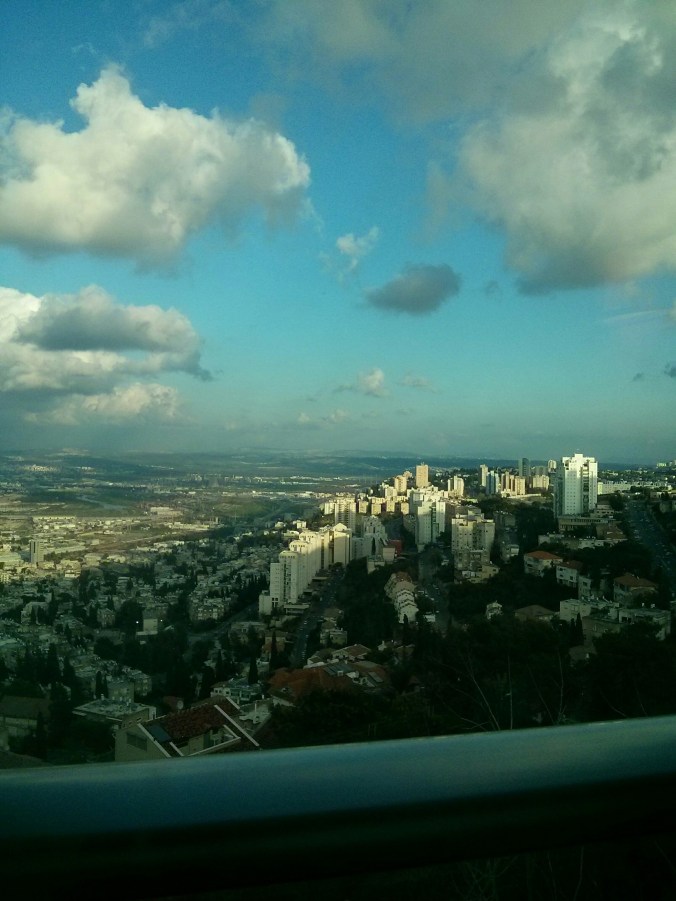
Haifa from my hotel

Bet She’arim – details from sarcophagi dating from the first to the fourth century CE.  The fourth picture is a detail of the evidence of how they must have shaped the burial caves.

And everywhere you look, flowers!

Baha’i Gardens, Haifa – springtime with the Baha’is in the upper garden (accessible only with a guide!)  From the top to the middle where the shrine is, it’s about 700 steps.


Hidden in Plain Sight?

Purim = costumes, parties, alcohol, triangular cookies, candies

Well, yes and no.  It’s easy to forget that there might be a deeper meaning to Purim.

For more on Purim in Israel, you can read last year’s post.

Things that make you go hmm

One of the (many) interesting things about Purim is that the story is one of the books of the Bible, but God isn’t mentioned anywhere.  Traditionally, Jews read the story of Esther aloud in community events, loudly boo when the villain is mentioned, and yet somehow God got left out of the manuscript.

Here’s a 5-minute video review of the story:

Skeptics might say that the story is just a well-written, cleverly plotted piece of historical fiction about a girl who becomes queen and it puts her in a position to save the Jews.  Like any good book, movie, or drama, plot points occur at just the right time to have a dramatic payoff later.

Some people would say that this story is a recounting of Jewish history in Persia.  In this group, you might have your atheists and agnostics who will write the story off as a series of coincidences.  In the chaos that is our real life, coincidences happen all the time and we don’t even notice them.

Accepting that there are some things in the world that are unexplainable might allow another group of people to look at the Purim story as “synchronicity” – a series of meaningful coincidences that link events together.  Mordechai annoyed Haman and it just so happened that the night before Haman was going to talk to the king about this pest Mordechai, the king couldn’t sleep and just so happened to open his history book to the time when Mordechai just so happened to hear about a plot to kill the king and saved him.

Coincidence

And then there is the third group who see the hidden hand of God in history, nudging events to put people in particular places, but still allowing them to use their free will.  This is a different God than the God of Genesis who’s in everyone’s business all the time.

hands-864037_1280

I think the message of Purim reaches out to all three groups.

To our skeptical atheists and agnostics: Sometimes you are in the right place at the right time.  It doesn’t matter how you got there, choose to do something.

To our people who accept the unexplainable: A complicated series of events drew you to a particular place and time.  Choose to act and follow the path.

To our believers: Even when it seems like He’s hidden, God is everywhere.  You were chosen to be in a certain place at a certain time.  Choose to accept your role and fulfill your destiny.

Whichever group you belong to,

Happy Purim!

To Remember

Hebrew is a very logical, systematic language.  Once you know a root, you have a whole vocabulary arena open to you.  This week’s root is זכר (z.k.r), which is the root for “to remember.”

The Yiddish word for the annual remembrance of the death of a loved one is called a yahrzeit, the time of the year. In Hebrew it is more often called an azkara, a memorial. I like that one better.  I want to remember my dad, not just mark time. The prayer that is said is called yizkor.

This week completed the year of firsts without my dad.  Living so far away from him, our relationship was built on phone calls, so even though he wasn’t actually here, he was as close as a phone call.  Now if I want to share something with him, I have to remind myself that he’s in a place without cell service.

Dad loved to eat at diners, so my brothers in the US took time off and went to a diner.  I was so glad that they called me so I could join them virtually.  It was good for us to share memories and tell funny stories about Dad.

Now we begin the year of seconds without Dad.  But no matter how many years pass, we have our memories, we remember, and usually we laugh.  May his memory always be a blessing to us.

family
Those were the days!

p1020248
David J. Brown z”l
Aug. 15, 1941 – Mar. 1, 2016

A nudnik in the backyard

One of my favorite things about Jerusalem is that everywhere you go you find layers upon layers of human history.  It’s a lot like geological layering, but in human history each layer has a story.  I liked writing the Michener history of The Hill of Evil Council and was planning to do that this week, but I’m going to come at it from a slightly different angle.

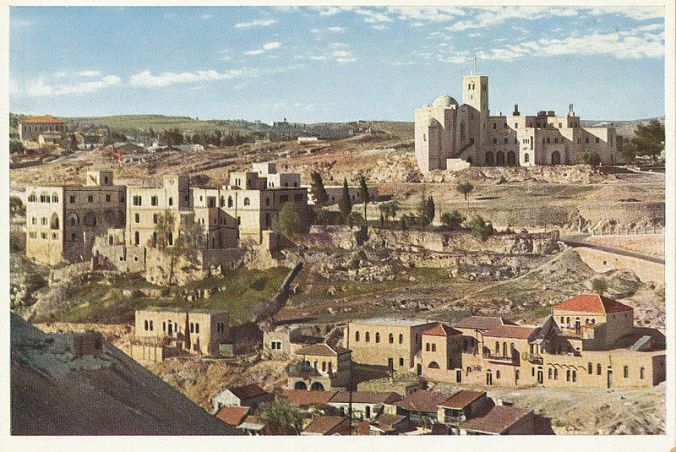
My office has what might be called a backyard.  It’s an archaeological site, but still it’s a space between us and St. Andrew’s Scottish Church.  Even now, if you didn’t know what you were looking at, it would look like someone had carved into the rock and made a few flat surfaces and cleared some space in the middle.  Unfortunately, I don’t have a good picture of it, but that’s not really what this post is about anyway.

800px-st_andrews_jerusalemJust below the domes of the church – upper right of the image – is the archaeological site. (Postcard from 1930 when the church was completed.)
In short, it’s a First Temple Period burial cave.  In 1979, Gabriel Barkay excavated the site and found evidence of a burial cave, Roman coins to suggest that the 10th Legion had been there during the siege of Jerusalem in 70 CE, and mosaics from a Byzantine-era church.  The cave had collapsed because it had been used as a weapons cache during the Ottoman period and most likely something exploded accidentally causing the cave to fall in.  In Jerusalem, that’s a pretty typical backyard.

Once the archaeological team decided they had cleared the site, they brought kids in for field trips to do some amateur archaeological digging.  They brought in a group of 12-13-year-old boys and among them was one nudnik.  A nudnik is a Yiddish word meaning an annoying pest of a person.  I don’t think it’s quite as harsh as it sounds in English.

Anyway, the nudnik is aggravating Barkay and he sends the kid down into a hole and tells him to brush the floor and make it as clean as possible.  The kid, being a nudnik and a boy, gets bored and finds a hammer.  Rather than brush the floor, he starts hammering it.

Our nudnik comes back to Barkay and tells him that he found something.  Barkay is completely incredulous.  They go down and realize that the “floor” was a false floor – or possibly the ceiling fell in and created the illusion of a floor.  Barkay gathers his team and they dig and find one of the biggest and most significant archaeological hauls in Israel.  Lots of jewelry, bones, trinkets, pottery, and most significantly, two tiny scrolls of silver that have verses from the Bible written on them in script that dates from the late First Temple Period (650 BCE – 587 BCE).  On the silver scrolls were written what is known as The Priestly Blessing (“May the Lord bless you and keep you…”).

These scrolls are the oldest artifacts ever found with biblical text on them and they are 400 years older than the Dead Sea Scrolls.  (Don’t worry.  They are in the Israel Museum now.)

MORAL OF THE STORY 1:  Don’t underestimate a nudnik!  Imagine that one of the greatest archaeological finds in Israel stood undisturbed for 2,500 years.  None of the thousands of people who built on that hill ever found this treasure.  No soldiers, no tomb raiders, no shepherds, no archaeologists.  It was a nudnik kid!

MORAL OF THE STORY 2:  Looks can be deceiving.  A rocky hillside that functions as a backyard is actually the site of one of the greatest treasure troves found in Israel!

It’s my pleasure to be the messenger

As I was walking to the Western Wall this morning it occurred to me that I live in one of the most special places on earth.  The Old City of Jerusalem is just part of my neighborhood, so I often forget to take a moment and enjoy my surroundings.

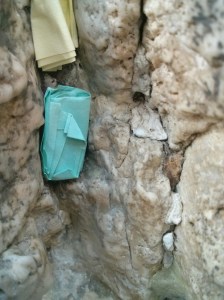
After a rainy and cold week, the sun was shining this morning.  It was the perfect day to deliver a small note to the Western Wall on behalf of a friend and take the opportunity to say a few words of gratitude for all the blessing I have in my life.

img_20170217_134950

A note for a friend (the blue-green one)

img_20170217_135014

Looking up

pano_20170217_135529

Panorama

img_20170217_135638

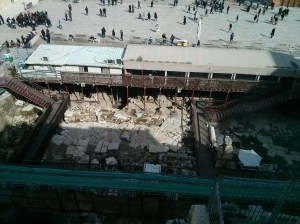
Recent excavation at the Western Wall Plaza of a Roman era street

img_20170217_141128

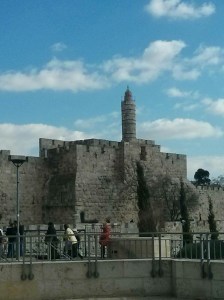
Tower of David, Jaffa Gate

Aliyah-versary

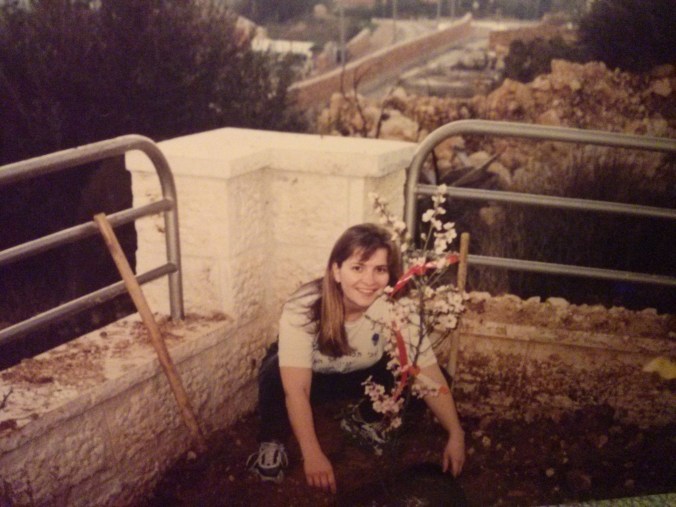
On the day I arrived in Israel 15 years ago, February 8, 2002, I planted an almond tree in my aunt’s garden.

IMG_20160204_231013

There were some hard days for that tree and it seemed like it died.  But it didn’t.  It was busy digging into the land and strengthening its root system.

It rejuvenated itself, grew again, and began to thrive.


And now this tall, strong tree bears delicious fruit.

img_20170120_175224

*This story is brought to you by Metaphors-R-Us.

It’s gonna have to be complicated

What? Hm? What is that noise? Urf. Phone.

“Hello?”

“Where are you? What are you doing?”

“I’m sleeping.  It’s two o’clock in the morning.  Where else would I be?”

“Oh, thank God!  Mike’s Place was bombed.  Have you talked to our friends?”

“What?  Are you serious? Where did you hear this?  Oh, my God!  Wait!  Where are you?”

“London, of course.”

And that’s how I heard about it.  On April 30, 2003, my friend in London called me in Jerusalem to tell me that the bar we always went to in Tel Aviv was blown up by a suicide bomber.  I called our friends who lived in Tel Aviv and confirmed that they had been there that night and thankfully, they were okay.

Terror in the shadow of the US Embassy

Three people died and dozens were injured but it would have been a lot worse if the guard at the door had not put himself between the bomber and the customers.  He absorbed the blast and spent much of the next week on life support, but when I saw him in the hospital a week later, he was alive, awake, and able to walk around.

I visited him on the way to the reopening of Mike’s Place.  Yes, the math is correct.  They had a ceremony a week after the bombing to remember those who died and then in a celebration of life and not living in fear, the bar was reopened, they served drinks and partied through the night in the shattered, burned-out remains of the bar.

Mike’s Place is a bar on the beach in Tel Aviv and sits in the shadow of the US Embassy.  It’s known for and prides itself on being a slice of Americana where you can get a double bacon cheeseburger and fries if you want to.  Everyone speaks English and everything feels familiar to any American or Canadian.  In an odd coincidence, many of the bartenders were named Dave.  Today there are seven branches of Mike’s Place all over Israel.

From a friendly country

Why tell this story now?  Because the perpetrators of this bombing were British citizens travelling all around Israel and in and out of Gaza and Jordan on British passports.  Israel did not put a ban on all British citizens travelling to Israel.  They didn’t put a ban on Muslims travelling to Israel.  They didn’t stop all people affiliated with radical left organizations from coming into Israel either.

Here’s what the Ministry of Foreign Affairs says:

The fact that the attack was perpetrated by a foreign national, and that another foreign national was supposed to have perpetrated an additional attack, sharply raises the issue of how to deal with the involvement of foreign nationals – citizens of friendly countries – in terrorist activity designed to maim and murder innocent civilians. This was not the first time that the State of Israel has been the target of foreign terrorists bearing British passports.

This is one of the most disturbing and complicated issues to deal with from a security-intelligence point-of-view, due to the fact that no Western country is capable of providing an effective answer without the full cooperation of all countries that are threatened by Islamic fundamentalist terror.

Due to the seriousness of the threat, as reflected in the April 30, 2003, attack, the entry of foreign nationals into the State of Israel – both via Erez checkpoint [from Gaza] and the international crossings – is being reexamined.

Policy should be longer than 140 characters

I don’t have an answer to how best to deal with potential threats crossing a nation’s borders, but I can say that a blanket policy that is uncomplicated enough to fit into the 140 character Twitter limit is not going to work.

I remember that around this time Shaul Mofaz was Israel’s Minister of Defense and on a diplomatic trip to the US he was stopped at JFK and refused entry because he also holds an Iranian passport.  Only high-level diplomatic intervention allowed him to enter the US.  Today this doesn’t happen very often, but this is what a blanket application of a simple policy looks like.  Don’t let anyone in with an Iranian passport.  Result: Not even a diplomat from a friendly country is allowed entry.

If you are not “us,” you are the enemy

One of the worst cases of applying a blanket policy like this is Executive Order 9066, signed by President Franklin Roosevelt during World War II, which gave the Secretary of War the power to exclude people from military areas.  Quickly following this was Public Law 503 based on a variety of Public Proclamations having to do with Military Areas 1 and 2, or the western states.

The US was at war with Japan, Germany, and Italy, but 120,000 Japanese found themselves in internment camps (refusal meant a large fine and a year in jail), yet only 14,000 Germans and Italians were sent to these camps.  Of the 120,000 Japanese, two-thirds were born in the US who should have had full citizenship rights like any other person born in the US.

Japanese citizens were sent to camps surrounded by barbed wire and armed guards in spite of two reports that said that there was no evidence whatsoever that they would rise up and join Japan in the war or undermine US efforts.  They would be loyal.

The excuse of “we were at war” doesn’t fly.  If that was the case, the proclamations and laws should have applied equally to Germans and Italians.  Were there so few Germans and Italians in the western United States?  The law was suspended in December 1944, but the war with Japan did not end until August 1945.  Was it still about the war and questions of loyalty?  The law stayed on the books until 1976 when President Gerald Ford officially rescinded it.  Only in 1988 did the Japanese get (paltry) compensation for the property that was taken from them and the years that they spent in the camps.

I found out about this chapter in American history by accident when I was in junior high.  I read a book about a girl in an internment camp in the US.  I was confused and stunned.  This was dystopian fiction, right?  I asked my mom and she told me that there were people put in camps in the US during World War II.  In MY United States?  In the land of the free and home of the brave?  How could this be?  The Holocaust was in Europe, and even with that knowledge, people were put into camps.  Here?  Did no one speak out?

I think the Japanese were interned because it was easy to mark them as enemies.  They don’t look like “us.”  Anthropologists use the word “other” to explain the “us” and “them” mentality.  They are “other;” they are not “us.”  Italians and Germans are part of “us,” but the Japanese are visibly and undeniably “other.”

And there’s your simple Twitter policy.  “They” are not “us.”  It’s so obvious you can see it.  You don’t have to understand nuances, you don’t have to ask questions, and you don’t have to think.  You just have to believe that the “other” is evil and you’re done.

This is the point where we remind ourselves that those who do not learn from history are doomed to repeat it.  That’s why there are no simple answers and no simple solutions.  It’s gonna have to be complicated or we will find ourselves in the dystopian future we fear so much.

Sources on Japanese internment:

HERE, HERE, and HERE.