A nudnik in the backyard

One of my favorite things about Jerusalem is that everywhere you go you find layers upon layers of human history.  It’s a lot like geological layering, but in human history each layer has a story.  I liked writing the Michener history of The Hill of Evil Council and was planning to do that this week, but I’m going to come at it from a slightly different angle.

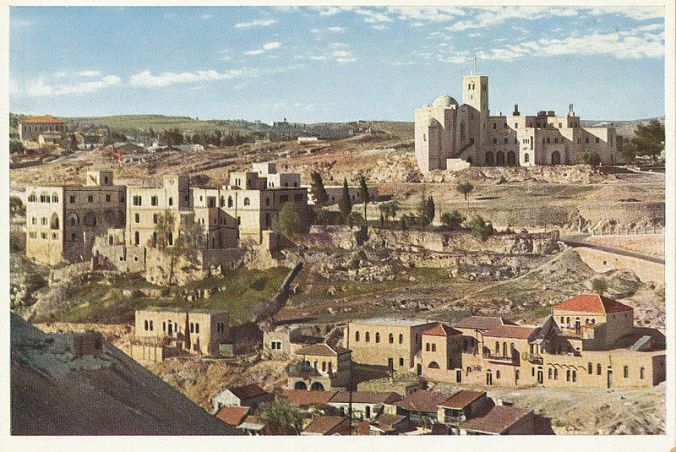
My office has what might be called a backyard.  It’s an archaeological site, but still it’s a space between us and St. Andrew’s Scottish Church.  Even now, if you didn’t know what you were looking at, it would look like someone had carved into the rock and made a few flat surfaces and cleared some space in the middle.  Unfortunately, I don’t have a good picture of it, but that’s not really what this post is about anyway.

800px-st_andrews_jerusalemJust below the domes of the church – upper right of the image – is the archaeological site. (Postcard from 1930 when the church was completed.)

In short, it’s a First Temple Period burial cave.  In 1979, Gabriel Barkay excavated the site and found evidence of a burial cave, Roman coins to suggest that the 10th Legion had been there during the siege of Jerusalem in 70 CE, and mosaics from a Byzantine-era church.  The cave had collapsed because it had been used as a weapons cache during the Ottoman period and most likely something exploded accidentally causing the cave to fall in.  In Jerusalem, that’s a pretty typical backyard.

Once the archaeological team decided they had cleared the site, they brought kids in for field trips to do some amateur archaeological digging.  They brought in a group of 12-13-year-old boys and among them was one nudnik.  A nudnik is a Yiddish word meaning an annoying pest of a person.  I don’t think it’s quite as harsh as it sounds in English.

Anyway, the nudnik is aggravating Barkay and he sends the kid down into a hole and tells him to brush the floor and make it as clean as possible.  The kid, being a nudnik and a boy, gets bored and finds a hammer.  Rather than brush the floor, he starts hammering it.

Our nudnik comes back to Barkay and tells him that he found something.  Barkay is completely incredulous.  They go down and realize that the “floor” was a false floor – or possibly the ceiling fell in and created the illusion of a floor.  Barkay gathers his team and they dig and find one of the biggest and most significant archaeological hauls in Israel.  Lots of jewelry, bones, trinkets, pottery, and most significantly, two tiny scrolls of silver that have verses from the Bible written on them in script that dates from the late First Temple Period (650 BCE – 587 BCE).  On the silver scrolls were written what is known as The Priestly Blessing (“May the Lord bless you and keep you…”).

These scrolls are the oldest artifacts ever found with biblical text on them and they are 400 years older than the Dead Sea Scrolls.  (Don’t worry.  They are in the Israel Museum now.)

MORAL OF THE STORY 1:  Don’t underestimate a nudnik!  Imagine that one of the greatest archaeological finds in Israel stood undisturbed for 2,500 years.  None of the thousands of people who built on that hill ever found this treasure.  No soldiers, no tomb raiders, no shepherds, no archaeologists.  It was a nudnik kid!

MORAL OF THE STORY 2:  Looks can be deceiving.  A rocky hillside that functions as a backyard is actually the site of one of the greatest treasure troves found in Israel!

It’s my pleasure to be the messenger

As I was walking to the Western Wall this morning it occurred to me that I live in one of the most special places on earth.  The Old City of Jerusalem is just part of my neighborhood, so I often forget to take a moment and enjoy my surroundings.

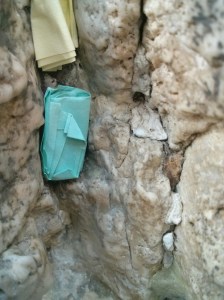
After a rainy and cold week, the sun was shining this morning.  It was the perfect day to deliver a small note to the Western Wall on behalf of a friend and take the opportunity to say a few words of gratitude for all the blessing I have in my life.

img_20170217_134950

A note for a friend (the blue-green one)

img_20170217_135014

Looking up

pano_20170217_135529

Panorama

img_20170217_135638

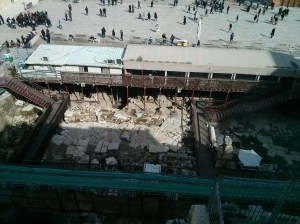
Recent excavation at the Western Wall Plaza of a Roman era street

img_20170217_141128

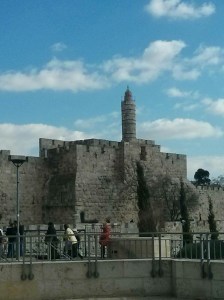
Tower of David, Jaffa Gate

Aliyah-versary

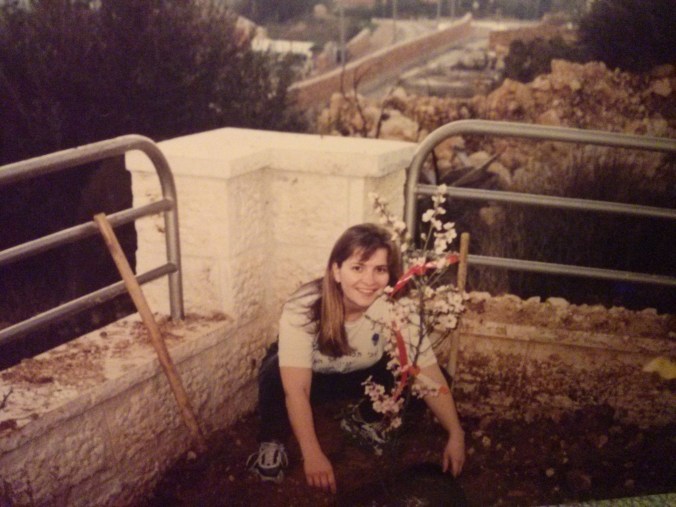
On the day I arrived in Israel 15 years ago, February 8, 2002, I planted an almond tree in my aunt’s garden.

IMG_20160204_231013

There were some hard days for that tree and it seemed like it died.  But it didn’t.  It was busy digging into the land and strengthening its root system.

It rejuvenated itself, grew again, and began to thrive.


And now this tall, strong tree bears delicious fruit.

img_20170120_175224

*This story is brought to you by Metaphors-R-Us.

It’s gonna have to be complicated

What? Hm? What is that noise? Urf. Phone.

“Hello?”

“Where are you? What are you doing?”

“I’m sleeping.  It’s two o’clock in the morning.  Where else would I be?”

“Oh, thank God!  Mike’s Place was bombed.  Have you talked to our friends?”

“What?  Are you serious? Where did you hear this?  Oh, my God!  Wait!  Where are you?”

“London, of course.”

And that’s how I heard about it.  On April 30, 2003, my friend in London called me in Jerusalem to tell me that the bar we always went to in Tel Aviv was blown up by a suicide bomber.  I called our friends who lived in Tel Aviv and confirmed that they had been there that night and thankfully, they were okay.

Terror in the shadow of the US Embassy

Three people died and dozens were injured but it would have been a lot worse if the guard at the door had not put himself between the bomber and the customers.  He absorbed the blast and spent much of the next week on life support, but when I saw him in the hospital a week later, he was alive, awake, and able to walk around.

I visited him on the way to the reopening of Mike’s Place.  Yes, the math is correct.  They had a ceremony a week after the bombing to remember those who died and then in a celebration of life and not living in fear, the bar was reopened, they served drinks and partied through the night in the shattered, burned-out remains of the bar.

Mike’s Place is a bar on the beach in Tel Aviv and sits in the shadow of the US Embassy.  It’s known for and prides itself on being a slice of Americana where you can get a double bacon cheeseburger and fries if you want to.  Everyone speaks English and everything feels familiar to any American or Canadian.  In an odd coincidence, many of the bartenders were named Dave.  Today there are seven branches of Mike’s Place all over Israel.

From a friendly country

Why tell this story now?  Because the perpetrators of this bombing were British citizens travelling all around Israel and in and out of Gaza and Jordan on British passports.  Israel did not put a ban on all British citizens travelling to Israel.  They didn’t put a ban on Muslims travelling to Israel.  They didn’t stop all people affiliated with radical left organizations from coming into Israel either.

Here’s what the Ministry of Foreign Affairs says:

The fact that the attack was perpetrated by a foreign national, and that another foreign national was supposed to have perpetrated an additional attack, sharply raises the issue of how to deal with the involvement of foreign nationals – citizens of friendly countries – in terrorist activity designed to maim and murder innocent civilians. This was not the first time that the State of Israel has been the target of foreign terrorists bearing British passports.

This is one of the most disturbing and complicated issues to deal with from a security-intelligence point-of-view, due to the fact that no Western country is capable of providing an effective answer without the full cooperation of all countries that are threatened by Islamic fundamentalist terror.

Due to the seriousness of the threat, as reflected in the April 30, 2003, attack, the entry of foreign nationals into the State of Israel – both via Erez checkpoint [from Gaza] and the international crossings – is being reexamined.

Policy should be longer than 140 characters

I don’t have an answer to how best to deal with potential threats crossing a nation’s borders, but I can say that a blanket policy that is uncomplicated enough to fit into the 140 character Twitter limit is not going to work.

I remember that around this time Shaul Mofaz was Israel’s Minister of Defense and on a diplomatic trip to the US he was stopped at JFK and refused entry because he also holds an Iranian passport.  Only high-level diplomatic intervention allowed him to enter the US.  Today this doesn’t happen very often, but this is what a blanket application of a simple policy looks like.  Don’t let anyone in with an Iranian passport.  Result: Not even a diplomat from a friendly country is allowed entry.

If you are not “us,” you are the enemy

One of the worst cases of applying a blanket policy like this is Executive Order 9066, signed by President Franklin Roosevelt during World War II, which gave the Secretary of War the power to exclude people from military areas.  Quickly following this was Public Law 503 based on a variety of Public Proclamations having to do with Military Areas 1 and 2, or the western states.

The US was at war with Japan, Germany, and Italy, but 120,000 Japanese found themselves in internment camps (refusal meant a large fine and a year in jail), yet only 14,000 Germans and Italians were sent to these camps.  Of the 120,000 Japanese, two-thirds were born in the US who should have had full citizenship rights like any other person born in the US.

Japanese citizens were sent to camps surrounded by barbed wire and armed guards in spite of two reports that said that there was no evidence whatsoever that they would rise up and join Japan in the war or undermine US efforts.  They would be loyal.

The excuse of “we were at war” doesn’t fly.  If that was the case, the proclamations and laws should have applied equally to Germans and Italians.  Were there so few Germans and Italians in the western United States?  The law was suspended in December 1944, but the war with Japan did not end until August 1945.  Was it still about the war and questions of loyalty?  The law stayed on the books until 1976 when President Gerald Ford officially rescinded it.  Only in 1988 did the Japanese get (paltry) compensation for the property that was taken from them and the years that they spent in the camps.

I found out about this chapter in American history by accident when I was in junior high.  I read a book about a girl in an internment camp in the US.  I was confused and stunned.  This was dystopian fiction, right?  I asked my mom and she told me that there were people put in camps in the US during World War II.  In MY United States?  In the land of the free and home of the brave?  How could this be?  The Holocaust was in Europe, and even with that knowledge, people were put into camps.  Here?  Did no one speak out?

I think the Japanese were interned because it was easy to mark them as enemies.  They don’t look like “us.”  Anthropologists use the word “other” to explain the “us” and “them” mentality.  They are “other;” they are not “us.”  Italians and Germans are part of “us,” but the Japanese are visibly and undeniably “other.”

And there’s your simple Twitter policy.  “They” are not “us.”  It’s so obvious you can see it.  You don’t have to understand nuances, you don’t have to ask questions, and you don’t have to think.  You just have to believe that the “other” is evil and you’re done.

This is the point where we remind ourselves that those who do not learn from history are doomed to repeat it.  That’s why there are no simple answers and no simple solutions.  It’s gonna have to be complicated or we will find ourselves in the dystopian future we fear so much.

Sources on Japanese internment:

HERE, HERE, and HERE.


“Alternative Facts”? Sure, I’ve heard of those!

alt-factsI just liked this headline from The Guardian
When Kellyanne Conway used this phrase this week, my first thought was that if she had any sense she would have said that it was a “different interpretation of facts.”  And then it occurred to me, “Hey, we have plenty of ‘alternative facts’ reported about us in Israel.”

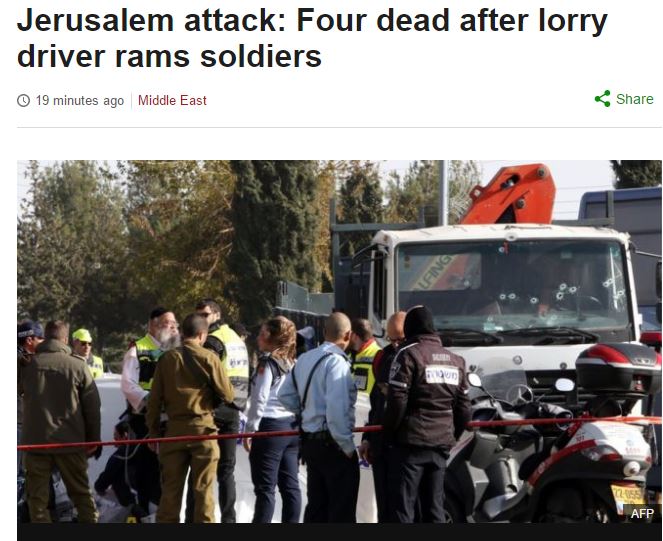
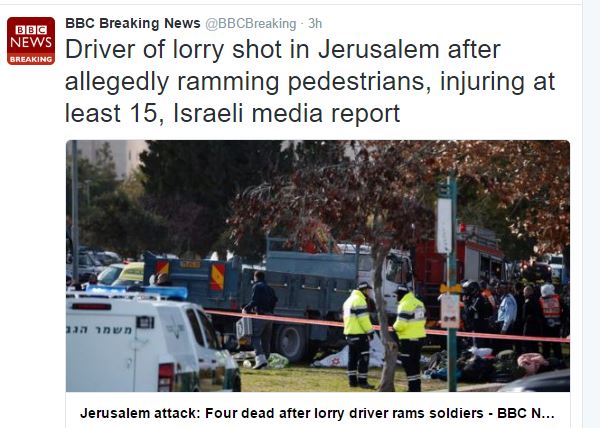
A few weeks ago 4 soldiers were run over by a truck driver on purpose in a targeted attack.  Here’s what the BBC first reported.

bbcScreenshot from my computer

There is actually nothing untrue in this headline.  A truck driver was shot.  It happened in Jerusalem.  There were allegations that he hit people and injured them.  And the Israeli media reported it.

But do you see the problem here?  It’s the arrangement and presentation of the facts.

Does it feel different when you see the headline this way?  Here’s their later post.

bbc3
Screenshot from my computer

Still true, but now you understand who the victims are and who the perpetrator is and that it was an attack – not an alleged attack according to others.

I’m an editor.  I work with words for a living and it matters how facts are framed.  For instance:

Four young soldiers murdered in vicious truck ramming attack.

Four killed by truck.

Truck driver runs over four soldiers.

Terrorist shot in his truck after he killed four soldiers.

Truck driver shot after fatal accident kills four.

All of these sentences have the same facts, but you feel differently about each because of how those interpretations are framed.  And yet none of them is a lie.

The most shocking example of different interpretations of facts I’ve heard of was in 2007 when a master’s student won an award for a research thesis that looked into the question of why IDF soldiers don’t rape Palestinian women.  Her conclusion – hold on to your socks – it’s because IDF soldiers are racists and dehumanize Palestinian women so they wouldn’t even want to rape them.  Let me repeat.  She WON AN AWARD for this work and Hebrew University stood behind the decision.  (Here’s an analysis of the paper done by a professor at Haifa University. Here’s a shorter article about it.)

That’s an alternative fact if ever I’ve heard one.

I’m not defending Kellyanne Conway.  I’m not defending journalists who write news stories with their own biases and agendas.  And I’m not defending the academic world.

I’m appealing to you, dear reader, to be aware.  Read multiple news sources.  Read news you don’t agree with (in moderation if you have high blood pressure).  Watch out for fake news.  Analyze and deconstruct what you read and hear.  More than anything else, hold people accountable for the words they use and how they use them.

More on history and truth from my blog:

The truth about history.

How history will remember.

UNESCO rewrites history.

Oh, Jerusalem

Today is Inauguration Day in the US.  In Israel, it’s just an ordinary Friday.  We’re running our weekly errands and preparing ourselves for Shabbat or other weekend plans.

US voters in Israel tend to vote for the president on one issue and one issue alone: how will the next president relate to Israel.  It’s a variation on the punch line, “yes, but is it good for the Jews?”  This is understandable.  We human beings care about our immediate surroundings, our families, and our close friends.  If it doesn’t affect us personally, then it’s more of an “out there” issue and not an “in here” issue.

Israel, it turns out, has the same opinion.  I ran across a video from Mayor Nir Barkat asking citizens of Jerusalem to welcome President Donald Trump as a friend and to sign a letter supporting the decision to move the US embassy to the undivided capital of Israel, Jerusalem.  I’ve spoken to other Israelis and they agree with our mayor.  I don’t think this is a minority opinion.

(It’s 1 minute and subbed in English.)

As great as Trump may be for Israel, I feel that Israel may be a bit narrow in its view and possibly short-sighted.  Leaving peace negotiations aside and all the problems in the Middle East (yes, I can do that!), if a person is insulting the leadership of other countries, nominating a cabinet that seems to be unqualified for their positions, and is divisive in his own nation – is that person actually good for Israel?

I would have to research it more, but it seems similar to Israel being one of the few countries that had dealings with South Africa at the height of Apartheid when all other countries were boycotting South Africa.  The rationale was that Israel had so few friends in the world.  Is that the case today?  Many, many Israelis would say it absolutely is.

Well, I’m not a political analyst, so I don’t know what will happen.  It remains to be seen.

I still like our mayor – he’s done a lot of great things for Jerusalem – but since I’m already questioning him, I have another complaint.

I don’t drive in Israel.  I have a license, but I don’t enjoy the experience and I live in a place where parking is almost non-existent.  It’s a lifestyle choice.  But this week, I had an unbelievable experience in traffic.

MFA was driving and I’m glad she was and not me.  I don’t know if I could have handled it.  After lunch one day, we got into the car to drive the 5-10 minutes to my house.  We got on a main road and saw that it was clearly rush hour, but still, it was only about a mile, traffic should be moving, right?  Nope.

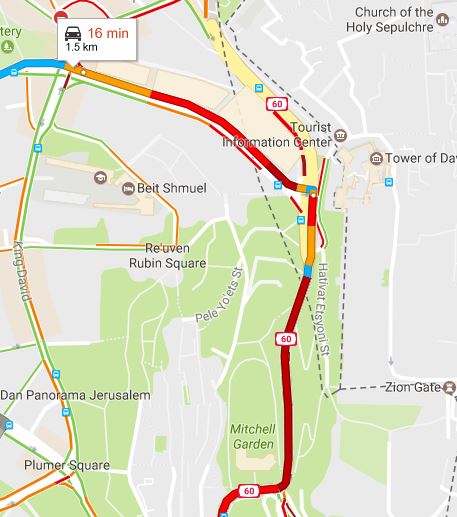
trafficThis is our route and the traffic situation as I write this post.

This main road runs under the walls of the Old City, so it’s impossible to turn off onto a side street – there are no side streets – so you are stuck.

On the way, in the opposite lane, we saw a guy violently pop his car up on a curb, leave his wife in the car, and forcibly pull another guy out of his van to let him know how much he disliked his driving.  That was tense.  Luckily, they got back into their cars and went on – whew, no fisticuffs.

We finally get to the left turn we need to take and MFA is careful not to block traffic in the intersection too much since we can’t quite get all the way into the next street.  Then we’re stuck there for a good long while.  We move about a foot in 10 or 15 minutes.

A young woman edges up close to us as if she wants to get into our lane.  This seems totally bizarre because there is no reason for her to get into our lane right here and she’s blocking cars behind her as well as merging traffic from the other side. People, including a bus driver, get out of their vehicles to yell at her and she just shrugs her shoulders at them.  Some – who are not blocked by her – are laughing because this girl clearly just doesn’t care at all.

The car in front of us moves a bit and MFA decides to be nice and let the girl in because it should loosen up all the traffic that she’s blocking.  And this girl, this crazy, crazy girl, cuts across the lane to MAKE A U-TURN!!!  She’s blocked by traffic going the other way that won’t let her in.  And at the same time, ANOTHER CRAZY GIRL taps the back of the first girl’s car and swerves around her TO ALSO MAKE A U-TURN!!!

crazy
In our car, we are both screaming.  WTF!!!

When we get to the end of the street we see that many of the problems here stem from double-parked tour buses and people blocking traffic as they try to get into the parking garage.  After we passed the last entrance to the parking garage, there was not a car in sight!  Nothing.  Completely clear roads.

I’m sure I should care about the US Embassy moving to Jerusalem, but to be honest, I think a bigger issue is this stupid traffic and selfish drivers.  Yeah, I probably seem to have narrow vision and may be short-sighted, but I’ll tell you what: When the sun is setting and the colors are changing on the gorgeous walls of the Old City of Jerusalem, I don’t want to feel murderous rage toward my fellow human beings who don’t care at all about anyone else around them.

No matter what Trump’s relationship with Israel is, he’s not going to fix traffic.

Dear Mr. Mayor, I know you need to have vision and see the big picture, but I’m too embarrassed about this traffic situation to want anyone to visit, much less move the embassy!!  Fix this first!!

Fragile / Not Fragile

Not a good coincidence.  Two days after I wrote about the history of Hill of Evil Counsel/Armon HaNatziv another awful event was added to the disasters on that hill and I’m writing about it on Friday the 13th (which actually has no meaning in Israel – you can take the girl out of the US, but you can’t take the US out of the girl).

On Sunday four soldiers, three girls and a boy, were killed by a terrorist using a truck as a weapon.

Groups of IDF soldiers come to Jerusalem on Sundays for cultural education days during their service.  You’ll see them at museums, visiting historical sites, and also at overlooks like this one.  In Israel, men and women between the ages of 18 to 22 serve in the military.  Men serve around 3 years and women serve nearly 2 years.  You can intellectually understand the numbers reflecting their ages, but you don’t realize how young they are until you see them.

My office job is at a museum and I took time to notice the soldiers who came in this week.  Their eyes are clear and innocent.  They haven’t seen serious difficulties yet.  They still have their whole futures ahead of them.  They are full of idealism and hope.  They are not yet cynical and jaded about life.

The American part of my brain still notices that every one of them carries a weapon slung across their shoulders and the Israeli part of my brain knows that this is perfectly safe. When they go into a tour of the museum they lay their weapons in a square built up like Lincoln Logs and leave one or two people to guard them.  It’s a weird feeling to pass a gun tower made up of 50 or so rifles guarded by another young person with a rifle at the ready.  This is not out of the ordinary.

Yet, these soldiers are still kids.  They are kids with targets on their backs.

In the days after the attack, I find my senses heightened.  I’m listening a lot harder. Is that a helicopter? How many ambulance sirens were there? Are those footsteps behind me?  And I’m tuned to my surroundings.  Is that a shadow? Have I seen that person before? What are they doing?

I went to the shuk the next day and ran my errands as usual, all the while keeping vigilant watch on everything around me.

The illusion of calm had been fragile.  Our will and courage to go on is not fragile.

A Hill in Jerusalem

With a hat tip to MR for telling me to write about this, I’m taking a page (well, a book really) from James Michener and will share the history of a particular hill in Jerusalem.  Today this beautiful overlook south of the Old City is called Armon HaNatziv.

map-of-armon-hanatziv

Like Michener, let’s start at the beginning of recorded time.  One of the first things to happen on this hill was Abraham telling his servants to wait for him while he and his son Isaac went to Mt. Moriah (Genesis 22:5). I’m sure I don’t need to tell you what happened then.

David’s son Absalom started a conspiracy and went to war against David.  He apparently got some bad advice somewhere to the south of the City of David.  Absalom’s tomb is in the valley below the Temple Mount (II Samuel 15-18).  So while it’s not quite on Armon HaNatiziv, it’s pretty close.

There seems to be some thought that King Solomon let his foreign wives build a temple on this hill to foreign gods.  And this turned Solomon away from the Lord.  (See I Kings:11.)

King Herod decided that he needed to get water to Jerusalem. He managed to build a water system that brought water uphill to Jerusalem from Bethlehem.  Rather than go over this big hill to the south of the city, he dug through it.

Around the same time, Judas met with some Pharisees on a hill to the south of Jerusalem where they were plotting to get rid of Jesus.  With the 30 pieces of silver he got, he bought some property on the top of the hill where he “burst open” and died.  From that point on, the place of conspiracy was known as the Hill of Evil Counsel and the place where Judas burst was called the Field of Blood. (See John 11:47-53 and Acts 1:18-19.)

In 70 CE, Jerusalem fell and Jews were flung to the four corners of the earth.  I’m sure more things happened on the hill, but we’ll jump forward in time to the British Mandatory period.

armon-hanatziv
View from Armon HaNatziv at night.

After World War I, the Ottoman lands were divided up and Britain came in to rule Palestine.  Their office was at first in Augusta Victoria, but there was this very nice place on a hill to the south of the city with an excellent view so they built their main offices there.

Yehuda Avner, z’’l, former ambassador and author of the book The Prime Ministers, wrote an article about David Ben-Gurion meeting with the British High Commissioner at their headquarters in 1937.  The British wanted Ben-Gurion to stop bringing in Jews, especially from Germany.  He felt there were plenty here already and would Ben-Gurion just halt the inflow temporarily?  Well, you can imagine how that conversation went.  And it gives you a brief insight into the fact that Jews in Europe were getting into a position of having nowhere to go.  (It’s an interesting article and worth a moment to read.)

When Jerusalem was Hebraizing names for neighborhoods they translated Government House into Hebrew and got Armon HaNatziv (the literal translation is Palace of the Governor).

In 1948, the UN was looking for an office and somehow decided to take over the British offices.  So today, the UN Observer Headquarters is on Armon HaNatziv, also known as the Hill of Evil Counsel. According to their website, though, the place is located on Jabel Mukaber – where a caliph shouted Allahu Akbar.

With the blatant bias of various UN and UN committee decisions recently (I’ve discussed the UNESCO decisions here and here), it seems like a pretty odd coincidence indeed that the UN headquarters in Jerusalem would be on a hill with so much difficult history.

(Christian sources come from here; various internet searches led me to other information; some information is just from my own knowledge; but any mistakes are my own.)

Goodbye 2016!

In the last days of the calendar year, everyone on the internet provides a review of 2016.  Lots of people this year are using the hashtag #f**k2016 (with no missing letters, of course).  I’m ready to let go of 2016 and in fact, I almost titled this post “Goodbye 2016!  Don’t let the door hit you on the way out!”  But I’m a glass half full kind of gal who looks at the world through rose-colored glasses.

I’ll admit, 2016 was not a great year.  But I wonder if it’s because, along with my dad, it seemed like so many of my childhood icons died and the internet was full of bad news, worse news and then fake news.  One of the reasons I’m not talking about Trump’s election and the recent UN vote is because I have no way to vet the news any more.  I don’t even know what’s true.  I was sure that this week’s celebrity deaths were fake too.  George Michael, Carrie Fisher, and her mom, Debbie Reynolds!?!?  WHAM, Star Wars, and Singin’ in the Rain all hit in the same week?!?!  I call conspiracy!


Living in Israel, I tend to do more of my soul accounting (heshbon nefesh) and reviewing of my year in September around Rosh HaShana and my birthday.  I have two new years to account for and it seems like a good time.  But I also do it when the calendar changes.

In 2016 I tried to let go of perfectionism.  Was I the perfect daughter/sister/aunt/cousin/niece? No.  Was every blog post this year perfect?  Clearly not.  Was every project I completed perfect?  Nope.  Did I make the perfect choice every time?  Definitely no.  Did I do anything perfectly last year?  I doubt it.  But I kept trying and I kept moving forward.  It’s pretty common knowledge that perfectionism leads to paralyzing fear – if you can’t do a thing perfectly, it’s better not to do it at all.  Letting go of perfectionism means that I am more willing to try new things and possibly fail at them, but that experience will help me grow and hopefully become a better, stronger person.

Releasing perfectionism and being aware of so many deaths is also a reminder to LIVE.  One of my favorite quotes of all time is from Auntie Mame:  “Live!  That’s the message!  Life is a banquet and most poor suckers are starving to death!”

Clip from Auntie Mame (1958) with Rosalind Russell

We don’t know what tomorrow will bring.  We have no idea what the world will be like after January 20.  We can’t trust the 24-hour news cycle driven by numbers of clicks.  All we can do for sure is wake up in the morning, be kind to the people around us, try to be good human beings, and have the best day we can.  Then, if (or when) the morning comes when you don’t wake up, you and all your loved ones will know that your last full day was a good one.

For Whom the Bell Tolls

BY JOHN DONNE

No man is an island,

Entire of itself.

Each is a piece of the continent,

A part of the main.

If a clod be washed away by the sea,

Europe is the less.

As well as if a promontory were.

As well as if a manor of thine own

Or of thine friend’s were.

Each man’s death diminishes me,

For I am involved in mankind.

Therefore, send not to know

For whom the bell tolls,

It tolls for thee.

(Do you think John Donne knew about Brexit?)

So as not to end on a death knell, here are my hopes for all of us in 2017:

Be the master or mistress of your own destiny!

Try new things – even if, and especially if, they scare you a little!

Forgive yourself!

Wake up in joy and go to sleep in satisfaction!

Strive to be the best version of yourself!

Happy New Year! 

May 2017 be the best year yet!

‘Tis the Season to Deck the Halls – or Not

This year Christmas and Chanukah are at the same time!

Christmas in Israel is not really a thing.

Is everything wrapped in green, red, silver. and gold?  Nope.

Are the streets festooned with lights of every color? Nope.

img_20161223_130850

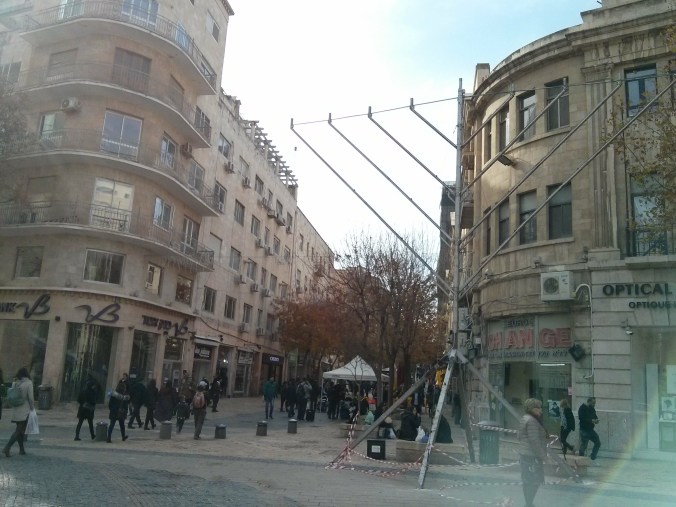
Ben Yehuda/ Zion Square.  No festooned lights, but a giant Chabad menorah

Is there a Santa booth so that parents can take pictures of their usually crying and nervous children asking for things for Christmas? Nope.

Christmas carols while shopping?  I was out today and didn’t hear a single one, so Nope.  Youtube is a good source of American Jews adding their voices to Chanukah culture.  This year’s Maccabeats offering is an homage to Hamilton.

Maccabeats – Hasmonean: A Hamilton Chanukah

(*Note to email readers: This post has a lot of pictures and video links that don’t seem to show up in the email. So come to the site to see the videos.)

Christmas cookies, Christmas fudge, gingerbread, fruit cake?  Nope, nope, nope, and thankfully nope.  We have donuts.

donuts

These are the fancy ones.  There are also yucky, I mean, plain, old-fashioned, jam-filled ones. Source

Christmas trees?  N . . .  well, I did find one at the, ahem, cough, YMCA, of course.

Are the television channels playing every snow-themed, Christmas-y movie or show ever made?  Nope.

Frosty? Nope.

Rudolph? Nope.

A Christmas Carol – any of the many versions? Nope.

It’s a Wonderful Life? Well, I like that one so I try to watch it.  I have the DVD.

The Grinch? Nope.

Well, what do you have?  Apparently, Israel decided to take on Black Friday, Even though Israel doesn’t have Thanksgiving or Christmas, advertisers decided to cash in on the shopping frenzy of December.

black-friday-2
Advertisement that I got in my email – Black Friday is spelled in Hebrew בלאק פריידי, and pronounced “black friday.” They didn’t translate it, they transliterated it.

At first I laughed because there is simply no connection to the Friday after the fourth Thursday of November in a country that doesn’t have a Christmas shopping season.  But then I was sad.  Of all the Christmas traditions to borrow, why that one?  When did Christmas become about greed?

Dr. Seuss, one of the great philosophers of our time, reminds us with How the Grinch Stole Christmas that Christmas cannot be bought in a store.  It’s not about the STUFF.  It’s about things that money doesn’t buy like:

Being with Loved Ones

Generosity of Spirit

Gratitude

Joy

Israel, in spite of the Black Friday blight, is a lot like Who-ville.  The Grinch doesn’t need to come and take all the stuff that we don’t have – the ribbons, bows, presents, trees, roast beast, etc.  What he can’t take away is lighting the candles together with friends and family. Singing songs of freedom.  Telling and retelling the stories of our forefathers standing up for their beliefs (ok, also the miracle of the oil).  I might even go so far as to say that Israel might have a little bit more Christmas spirit than other places that have replaced Christmas with greed.

Let your heart grow three sizes today and have a Merry Christmas, a Happy Chanukah, and Joyous Solstice!

The Grinch’s heart grows three sizes.


I’m a big fan of the Maccabeats, so here’s a list of their Chanukah songs in no particular order.  Start a new a Capella Chanukah tradition!

Maccabeats Shine (original song)

Maccabeats Candlelight

Maccabeats Miracle

Maccabeats  Burn

StandFour (Maccabeats) 8 Nights

Maccabeats All About the Neis