Yom Kippur – A Crash Course

What is the greeting for Yom Kippur?

The traditional greeting for Yom Kippur, which can be used between Rosh HaShana and Yom Kippur, is Gmar chatima tova.  The words translate to finish, seal, and good.  Chatima is also used in modern Hebrew for a signature.  What people understand when they hear this phrase is “may you be sealed in the Book of Life.”

Yom Kippur sounds pretty serious.  Why is that?

Yom Kippur is the tenth day of the month of Tishrei.  Rosh Hashana, the New Year, is on the first and second of the month.  Between these two holidays Jews are supposed to take a spiritual accounting, a cheshbon nefesh, of their actions in the past year.  During the ten days, you have an opportunity to make things right between yourself and other people.  On Yom Kippur, your actions for the past year are weighed and you have to get square with God.  At the end of the day, your name will be inscribed either in the Book of Life or the Book of Death.

I’ve heard that Kol Nidre is sung to a beautiful and haunting melody.  What does it mean?

Kol nidre means “all promises.”  This haunting, spiritual, moving melody is the tune at the start of the Yom Kippur service that basically uses legal language to nullify all promises made before God.

A cultural aside: Orthodox Jews in Israel often commit to something and follow it up with the phrase bli neder.  This absolves them of the promise that would be among the vows that are cancelled in the Kol Nidre service.

Kol Nidre holds a very interesting place in US movie history.  Al Jolson’s The Jazz Singer was one of the first “talkies.”  In the opening scene we are shown a synagogue with everyone preparing for Yom Kippur.  The cantor is saddened that his son did not come to sing Kol Nidre with him and then we hear the voice of Cantor Yossele Rosenblatt singing Kol Nidre.

Here’s a clip of one of the final scenes where Al Jolson himself sings Kol Nidre.

What is Israel like on Yom Kippur?

Quiet.  Even if people don’t do anything for Yom Kippur themselves, they respect the solemnity of the day and don’t drive.  Everything is closed in the Jewish areas.  (I don’t personally know if stores and restaurants are open in the Arab neighborhoods, but I have seen a few cars driving around on Yom Kippur and plenty of tourists in the Old City.)

I have friends that take pictures of themselves sitting in the middle of normally busy highways that on Yom Kippur are totally empty.  Children in Jerusalem ride their bikes in the middle of the street.

Air quality in Israel is measurably improved on Yom Kippur due to the complete shutdown of transportation. Even Israeli air space is closed.

I can’t statistically prove it but it seems to me that no matter how cold it may have been in the days before Yom Kippur, it is always hot on Yom Kippur.  It’s a 25-hour full fast – no eating and no drinking – and it is so much harder to fast when it’s hot.  By 4pm, everyone is listless and even in the synagogues they are counting the minutes until the fast is broken.  It is in these last hours when you feel that your soul is really on trial.

***

Let me take this opportunity to apologize for any wrongs I may have committed, or wrong information I may have provided.  I apologize for any offense my blog posts may have caused.  I also want to apologize for writing long posts and not always editing properly.

Gmar Chatima Tova!

Me and Shimon

Lots of people posted pictures of meeting Shimon Peres z’’l after he passed away last Wednesday.  I met him too, but unfortunately, I don’t have a picture of it.

Shimon Peres was the last of the generation of pioneer leaders in Israel.  To honor his legacy, Israel shut down most of Jerusalem for the past day and a half along with the highway corridor to the airport so that 70 or more world leaders could attend the funeral.  It’s been very quiet in Jerusalem today except for the sirens letting us know an entourage was passing by and the helicopters flying around on patrol.  The King David Hotel apparently had to move their paying guests to other locations so that they could, as per tradition, host all the world dignitaries.  As I passed by there yesterday I saw that the whole front was tented and police barricades were already in place.

As I mentioned, I met Shimon Peres once and it was kind of a funny story.  A friend was in Israel and I was able to use my connections to get us a visit to the Knesset – not the regular tour, but back where the politicians’ offices were.  Since my friend studied Middle East politics this was the best possible thing I could have possibly organized for him.  I was actually a bit amazed at how star-struck he was, but he said that all of his reading in university was by and about the people walking around in the corridors in front of his eyes.  It would be like a character from a novel coming to life and being willing to chat with you.  I hadn’t been in Israel long, but long enough to become cynical about the star power of politicians.  They’re just regular people, after all.

We were lounging around on some couches in a central area and along came Binyamin Netanyahu, at this time still just a member of Knesset.  My friend ran up to him to shake his hand.  I noted that the three security guards evaluated my friend’s threat level and decided that in spite of appearances he was a harmless fan.  My friend was a bit disappointed in the meeting because it was so fleeting and the handshake wasn’t perfectly executed.  But still.  Netanyahu.  Check!

There were other rock star politicians to meet and my friend ran up to them and shook all of their hands.  The Knesset session was about to open so we got up to head out.  As we passed some stairs, Shimon Peres and his one security guard were coming up.  My friend instantly stuck out his hand and leaned forward, “Mr. Peres, it’s such an honor to meet you!”  I gave the security guard a look letting him know that this guy was perfectly harmless.

Shimon Peres asked him who he was and what brought him to Israel and the Knesset.  My friend answered, but Shimon Peres was suddenly more interested in who I was so my friend somewhat reluctantly introduced me as the person who got him this backstage pass to Israeli political Lollapallooza.  Shimon Peres turned to me and put out his hand.  I shook it and told him in Hebrew that I had recently made aliyah and I lived in Jerusalem.  I don’t remember what he said, but I do remember that his voice was low, rumbling, and a bit hypnotic.  And the handshake kept going on – a good, solid, well-executed, but slightly overlong handshake.  By this time, Shimon Peres had turned away from my friend and was speaking only to me.  I saw out of the corner of my eye that my friend was a tiny bit jealous that this particular rock star had moved on to someone who was not such a superfan like he was.  Then the moment was broken by the security guard reminding Mr. Peres that he had to go into the Knesset chamber.

And then Shimon Peres was gone.

The final person to enter the Knesset hall was Ariel Sharon, who was prime minister at the time.  I suddenly worried that my friend would try to run up to Ariel Sharon and so I turned to him and said, “For the love of God, whatever you do, don’t run up to Sharon.  His security detail is not going to be very understanding and they’ll probably kill you.”  Dejectedly, he agreed to the logic, but we were close enough to see him walk by into the chamber with his band of at least eight security guards.  He was a speedy walker and surprisingly short.

And then we were alone in the waiting area.

My friend has gone on to meet many other political rock stars, but on this day, we met Shimon Peres and Peres was more interested in me.

435px-shimon_peres_by_david_shankbone

Shimon Peres 1923-2016

Shimon Peres also had a great sense of humor.  Here’s a YouTube video of his job hunt after being president of Israel.

***

Wishing everyone a Shana Tova u’Metuka! 

May the Jewish year 5777 be filled with joy, good health, great success, and may we all be written and sealed in the Book of Life!

Airbnb: Cultural connection or comedy of errors?

I used Airbnb while visiting Denmark and I had a great experience!  Airbnb allows people to rent out their homes or rooms in their homes to travelers.  Hosts are allowed to decline travelers so, unlike a hotel, there is a sense of control about who comes into your home, and it can be a good way to make extra money from your property.  Travelers can choose from among many hosts and choose the situation that best suits their needs.

reading-1142801_1280

As a traveler, it’s nice to come “home” after a long day of touring.  Hotels are fine and generally comfortable, but there is a feeling of anonymity or uniformity.  It was also fun to see how Danes live.  They are surprisingly minimalist – though perhaps that’s an Airbnb characteristic – I didn’t see clutter or unnecessary stuff around.  Shoes off at the door and beds are surprisingly warm and smooshy (there’s an extra 5-inch sleeping pad on the bed).  I felt as though I experienced the real Denmark, not just the façade shown to tourists, and I liked that a lot.

As much as I like the idea of Airbnb, I don’t think I’ll become a host.

When I went to Brazil I loaned my apartment to friends (who I didn’t know) of a friend.  While there I got an email from my cousin that said “Something funny happened with your apartment.”  Since I had only recently moved in and I was on the other side of the planet, I couldn’t imagine a single thing that could happen in my apartment that could be considered remotely “funny.”  My cousin told me the short version of the story:  the guests had some comical misunderstanding and then the situation was sorted.  Ha! Ha!  All’s well that ends well!

When I got home, I found a lovely note and a gift from the couple and it seemed that all was indeed well.

Then I heard the whole story from my friend who had asked for the favor in the first place.  My cousin had given the couple the keys and explained how to get to my apartment.  They went in, left their suitcases, and continued their touring day.  They came home late in the evening to find another couple in the apartment and the police.  It seemed to them an absurd, double-booking situation.  How could I have double-booked them?  Who are these people in the apartment anyway?  Why are the police there?  The travelers were distraught and upset because it was the evening of a holiday and they knew they couldn’t find another place, not to mention that they didn’t speak Hebrew and couldn’t understand what was happening.

Turns out it wasn’t my apartment.

The actual apartment owners had come home late in the evening and found strange suitcases in their living room.  They debated for a bit as to what to do since it didn’t seem to be a dangerous situation, but still they decided to call the police.  These were after all “suspicious objects” in the middle of their apartment and they had no idea how they got there or to whom they belonged.

The travelers had no one to call but our mutual friend in England.  There were all kinds of shouting and wondering how a double-booking could have happened and weren’t arrangements made?  Somehow, it was not clear to the travelers that the couple in the apartment owned it, nor that it was not my apartment at all!  Our mutual friend in England didn’t know exactly where my apartment was, and couldn’t understand how the travelers could be anywhere but my apartment.  And there was the fact that the keys worked in the lock.  Finally, someone figured out that they should call my cousin. By then it was 1:00am.   Luckily she answered and explained to the couple whose apartment was invaded where my apartment was and exactly how to get there.

There was nothing more for the police to do – no crime was committed and it was obviously a series of misunderstandings – so they left.  The travelers were installed in the correct apartment and the apartment owners could go back to their own home that was finally cleared of unexpected guests.

I heard later that the apartment owners became friendly with the travelers and even invited them for coffee.  I didn’t know the apartment owners because I was new to the complex and even though I tried to find them, I couldn’t figure out where the travelers had gone wrong in the instructions and where the other apartment was.  I don’t know where it is to this day.

Home invasion, suspicious objects, the police, and any number of misunderstandings, comical or otherwise, seem like too much trouble.  I think I’ll pass up being an Airbnb host.

Greetings from Denmark!

This week I’m in Denmark.  I thought it might be hard to relate my Danish experience to Israel, but it turns out that Denmark does have a few connections to Israel.

Land of Israel’s winter desserts

Always a fan of dessert, I had forgotten that the legend about Krembo is that it originated in Denmark.  Krembo is sold only in the winter (mostly because in summer it would just turn into a gooey mess on the grocery store shelf).  It’s a chocolate-coated, fluff-filled, sweet mess on a thin cookie.  Here in Denmark, it’s called a Flødebolle and you can buy them any time.  There are differences though.  Here they can add coconut on the coating and they use a wafer for the base, fancy ones use marzipan.  Israel has vanilla and mocha, but here they have vanilla and strawberry.

krembo

I went to the bakery to get a treat after dinner and I bought a sugar-coated fried donut.  Then I took a bite and realized, “Oh, it’s a sufganiah!”  But here they call them a Berliner.  It’s not originally Danish, but apparently you can get them year-round.

berliner


Kibbutz volunteers

In Israel it’s not uncommon to meet someone who volunteered on a kibbutz.  I didn’t expect to meet two Danes who were volunteers within two days.  On the plane to Denmark, I sat next to a man and his son and in the course of the conversation, I found out that the father had volunteered on a kibbutz in the north 20 years ago.  This was his second visit this year and he hoped to come again in December.  He visits his kibbutz and has fond memories of it.

I arrived at my conference and while talking to the organizer he came out with a few words of Hebrew.  He spent 3 months volunteering on a kibbutz in the Negev.  At 22, he’s already a multilingual, open-minded, curious individual.  I’m a bit jealous that he’s fluent in Danish, English, Greek, German and Hungarian with a few words in other languages.  I guess it’s never too late to improve on my one and a half languages.

These volunteers tend to go to kibbutzim to have adventures and an unusual experience.   They aren’t Jewish and are not Zionists.  It’s just that no other place in the world has this kind of volunteer experience.

Here are a few highlights from my trip so far 

img_20160913_230718

Fancy Danish Krembo

pano_20160915_141233

“Your Rainbow Panorama” at the Aarhus museum

A look out the windows on and on the floor

Appreciating the curve

Open-air museum with houses from all around Denmark reconstructed exactly as they had been in their original locations

img_20160914_080825

It’s very green here!


Dire Straits Experience in the Sultan’s Pool

This week I had the absolute pleasure of seeing the Dire Straits Experience at the Sultan’s Pool in Jerusalem (with thanks to my friend LC for suggesting it).

I didn’t remember all the songs (and to be fair, I’m not a die-hard Dire Straits fan). But the Mark Knopfler feel was there – the voice, the guitar solos, the unique style.  One of the members of the Dire Straits Experience was in Dire Straits and mentioned that the last time he was in Jerusalem was in 1985 and he was so glad to be back in this special city.

The last time I saw a concert in the Sultan’s Pool was also in 1985.  I went with my cousin to see a popular Israeli band, Mashina.  I was so impressed that my aunt bought me the record (and yes, I do mean the LP vinyl black round thing you play on a record player).  There was a US kids group too, but I don’t remember anything about them.  Most everyone was there to see Mashina.

machina

We don’t get a lot of big names in Jerusalem.  We only just upgraded our stadium, but I’m not sure anyone really wants to play in it because Jerusalem is complicated.  Louis C.K. recently came to Jerusalem for a show, but his comedy tends to be complicated and we have a lot more native English speakers in Jerusalem than in Tel Aviv.

We have more small venues.  One of the best is the Sultan’s Pool.  In ancient times, it was a reservoir and in fact, an arch with a faucet and an inscription in Arabic still stands to remind us of the history.  Now it’s an open-air amphitheater under the walls of the Old City.

img_20160906_202201

Between ancient times and modern times, or more specifically, between 1948 and 1967, the Sultan’s Pool was no-man’s-land.  Jordanian snipers sat on the walls of the Old City and guarded the border that ran through the valley.

I think it’s interesting that the Sultan’s Pool is the top of the valley called Guy Ben Hinnom.  Slurring the words together you get the vocalization of “gehinom” or the Jewish equivalent of purgatory.  The Bible mentions the valley (guy) of Ben Hinnom as a place of child sacrifice (II Kings 23:10; Jer. 7:31 and 32:35).  And yes, from 1948 to 1967, the border (aka the Green Line) ran through this valley.

The saxophonist, who had played with Dire Straits in Jerusalem in 1985, mentioned that they’ve played in many different countries in a variety of political situations, but it was music that brought everyone together.  And he’s right.  Today, we’ve turned the no-man’s-land gehinom into a valley filled with music.

Here’s a video of a few collected clips that I took at the concert.  The quality isn’t great, but it gives you the experience of the Experience.  At the very end, I passed a street musician – a haredi guitarist – and it sounded like he had been inspired by the concert.

I was far away from the stage – and now I’m a little bit sad that they didn’t play “So Far Away.”

img_20160906_221353

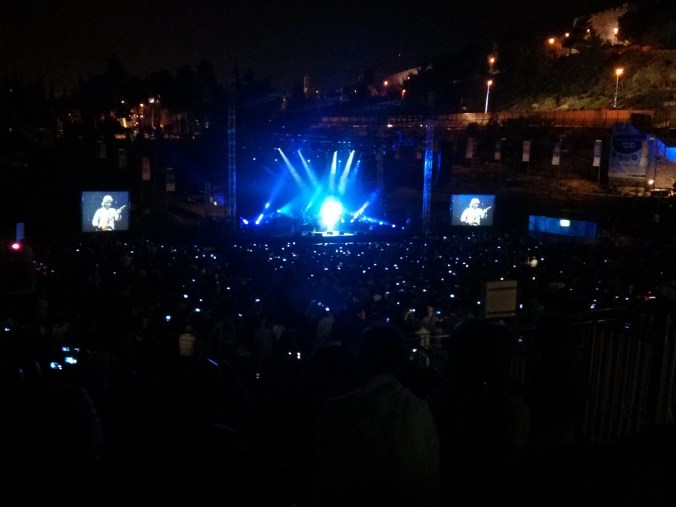
Concerts today – pictures of people taking pictures/video with their phones!

Still the light show was fun!  The noise curfew is at 11:00pm and so after 2.5 hours, we said Good Night to the Dire Straits Experience.

img_20160906_222615

“So Far Away” – Dire Straits

Aharei ha’chagim / After the holidays

Parents all over Israel breathed a collective sigh of relief as they sent their kids to school on Thursday, September 1.

after the holidays
Another phenomenon that began on approximately the same day was the throwing around of the phrase “aharei ha’chagim” (after the holidays).  The “holidays,” starting this year on October 2, are: Rosh Hashana, the Jewish New Year; Yom Kippur, the Day of Atonement; and Sukkot, an 8-day festival that includes building temporary shelters outside.  Jewish holidays are national holidays so in this 3-week period there are a lot of days off, children are home from school, and it’s hard to get anything done.

One of the rhythms of life in Israel is for people to put off new projects until after the holidays, but this national procrastination often starts about a month before the holidays actually begin.  This can sometimes delay projects for up to two months!  The holidays are usually in September, so after the slow-down of August, people are busy trying to catch up at work.  They don’t want to start anything new.  So it’s a pretty common conversation among workers to discuss some new project in September and the agreed-upon start date is “aharei ha’chagim.”

The only comparable scenario that I can think of in the US is if you have an idea for something new on December 20, it’s pretty easy to say that you’ll discuss it after the first of the year because you have to get through Christmas and New Year’s.  It’s a slight exaggeration, but imagine the slow-down if any project you pitched in November was delayed until after Thanksgiving, Christmas, and New Year’s.

Aharei ha’chagim can also be used sarcastically at other times of the year.  If someone is constantly delaying a project, it would be perfectly appropriate to ask, “Oh, and when will you be getting started on that? Aharei ha’chagim?” I imagine that it could be used by a parent to their teenager, “When did you plan to clean your room? Aharei ha’chagim?”

Aharei ha’chagim is most often used around the holidays in September, but it is also used before the Passover holiday in the spring. Passover is 8 days long and about 2 weeks before people might start delaying projects to aharei ha’chagim.

Stepping back to look at the big picture, I see aharei ha’chagim as part of the intensity of life in Israel, not a lazy delaying tactic.  In Israel, you work hard during the week and during the year and then rest completely and unplug from the world during Shabbat and holidays.  You finish everything you have on your list before the holidays, rest and rejuvenate during the holidays, and then give 100% effort to something new aharei ha’chagim.

August in Israel

When people talk about the quality of life in Israel, they are not talking about the variety of things you can buy or the overabundance of choice in all things.  Quality in Israel is intangible.  I often mention rhythms of life – for example, businesses are closed on Saturdays and Jewish holidays are part of the national calendar, which means people can be home with their families, out in nature, or just take a day for themselves.

“Be fruitful and multiply” (Genesis 1:28)

God may have given the command, but he didn’t consider childcare in the twenty-first century and how all people, no matter their job, should be able to spend time with their children.

And so we come to August in Israel.  Daycares shut down in August.  All of them.  This allows daycare providers to have a vacation to spend time with their own children.  However, since we live in a modern society that doesn’t just shut down in August, parents have to look for alternate solutions.

Israel has a booming day camp business in August.  Every kind of day camp you can think of can be found catering to most age groups.  If you can’t afford camp (and many people can’t) the other option is to take your vacation days in August.  Parks are filled with families; I’ve seen mostly ultra-religious families with their half-dozen or more children.  I remember when I was a kid in the US, you could take yourself to the local pool and cool off in the summer.  Jerusalem doesn’t have outdoor public swimming pools and the indoor pools require expensive memberships, so you see many kids playing in public fountains.  Independence Park has a water feature that looks like a stream and there are dozens of children playing in it every day with families nearby picnicking on the grass.

Downtown Jerusalem is crowded and I hear mostly Hebrew in the streets (unlike other times when I hear a lot of English and French). Families take advantage of cool Jerusalem evenings and stroll late into the night with their children.  “Bedtime” must be when the kids collapse because it is certainly not 8pm.

Those not taking vacation days in August or sending their kids to camp look for other solutions.  Some people can rely on their parents to take care of the kids (often they joke that this is “Grandma Camp”), but others have to juggle other options.  August is “take your child to work” month.  I’m working in an office these days and since it’s August, I’m getting to meet everyone’s kids.  This is completely normal and accepted; both mothers and fathers bring kids to the office (usually only one and not every day so as not to totally disrupt the office environment).

On the surface, August seems unnecessarily complicated.  People have to work.  That’s how a modern, capitalist society functions, right?  So, if you want people to work and have children, then daycare should be available.  Let’s say instead that the value is not just having children, but actually spending time with your family.  Then August starts to make sense because it imposes a work/life balance.  Quality of life doesn’t mean an easy life.  Often it is the things you work the hardest for that give you the most value.

***

I had the chance this week to see Shakespeare’s Macbeth in the park – with lots of kids, who enjoyed it for the most part.  No sets, minimal costume, no mics, and the audience moves around to different locations in the park with the scene changes.  Over the years, I’ve seen Richard III, A Midsummer Night’s Dream, and Macbeth.  It’s not Broadway or the West End, but it’s Shakespeare and it’s fun!

Love is in the air – Tu B’Av

It’s today!  For lack of a better reference, Tu B’Av is Jewish Valentine’s Day.  The name is simply the date (tet vav = ט’ו = 15, pronounced too; Av is the Hebrew month).  It’s actually much older than Valentine’s Day and is shrouded in mystery, apparently.  In the olden days – the Second Temple Period – unmarried women in borrowed white dresses would go out to the fields and dance under the full moon of the 15th of Av.  Unmarried men would go out and choose a bride.  The borrowed white dresses ensured a level playing field for the women and men chose their brides based on personality rather than status.

Today, Israel has borrowed the romantic ideas of Valentine’s Day in the US, so chocolates are flying off the shelves and flowers are sold by the ton.  It’s considered a great day to get married, so venues are booked far in advance.

In a previous post, I wrote about Jerusalem’s Love Map .  Checking it again today, there are many more hearts and stories.

Jerusalem map

And since no one else in the world can see our special Google Doodle, here are some images (though they are actually tiny romantic animations).

doodle 2Doodledoodle 3

I’m compelled to share one hilarious element of the Google Doodle.  They spelled the holiday wrong.  When you click on it to get more information, the first site is the Google Doodle site, everything else is related to the show Ab Fab or it has to do with abdominal exercises. So if you want to find out more about Jewish Valentine’s Day, don’t be Google and spell it To Be’Ab, spell it Tu B’Av and get the right search results.

And finally, I leave you with the song that inspired the title, from one of the best movies ever, Strictly Ballroom.  Remember, a life lived in fear is a life half-lived!

Tisha B’Av and Dad’s birthday

On Sunday it will be Tisha B’Av – translated as the 9th of the Hebrew month of Av – and Israel will slow down a bit.  The 9th of Av is an unusual day in the Jewish calendar.  It commemorates the destruction of both Temples.  It’s a fast day and considered to be a day of mourning.  But many people in Israel kind of ignore it.  Employers offer it as one of the several days a person can choose to take off for religious purposes.  So a lot of people are still working – and according to religious laws, a person is allowed to work even if they are fasting.

For skeptics who wonder how it could be that both Temples were destroyed on the same day, well, it’s mostly a matter of odds.  In ancient times, you usually didn’t gather your armies in winter – Israel isn’t in the tropics, so we do have a winter – which eliminates at least 4 or 5 months.  In spring, you gather your armies and then you have to get to where you want to go, in this case Jerusalem.  By the time the end of July or early August rolls around, there’s a good chance you’ll reach your goal.  And because the Jewish calendar is lunar, the 9th of Av moves around.  So it’s possible that the First Temple fell on July 31 and the Second Temple fell on August 9, but they would still both be the 9th of Av. There are also those who go through history and point out all the terrible things that happened to the Jews on the 9th of Av.  Two often-cited examples are the expulsions of the Jews from Spain and England.

In Israel there are groups that march around the outside of the walls of the Old City and those who will likely ascend the Temple Mount on Sunday.  I hope it will be uneventful, but you never know.  The atmosphere in Israel is always combustible.

The day after the 9th of Av is Dad’s birthday.  Actually, I’m not sure how to say that correctly.  The day is still Dad’s birthday, but since he is no longer with us, maybe it’s more correct to say it in the past tense.  To me, it’s still in the present tense.  Monday is Dad’s birthday.  It will also be one of the “firsts” in the mourning year – the first time that I can’t call my Dad on his birthday.  His number is still in my phone, but it won’t connect, and for a minute I might say to myself, “Oh, he’s in a place where he doesn’t have cellular service.”  And that will be true.  Then I’ll have to remember that he won’t be answering at all.  That will be hard.

Like Tisha B’Av, it will be a mournful day, but one in which I’ll still work and I’ll keep moving forward.  As we all do even if our Temples, literal or symbolic, are destroyed.

fire-989869_1280

Toilet tanks of Memory Lane

This week I got a new toilet tank.  I know.  That doesn’t sound so earth-shattering or life-changing.  And it isn’t.  But this toilet tank triggered a few memories and those are usually worth writing about.  It’s especially well-timed because this is the first post in the second year of my blog (hooray!) and the toilet tank reminded me of how I got to Israel in the first place.

IMG_20160805_184109

Back in February 2001, I began kibbutz ulpan on Kibbutz Ma’agan Michael.  Half the day I would study Hebrew and half the day I would work somewhere on the kibbutz.  I began my kibbutz life in the kitchen and I was put in charge of the dairy cart – cottage cheese, soft white cheese (like sour cream), sliced cheese, and whatever other dairy products were available.  Needless to say, I couldn’t even look at dairy products after a while, much less eat them.  This was a great weight loss plan!

Ma’agan Michael is a rich kibbutz with multiple income streams including tropical fish, edible fish, bananas, cactus fruits, and a few other small industries.  But their big moneymaker is Plasson.  They make plastic plumbing parts and ship them all over Israel and internationally.

After my stint in the kitchen and noticeable weight loss, I begged to be outside, so I transferred to the banana fields.  I knew how to drive a manual transmission so I was an asset as a tractor driver.   But when it was too hot, we weren’t allowed to work outside and I spent one, possibly two, days at the Plasson factory.  We were put to work putting plastic rings (washers) of different shapes and sizes into a plastic bag.  We did it BY HAND!!!  Seriously, it was the longest day of my life.  I’m not really cut out for factory work.  But I did my job and I have a memory tucked away of once having worked at Plasson.  So every time I see a Plasson toilet tank, I think of my time on the kibbutz.

The truck and one of the tractors that I drove.

Banana tree

Tying bunches of bananas.

Looking back now, I can see that the 5 months on the kibbutz was a transitional time for me.  Life was not really moving forward the way I had envisioned.  Taking a time-out on the kibbutz gave me the opportunity to truly see it.  Moreover, I unexpectedly felt very drawn and connected to Israel and my Jewish heritage.  I had been to Israel many times before, but I never felt like this.

I went back to the US that July and had a difficult summer trying to figure out what I was going to do.  And then 9/11 happened.  Watching the chaos and trying to comprehend the tragedies unfolding on my television screen made me realize that life is short and I would not accept a “life of quiet desperation.”

For my 29th birthday the year before, I jumped out of an airplane – freefall for 5,000 feet (1,500 meters), parachute for 5,000 feet.  For my 30th birthday a few weeks after 9/11, I jumped out of a life that no longer made me happy.  Life in Israel was my parachute.

sunset

Some of the best sunsets in the world are at Ma’agan Michael!

***

Environmental side note:

In Israel – and probably a lot of other places – we have two flushing options.  The small button is for small flushes and the big button is for when you need a big flush.

IMG_20160805_184131