The Truth about History

When I was in university many years ago, I studied history.  I didn’t learn a linear collection of facts, I learned feminist history (also known as her-story), varieties of narratives, and that history is complicated.  I was happy to learn history this way and I still believe that it’s valuable and necessary.  The world IS complicated.  Many people have a lot to add to the commonly known facts.  But I think we’ve come to a crisis about history and what is true.

In a short little essay, it’s impossible to deeply explore this idea, so this is no more than a brief consideration about a few things that struck me this week.

I like being in Israel in the springtime and I like the spiritual journey that Israel as a country and as a people takes to get to Independence Day.  It’s no secret that I consider myself a Zionist.  But right around Independence Day there is another commemoration day called Nakba Day.  Nakba is the Arabic word for “catastrophe.”  On May 15, the Palestinian population marks the catastrophe of a Jewish state being created that at the same time created a refugee crisis.

I think people today consider history to be a story that is told about the past.  There are heroes and villains.  It’s not a gigantic leap to suspect that each nation is the hero in its own story.  Even if we accept that not all heroes are perfect and not all villains are totally evil (a common theme in today’s storytelling), we still kind of need to see a cohesive storyline about the events of the past.  We find comfort in cause and effect.  It’s sensible and logical.  Otherwise, it’s all just chaos and nothing matters.  So when we tell ourselves stories about our past, we don’t simply recite facts in chronological order.  We want to be entertained.

are-you-not-entertained-w-text-720x396

Wikipedia says that postmodernism is “typically defined by an attitude of skepticism or distrust toward grand narratives, ideologies, and various tenets of Enlightenment rationality, including the existence of objective reality and absolute truth, as well as notions of rationality, human nature, and progress.”  We are also told that this is where the idea of relativism comes from, which includes the idea that truth is relative, both yours and mine.

So we circle back to Israel.  According to postmodern history, Independence Day and Nakba Day are two equally true truths.  From the point of view of Israel, its narrative is that five Arab armies attacked and Israel fought a war to give birth to the state.  From the Palestinian point of view, they got kicked out of their homes and a new state was created that had no place for them.  Postmodern theory tells us that with these two equally true truths – and the understanding that there may be more equally true truths – here we have a full picture of history.

The problem for me is that without the idea of an objective truth – tangible evidence and a series of provable facts – to balance each narrative against, then what exactly is true about any narrative?  It’s true to you and therefore it’s true to everyone?  I believe there is a place for narrative, but there also has to be a place to measure that narrative against facts and evidence.  Additionally, if two narratives exist in parallel, do they even have to intertwine or can they stand alone and still be true?

Pulling all these thoughts together, I’m led to a spine-chilling fear.  History is a story.  Our narrative is true.  We are heroes in our own stories. Today, we need to tell our stories in 144 characters or less.  So the one with the shortest, most compelling, most entertaining, most memorable slogans wins history?  After all, the most often repeated narrative becomes the first among equally true truths. I hope that this is not what we have come to.

This short essay is not an attempt to debate the truth of the Nakba or the truth of Independence Day.  There are large sections of many libraries doing that without my input.  The point of this essay is to suggest that all of us have a responsibility to remember that there are many voices that add to our understanding of the past and we should rejoice in the complexity of the world, but if we allow that all truth is relative and subjective, then everything and nothing is true.  Somewhere there is a middle ground where we can have all the voices and a measure of truth.

Soldiers Remembrance Day (Yom HaZikaron)—Independence Day (Yom HaAtzmaut)

After Passover, Israel marks Holocaust Remembrance Day, remembering and honoring victims of the Holocaust.  The following week, the nation remembers fallen soldiers and victims of terror attacks.  Immediately afterwards, the streets are filled with joy for Independence Day.

It took a while for me to connect to this rhythm of honoring the memory of the dead and celebrating the birth of a country.  But I think the bottom line is that Israel loves life while not rejecting or denying the sacrifices made by others.

Maagan Michael 2001

The first time I experienced the 5-minute limbo between Yom HaZikaron and Yom HaAtzmaut, I was emotionally confused.  At Maagan Michael, these days are taken very seriously.  The kibbutz was around in some form or another since before the birth of the state, so their cemetery held soldiers from every war.  There were ceremonies.  The cemetery was cleaned and decorated.  People told stories, they honored the fallen, and they remembered.

Maagan Michael’s cemetery

And then as we gathered together to solemnly close the day together, we said a few final words, and then we stopped.  Five quiet minutes passed.  And then fireworks.  Now it was time to be happy.  Hoorah!  Independence Day!  Time to party!  BBQ tomorrow!

Honestly, it felt a little manic-depressive, but the other way around—solemn sadness and then within 5 minutes, joy and elation.  But I get it now.  Life is short and you cannot linger in the sadness forever.  Similarly, people continue to live their lives even in the shadow of terrorist violence, even when we were in the dark days of suicide bombings.

And now, it even makes sense to me:  it is important to remember and honor the soldiers who sacrificed their lives defending the state, and also to remember and honor the innocent civilians who were victims of terror; and the best way to do that is to live, to be joyful, to be courageous, and to celebrate.  But it’s also important to keep those days separate so that the commemoration and memory don’t turn into a celebration.  I think often of Memorial Day in the US.  If you don’t know any soldiers, it’s just a 3-day weekend to kick off summer with a BBQ or buy a mattress because there’s a big sale on.  Not here.

Tradition!

This is a little clip (19 seconds) from The West Wing describing how Israel remembers their soldiers.  I have one tiny little issue with it, though I understand why it was phrased that way.  Leo McGarry says that it happens on May 13, the day before Israeli Independence Day.  Well, in 19 seconds, it’s a little hard to explain that the date changes because Independence Day is celebrated according to the Jewish calendar, so Remembrance Day on the 4th of Iyar, whenever that happens to be on the Gregorian calendar.

And he’s right.  Here are a few snapshots of my television screen this year.  There was soft Israeli music playing in the background, not sad music exactly, but definitely mellow and understated.  As I watched the names change, I realized that every single name represented a family that lost someone.  This year, the number of fallen stands at 23,447.

Major Levy Feigenbaum z”l 1 July 1974

Staff Sargent Avraham “Bomi” Schwartz z”l 23 September 1974

On Yom HaZikaron, there are two national sirens, one at 8:00pm to signify the start of Remembrance Day for one minute, and one at 11:00am the next morning for two minutes.  The same behaviors apply as they do for Yom HaShoah:  everyone stops, people stand, and we do it all together.

For Independence Day, Jerusalem allows parties all night.  I didn’t go – I’ve been there and done that, and it’s usually a wild, drunken scene.  Still, I could hear the partying in the street from home and I had a perfect view of the fireworks.  On offer was a city-sanctioned “rave” downtown, folk dancing at the square by city hall, and many of the bars had some kind of Independence Day party theme.

Seriously, I didn’t even go outside for these.

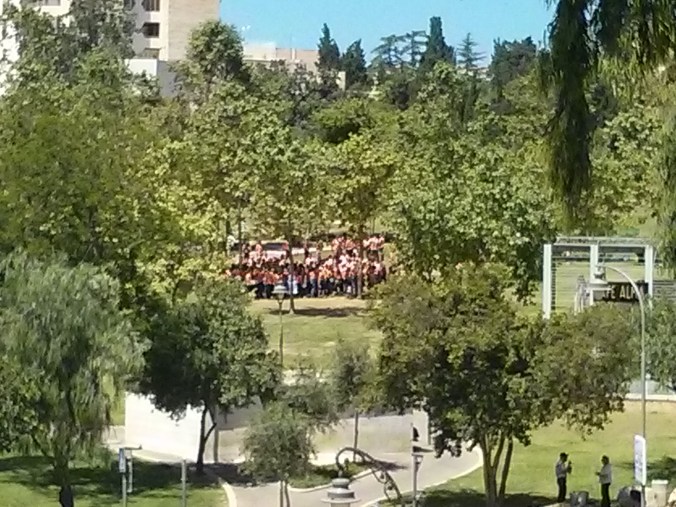
The next day, the park was filled with youth groups, buses dropped off thousands of tourists in the area, and I happened to see a March of the Living group from Argentina.  (March of the Living groups usually visit concentration camps in Europe and commemorate Yom HaShoah there and then come to Israel for Yom HaZikaron and Yom HaAtzmaut.)

IMG_20160512_111151

The spring holiday cycle

So now this year’s journey is complete:  we began as slaves in Egypt and took 40 years of wandering to become a nation; we faced near-annihilation in the Holocaust; we built a state and to protect it and its citizens, soldiers sacrificed their lives and civilians lost their lives in terror attacks; and now we have arrived at Independence Day, when we celebrate the last line in the national anthem, “to be a free people in our land, the land of Zion and Jerusalem.”

Holocaust Remembrance Day (5 May 2016) – Yom HaShoah

Every year we stop everything and stand for two-minute national siren to remember six million Jews who perished in the Holocaust.  For 24 hours television stations broadcast Holocaust stories and interviews.  Radio stations play somber music.  Restaurants and entertainment venues are closed.  During the siren, drivers pull over to the side of the road and get out of their cars.  Busses stop and often passengers get off to stand for the siren.  Walkers stop in the street.  It is a national pause to take the time to remember.

A video from this year taken on Highway 1 between Jerusalem and Tel Aviv.

In Israel, national and religious holidays start at sunset the evening before.  On the eve of Holocaust Remembrance Day, I witnessed an incredible sunset.  It was so stunning not only for the colors in the sky, but it seemed to change the quality of the air.  The air seemed to be infused with pink and gold and so full of magic that you might even be able to scoop some into a jar to save for later.

This slideshow requires JavaScript.

In all the years I’ve been in Israel, I’ve never had the chance to be in a public street for the siren.  The siren is at 10am and usually people are at work.  If no official ceremony is held, people will stand up at their desks.  Places where there are official gatherings, people will stand together and often will have a short remembrance ceremony.   I’ve experienced both.  But this year, I happened to be out in the street.  I didn’t take a video or photos because I wanted to participate, not observe from behind the safety of a lens.

Still, I saw some things:

  • A few minutes before 10am, I could feel people start to slow down and start to gather in the square.  They knew what was coming.
  • A woman brought her own package of Kleenex and was prepared for her emotional response.  She shared her Kleenex afterwards with someone who hadn’t expected to have such an emotional reaction.
  • Of the 50–60 people that I could see in the square, everyone stopped what they were doing and stood, except 3 people who continued walking.  Two were a Muslim couple and what I guess to be an Arab man.
  • Several Muslim women (marked by their headcoverings) stopped and stood solemnly with everyone else.
  • Time stands still.  And then when the siren ends, the world starts moving again as if released from a pause.

What I notice in myself is that at first the two-minute siren seems so incredibly long.  And then if I think about it in depth, how could it possibly be long enough?

I feel mixed emotions.  First, I’m sad because this is a remembrance for the light of six million human beings snuffed out due to hatred, along with millions of others who were also crushed under the wave of fear, ignorance, and hatred.  But then, incongruously, I’m happy.  All of us in this square, and actually the whole country, are standing together on this day to honor the memory of the fallen.  “Never Forget!” is not just a phrase, but is an active choice made by every person who stops, stands, and remembers.  I remember not only for myself, but for the people standing next to me, and they remember not only for themselves, but also for me and their neighbors.  During this powerful two minutes, Israel stands together.  Not just in theory or with words, but with an active choice to pause and stand together.

***

There are those who say that Israel exists because of guilt over the Holocaust.  The UN vote on 29 November 1947 was a short two years after the end of the World War II, so there may be some truth to that.  Whatever guilt there may have been, it still required a lot of political campaigning to get the votes.  The result was not a foregone conclusion.

But can we or should we say that Israel has to exist so that a Holocaust will never happen again?  A Jewish homeland has to exist so that if Jews are suddenly unsafe or expelled, they will at least have a place to go?  There is, of course, a grain of truth to that.  The flip side of that logic is that if Jews are safe in the world, then there is no need for Israel to exist.

Rather than focus on the Holocaust as the reason for Israel to exist, which leads to a victim mentality, it is far more positive and a source of strength to say that Israel exists due to an historic connection to the land itself, the place in the world where the Jews as a nation trace their history.  The Holocaust must always be remembered, but it should not be the defining point of Jewish history or Israeli history.  The memory of the victims must always be honored, but it was the survivors who built the modern state of Israel.

From Passover, we move to Holocaust Remembrance Day, then we will go to Soldier’s Remembrance Day, and then Independence Day.  It is a symbolic journey from slavery, to near annihilation, to fighting for the land, and finally to freedom.

“Next Year in Jerusalem!”

next year in jlemFor Passover in 2001, I was in Israel volunteering at Kibbutz Maagan Michael and I had an invitation to a Passover Seder in Jerusalem.  I think for most people, they just say “Next Year in Jerusalem!” at the end of the Seder as part of tradition with no intention whatsoever of being in Jerusalem the next year.  For me, it had long been my secret wish to have Passover in Jerusalem.  It was less a Zionist imperative and more “I’ve been saying it for years and now I’m going to do it!”  And wouldn’t it be amazing to fulfill that dream?

So here it is April 2001 and I am actually going to be in Jerusalem for the Seder.  This is it!  Dream fulfilled!  I came to Jerusalem for the Shabbat before Passover – known as Shabbat HaGadol (the Great Shabbat).  On Saturday, I had lunch in the home of a religious family who lived in the Old City.  The family spoke very little English and my friend and I were there only there to meet the son (a friend of my friend, both of them were named Yair, which was a little confusing) who was going to walk with us around the Jewish quarter and take us to the Western Wall.  We hadn’t actually planned to have lunch, but our timing was a little off and they were just sitting down, so they invited us to join them.  So with my extremely limited knowledge of Hebrew, I listened to the conversation and the prayers and found that I could pick out a few words.  One of the phrases I remember hearing is Shabbat HaGadol.

There were at least eight of us at the lunch.  The food was excellent and filling.  The conversation flowed in Hebrew, and the two Yairs filled in some of the gaps for me.  And then it happened.  The idea of fulfilling my secret wish, actually being at the center of Judaism here in the Old City, and sitting at a Shabbat lunch surrounded by Hebrew simply overwhelmed me.  My eyes welled with tears.  And then one slipped out and rolled down my cheek.  I was embarrassed, but after the first one, there’s really no stopping them.  I wasn’t crying exactly.  It was really more like my emotional cup was overflowing and it came out of eyes in salty tears.

The family and my friends sitting around the table let it happen like it was the most normal thing in the world, as if everyone who comes to Shabbat lunch on Shabbat HaGadol leaks tears all over the table.  The embarrassment was my own, but it only lasted a short while, because no one seemed to mind.  They noticed, but saw that it was because I was washed over with emotion, not because I was sad.  I did explain afterwards through translation that it was because sitting there in that moment represented a secret wish fulfilled.  It was next year and I was in Jerusalem!

The story of my tears became sort of a legend in the family.  I spent other holidays with them – without all the tears.  But they always remembered that I was the one who cried at their table and by the next Passover, I had turned my life inside out and upside down and moved to Israel.

So That Happened

On Monday a bus blew up.

I heard a lot of sirens all of a sudden just before 6pm.  At first I thought it was a VIP and his entourage.  But then there were more.  And more.

Facebook.  A friend’s comment.  “Anyone know what happened on Derech Hevron?” And then the answers started flooding in.  It wasn’t Derech Hevron.  A bus.  Was it terror?  Wait.  The police don’t want to say that yet.  Definitely bus on fire.  Second bus also on fire.  Then the evidence pointed to terror.

*Sigh*  I remember those days.  I didn’t like those days.  I don’t want those days back.

Between 6pm and 7pm I had to make a decision.  My Tai Chi class is in the same neighborhood as the bus bombing.  Should I take a bus as usual?  Class wasn’t canceled (of course), so I decided to walk.  I walked in part because I could use the additional exercise.  The chance of another bus attack was pretty small, but it’s been so long since a bus attack that I just didn’t want to get on a bus.

It took 45 minutes and I was pretty pleased with myself.

On the way back, another choice.  As I was passing the bus stop, the bus came.  I could have gotten on.  There were plenty of people taking the bus right then.  But I chose to walk.

I was happy with the accomplishment of walking to and from class.  It was a good long walk and something that I had considered doing before.  But I’m bothered by the fact that the thing that pushed me to do it was a bus blowing up.

Two days later, I had a chance to ease my bothered feelings.  I took a train and a bus to where I needed to go.  I walked in crowded areas where I needed to run my errands and life was back to normal.

Since this is Israel, “normal” right now means high alert.  Over major holidays in Israel there is a much more visible presence of security personnel and starting today and for the next 48 hours the West Bank and Gaza Strip are closed off.

I am sure that upon hearing the words “West Bank closed off” there are those who would cry “oppressive occupation” and excuse all violence against civilians as “legitimate protest.”  I disagree.  Besides nothing being “legitimate” about blowing up a bus filled with civilians, as a citizen of Israel, I expect my government and our armed forces to protect civilians.  I expect to feel secure as I walk or take a bus in my streets.  And when I look at images like this, I’m glad that security personnel are doing everything in their power to keep us safe.

bus bomb

Screen capture from HaAretz

Originally, I had plans to write a nice Friday email about my first Passover in Israel, but this week provided many other potential topics – this bus bombing, a follow-up on Western Wall/Temple Mount issues, and Prince, another icon from my childhood, passed away.  Well, it will still be Passover next Friday and I may yet write about these other things too.

Wishing everyone a peaceful Passover!

How is it Passover already?

It happens every year.  I know Passover is coming.  I see the introduction of Passover foods at the supermarket and then, BAM, it’s already here.  Passover is in a week, but people have already started and finished their major cleaning and are stocking up on Passover foods.

“Cleaning for Passover” means a lot of things to a lot of different people.  If you keep kosher, then “cleaning for Passover” means that you have cleaned all traces of bread, leavening, and any of the other forbidden grains out of your home.  Often that entails moving large appliances and being shocked at how much dirt and grime is under there, so then “cleaning for Passover” turns into a major spring cleaning effort.

Then once the house is “clean for Passover” you can’t bring any bread products into your house until after Passover.  If you’re like me, the idea of not eating bread makes me crave baguettes, sandwiches, cake, and every other flour-based product on the market.  I’m sure people manage to not eat bread (Atkin’s Diet anyone?), but around Passover, I can’t think of anything I want to eat except bread.

No bread

Some years I clean for Passover and others I don’t.  Interestingly, I found that if I don’t clean for Passover, I tend to have more ants in and around the house.  I imagine that our ancestors noticed that they had fewer bugs if they did some spring cleaning and the cleaning frenzy was conveniently timed around Passover when they weren’t supposed to have any bread products around anyway.  Coincidence?

Some thinkers take the idea of leavening into the spiritual realm.  What is bread if not substance filled with air?  How does a person who is puffed up with himself or herself appear to others?  Passover cleaning can also be done within to rid yourself of arrogance.

Another spiritual avenue gets to the heart of who you are as a person.  At first Moses didn’t have courage.  After he killed the slave master, he ran away to the desert.  He could have had a fine life, but then a burning bush spoke to him (and was not consumed).  If a burning bush tells you to go to Pharaoh to demand that he free the people of Israel, are you going to do it?  If you have a speech impediment (Moses did), do you think to yourself, “yeah, I’ll just clearly tell Pharaoh what’s what.”  Luckily, Moses had a brother (Aaron) who was willing to stand up with him and demand freedom, but Moses himself (and Aaron) had to have the courage and faith to do what needed to be done.

Standing on the shores of the Red Sea, the people of Israel bitterly complained.  They had Pharaoh’s army chasing them and the sea in front of them.  They wailed that it would be better to be slaves than die out here.  Moses assured them that the path would open before them, but they had to see it with their own eyes.  So the sea parted and they went forward.  But was it enough?  No.  After all they saw and experienced, they still felt the need for a golden calf so that they could have physical thing to worship.  Forty years in the desert would be enough time to raise up a new generation who only knew freedom, who would be courageous, and who would have faith.

sea-1034911_640

The Exodus is a Hero’s Journey for Moses as well as for the nation of Israelites.  We can be inspired and re-inspired by the story.  Each year we have the opportunity to find something new.  Are we going to find courage within ourselves?  Will we demand to see everything with our own eyes before we have faith in something?  Will we be courageous and free and then fill ourselves with our own arrogance about how fabulously enlightened we are?

In the meanwhile, I think I’ll move my refrigerator and clean underneath it.  I hope not to find anything new there, but perhaps I’ll find something that I lost in the past year.  Ah, well, that will be a spiritual story for another day.

A Trip Through the Kitchen and Down Memory Lane

I’m not a chef.  I know how to cook a few things, but I wouldn’t say that my skills in the kitchen are particularly stunning.  So why would I go to a cooking workshop?  For the company and the food, of course.

many hands
Many hands doing the work.  Plenty of spices, plenty of oil, plenty of fresh vegetables, plenty of good company.

I used my talents to do what I do best: I took raw material and massaged it into a relaxed, fluffy work of art.


​​The bread is baked on river stones in a very hot oven.  (Thanks to CB for these 3 photos.)

The truth is that throughout the evening of fun cooking adventures and fabulous dinner companions who chop vegetables better than I could ever hope to, I found myself happily remembering other cooking experiences and other dinners that were very Israeli and very special in their own ways.

Israeli food is flavorful.  Each recipe of our excellent dinner involved many “exotic” spices that are not at all exotic in Israel: sumac, turmeric, “spice store blend” – unique to every store and includes things like cardamom, cinnamon, pepper and at least three or four others that I can’t remember – both hot and sweet paprika, coarse cut black pepper, cumin, and who knows what else.  It’s also not measured by the teaspoon.  Spices in Israel flavor food by the rounded tablespoon.  Don’t be shy! Throw that stuff in there!

An ex-boyfriend of mine in Israel once described my cooking as having “delicate flavors” and with a pleading look in his eyes asked if I would mind terribly if he sprinkled half a bottle of chili sauce on it so that he could tolerate eating it.  He was (and I imagine still is) a MUCH better cook than I was.  But I learned.

As my adventuresome spirit in the kitchen expanded, I made a stir fry for this particular boyfriend and asked if he could recognize the spices I put in.  Spoiler alert: I used just about everything on the spice shelf using my nose as a guide.  It wasn’t too bad, if I do say so myself.  So he took a few bites.  Then closed his eyes and listed everything I put in there including stuff that he didn’t know the name of but knew the flavor of.  To this day, I can’t even come close to doing that.

2 pots compressed
​The first two pots.  One the left is the basis for shakshuka – very spicy! – and on the right is the basis for the meatballs with mangold leaves (something resembling Swiss chard).
meatballs compressed

The cooking workshop focused on Moroccan, Tunisian and Kurdish food using fresh, seasonal ingredients from the shuk, so as the cooking progressed, I was transported back to my former neighbors’ home for a Shabbat dinner.  The mother is Moroccan and a superb cook – and she ensured that both her sons and her daughter followed in her cooking footsteps.  She and her whole family are generously hospitable, so I had the pleasure of savoring her food in all seasons.
full stove compressed

My neighbors’ kitchen looked a lot like this on Friday afternoons.  Plenty of food for as many people as could fit at the table.  Everyone was always welcome and there was always enough.  Once I had surprise guests on Friday and I already had an invitation to the neighbors’ house.  I asked if I could bring a few more people and without thinking twice or batting an eyelash she said that they were welcome.  And even then, there was plenty.


The final result:  Full plate, happy (and full) tummy, stimulating conversation with new friends, and a pocket full of memories from years past.

Springtime Stroll in Jerusalem

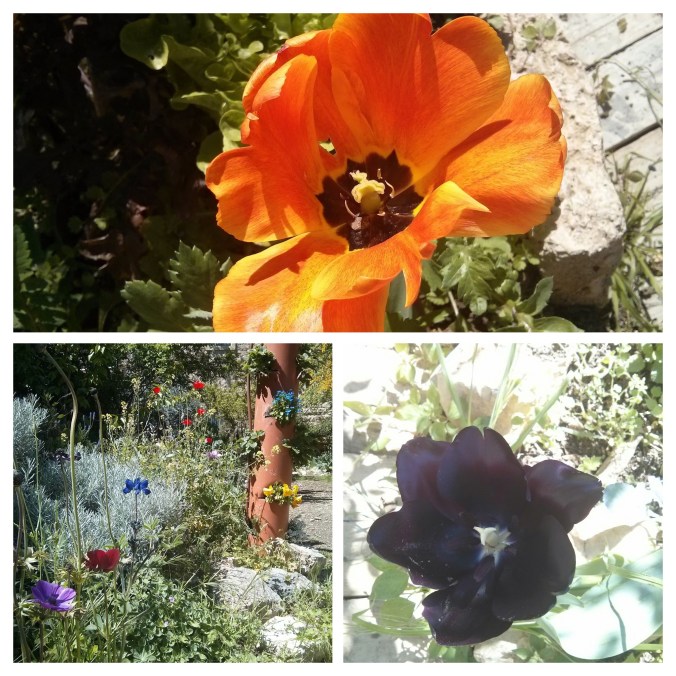
While a lot of really depressing things have happened this week, this Friday post comes to you on April Fools’ Day.  So rather than try to make sense of that paradox, here’s a photo essay of a springtime walk in Jerusalem.

This week as I walked to various appointments I noticed that there was a wonderful aroma in the air and so many flowers were blooming everywhere I looked.   I didn’t take pictures at the time, so this afternoon I retraced my steps and captured some of the beauty of Jerusalem.

Community garden on Zamenhof Street, tended by volunteers from the neighborhood.

IMG_20160401_141040-COLLAGEZamenhof Street and Lincoln Street.  Funny fact:  The pronunciation of Lincoln in Hebrew doesn’t resemble the English very much.  All the letters are pronounced with an extra vowel between the last l and n – Lin-co-lin.

IMG_20160401_141325-COLLAGEOutside the Orthodox Union building.  They take care to bring lots of glorious color to the street.

IMG_20160401_142432-COLLAGENear Jabotinksy Street.  As I took the photos of the window box and the orange blossoms, a group of monks in brown robes tied with rope belts walked by speaking Italian.  Just a typical day in Jerusalem.

IMG_20160401_142714-COLLAGEGan HaShoshanim.  I was nearby, so I decided to take a detour and I’m glad I did.  Another interesting fact:  Gan HaShoshanim means rose garden, but there are no roses growing in this park.

IMG_20160401_143736-COLLAGEArlozorov Street.  Wisteria, lilacs, and many other beautiful things.
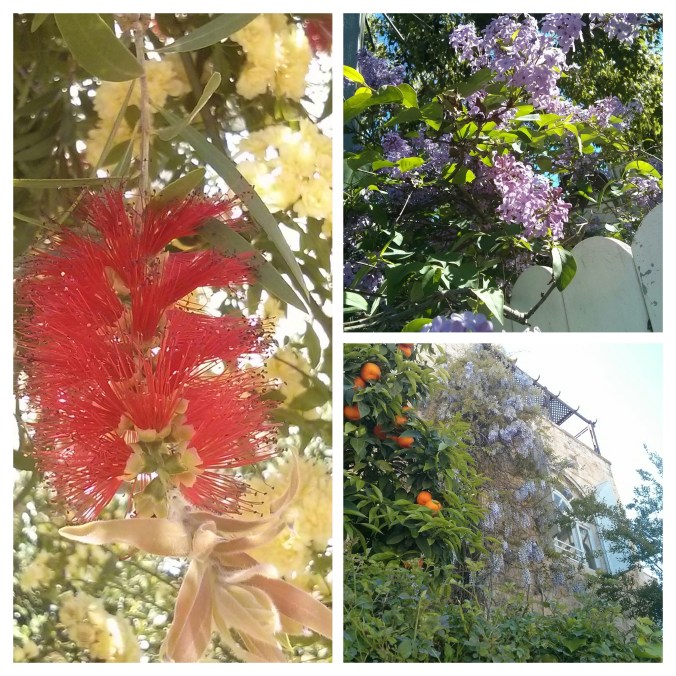
IMG_20160401_150119-COLLAGEAnd finishing my walk with a passion fruit ice cream.  I can happily confirm that it was GOOD!

IMG_20160401_152012

I hope you enjoyed this little springtime stroll.  There’s so much more to Jerusalem than the typical Old City views and while there may not have been actual roses to stop and smell, there is plenty of beauty to stop and admire.

Happy Spring!

Purim in Israel

Today and yesterday were Purim in Israel. The story of the holiday can be found in the Book of Esther.  A young Jewess wins a beauty contest to become queen and is uniquely poised to save the Jews of Persia from the very powerful Haman whose mission is to exterminate the Jews.

The story of Esther might not be your first thought if you are here in Israel on Purim.  Purim is celebrated as a cross between Halloween and April Fools’ Day.  Top items on the to-do list:  Drink A LOT and party like it’s 1999.  Give baskets of sweets to neighbors and friends (the opposite of trick-or-treat).  Pull pranks and laugh a lot.

You could liken this version of Purim with secular Easter celebrations.  Why does a bunny bring eggs in a basket?  Why does he hide them?  Why is the Easter Bunny a he?  What does a bunny have to do with Jesus rising from the dead?  Moreover, why is it that in France, Easter bells deliver eggs from Rome?  Well, I digress.

There are 4 things that you are actually supposed to do on Purim.

  1. Listen to the Book of Esther (in Hebrew, it’s Megillat Esther – you have to listen to the whole megillah)
  2. Have a festive meal where you drink a lot
    • This is where the sages suggested that you drink until you don’t know the difference between Mordechai and Haman
  3. Send gifts of food (in Hebrew, Mishloach Manot) to friends
  4. Give to the poor

You’ll note that dressing up is not mentioned and neither are pranks and jokes.

Purim is not one of those holidays where offices are closed, but workers are given the option of taking one of the two days off.  One of two days, you ask?  Purim in non-walled cities is on the 14th of Adar and Purim in walled cities is on the 15th of Adar (don’t ask, it’s complicated).  Jerusalem is considered a walled city, so we celebrate on the 15th, but since people have families outside of Jerusalem, some of them celebrate on the 14th.  Nowadays, the celebrating goes on for 2 days because it’s less confusing and a lot more fun.

ScreenHunter_01 Mar. 25 23.01

This guy’s video went viral in Israel for his awesome flight through Tel Aviv.

Back in the day, people used to dress up as characters from the Book of Esther.  No longer.  You’ll see superheroes; characters from literature, movies and TV; fantastical characters; clever visual puns; or at a minimum, people wearing funny hats or wigs.  If ever I dress up, I just plop on a tiara and call it done.  I read one article that traced the dressing up to Italian Jews following the traditions of Mardi Gras.  But the retroactively spiritual version, which I like, is that everything is hidden in the Book of Esther.  She wears the mask of a non-Jew to win the beauty contest.  God is not mentioned in the story, but the story is propelled forward by several coincidences that might be considered the invisible hand of God.

If you try to ask for hamantaschen in Israel, people will look at you funny.  The triangular, filled sugar cookie traditionally eaten for Purim is called oznei haman in Israel.  You might notice that Haman is mentioned in both cookie names, but strangely enough taschen and oznei are not the same.  Hamantaschen is the German for Haman’s pockets.  Oznei haman are Haman’s ears.  And then there is the common story that the cookie represents Haman’s hat.  But still, why are we eating anything related to Haman at all?  He’s a villain!  There’s no good answer for that, but the cookies are yummy nonetheless.

purim

There’s a joke about Jewish holidays that goes like this:  Jewish holidays can be summarized as “They tried to kill us.  They failed.  Let’s eat.”  Purim is a great example.  But it is also a reflection of day to day life in Israel and we don’t need any holidays to remember that.  So Happy Purim!  Let’s eat!