Mourning in the Morning – Pt. 2

Cynics who think everything is random chaos and coincidence should stop reading right now.  This post is not for you.

Those of you who are a little bit cynical might think, well, you know, your mind is focusing on certain things right now, so of course you’d be attuned to them and you would see some kind of pattern.

Those of you who are religious might see the hand of God.

And those of you who are spiritual on any level might just see that there is a force bigger than ourselves (call it what you will) that gives us what we need when we need it.

Carl Jung called meaningful coincidences synchronicity.  And unsurprisingly, I recently saw an article on the science of Synchronicity.

In mourning my dad’s death, I feel as if the Universe has set up a safety net that I can fall into and is shining a light down a path that I can take to wrap my head around losing my dad and find a way to move forward.

Before my dad left this world, there were a few cultural icons from my youth who died after short, secret battles with cancer.  I’m specifically thinking of David Bowie and Alan Rickman who died within days of each other.  As I was thinking about their deaths in the following weeks, my dad faced his “terminal” diagnosis.

My dad, David, died on March 1, which is coincidentally St. David’s Day in Wales.

When my brother called to tell me the news, my pants suddenly tore.  One Jewish ritual is to rend garments when mourning – usually the tear is closer to the heart – but since my garments spontaneously rended, they didn’t have a lot of choice and chose a path of least resistance.

The morning after I got the news, I had planned to have oatmeal for breakfast, but I was out, so I had eggs instead.  What I didn’t know until later was that the first meal for mourners is traditionally eggs to symbolize life.  Coincidentally, Mom, on the other side of the world, also bought eggs.

I had already made an appointment with my acupuncturist.  I didn’t cancel it after Dad died because I knew that at that point I needed it more than ever.  I mentioned to her that I was waking up between 4am and 5am.  In Chinese medicine, 3am to 5am is the time the lung meridian is active.  The lung meridian holds grief.

A few days later, I got an email offering a free, 4-part series on yogic breathing exercises.

A few days after Dad died I had a dream that I was robbed.  My house had been ransacked and I felt so violated and angry that it had happened while I was asleep.  I woke with heart palpitations and in a total panic.  When I mentioned the dream to a friend, he said that, in fact, something valuable was suddenly taken from me.  Ah.  Indeed it was. (Thanks to BR.)

The usual emails came in from various lists I subscribe to and they all had something to offer.  Like, a book advertisement for The Mourning After or a book recommendation for Cry, Heart, but Never Break.  An article on the new moon led to a site on mourning.
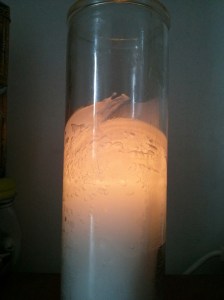
IMG_20160309_165720I mentioned in my earlier post that I didn’t sit shiva in the usual way, but I felt that I should do something similar and meaningful to me.  Luckily, since this is Israel, my local grocery store has a stock of memorial candles, including a special 7-day memorial candle.

As it happened, the candle burned for almost 9 days.  That allowed time for my friend to take me to lunch at a plant nursery and buy new plants for my sadly neglected boxes.  I planted the new plants while the candle still burned, so now when I look at the flowers, I feel that there is bridge between mourning my dad and the inevitable continuation of life after. (Thanks to MR.)


A few days after Dad passed away, Nancy Reagan died and the US consulate next door flew the flag at half mast.  I knew it was for Nancy Reagan, but it felt like it was for Dad too.

IMG_20160324_131728 (1)

Then there was the marathon (see my earlier post).

Once Upon a Time, one of several shows I watch, has taken all their characters down to the Underworld.

Even with all the coincidences, there was one thing I did on purpose.  I listened to a lecture series on Death, Dying and the Afterlife.  I didn’t buy it because I’m morbid or needed the intellectual stimulation.  I had suggested buying it for my dad because I thought it might help him get through his last months or weeks, though it turned out to be only days. As advertised it did celebrate life, after all, and I wondered how Dad would have responded to some of the lectures.  So as I listened and questioned and wondered, I felt that I was listening with Dad.

Little by little, day by day, I’m moving forward.  I am comforted by the synchronicity, the meaningful coincidences, that buoy me as I find my way in the world without my dad.
P1020238

David Brown z”l

Choose LIFE – Jerusalem Marathon!

Dad will be officially remembered by friends and family tomorrow – even though he’ll be remembered by all of us all the time (with blessings to go with the memories).  I wanted to write a bit more about the mourning process – and I will – but not today.

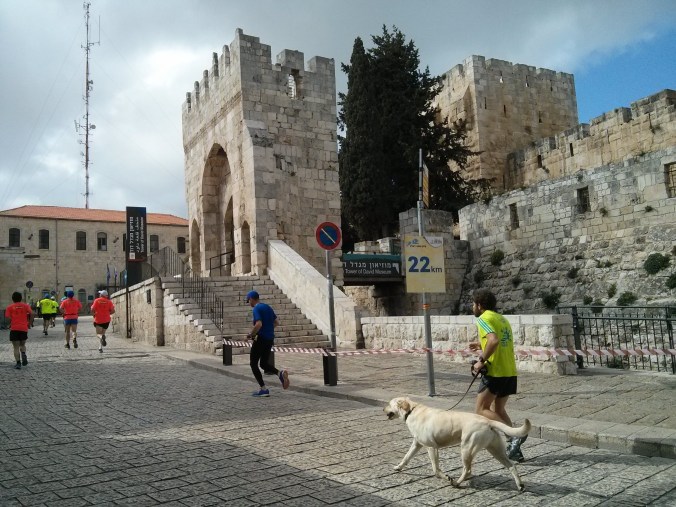
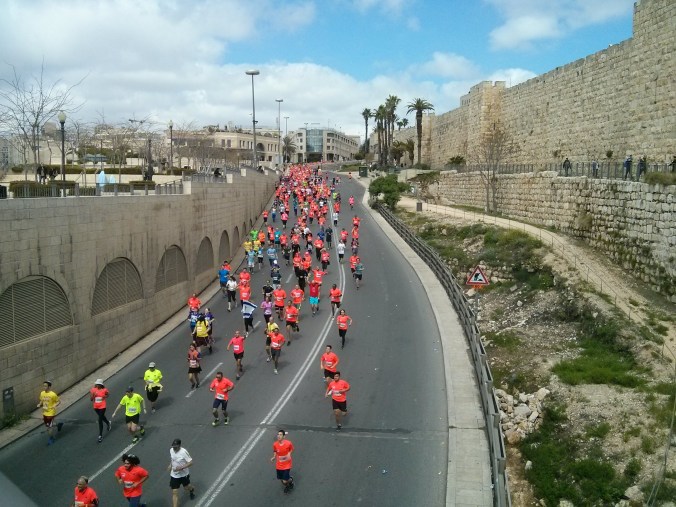
Today is my favorite day of the year in Jerusalem.  Today is the Jerusalem Marathon!  I love the fact that we close down the city to welcome people from around the world to run through the streets with smiles on their faces to celebrate life!  This year 25,000 people ran (2,500 of them from outside of Israel).  Not all ran the marathon; there were 22 km, 10 km, 5 km, and 1.7 km family fun run options.

This year Jerusalem – and all of Israel – has been facing a lot of terrorist violence in the streets, but that did not stop the marathon.  The police and army were out in full force and were a very obvious presence.  There is always significant security, but this year I noticed many, many more visibly armed soldiers, rifles at the ready.

I watched the marathon at Jaffa Gate – yes, that’s right, a number of stabbings took place there in recent weeks, but that wasn’t going to stop me.  There were fewer spectators than previous years, I’ll admit, but I did see many tourists passing by on their way to visit the Old City.

IMG_20160318_090902 (1)

From inside Jaffa Gate

I saw a lot of beautiful things today – in no particular order:

  • Blind runners were linked to guide runners so they could participate
  • Runners ran for causes and happily ran together with friends
  • There were runners in wheelchairs and those who couldn’t go on their own power had friends pushing them
  • Runners ran with their dogs

IMG_20160318_091203

  • Christians ran with flags of support for Israel
  • One man entered Jaffa Gate and took a cross from his friends to run with in the Old City (the cross was made of 1x4s, I think, was about 6 feet tall, and painted black with the phrase “Pick up your cross and follow me” on it.)
  • Other Christians handed out red roses as remembrances of those who died
  • At one point I was surrounded by a group of IDF soldiers who were passing by Jaffa Gate and at the same moment, a group of runners from a particular soldier corps ran by.  I’m not gonna lie – that was a gorgeous sight to behold!
IMG_20160318_103234

My favorite view of the marathon – Batman is cheering on the runners (directly below the Tower of David


IMG_20160318_102847

Approach to Jaffa Gate along the walls       


IMG_20160318_094159

Spiderman on a skateboard – he’s one of the guys cheering on the runners

(Link to my video – a few seconds of the marathon, for atmosphere [I hope it works. It’s my first uploaded video ever!])

Last year, I had a meaningful experience at the marathon.  I had some self-doubt about the direction I was going with my life and just crested the stairs as I arrived at Jaffa Gate, the music overwhelmed me with the lyric “Don’t you worry, don’t you worry, child. Heaven’s got a plan for you.”   Turns out there was a plan.

IMG_20160318_103608

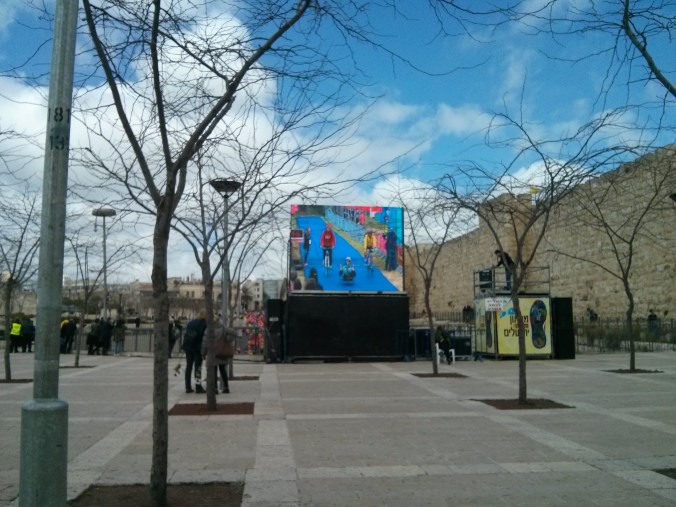
The DJ and the nearly empty plaza (people did pass through, but didn’t hang around here)

I wondered what the music would bring this year.  The DJ was the same after all.  I have to say, I feel bad for the poor guy.  He probably arrived before dawn to set up and then spent the entire morning playing music and calling out “AAAYYY, OOOHHH!!! AAAAY, OOOHHH!!!! BOKER TOV, YERUSHALAYIM!!!!  EIZEH YOFEEEEEEEE!!!!!  KOL HAKAVOD!!!!!”  I’m surprised he doesn’t get laryngitis.

I was waiting for a friend to pass by who was running the 10K.  The DJ played a remix of “Billy Jean” by Michael Jackson and I knew my friend, who is a fan of Michael’s music, would arrive within a few minutes.  And I was right!

The DJ played David Bowie’s “Let’s Dance” – “If you say run, I’ll run with you.”  Since David Bowie recently died of cancer, I felt like it was a moment for my dad – even though he was not a fan.  Another reminder of my dad was seeing the business owners around Jaffa Gate. They just did what they normally do:  drink coffee and smoke cigarettes.  Dad would have been very comfortable indeed with those guys.

I meandered around a bit longer and I thought to myself, “The music was better last year.” I hadn’t even finished the thought, and guess what?  Swedish House Mafia, “Don’t You Worry Child.” And it starts like this:

There was a time
I used to look into my father’s eyes
In a happy home
I was a king, I had a golden throne
Those days are gone
Now the memories on the wall
… And my father said, “Don’t you worry, don’t you worry, child…”

And I smiled (through a few tears, if I’m totally honest).

This week Israel ranked (again) as the 11th happiest country in the world. The study uses several guidelines and benchmarks to support the findings, but I think it only takes coming to Jerusalem on marathon day to see that this is true.  No matter what happens, we choose life.

In the end, this did turn out to be a bit about Dad, but I’d like to think it was more about the ability to celebrate life and be joyful in the moment.

Mourning in the Morning

Mourning in the Morning

Yes.  That’s a play on words. Is it appropriate? Well, in my family it kind of is. We deflect with humor.  That’s not to say that the jokes always work.

At the same time, the statement is also true.  During the day, and even late into the evening, I can distract myself and I don’t have to face the reality that Dad is gone.  But in the morning, in those moments when I’m coming out of a strange dream and I don’t know what’s real and what isn’t, I notice a hollow feeling just under my sternum.  And then I remember that Dad is gone.

Death is easy, mourning is hard

At the risk of sounding too glib, I feel like death is easy, but it’s mourning that’s hard.  We don’t understand death and we don’t know what happens, but it seems like once we’ve wrapped our minds around death, then mourning is swept under the rug.  You know, life goes on and you just have to pull yourself together.  Do what you gotta do and move on.  If you don’t move on, well, there’s something wrong and you should get some professional help.  After the trauma of death, moving on with life should be easy, shouldn’t it?

I don’t know about other religions, but the Jews have an app for that (I know, terrible).  There are a lot of traditions and rituals for all sorts of things, but the general principles of the one for mourning make a lot of sense.  The relationships that call for these mourning rituals are: mother, father, spouse, brother, sister, son, daughter.  Once the burial occurs, the family goes home and “sits shiva” for 7 days (shiva is based on the root for the word 7).  Everything stops for them – no work, no taking part in their normal lives.  The next milestone is the “shloshim” (30 days after the death).  The family goes to the cemetery for the unveiling of the headstone and has a special ceremony.  Every day for 11 months, the mourners say Kaddish (a prayer said when someone dies, which is not about death at all, but praises God).  And then on the anniversary of the death and every year after, the mourner remembers their loved one and lights a candle that lasts 24 hours.  (There are many, many other rituals and traditions, but this is not meant to be a primer on Jewish mourning.)

The basic principle here is that you are able to mourn and take note of every “first” without the person in your life – the first week, the first month, the first birthday, the first holiday, the first year.  I like the principle, but I have to admit the format doesn’t quite work for me.  Living in Israel and being 10 time zones away from my dad created a distance that is also felt in the mourning process.  I didn’t see dad every day.  I didn’t even talk to him every day or even every week.  We just talked whenever.  So the first 7 days was important to allow myself to wrap my brain around the fact that dad is gone, but I didn’t “sit shiva” in the traditional sense.  My firsts will be the first time I want to call dad and tell him about something that happened, the first Father’s Day that I have no one to call, the first time I can’t call Dad on his birthday, the first time Dad doesn’t call me on mine, the first New Year’s.  These will be the days that I feel the loss more acutely.  As for my everyday life, Dad was distant before, and now he’s just a little bit further away – without any cell service.

IMG_20160309_165720

This is a memorial candle that burns for 7 days – more on this in another post.  This picture was taken on Day 5.  I haven’t let the flame go out (even at night).

Jews also have some guidelines for those who visit the mourners.  It’s common sense, for the most part.  Be quiet.  Let the mourner start the conversation.  Listen.  Share memories of the loved one.  So while I didn’t shut down my life for a week and sit shiva in a traditional sense, I had what might be called a virtual shiva.  My friends called and let me talk about Dad and they took the time to listen.   Some shared their thoughts about how they dealt with death of their own fathers.  Facebook allowed my friends from around the world to share their condolences.  My close family in Israel came over and we shared memories about Dad.  The whole process felt much more genuine to me than having a lot of people stopping by.

Thank you to all of you who sent good wishes.
It made me feel truly loved and supported.
Big virtual hugs all around!

My own process of mourning brought into much clearer focus the aftermath of a terror attack – and we’ve had quite a few this week.  When it isn’t our loved one, we look at the political ramifications, figure out how to defend against it so it doesn’t happen again, celebrate the heroism of defenders, share briefly in the sorrow of the mourners.  After the funeral, the press moves on and so do we.  But someone actually died.  That person’s family is grieving.  They are going to go through all the firsts and that hole that was created in their lives will never be filled again.  It will heal, but there will always be a scar.

The blessing of memory

While baruch dayan emet (Blessed is the true judge) and the Kaddish help to ensure that you don’t lose faith when you’re going through such a hard time, yehi zichro baruch (May his memory be a blessing) helps you to heal the scars in your heart.  I find myself smiling at memories of my dad.  I’m happy to hear about the memories of my dad from others.  I’m slowly filling up that hollow feeling in my chest with good feelings and happy memories of my dad.  I don’t expect that the empty feeling will  go away entirely, but the memories will definitely be a blessing.

Death is a door

Nobody likes to talk about death.  There are so many euphemisms for death just so that we don’t have to say it.  Transitional: passed away, passed on, crossed over, went to the great beyond, no longer with us.  Scientific: expired (like milk?), deceased.  Fated: taken, number came up.  Weird: kicked the bucket, bought the farm.  Yesterday, my dad cashed in his chips.

RWS_Tarot_13_Death


It might be a little scary to think of Death coming as a Grim Reaper to gather your soul.  So scary that maybe immortality is better (and so say many, many TV shows and movies, especially vampire ones).


In the Tarot deck, Death seems like it would be the scariest card.  It’s Death!  But it is actually the one with the most potential.  Death means change.  One thing passes on to make room for another.  The loss is sad, but there needs to be room for something new to come into your life.


The truth is that while I like all the euphemisms – mostly because I like to play with language – I don’t think that death has to be feared.  It will happen to all of us.

Here in Israel, there are also many euphemisms for death.  Niftar comes from the root meaning “to be released.”  Halach l’olamo means “went to his world,” which, all things considered, sounds very pleasant.  There is talk of an olam ha’bah, “the next world.”

When my grandmother “went to her world” I was 8 years old and didn’t quite understand why she left her cane.  Hysterical, I shrieked, “How is she going to walk around without it?!?!”  Dad told me that where she was she didn’t need it anymore.  She was young and healthy and having a picnic in the shade of a tree with Grampa Brown, who was also healthy and young.  The tree was by a small stream.  It was a sunny, warm, pleasant day and they were happy.

In order to get to this other world, you have to go through a door.  That door is death.  We don’t really know what is on the other side of the door.  We are asked to have faith that when our souls leave the body they’ve inhabited on this earth, our pure souls, the sparks of light that we are, will go on to something else, something better, something our material minds cannot even begin to comprehend.

Of the things you say to a mourner, my favorite is yehi zichro baruch, sometimes said as zichrono livracha, which means “may his memory be a blessing.”  To me it means that every time you remember the dearly departed, there is a blessing that comes with it.  I like less baruch dayan ha’emet, which means “blessed is the true judge.”  That more or less suggests that God works in mysterious ways and we praise God even in sorrow.

Dad wasn’t an Eric Clapton fan, but “Tears in Heaven” seems appropriate.

Beyond the door
There’s peace I’m sure
And I know there’ll be no more
Tears in Heaven.

Dad, your memory is a blessing to me and all who knew you.  Holding on to those memories keeps you close to my heart.  You’ve gone through the door and I hope whatever is over there is exactly as you described it.  You have been released from this world and the pain of illness, and I’d like to imagine you are with your mom and dad having a great picnic.  When the time comes (far in the future), please be there to greet me and show me around.

DSCF0036

Me and my dad, zichrono livracha

Only in Israel moments?

Another season, another reason, for makin’ whoopee…

In the family values corner, we have a hotel ad playing on the fact that it is a leap year.  In Hebrew, they say a “pregnant year” rather than a leap year, so one hotel in Jerusalem decided that that would be the basis of their promotion.  “Make babies in our resort on February 29 and you’ll celebrate your life events at the hotel, on us.” (For the article and whole video ad see here.)

ScreenHunter_01 Feb. 26 14.28

Wedding crashers?

A couple from the US came to Israel to have their wedding and for various reasons many of their guests couldn’t attend.  Nearby another group was celebrating a bat mitzvah.  The guests of the bat mitzvah saw that the wedding lacked guests and so joined in to bring a little life to the party.  Wedding crashers, you say?  Not in Israel.  When a bride and groom are married, the guests are there to perform the mitzvah of simhat chatan v’kallah, rejoicing with the groom and the bride.  Guests provide the joyful spirit, dance with the bride and groom, give their all to make the couple happy on this very special day.  (For this story, go here.)

Hipsters in Zion

I read a blog post written by a woman who suggested that early Zionist leaders could have been hipsters.  They had pretty awesome beards.  The author went with Herzl for looks.  I don’t know what she was thinking with A.D. Gordon.

ScreenHunter_02 Feb. 26 14.45

But when I first saw the headline, I thought she meant these artist renditions.

ScreenHunter_03 Feb. 26 14.47

Hi-tech history

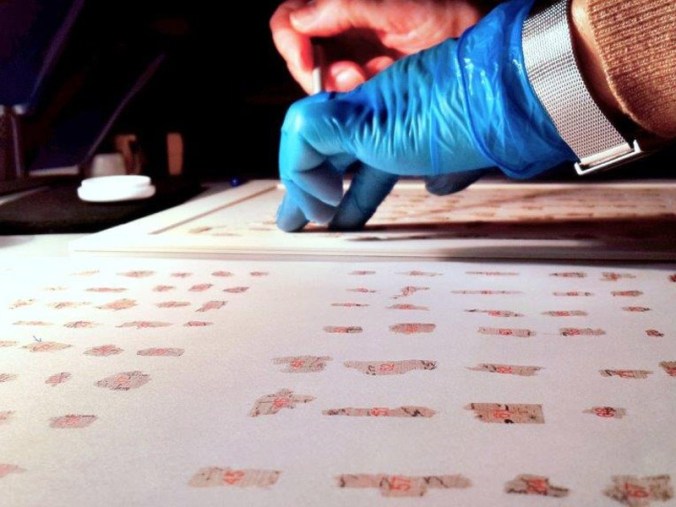
The Dead Sea Scrolls are getting even more digitized.  Just imagine:  Some guy wrote stuff down 2,000 years ago.  Those scrolls were put into pots and kept in caves.  Someone accidentally came across them and – long story, short – they ended up in a museum.  Scholars study them.  People visit them.  They were digitized and visible online to anyone with an internet connection.  This new project is upping the digital ante by making a whole new virtual environment to work in to decipher mysterious elements of the scrolls.

deadseascrolls1

Copyright: Shai Halevi – Source.

And what do you do on school field trips?

Oh, you know, find 3,400-year-old artifacts.  How about you?

Surprisingly, some of the biggest and most important finds in Israel were found by children on school trips or hiking on their own.  The nice part of the story is that the child and his family turned it in to the Israel Antiquities Authority.  He got a certificate for good citizenship and IAA officials visited his school.  Will it inspire him enough to become an archaeologist some day?  I hope so!

kid

Copyright: Clara Amit – Source.

And that was another side of Israel for this week.

Danger in Israel

It’s not terror.  There have been more deaths in Israel due to traffic accidents than terror.  I had a friend who kept track of these things (I trust him because he is a science person) and he found that even in the worst days of the Second Intifada, there were still more people killed in traffic accidents than due to terror attacks.

This week a full bus collided with a truck stopped on the side of the road on Highway 1 in Israel.  Six people died, three of them were under 18.  It’s especially horrible because the driver of the bus had already had an accident similar to this one on the same road and was suspended from driving between cities for two years.

Israel is still safer than other places in our part of the world.  (For statistics and another opinion, see this article.)  I remember being in Sinai and our driver was driving on the wrong side of the road.  When asked why, he said that this part of the road was smoother, so there was no reason for him to do damage to his car if the road was simply better on the other side.  You could see miles ahead, but it was still a bit disconcerting because he drove like he was being chased.

In Egypt, a taxi driver was taking us to the airport in the wee hours of the morning.  He didn’t have his headlights on, so we mentioned that he might want to turn them on.  He said that having them off saved gas.  (If anyone can tell me that this is true, please comment.)  Besides, there were streetlamps on the highway, so nothing to worry about.

Here in Israel, there is a different driving culture than most Americans are used to – and thankfully it’s not quite like Sinai or Egypt.  Streets are noisy.  The horn is a method of communication with your fellow drivers.  It might say, “Hey! I’m right here (in case you are not using your mirrors).”  Perhaps, “Woohoo!  I’m going through the intersection.”  Taxi drivers often use it to say, “Hey! Wanna taxi?”  It is also used aggressively, “Go!!! The light changed .3 milliseconds ago!!!”  Or “what the hell is the matter with you?!?! Why are you making a 3-point turn in the middle of the road and blocking both directions of traffic?!?!”  This last one is more common than you might think.

A video of driving on the highway in Israel.  It’s not that bad.  Really!

My Israeli driving test

When I converted my US license to an Israeli license, I was required to take at least one lesson, but I didn’t have to take the written part of the test.  In those days, English-speakers told many horror stories of awful driving tests and almost no one passed on their first try.  Additionally, in Israel you can get an “automatic only” license or “manual transmission” license that allows you to drive both standards and automatics.  I went for the manual since I knew how to drive one.  But I was worried.

You take the test in the instructor’s car, which is why it’s good to have at least one lesson so that you can get used to the car.  I arrived at the testing facility and was going to be tested with another student in the car.  The person giving the test didn’t speak a lot of English, but we decided it would be fine.  I carefully pulled out of the parking lot, taking my time and generally being over-cautious.  We get on the road and the tester says “Left!”  I was in the outside lane so I changed lanes to the inside lane.  He started yelling, “Left! Left!” and then tried to grab the steering wheel.  I used a Karate Kid wax off motion to block and shouted back “Ok.  I got it!”  He meant the left turn lane.  So I made the turn.  “Pull over.  Stop the car.”  End of test.

I was sure I had failed.  It was Friday and I wouldn’t get results until the next week, so I spent the weekend wondering how many more lessons I would need, how much it would cost, hoping that I wouldn’t fail too many times and have to take the written portion in Hebrew.  The results came out and I passed.  I guess it was because in the chaos I still had control of the car.  I didn’t question it and I won’t now.  As far as I’m concerned it’s just another miracle of the many that take place in Israel.

And if you decide to visit Israel, don’t worry about terrorism, just be sure to look both ways before crossing the street.

A simmering pot

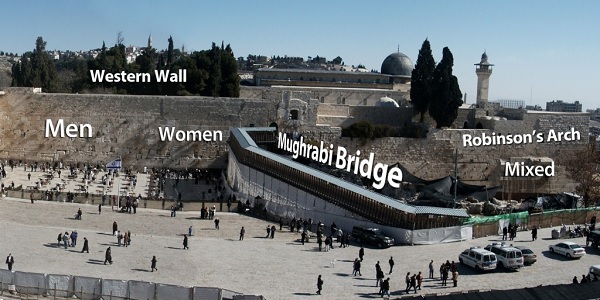
Last week Israel’s cabinet agreed to have a mixed gender prayer area near the Western Wall plaza that would be administered by Israel’s government not the (ultra-Orthodox) foundation that administers the Western Wall .

Yay for plurality! Hoorah for equality!

This is widely seen by the Jewish community outside of Israel and many inside Israel as a good thing because it feels more inclusive and is more open to the non-Orthodox communities who don’t feel connected to the Orthodox vibe of the Western Wall open air plaza. Now they have their own place. It’s close to the plaza, but at the same time they are not in each other’s faces about how they choose to commune with God.

But hang on…

First of all, this space has existed for quite a while. It’s not new. What is new is the entity that would administer it and the fact that it would be expanded. Until now, it was just a tacitly agreed upon space for Reform, Conservative, and various other streams of Judaism to gather and pray as they wish (mostly by not separating the genders).

Women of the Wall have been advocating for plurality and equality and part of the organization agreed to the mixed-gender space. The members who don’t agree feel that they should be allowed to pray in the women’s section as they wish – they don’t really want a mixed gender space. The problem they’ve been facing is that the Orthodox do not agree that a woman can be allowed to put on tefillin, wear a prayer shawl, or read from the Torah. They have fought this battle in court (and won), but have been harassed by both men and women at the wall and arrested for disturbing the peace for gathering at the Western Wall to pray.

Then there are the archaeologists who say that the new construction would damage the archaeological evidence that exists there – specifically, evidence of stones from the wall that fell during the Roman conquest.

Like any other decision, it’s complicated and there are naturally positives and negatives. Decisions get made with compromise and everyone has to give a little.

But there’s more. And this is why this article is called “the simmering pot.”

The violence (aka the knife intifada) that began last year is based on a perception that Israel is trying to change the status quo on the Temple Mount. In October 2015, UNESCO voted on a draft proposal that tried to declare the “Western Wall an ‘integral part’ of the Al Aqsa mosque compound.” That was eventually dropped, but in November Mahmoud Abbas insisted that Israel was trying to change the status quo on the Temple Mount by protecting “settlers” who were “violating” Muslim and Christian holy sites. (The “violation” being prayer. Jews are not allowed to pray on the Temple Mount and are arrested by Israeli police for doing so.) And now, with the vote on the mixed gender prayer site, the Waqf (the Jordanian authority administering the Al Haram al Sharif [Temple Mount]) has declared this vote Israel’s newest intention to change the status quo by “Judaicizing the holy site.” The “holy site” in this case being the Western Wall.

Let’s look back to September 2000. Ariel Sharon visited the Temple Mount to show that all Israelis have a right to visit the site. And then we had the Second Intifada. (Yes, that is a wild oversimplification.)

A vote for a mixed gender prayer site seems like a small thing. But this is Israel. The Western Wall supports the Temple Mount compound where the Al Aqsa Mosque and the Dome of the Rock stand. Context and interpretation are everything. And so the pot simmers on.

Tu B’Shvat Aliyah

In Hebrew aliyah translates literally as “ascend.”  It’s also the word used for immigrating to Israel.  For reasons unknown to me, the English is styled as “to make aliyah.”  I made aliyah (or I ascended) to Israel on February 8, 2002.  It wasn’t exactly Tu B’Shvat, but that year it had been the week before.

I was met at the airport by my aunt, my mother’s sister, who not only immigrated to Israel first and raised her children here, but also was in charge of bringing many more Jews to Israel in her various roles in the Jewish agency.  She took me to her house first where I showered and slept for a while.  It was a night flight and I was totally exhausted.

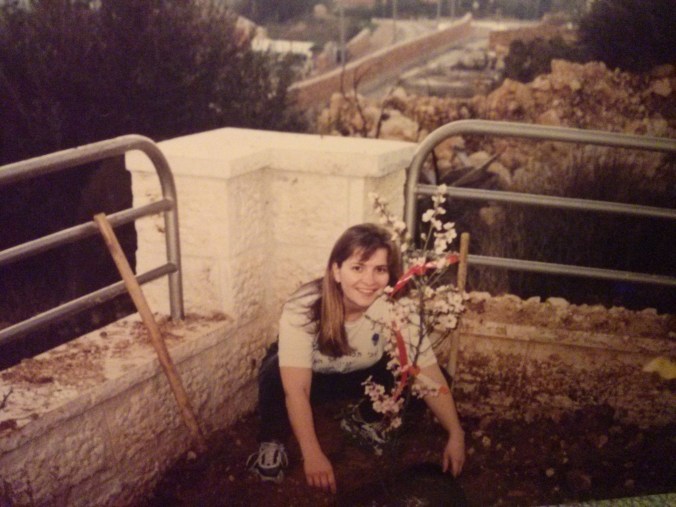
Later in the afternoon, my cousin arrived and we were all just sitting and catching up.  But then my aunt made an announcement:  We have to plant an almond tree before the sun sets.

My cousin and I set to digging and planted the tree.

IMG_20160204_231013

What do you do on your first day in Israel?  If it’s Tu B’Shvat and your name is Ilana, you plant a tree, of course!

Roots

And then something happened and that poor little tree died.  Well, you know, sometimes trees have a little difficulty adjusting to a new place.  The gardener said that was that and whattayagonnado?  So they cut it down.

And then something odd (miraculous?) happened.  It grew back.  Apparently, the roots had survived and it just rejuvenated itself from its own root system.

Birthday for the Trees

In last week’s post, I mentioned that Tu B’Shvat is the New Year for the Trees and that in Hebrew the holiday is called Chag L’Ilanot (Ilan is a tree; Ilana is the feminine version).  I make a special point of Tu B’Shvat because in 2002, it represented a new beginning for me – a new year for this Ilana.  Every year a new chapter unfolds in late January/early February; I’ve gained a year in Israel and I have a clean slate for the next year.

Even though my birthday is around the Jewish New Year and I like the feeling of January 1 as a definitive calendar page turn, I like Tu B’Shvat because I chose this new year and by the circumstance of my name, it chose me.

Epilogue

I don’t know if the tree in my aunt’s garden is still the rejuvenated one or if it was replaced.  But it actually doesn’t matter.  There is an almond tree in that corner of the garden.  Whether it is the one I planted with my own hands, the one that rejuvenated itself from its own roots, or a new tree altogether, the end result is that every version of that almond tree belongs in that place.

The snow that wasn’t, the freeze that was, and the trees


Snow in Jerusalem! Or not. 

This week Israel had a huge storm and it was very cold.  Everyone was hoping for snow and the forecast was for 5 to 6 inches of snow sticking in Jerusalem.  Israelis tend to get very excited about the idea of snow in Jerusalem.  It’s rare and even the most hard-boiled, cynical sort might smile a little at the thought of white stuff all over the city.

IMG_20160126_121028

The snowstorm that wasn’t

Then it rained.  A lot.  The forecast changed to maybe 2 to 3 inches.  And then the storm passed.  Altogether the “snow storm” part of the storm was about 30 minutes one evening.  And nothing stuck to the ground.  (Other parts of Israel that are at higher elevations did get a bit of snow.)

The day after the storm was supposed to be clear and sunny.  So all’s well that ends well, right?  Not so fast.

A word about Israeli plumbing

A lot of people have solar heaters for their water tanks so their boilers are on the roof.  For some reason (I don’t really know the whole history), water pipes are on the outside of buildings going up and down from the water tanks on the roof.  There is a chance of freezing, but it rarely gets cold enough in Jerusalem for that to happen. Until it does.

My water heater is not a solar heater with pipes leading up and down from it.  My pipes have not frozen in snow storms or in cold snaps.  Until they did.  It was a very cold morning after the storm passed and I turned on my shower to find nothing coming out of the tap.  I turned on the hot water and I had plenty of boiling hot water – too hot to bathe in.  What?!?!

It seems that the water from the main source froze in the pipes.  My neighbors, with their solar heater, had no water at all in the morning.  The neighborhood had a few pipes burst, so there was water running in the street.  The city had to turn off all the water to fix the municipal pipes, so I had no water at all for a couple of hours.  Finally, the water came back on in the afternoon.

Needless to say, I dripped the faucet last night because while it is gorgeous and sunny, it’s still dipping down around freezing at night.  Good news!  The water was running this morning!

Tu B’Shvat

Tu B’Shvat is a minor Jewish holiday that happened last week.  I hesitate to say “was celebrated” because the main thing to do on this day is plant trees and it was way too stormy for that.

Tu represents the Hebrew letters that add up to 15 and Shvat is the name of a Hebrew month.  It has ancient connections to taxing and tithing.  Anything before Tu B’Shvat is from the year before.  Anything after is considered in the new year.

Traditionally, Israelis eat a lot of dried fruit for Tu B’Shvat – dates, figs, apricots, pineapples, kiwis, and a lot of other stuff I don’t even recognize or know the names of.  Some take a more mystical/spiritual approach to Tu B’Shvat and have special dinners with symbolic foods.  Everyone in Israel knows when Tu B’Shvat takes place because all the almond trees in the country are in bloom.  It’s truly amazing to see hillsides filled with beautiful pink blossoms at the end of January.

tu-bshavt-21

It’s also generally known as the “new year for trees” or the holiday of trees.  In Hebrew that’s Chag L’Ilanot.  So to all the other Ilanas, Ilans, and any actual trees out there, Happy New Year!  Take a day off.  You deserve it!

The Silent Treatment

When I read The Great Brain as a kid, I remember being surprised by the punishment that the parents gave to their kids.  This was late 1800s Utah and spanking was perfectly normal.  Not for these kids.  These parents gave “the silent treatment” for a specified length of time. The author described it as the worst of all possible punishments.  At least with a spanking, it was over and done with.  The silent treatment made the kids feel invisible.  Oftentimes, the kids would cry with relief when the silent treatment was over because they felt like they were returned to the land of the living.

ScreenHunter_03 Jan. 23 19.46

This week Israel’s newspapers were filled with the news of a woman who was stabbed to death in her home, in front of at least one of her six children (four were her natural children and two were adopted).  She was a nurse who was learning Arabic to better communicate with her colleagues and patients.  By all accounts she was an amazing person.

And then I saw a surprising headline that asked why Dafna Meir’s murder was not reported in the international media.  We all know that “if it bleeds, it leads.”  There was plenty of blood.  We saw the pictures.  Check.  The victim is sympathetic – a mother, a wife, a nurse. Check.  It was a pretty dramatic story.  She was stabbed in front of one of her children and the manhunt went on for quite a while.  Check.

I went to Google and typed in her name and went to the news tab.  Page after page of Israeli newspapers or Jewish newspapers around the world reported the story.  But no major international news organization was reporting it.  I found one small German paper that reported it in full, but I couldn’t determine if it was a Jewish paper or not.  But it was true.  The international media ignored her.

Dafna Meir lived in Otniel, which is a small town in Judea and Samaria (you could read that also as a “settlement in the West Bank”).  She was a religious Jew.  The 15-year-old Palestinian that stabbed her was on the run (meaning that no Palestinian was injured in this attack).  So if you believe that the simplest explanation is the most likely, then we are faced with an anti-Semitic media ignoring any news that doesn’t fit into their narrative and agenda.  (Here is a very good article about this.)

The next day – while Dafna’s murderer was still at large and her funeral was taking place – a pregnant woman was stabbed by a Palestinian in her store in Tekoa (another small town in Judea and Samaria / another settlement in the West Bank).  She was not killed and the Palestinian was arrested.  Now the international media paid attention.  The attack in Tekoa and that other thing that happened the day before “represent a shift in the recent surge of violence.

The Meir family has publicly stated that they harbor no hatred against Palestinians. A Palestinian friend, who is apparently a relative of the murderer, paid a condolence call and was welcomed by the family.  Unfortunately, this bit of the story does not play into the “cycle of violence” narrative that the New York Times has put together to explain why murder in the settlements is understandable.

Conspiracy of Silence

While the simplest answer may often be the right one, some things still bother me.  How does every single editor of every major news outlet in the world decide that this story – a mother murdered in her home in front of her child – get ignored?  Can it really be that every single major international news organization blindly accepts that a woman murdered in her home is just the price she paid for living in that neighborhood and moreover that she should be ignored because she doesn’t fit the narrative that has been dictated by a certain political agenda embraced by the paper?  Did every single international journalist really shelve their humanity to serve a political agenda?

Many journalists claim to try to bring justice to underprivileged and underrepresented people.  They claim to want to shed light on the truth.  They are presented as “brave” and “unrelenting” in their pursuit of the story.  Today, I am reminded of the bitter and all too accurate pun:

If vegetarians eat vegetables, then what do humanitarians eat?

The international media’s deafening conspiracy of silence is the worst kind of punishment they can deliver.  With their silence, they ensure that Dafna Meir doesn’t exist and that their fixed narrative is unshaken.

I hope that all of us together can demand more from journalists.  Or perhaps call out the lazy and hypocritical ones.  We may even eventually find the invisible hand directing the narrative, the one that ensures that no one thinks for themselves or asks questions.

But for now, as a start, I will not be silent.

Lorax