History in the making

What I learned from my Facebook experiment last week is that I have to have a good first sentence hook and an interesting first picture.  Alternatively, I should start my post in the middle or the end.  That said, here’s the end: We have to keep telling our stories because our lives, even at this moment, are history in the making.
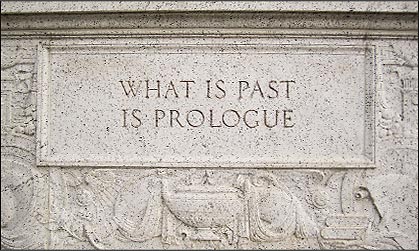
National Archives and a great quote from Shakespeare

National Archives and a great quote from Shakespeare

History in the making

This week marked the 20th anniversary of Yitzhak Rabin’s assassination.  Bill came.  Yes, Bill “Shalom, Haver” (goodbye/peace, friend) Clinton.  He spoke at a memorial rally in Rabin Square (renamed to honor Rabin after his assassination there).  The week was filled with what-ifs:  What if Rabin had lived? What if Oslo had really worked? What if, what if, what if.

I’m a little cynical about what ifs.  The truth is that no one knows what would have happened if events unfolded a different way.  As an idealist, I understand the desire to spin what-ifs and wouldn’t-it-have-been-great-ifs.  But as a historian, I believe it is more important to analyze the past and learn lessons from it.  Otherwise, you end up in a spiral of history, revisiting in different ways the events of the past, and repeating them over and over.

This is not to say that I’ve analyzed the past and have come up with a solution to the Israel-Palestine conflict, but I’m pretty sure that if we keep doing what we’ve been doing, we’ll continue to get the same results.  (A similar quote was attributed to Einstein, but apparently he didn’t say it.  “The definition of insanity is doing the same thing over and over and expecting a different result.”)

Viva la Revolution!

I’ve been thinking about history as a spiral because of the events in Romania this week.  Since I was there in September and I asked a lot of questions about the revolution in 1989, I was stunned to hear the news that the government stepped down this week after protests over a nightclub fire.  The fire was representative of the corruption of government agencies and the disregard the government has for its citizens.  I also spoke to a friend in Timisoara about it – not that I have a deep understanding about it now, but at least I feel a little more informed.

Here’s a video of the protest this week in the same square that the 1989 revolution took place in (and the square that I passed through every day I was in Timisoara).  My friend tells me that some of the chants and songs in the video were part of the revolution in 1989.  Here’s a LINK.

Telling the stories

I’m a historian by training, but the part of that word that is important to me is “story.”  Not just a collection of facts in a particular order, but an understanding of the events of the past that speak to us as human beings.

A few weeks ago, I saw a German film called “Labyrinth of Lies” about the guy who brought German citizens to trial in Germany for war crimes at Auschwitz.  This is not a Holocaust movie.  It is a story about having the strength, even when you barely have the will to go on, to tell the truth about the capacity of humans to be inhuman to each other. Here’s the trailer.

A documentary that caught my eye was “Winter on Fire: Ukraine’s Fight for Freedom.”  Evgeny Afineevsky, the director, was in the middle of the uprising in Kiev and documented it.  When he spoke about it in the interview I saw, he said something that stayed with me: “The history is happening.”  Here’s a trailer.  And an interview with the director.

History is now

Film today is yesterday’s book.  History is remembered when it touches our souls.  And hopefully, we can learn from it and do things differently.

I remember the events of 1989.  I remember Rabin’s assassination.  These are events that took place in my lifetime that are now history.  We have to keep telling our stories because our lives, even at this moment, are history in the making.
Into Each Life Some Rain Must Fall

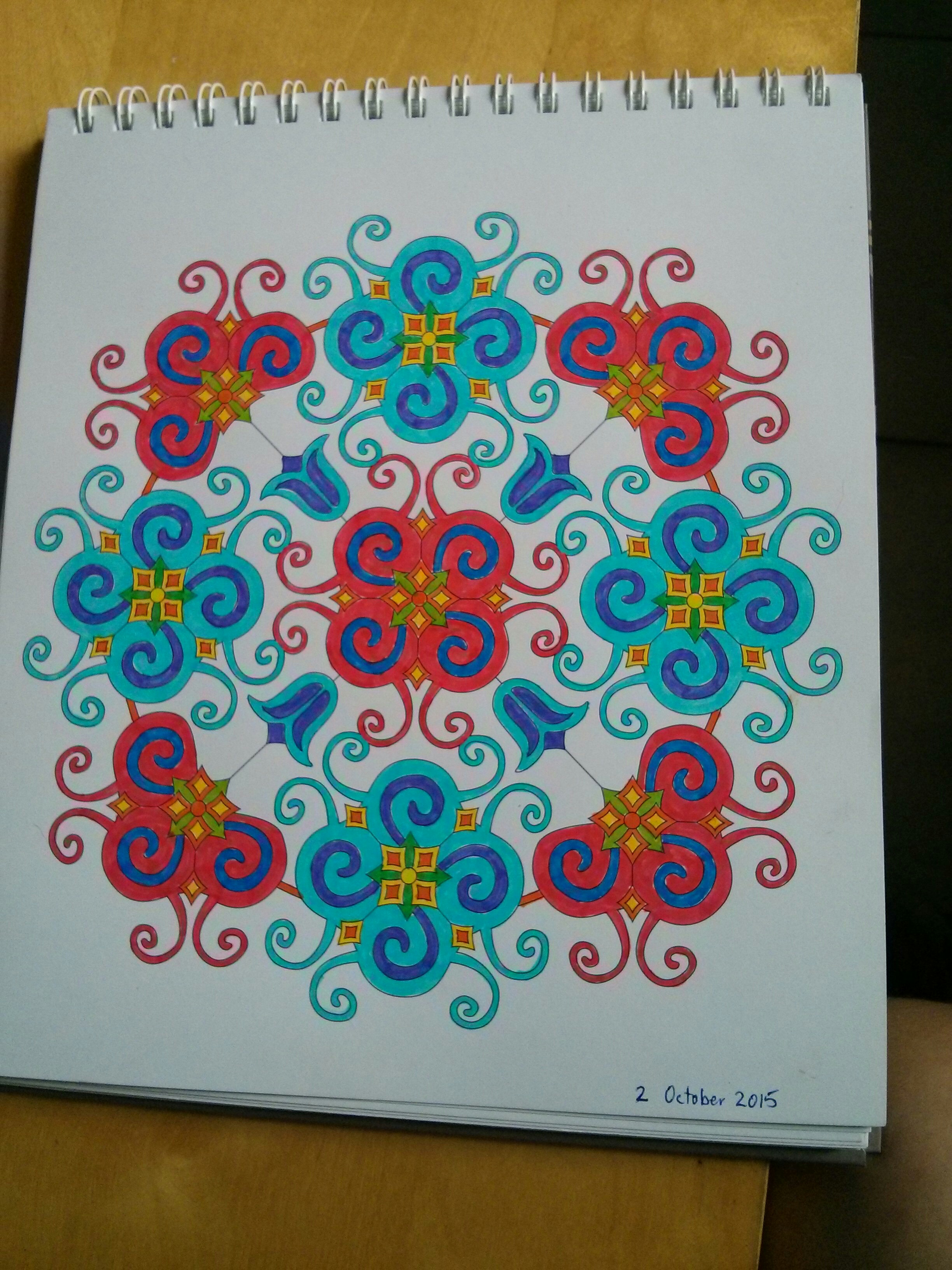
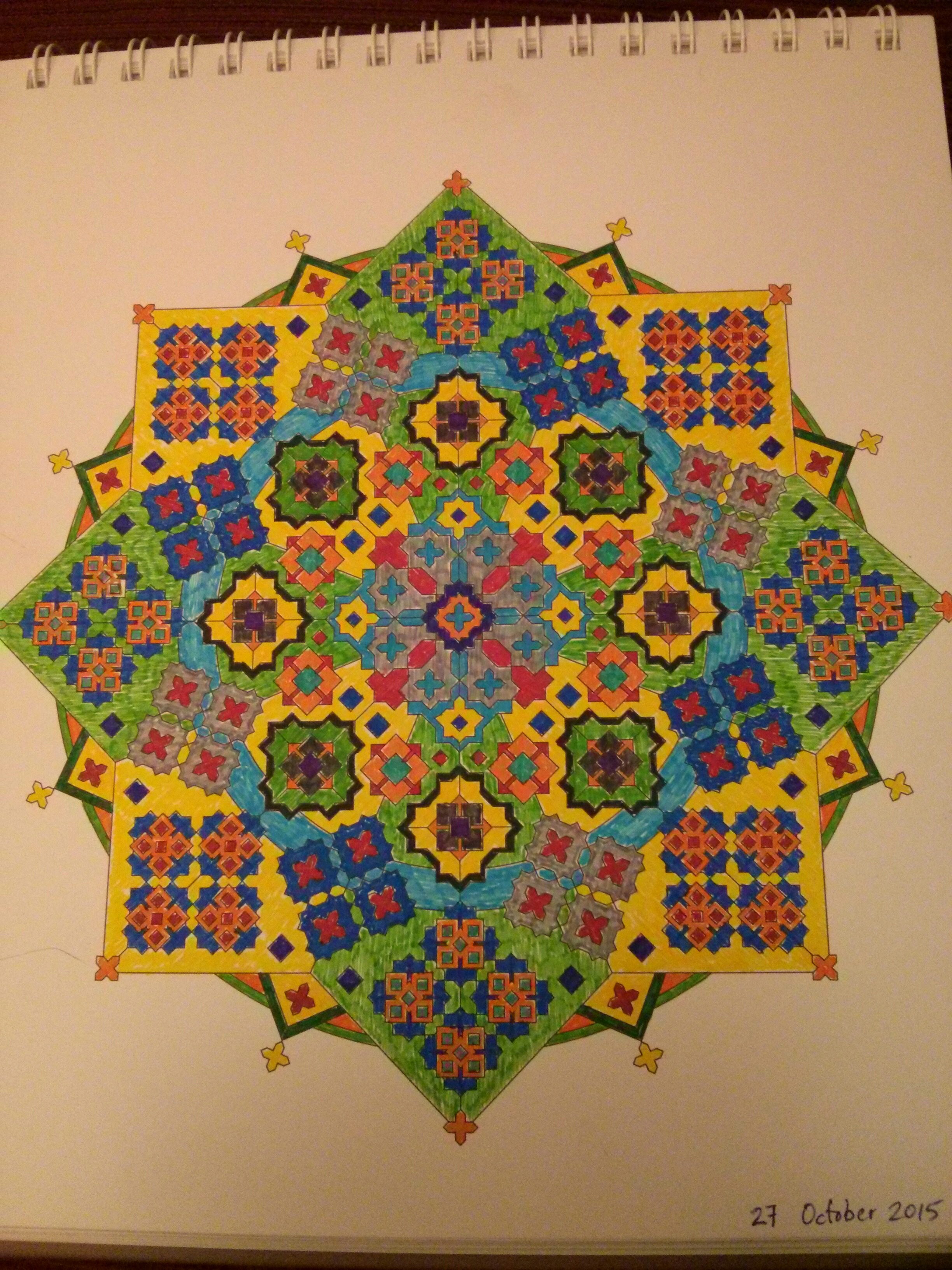
Here are the mandalas from this week.  This is also an experiment to see which pictures Facebook will post as links to the blog post.

Mandalas of the week (and experiments for the Facebook post)

Mandalas of the week (and experiments for the Facebook post)

IMG_20151029_180649

Rain

Here in Jerusalem it rained.  I went out with an umbrella a few times and it was just an average October for me.  After sunny and hot for months, I was pretty happy about the rain.

Rainy day and a pot of jasmine green tea

Rainy day and a pot of jasmine green tea

Down in the valley it was apparently apocalyptic.  Record setting rainfall.  Floods.  Power outages.  Some wanted to declare a state of emergency.  Keep in mind this is about 60 km (40 miles) away from Jerusalem, but 800 (2,600) meters difference in elevation.  For pictures and video.

Morgan Freeman in the House!

In awesome news this week, Morgan Freeman came to Jerusalem to film his documentary “The Story of God.”  But he didn’t just come to Jerusalem.  In these really tense times, he went to the Old City and filmed at the Western Wall and at the Church of the Holy Sepulchre.  Of course he had body guards, but as a celebrity, he would have had guards anyway.  He didn’t make a statement about the situation, but his actions said that he wasn’t going to stop filming because of the tense situation.  That’s good enough for me.  (The documentary is due out in April 2016.)

Screen shot from the Times of Israel

Screen shot from the Times of Israel

A Word of Hebrew

The word “matsav” means situation.  It can be used as an informal greeting, “ma hamatsav?” (what’s going on?) – though it usually sounds like “ma matsav?”  It can also be literal as “ma hamatsav po?” (what is the situation here?) when you are asking for an evaluation of a situation.

Matsav is also a kind of euphemistic term Israelis use when referring to everything going on in Israel at any given time.  Even English speakers will throw it in an English sentence because it’s so heavy with additional nuance.  “The matsav is just terrible.”  “What is the government doing about the matsav?”

A Few Words about the Matsav

Prime Minister Netanyahu gave a press conference last Saturday and stated four main points:

  1.  Israel respects Jordan’s special role as custodian of the site (via the Waqf).
  2.  The historical status quo will be maintained, that is, Muslims pray there, non-Muslims visit.
  3.  Israel has no interest in dividing the site and rejects any attempts to do so.
  4.  Israel welcomes increased coordination between Israel and Jordan to ensure restraint and respect on the site.

The takeaway is that it is not Israel’s policy to change the status quo on the Temple Mount.  There are Israelis who are actively campaigning for the right to pray there, but that does not make it Israel’s policy.  In fact, there is disagreement among the Jewish community itself about praying on the Temple Mount – for religious reasons, not political ones.

The other takeaway from these points is that the Temple Mount is administered by Jordan via the Waqf.  The Palestinian Authority is not involved and never was, even before 1967.  Israel does not administer the site, but is in charge of the security.  It’s complicated and messy.  So when Jews try to pray near the Al Aqsa Mosque, they are arrested by Israeli police.

Netanyahu also said that he would welcome CCTV on the Temple Mount (Jordan’s idea) to be able to respond to incitement from either side and possibly prevent violence before it happens. Full article.

Who is against the idea of CCTV on the Temple Mount?  Palestinian leadership and the Jewish activists who want to pray on the Temple Mount.

Why does it matter?

Sheik Muhammad Ahmad Hussein, the Grand Mufti of Jerusalem and the guy in charge of Al Aqsa, got on Israeli TV news this week and announced that there has never been any Jewish Temple on the site – not 3,000 years ago, not 30,000 years ago.  Al Aqsa Mosque has been on the site since the beginning of time.  It was apparently built by angels in the time of Adam.

Huh?

Let’s say for a minute that he means it spiritually; Al Aqsa has been there spiritually since time immemorial.  But he rejects any evidence that there has ever been a Jewish presence there.  Biblical references.  Rejected.  Archeological evidence.  Rejected.  Historical documentary evidence.  Rejected. What he actually means is that the Jewish people were never here and have no connection to the land and thus, Israel has no right to exist in this space for any reason.

Is the current wave of stabbings because of Temple Mount?  Not really. (Palestinian leaders have said so.)  Is the Temple Mount important in the big picture?  Absolutely.

And that’s the matsav from here.

Let’s all have a Shabbat shalom and a great rainy weekend!

And for everyone who’s celebrating, Happy Halloween!

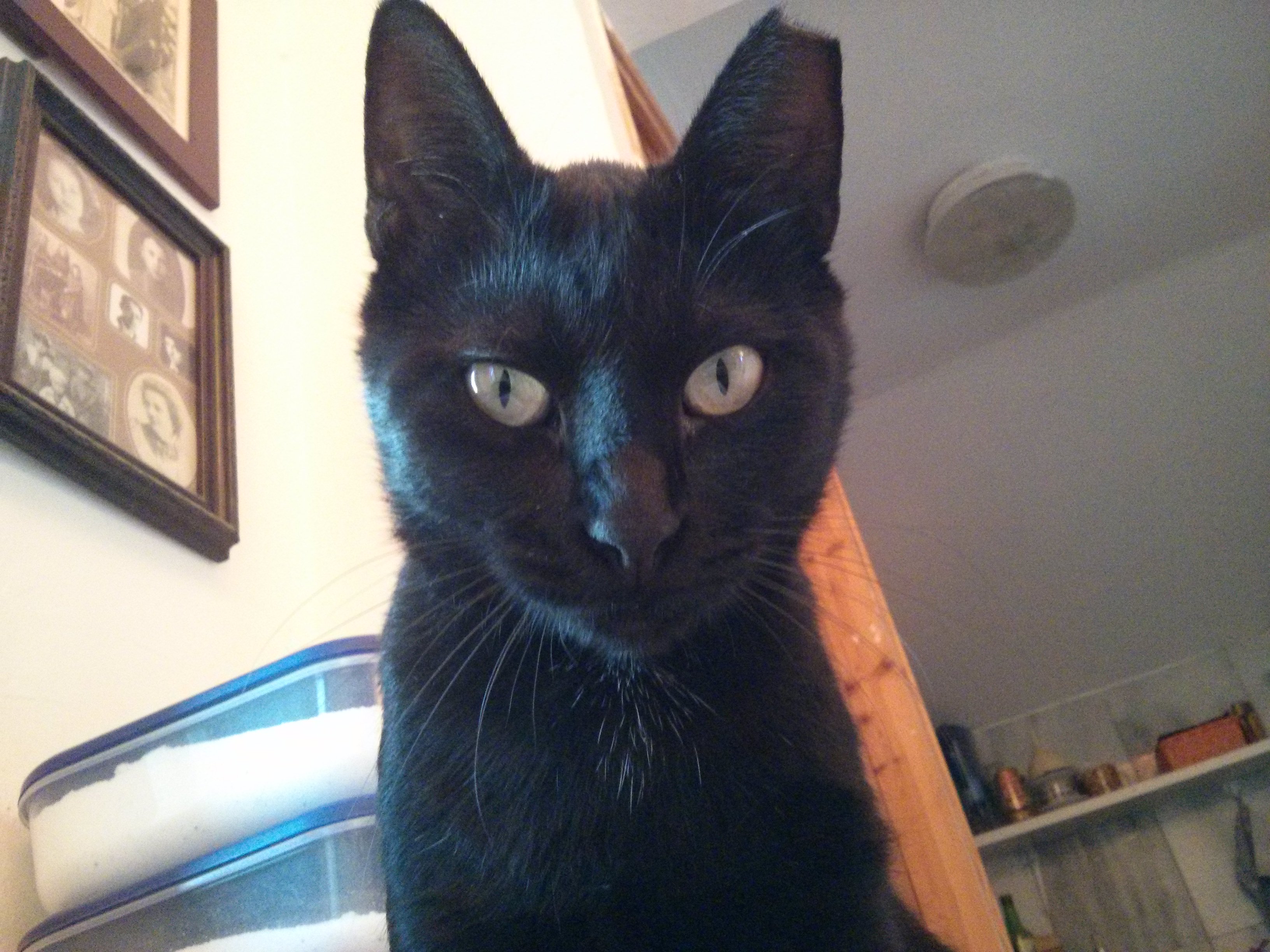
Happy Halloween from the Dark Knight!

Happy Halloween from the Dark Knight!

And now for something completely different

I don’t want to talk about the situation in Israel.  It’s not that I’m ignoring it or pretending that it’s not going on all around me, but I feel like constant attention to the news and repeatedly thinking about the events of the day is just causing a form of Post-Traumatic Stress Disorder.  The problem for Israel is that it is a collective PTSD causing itchy trigger fingers and shameful mob mania.

Instead, this is going to be about how I dealt with the stress this week.

Mandalas

I had seen mandala coloring pages and books in art stores for a while, but I wasn’t inspired enough to give it a try.  Then my friend M. invited me to a morning meditation with mandalas.  I have to admit I’m not a good meditator.  I’ve had good experiences once in a while, but I mostly suffer from what is commonly called “monkey brain.”  Thoughts pass into my mind, start making coffee and then go into an acrobatic routine.

A few minutes of research on the net and I found that adult coloring is a thing.  Mandalas are also a thing.  Coloring mandalas is a growing thing.  It’s not about staying in the lines or purposefully coloring outside the lines.  It’s not about how beautiful or artistic the mandala should be / could be / would be if you had more talent. It’s about focus, being in the moment, and just enjoying the now.

So now I have my own book and various coloring implements so that I have options.

IMG_20151023_123310     IMG_20151023_123324

IMG_20151023_123336     IMG_20151023_123344

Work in progress

Work in progress

Turning back the clock

IMG_20151021_112235

The stuff on the left is what I actually bought. The stuff on the right is all the samples!

Three words:  Korean. Beauty. Products. My friend C. introduced me first to Korean dramas and now she’s brought me into the fascinating and ultimately pleasurable world of Korean beauty products.  Rather than write a treatise on the various essences, serums, toners, cleansers, and masks, suffice it to say, it seems that in the past month and a half of making a bigger effort, 5 years have disappeared from my face.

My first foray into the beauty products line was in Romania, so I’ve been using things I bought there.  This week, my first package from Korea arrived!  Yay!

Ladies night – out on the town

In honor of my birthday (a month ago), S. and C. took me out on the town last night.  (That’s right. In the middle of the knife intifada.)  We went to place called Gatsby.  It’s set up like a speak-easy, so upon entering, you are in a tiny room facing a wall-to-wall bookshelf.  With the right code words – something along the lines of “my friend is inside” or “I have a reservation” – the middle panel slides over and you get your first peek at the 1920s style bar.

Gatsby entrance

Gatsby entrance

They play the feel-good crooner oldies of the 1920s, 1930s, and 1940s.  The handsome barman is dressed like he just jumped out of a 1940s movie and has enough flair to make drinks that involve fire.  The food menu is limited and the drink menu seems to be limited to whatever Gatsby might drink.  I had a mint julep served in an iced metal cup.  S. had something called Made in Israel (would Gatsby drink that?).  C. nearly fell off her chair when they wouldn’t serve her a Cosmo, but eventually settled for a whiskey sour.  The food was stylized and delicious.  I would have taken pictures but the place was too dark.

Gatsby doesn’t serve dessert.  Where is Daisy when you really need her?  So we crossed the street to Berta’s where we had something called a Hedgehog, a chocolate indulgence that makes you forget all your problems, and an apple pie that makes you feel all warm and snuggly.  I topped it all off with a chai latte.

Hedgehog and apple pie

Hedgehog and apple pie

And what’s a night out on the town without presents?  S. and C. know me so well.  A few things to add to my relaxation regimen.  Thanks, ladies!

Tea, shortbread, and collagen serum.

Tea, shortbread, and collagen serum.

A Terrible, Horrible, No Good, Very Bad Week

If last week was bad, this week was worse.  Tuesday was a terrible day.  A glance at Facebook told me that two nearly simultaneous attacks took place in Jerusalem and two stabbings in Ra’anana (a suburb of Tel Aviv).  This is the age of instant images so there was almost immediate video and photos of the attacks.  Most of it was too graphic for me to watch.  Other days were not much better.

There is simply too much going on for me to process in any coherent way, but I would like to refer you to one article that analyzes the situation concisely and accurately.  Yesterday’s op-ed in the Wall Street Journal.

For my part, I can share my thoughts as someone who lives in Jerusalem.  I’m cautious.  I don’t go out unnecessarily.  However, I am not walking around in a paranoid frenzy.  I see people out and about.  They’re smiling.  Traffic still backs up on a particular road in my neighborhood and people still get annoyed about it and honk their horns.  Life is going on, just a bit more cautiously.

The problem with these attacks is that they are random.  You never know who might attack or when something might happen.  The sales of pepper spray are off the charts.  Self-defense courses are springing open.  Videos of what to do in case of a knife attack are available on the internet.  I’ve taken a self-defense course (before I went to Thailand) and my study of Tai Chi, believe it or not, helps me to feel a little bit more secure.

An email I received giving me links to information that can help during this wave of terror

An email I received giving me links to information that can help during this wave of terror

At the same time we’re hearing news of terrible things going on, I’m also seeing news of friends getting married, getting engaged, having happy moments with their children, sharing good times with friends.  People go out on purpose to show they are not afraid.  Life is still precious and with glasses clinking, To Life!

The political stuff

Two political points – I won’t ramble on too much about this, but I think they are important.

If you see a headline that says “Man stabs several people in the street,” you might think that the guy probably had a psychotic break.  If you see that headline a few more times and come to “Wave of stabbings occurring day after day,” you might start to wonder where the police are and what the heck is going on.  It’s a crime wave and something needs to be done.

If the headline is then “Palestinian stabs Jew,” the first thought should not be “Oh, well, alright then, he’s probably enraged about the settlements/Temple Mount/occupation/etc.”  If the stabbings in the earlier headline are troubling, the new designations should not change the shock and horror of the violence.  (“Jew stabs Palestinian” is equally horrifying and also not excused by rage over the situation.)

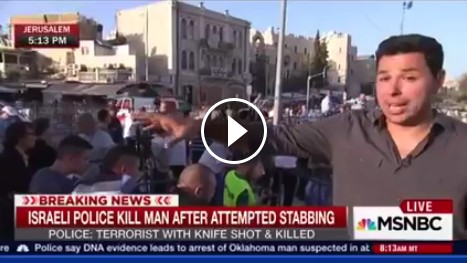
The worst is “Israeli police kill man after attempted stabbing.”  That is a headline with an agenda.  It is a true headline, but fails to mention the part where a Palestinian was the one trying to stab the police officer.  If the majority of people read only headlines, then Israel does indeed look like a violent police state.  In the screen capture below, the reporter also said that the guy was unarmed, but in stills, it is very clear that he has a knife in his hand.

Point #1: Read the article.  The headline is probably misleading.

The reporter misrepresented the situation and was corrected on air. But that doesn't change the headline.

The reporter misrepresented the situation and was corrected on air. But that doesn’t change the headline.

You might have heard about the 13-year-old boy who was mentioned by Mahmoud Abbas as a child executed in cold blood by the Israelis while he was alive and well in an Israeli hospital.  Besides the politics of that situation (we’d be here all day for that), I wonder why no one seems to be asking why a 13-year-old boy is stabbing another 13-year-old boy.

Where is the outcry about using this kid as a child soldier?  Who put the knife in his hand?  Is a 13-year-old legitimately enraged about the settlements/Temple Mount/occupation?  And if he is brainwashed to hate Jews, isn’t that a form of emotional and psychological abuse?  Who advocates for him?  Where are his human rights?

This is one kid in one situation.  I hope he is not a model for the next generation.  Palestinian activists point their fingers at Israel, blame Israel for the situation and claim that Palestinian lives are miserable, but I wonder why these same activists don’t take a nuanced approach and start asking who puts knives into children’s hands, sends them out to shed blood and encourages them to risk being shot by Israeli police.

Point #2:  The situation is complicated and there are no easy answers.  Look at the big picture.  

Let’s all have a Shabbat Shalom!  We could really use it.

Bringing guns to a knife fight

It seemed like every time I looked at Facebook this week, I saw another attack.  In the last few days there have been a significant number of knife attacks in Jerusalem and in other places around the country (Tel Aviv, Afula, Kiryat Gat, Hebron, and others).  There are a lot of people smarter and better informed than I am to answer the questions of: Why now? Is it because of the Temple Mount?  Is it because of the settlements? How should Netanyahu be handling the situation?

I don’t have those answers.  What I can do is share my thoughts on the situation as I see it and how it affects my day to day life.

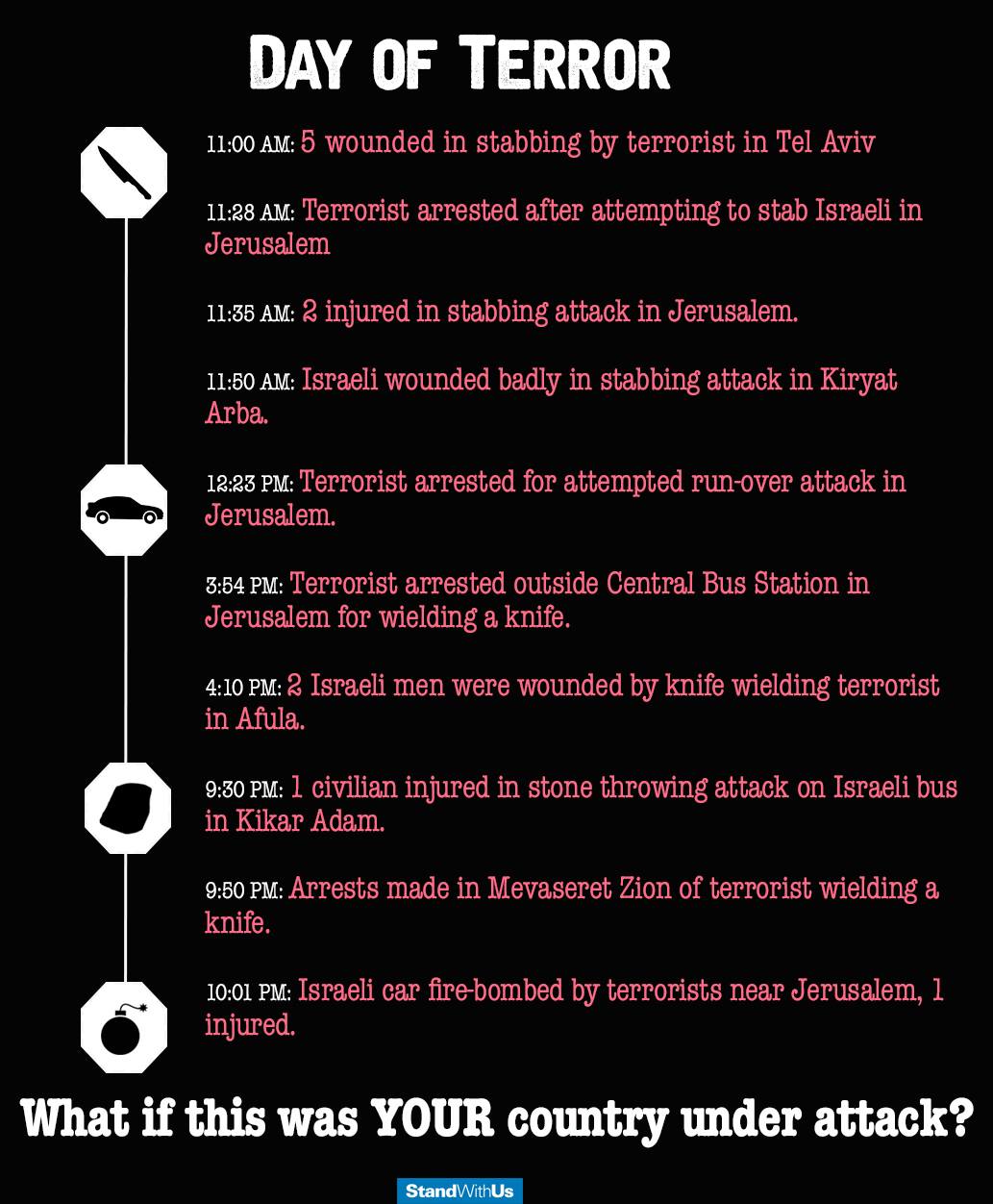
A terrible, horrible, no good, very bad day. (From the StandWithUs Facebook page.)

A terrible, horrible, no good, very bad day.
(From the StandWithUs Facebook page.)

I can honestly say that it’s scary.  But I don’t want to live my life paralyzed in fear.  I am, and will continue to be, cautious and aware of my surroundings. But in the same way that people don’t stop driving because of road rage or drive-by shootings, I’m going to go about my daily life.  I was going to have some visitors from the US and I would have gone into the Old City with them if they had decided to come.  In the end they canceled and I completely understand.  Meanwhile, this week I’ve been hearing a lot of sirens and there’s a helicopter circling regularly.

When you hear the word “stabbing,” it’s hard to imagine what that actually means.  We see it on TV and in the movies and in that imaginary world, it seems like a very survivable injury.  But then I thought about the last time I cut my finger cutting vegetables.  Sure.  It’s a tiny thing in comparison.  Then I tried to magnify the pain 100-fold or 1,000-fold.  I read a short piece written by a knife attack survivor.  She had been stabbed 13 times.  Besides the pain, the most disturbing part of her account was her description of the attacker.  What kind of dissociative state would you have to be in to plunge a knife into another human being 13 times?

Then there are the “rocks” being thrown at cars.  What’s a “rock” anyhow?  It’s not the rock that you send skipping across the water.  Make a fist.  It’s not a rock that size either.  In some cases, “rocks” are cinder blocks, the kind that you build houses with.  But not all rock-throwers are throwing cinder blocks; they’re heavy.  “Rocks” are generally about the size of a beer bottle.  Along with those rocks are actual glass bottles filled with gasoline and lit on fire.  This week I saw a video of an acquaintance of mine minutes after rocks had been thrown at his car.

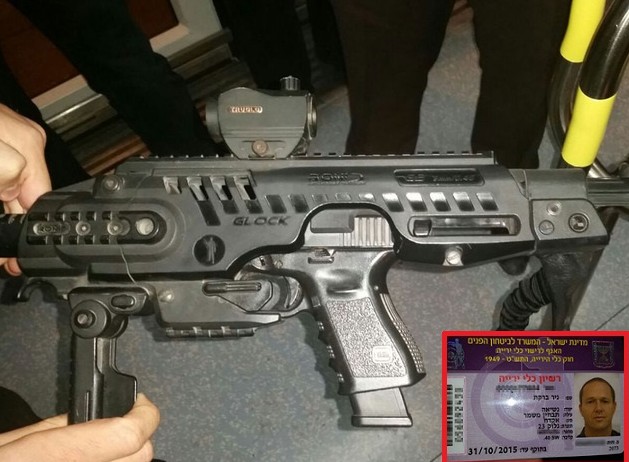
When this new wave of violence got started, our prime minister was in New York making a powerful speech in the UN and there didn’t really seem to be a policy in place.  The IDF was trying to keep a lid on a simmering pot, not very successfully.  And then, after a particularly bad day, the mayor of Jerusalem made a statement on the radio:  People with gun licenses and training should start carrying their weapons.

Say what now?

You can read his statement again, I’ll wait.  At first, I thought it was a mistake, but then it was reported in the English news and then it was backed up by the deputy minister of defense.  With the wave of knife and other violence, those people with gun licenses and training should carry their weapons and consider it a form of reserve duty.  (Nope, I’m not kidding:  HERE, HERE, and HERE.)

The mayor's converted hand gun. (Screen capture from the Times of Israel.)

The mayor’s converted hand gun and his license.
(Screen capture from the Times of Israel.)

To be fair, most men and many women serve in the military and have gun training.  It’s also not very easy to get a gun license in Israel.  On top of that, the number of Israel’s civilian gun accidents is quite low.  Israel has not turned into a Wild West town with a bunch of trigger-happy vigilantes.  I remember when a terrorist used a tractor to ram into bus in Jerusalem it was a quick-thinking, armed citizen (along with others) who shot the terrorist and saved lives.  I’m sure there are other examples.

I titled this post “Bringing guns to a knife fight” in part for the shock value, but that is actually what’s going on here right now.  The police and the army are not able to protect the citizens and we have to count on each other in these awful times.  I’m disappointed in and angry at the government and their inability to protect citizens, but one thing I know for sure is that when Israel gets attacked, we all stand together.

P.S.  I don’t want to post something about the media and the false picture they are painting outside of Israel, however, the “best” example is the BBC.

P.P.S . Things may get worse by the time I post this, but I want to leave you with a different image: As I write this, I have my door open so that I can hear the Greek music at the café across the street.  A few minutes ago, I heard rumbling engines and horns honking.  It was a motorcycle club on their Harleys flying Israeli flags and the honking was a show of support.  That is Israel.

O Jerusalem

4:30am

I awoke from a pleasant funny dream.  One cat curled behind my knees and another cat giving me what she considers a “massage.”  All the lights were on.  I had fallen asleep on the couch again.

I put myself to bed, but I couldn’t sleep.  One siren. Two sirens.  Lots more sirens.  I learned in my first years living in Israel that one or two sirens was probably an accident, but three signaled the likelihood of a terrorist attack.  Suddenly I was AWAKE.  What was going on?

Voices shouting on my street.  Subtle sirens.  Light honking.  I got up and went out onto my porch.  It looked like a brawl in the park.  I used my phone to Google current events.  Stabbings, more stabbings, brawls, violence.

Soon the crowd dispersed from my street.  And eventually, I fell asleep.  How I wanted to be back in my pleasant funny dream again.

Just another glorious day in paradise.

Just another glorious day in paradise.

4:30pm

Sirens all day.  Helicopters patrolling. Peeks at the news.  Why is there one terrible story after another?  Violence. Idiotic international media.  Funerals.  Sadness.  Hatred.  It’s just a vortex of negativity.  I understand the benefits of a “news fast,” but how else will I know what’s happening on my own street, in my own neighborhood, in my city?  I sure as hell don’t want to investigate it myself.

There were a lot of great and joyful things that happened in the past week and they will all be overshadowed by the violence.

I’m sad, but I’m not anxious.  I won’t throw myself in the middle of any dangerous situations, but I am not afraid.  Jerusalem is still my city.  It’s the eternal city and we’ll get through this too.

*Normally I write a Friday post, but today isn’t Friday.  It feels like Friday though because it’s the evening before a holiday.

Let’s prove Hobbes wrong

One of the things I dislike about the media is the idea of “if it bleeds, it leads.”  Reading the news in any country, one might think that Thomas Hobbes was right, life really is “solitary, poor, nasty, brutish and short.”  I actually wanted to write about Sukkot, the Christians who are visiting Israel right now for the Feast of the Tabernacles, the parade that marched through the streets of Jerusalem showing love for Israel and making a joyful noise, and the fact that I have had what I consider one “perfect day” after another.

And then my Facebook wall filled up with the news of two national tragedies.  I was troubled.

Tragedy 1:  Students were shot in class.  Christians seemed to be the targets.

Tragedy 2:  A Jewish couple was shot in their car travelling on a highway.  Their four children were in the back seats.

People died, but that’s not the story.  Eventually, we will hear about the victims, but the filler of the stories will be the politics.  Sides will be taken and the people who died and their families will be footnotes in some other story that other people are telling.

Where is the humanity?

One story took place in Oregon.  It will be about gun laws and probably about mental illness and societal breakdown.  The other story took place here – even naming the location is political.  That story will be about place and the question of terrorism versus “justified” rage.  In one story, the victims will fade into the background, wallpaper for a story about a guy who lost it and went on a rampage (I suppose).  In the other story, the victims will be either glorified or it will be suggested that they “deserved it” because of where they chose to live.

And again I ask, where is the humanity?  Human beings lost their lives today.  Families were shattered.  The race to find out how to spin the story to suit a particular narrative is beyond distasteful, it’s disgusting.

You probably know which story took place where.  But I purposefully didn’t point it out.  The reason is that I would like you, dear reader, to consider your response if you didn’t know where the stories took place.

I hope you would have the same reaction to both tragedies.  People were murdered in cold blood.  The victims were killed by gunmen who didn’t agree with their beliefs.  They were not fighting a war.  They were human beings going to school and driving on a road.  If we haven’t totally lost our humanity, the politics should not matter.

I especially want to applaud the local sheriff in Oregon, John Hanlin, who said that he will not say the name of the shooter.  The victims – may their memories be a blessing – deserve better than to be forever linked with their killer.

My thoughts and prayers are with the families of the victims of these tragedies.  The hole in their lives will never be filled by the politics.  Let us also find our own humanity and in some small way prove Hobbes wrong.

ScreenHunter_03 Oct. 02 19.06

Life doesn’t have be solitary, poor, nasty, brutish, and short.  Together, let’s try to reject the bleeding leads.  Let’s celebrate life.  Live joyfully.  Love, or at least respect, one another.  It’s possible, but we will have to find our humanity first.

At the Kotel on Yom Kippur

It’s my tradition to go to the Western Wall (the Kotel) on Yom Kippur in the morning before it gets too hot and too crowded.  I use this special time to be grateful for all the blessings in my life and think about the upcoming year.  I try to limit my asking for requests for other people.

Here’s what I saw and experienced:

  • It’s always hot on Yom Kippur – no matter the weather the day before or after.
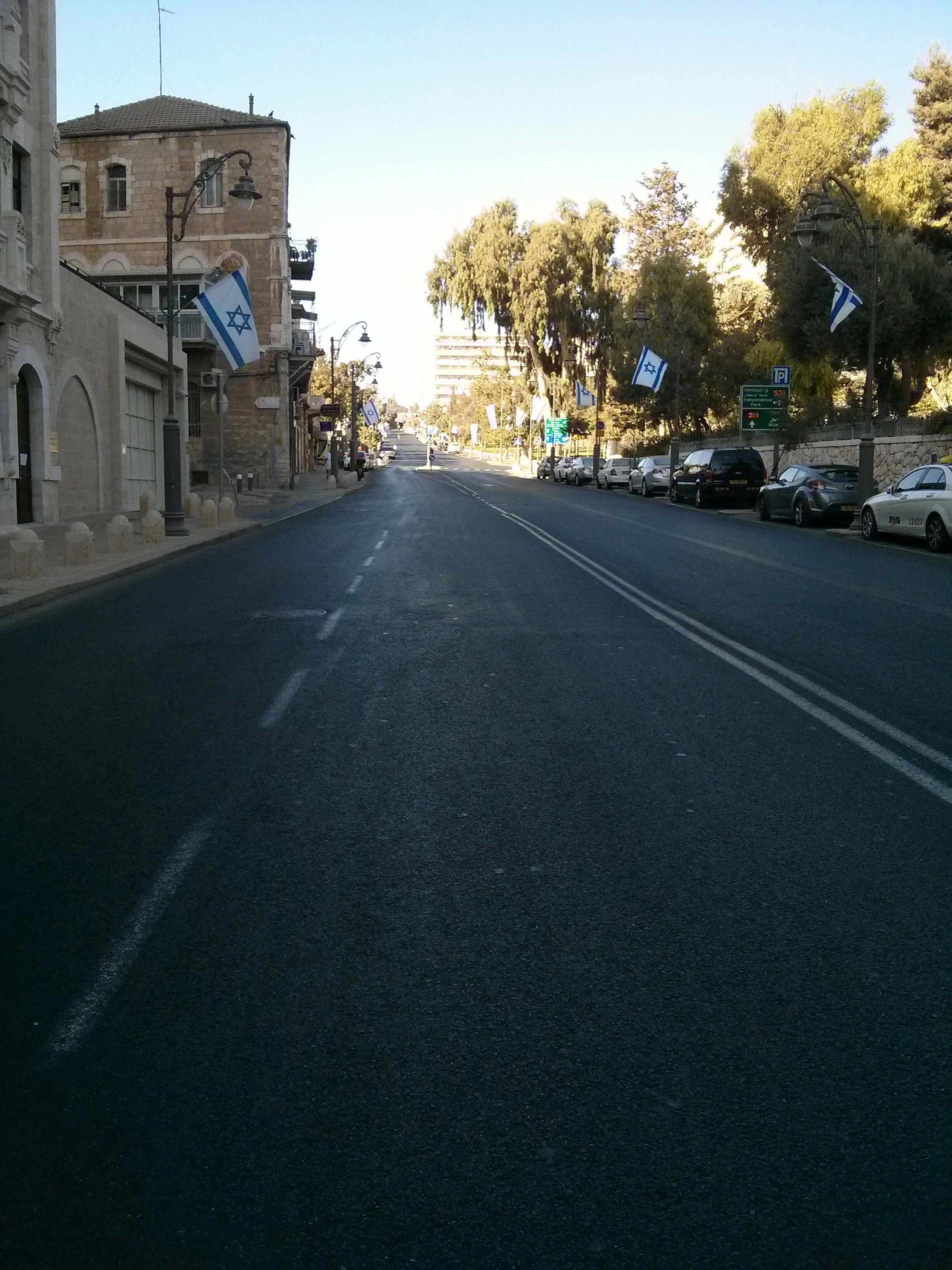
  • The streets were gorgeously quiet and empty.
Yom Kippur 8:45am

Yom Kippur 8:45am

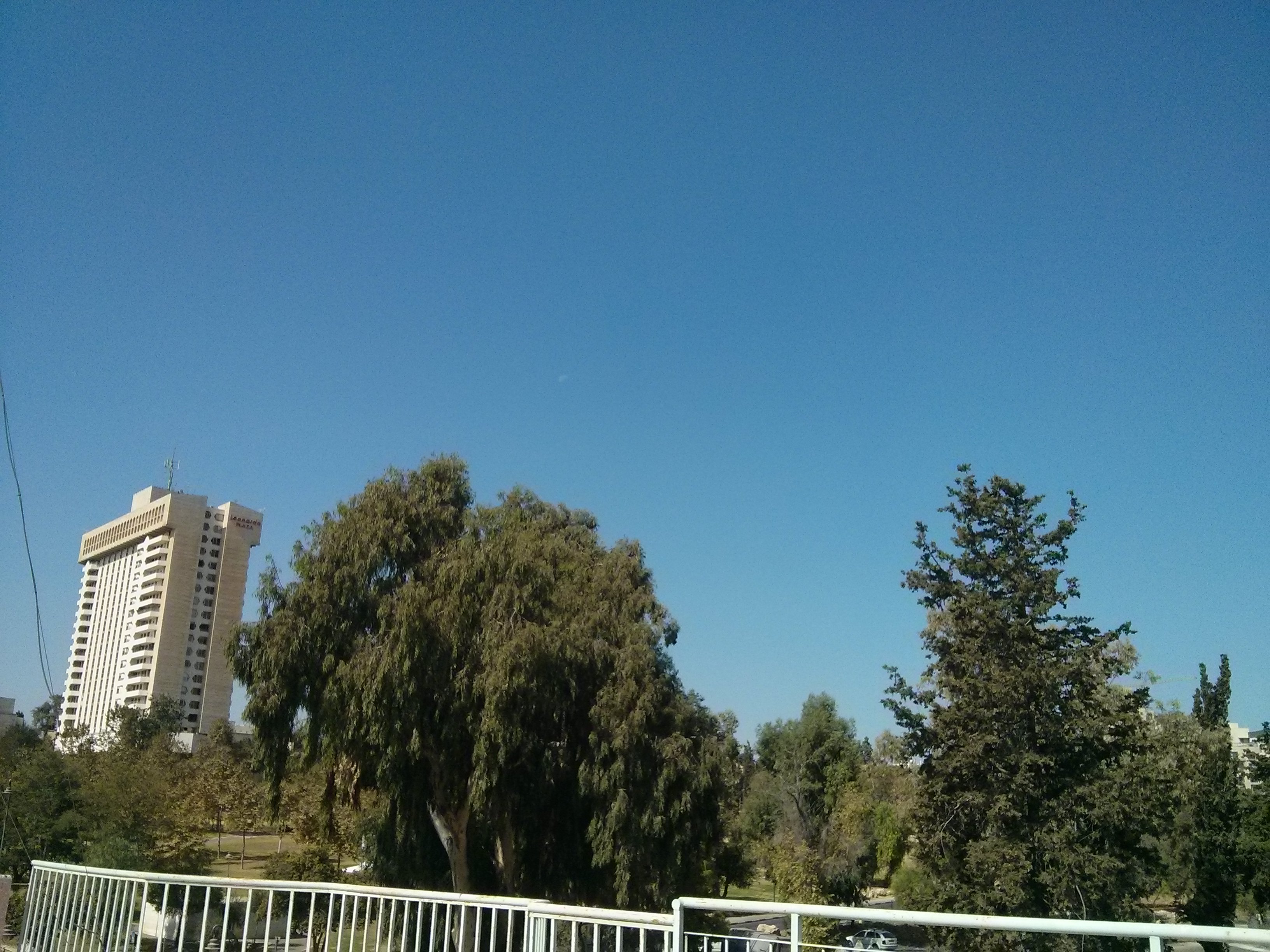
Overlooking the valley outside the walls of the Old City 9am

Overlooking the valley outside the walls of the Old City 9am

  • When I arrived at the women’s section, I saw two female soldiers praying, in uniform and with their guns.  Later one of them went up to the wall and said a few prayers, with her gun.
  • At the wall, the woman to my left was praying in a romance language (Italian, Spanish?) quite loudly.  I heard her say “gracias a Dios,” which seemed fine, and then “benedictus Christos.”  Hmm.  Probably not Jewish.
  • The woman to my right was reading a bible in Chinese.  Status unknown.
  • When I sat down, I looked around more carefully.  More than half of the people there were drinking water and didn’t quite fit.
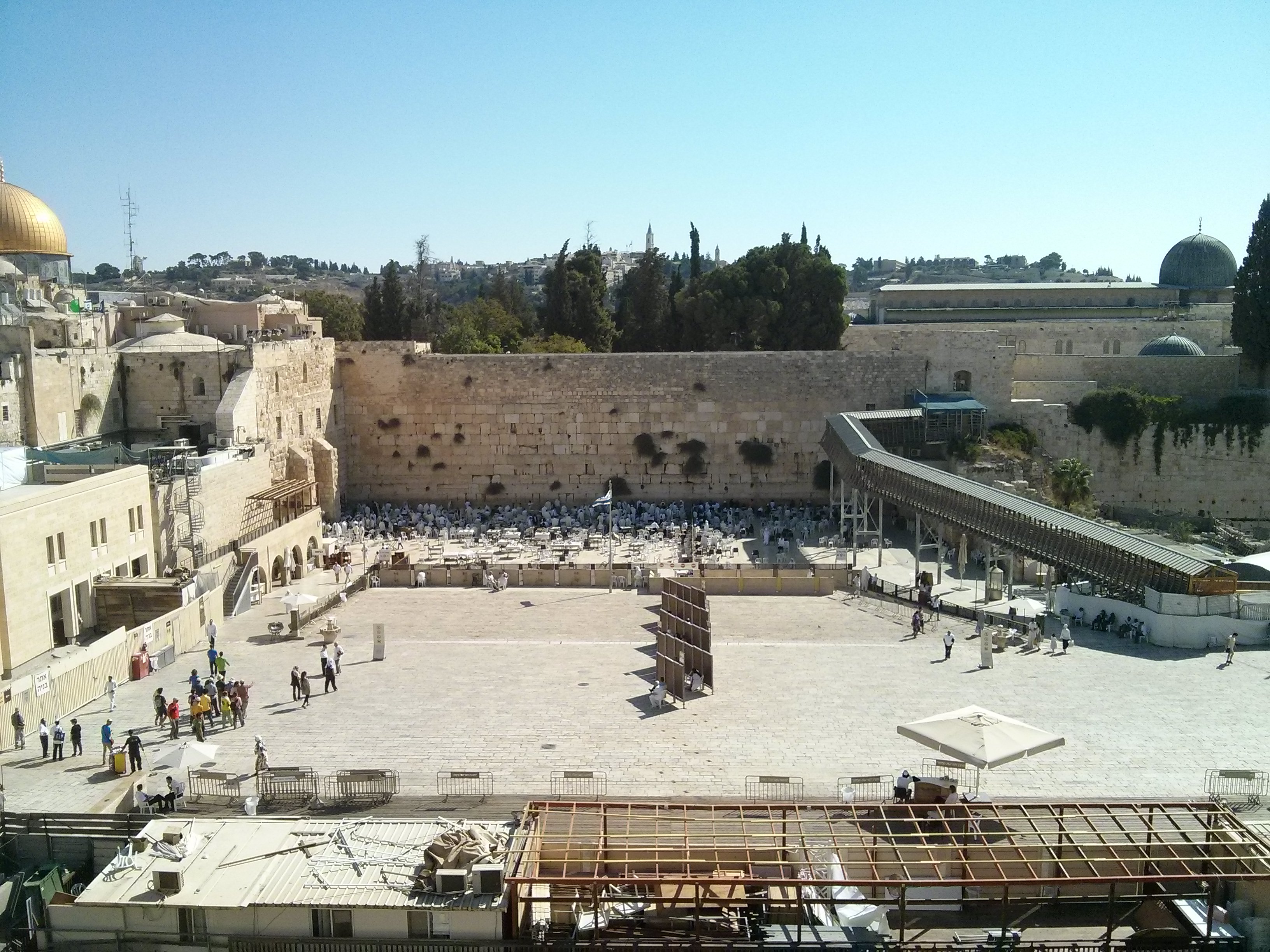
Bird's eye view 10am

Bird’s eye view 10am

  • When I left, there were large tourist groups – with their cameras – entering the Western Wall plaza.
  • I wondered if all these non-Jews thought that God was only answering calls at the Kotel on Yom Kippur; perhaps the connection wasn’t as good at other holy locations.
  • I didn’t see as many people in the Jewish quarter as I expected, but it might have been too early.
Not the Jewish quarter.  This is Jaffa Gate at 9am.

Not the Jewish quarter. This is Jaffa Gate at 9am.

  • There was a police presence.  At around 9am, it was calm and relaxed.  By 10am the Border Police were stationed with a much stronger presence.  (It hasn’t been calm, so they were expecting trouble.  In the end, it was a quiet day.)

I completed the fast and even though I didn’t spend the entire day in reflection, I did feel renewed and ready to start a new year.

I promised a post about my trip in Romania, but I had such a great time that I think the trip would be better served in several short entries (coming soon!).

Until then, Shabbat Shalom!  May we all have some peace and quiet, renewal and reflection.  And birthday cake.  We should all have some cake.

Yom Kippur and the Revolution

Upon arriving in Timisoara, Romania, this week, my first visit was to the Museum of the 1989 Revolution. I remember the events of 1989, but somehow I had forgotten that Romania was also one of the countries that overturned its government.  I learned a lot, earned a few points with my hosts, and saw Timisoara in a whole new light.  This was the birthplace of their revolution.

Timisoara

Timisoara

Since Yom Kippur is next week and I wanted to write about that too, I thought about how the two things fit together.

The 1989 revolution started with a small demonstration with something like 20 people who didn’t want their priest to be arrested.  One thing led to another until the Opera House in Timisoara became the headquarters of the revolution and the frenzy of it all swept across Romania.  Change begins with a small action; sometimes it’s hard and painful, but hopefully things will be better afterwards.  There are no guarantees.  You just have to believe in the cause and keep moving forward with your hopes and dreams to guide you toward something better.

Yom Kippur is not so different.  Yom Kippur is the 10th day of reflection at the beginning of the Jewish New Year.  The religious tradition is that for 9 days, you make peace with your fellow human beings.  On the 10th day, you make peace with God.  On Yom Kippur you fast for 25 hours (no drinking either!) and you dedicate yourself fully to prayer, reflection, and confession.   By the end you are an empty vessel ready to start anew.  For the next year, you start small and try to fill up your vessel self with something better.

In my own attempt to make peace with my fellow human beings, let me apologize for any slights or insults.  If I hurt you in any way, I’m sorry. I know that a general blanket apology pales in comparison to a real and personal apology, and I’m sorry for that too.

This year Yom Kippur falls on my birthday.  While I’m not looking forward to fasting on my birthday, perhaps this is an interesting coincidence that serves as a reminder that every year begins anew, with a clean state, full of potential, a chance to refill my newly emptied vessel self with something better.

G’mar Hatima Tova! (May you be written in the Book of Life!)

***

Next week I’ll write about my visit to Timisoara.  I still have 2 days left of my trip.

9/11 and Rosh HaShana

Today is 9/11.  Of course I remember September 11, 2001, and we should take a moment to commemorate those whose were robbed of the rest of their lives by a major terror attack.  Let this sad day remind us all that none of us knows what the future will bring.  Let’s be kind to one another today.

For me 9/11 is directly linked to the High Holidays.  Next week it’s the Jewish New Year.  Rosh HaShana (literally, the head of the year) is a two-day holiday that is usually in September or October.  I won’t get into the religious details and questions; you can look those up yourself.

Rosh HaShana is the beginning of a 10-day period that will end with Yom Kippur (the Day of Atonement).  In English, these days are called The Days of Awe.  In Hebrew they are called the much scarier yamim nora’im (The Terrible Days).  It’s traditional to take a spiritual accounting (heshbon nefesh) of the past year – determine if you did well, where you can improve, make some adjustments for the upcoming year.  It’s more than the January New Year’s resolutions that go out the window on January 2nd.  Not so the spiritual accounting of Rosh HaShana.  It’s not about losing weight and taking care of your health.  This spiritual accounting is internal and focusing on becoming a better person.

“Aharei ha-chagim!”

The bureaucratic joke in Israel is that if you have a project starting at any time in September it will likely be pushed off to “aharei ha-chagim” (after the holidays).  However, this is not after the two-day holiday of Rosh HaShana.  Not even after Yom Kippur ten days later.  No, “aharei ha-chagim” means after Sukkot is over.  In Israel if you start anything in September, you can count on at least a 3-week delay.  Because there are so many holidays and kids are out of school (even though they only started last week), the entire country grinds to a halt and everyone is on vacation (again!).

On one hand, there is something really powerful about taking the time to reflect on the year that passed and look to the future; or, more likely, taking the time to be with your family during the holidays.  The rhythm of life in Israel allows for both (without mandating either one).

On the other hand, this is 3 weeks of sanctioned procrastination.  “Acharei ha-chagim” can be used for just about anything.  All your big plans and aspirations?  Meh.  Leave them until later.  Perhaps some real soul-searching is going on in these 3 weeks and it might be a legitimate way to pause and take a breath.  But who can honestly say that they are taking the full 3 weeks to do an internal spiritual cleanse?

And so we come back to 9/11.  What is the spiritual message that I heard in this tragedy?  You never know when the end will come.  Around this time I ask myself:  Is my spiritual accounting up to date?  Was I kind enough?  Did I let the important people in my life know that I care about them and they matter to me?  Was I true to myself?  If today was my last day, would I have regrets? Am I procrastinating or am I regrouping? What can I do to make tomorrow/next year better?

Well, I don’t want to end on such a blue and morbid note.  Rosh HaShana is a happy holiday!  We are given the opportunity to clean our slates and start fresh.  So let me wish you all a Happy New Year!  A Shana Tova u’Metuka (a good and sweet year)!