The Silent Treatment

When I read The Great Brain as a kid, I remember being surprised by the punishment that the parents gave to their kids.  This was late 1800s Utah and spanking was perfectly normal.  Not for these kids.  These parents gave “the silent treatment” for a specified length of time. The author described it as the worst of all possible punishments.  At least with a spanking, it was over and done with.  The silent treatment made the kids feel invisible.  Oftentimes, the kids would cry with relief when the silent treatment was over because they felt like they were returned to the land of the living.

ScreenHunter_03 Jan. 23 19.46

This week Israel’s newspapers were filled with the news of a woman who was stabbed to death in her home, in front of at least one of her six children (four were her natural children and two were adopted).  She was a nurse who was learning Arabic to better communicate with her colleagues and patients.  By all accounts she was an amazing person.

And then I saw a surprising headline that asked why Dafna Meir’s murder was not reported in the international media.  We all know that “if it bleeds, it leads.”  There was plenty of blood.  We saw the pictures.  Check.  The victim is sympathetic – a mother, a wife, a nurse. Check.  It was a pretty dramatic story.  She was stabbed in front of one of her children and the manhunt went on for quite a while.  Check.

I went to Google and typed in her name and went to the news tab.  Page after page of Israeli newspapers or Jewish newspapers around the world reported the story.  But no major international news organization was reporting it.  I found one small German paper that reported it in full, but I couldn’t determine if it was a Jewish paper or not.  But it was true.  The international media ignored her.

Dafna Meir lived in Otniel, which is a small town in Judea and Samaria (you could read that also as a “settlement in the West Bank”).  She was a religious Jew.  The 15-year-old Palestinian that stabbed her was on the run (meaning that no Palestinian was injured in this attack).  So if you believe that the simplest explanation is the most likely, then we are faced with an anti-Semitic media ignoring any news that doesn’t fit into their narrative and agenda.  (Here is a very good article about this.)

The next day – while Dafna’s murderer was still at large and her funeral was taking place – a pregnant woman was stabbed by a Palestinian in her store in Tekoa (another small town in Judea and Samaria / another settlement in the West Bank).  She was not killed and the Palestinian was arrested.  Now the international media paid attention.  The attack in Tekoa and that other thing that happened the day before “represent a shift in the recent surge of violence.

The Meir family has publicly stated that they harbor no hatred against Palestinians. A Palestinian friend, who is apparently a relative of the murderer, paid a condolence call and was welcomed by the family.  Unfortunately, this bit of the story does not play into the “cycle of violence” narrative that the New York Times has put together to explain why murder in the settlements is understandable.

Conspiracy of Silence

While the simplest answer may often be the right one, some things still bother me.  How does every single editor of every major news outlet in the world decide that this story – a mother murdered in her home in front of her child – get ignored?  Can it really be that every single major international news organization blindly accepts that a woman murdered in her home is just the price she paid for living in that neighborhood and moreover that she should be ignored because she doesn’t fit the narrative that has been dictated by a certain political agenda embraced by the paper?  Did every single international journalist really shelve their humanity to serve a political agenda?

Many journalists claim to try to bring justice to underprivileged and underrepresented people.  They claim to want to shed light on the truth.  They are presented as “brave” and “unrelenting” in their pursuit of the story.  Today, I am reminded of the bitter and all too accurate pun:

If vegetarians eat vegetables, then what do humanitarians eat?

The international media’s deafening conspiracy of silence is the worst kind of punishment they can deliver.  With their silence, they ensure that Dafna Meir doesn’t exist and that their fixed narrative is unshaken.

I hope that all of us together can demand more from journalists.  Or perhaps call out the lazy and hypocritical ones.  We may even eventually find the invisible hand directing the narrative, the one that ensures that no one thinks for themselves or asks questions.

But for now, as a start, I will not be silent.

Lorax

Sticks and Stones … But Words …

Sticks and Stones Will Break Your Bones, But Words Will Frame Your World

After a month of holiday posts, the elephant in the room should probably be tended to.  Violence.  Yes, it is still going on.  In Israel, but everywhere else as well.

Last week, after I posted my entry to the blog, news came out of a shooting in Tel Aviv.  It was unclear at the time if it was regular violence, Islamic State-inspired terrorism, or a mentally unbalanced individual who went off the rails.  As of this writing, the perpetrator is still at large and there are still not many concrete details to be had because of a gag order on these events. (*Update: as of this posting the perpetrator was killed in a shootout with police.)

This week in Israel there is also a debate about whether torture was used during questioning of the suspects of the Duma arson attack that killed members of a Palestinian family, including an infant.  A few days ago a 21-year-old Jewish settler was indicted for murder in the case.

Then there is the odd story of the militia men in Oregon who have taken over a federal building.  I just read a news story that called them “Millennium Marlboro Men.”  Somewhere between the lyrical, romanticized descriptions of these guys, I gather the problem has something to do with land rights and freeing two guys who are in prison.

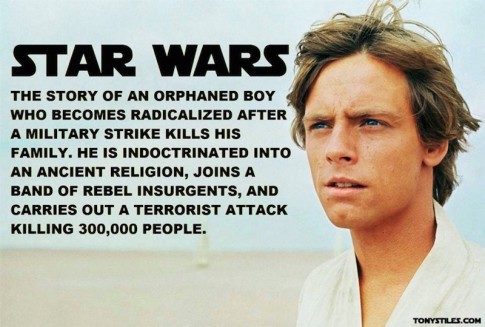
In the midst of it all, a Facebook meme and a proper opinion piece come up with the narrative that Star Wars is the story of how Luke Skywalker became a radicalized terrorist.  It’s a bit tongue-in-cheek, but there is some reasonable logic behind it, if you look at the story in a certain way.

starwars-485x327

(*Disclaimer: I don’t buy into this at all because I know that Star Wars is a Hero’s Journey story.  Hero myths are present in all cultures in the world and a “hero” is not usually a conformist.)

It’s the words that make all the difference in each story.

If the events are described as “terrorism” then it’s easy to condemn the perpetrator.  Throw in possible mental illness, well, then it’s a tragedy for all concerned and the finger of blame points at the perpetrator, but also the society that failed him (especially true in the US).  Toss around the term “Jewish terrorism” and, in Israel, the shock and shame are palpable.  iPhone-toting Marlboro Men with guns dressed in camo is straight out of the movies.  They are taking over a federal (read: Evil Empire) building for freedom.  And then our hero Luke.  He uses the Force to fire a rocket that blows up the Death Star and kills hundreds of thousands of people.  Is he in the Rebellion or is he a radicalized terrorist?

So who shapes our world?  Are we swallowing what’s given to us or are we critically thinking?  After all, the phrase “justifiable homicide” feels different than “cold-blooded murder.”  “Terror” is a lot heavier than “random shooting.”  It’s above and beyond the idea of “one man’s terrorist is another man’s freedom fighter.”  In the global society that we live in today, if someone decides that a person is a terrorist, then that can be proclaimed from the global rooftop.  Someone else can decide that same person is a freedom fighter and shouts that from the global rooftop.  Then it becomes a matter of who gets more social media followers, facts be damned.

Here’s the last news item for this week.  Shurat HaDin (an Israeli NGO) did a Facebook experiment.  They opened two pages:  one incited against Israelis and one incited against Palestinians and they uploaded a bunch of content to both.  Then they reported both.  The one that got shut down was the one inciting against Palestinians.  The one against Israelis didn’t (until the experiment was publicized).

In the end, it also matters who runs the global rooftop that you are shouting from.


New Year’s Special

Happy New Year!  Here in Israel people celebrate it, but not like they do elsewhere in the world.  Israelis like any opportunity to throw a party and have a good time, so December 31 – called Sylvester in Hebrew (after a pope, if you can believe it) – is a convenient time for that to happen.  Israel also has the influence of immigrants from the former Soviet Republics.  New Year in the Soviet Union looks like secular Christmas – decorated trees, Grandfather Frost who brings presents, and spending time with friends and family.  But Noviy God is Noviy God and if you ask a person from the former Soviet Union they will absolutely insist that it has nothing to do with Christmas.  Apparently this year, they went all out for Noviy God.

svityaz-noviy-god-2015

Not Christmas, Noviy God.

January 1 is not a day off.  If being at the office on Christmas and dating documents 25 December is weird, being at the office and writing 1 January seems almost criminal.  But there it is.  New Year in Israel was in September.  The first of January is just new page on the calendar.

Last night the weather was not cooperating.  Torrential rain would be an understatement.  The trees outside my house were nearly blowing sideways.  There are rumors that there might be snow in the next few days too.  And yet, I was able to hear all the revelers throughout the night.  Why they would want to be out in this weather is beyond me.  I quietly rang in the New Year with a toast for good health, much happiness, and great success in 2016!

Question of the week

What is the flaw in our society that ensures only outrageous campaigns get attention?

On Christmas Eve last week I went to a lecture about the influences Palestinian youth are subjected to that are likely inspiring them to attack Jews with knives.  The short answer is that Palestinian society under the direction of the Palestinian Authority honors “martyrs,” creates children’s programming broadcast on state television giving praise to 5-year-olds with aspirations to use knives to kill Jews, and hammers home the message that Jews are the descendants of pigs and apes.  There are literally thousands of other examples of this kind of messaging in Palestinian society.

Any person in their right mind would see these things and be horrified and call it what it is: emotional and psychological child abuse.  And yet it goes on and no one talks about it.  The speaker is well-informed, intellectual, and has sound, extensive documentation of every claim and the organization has the ear of members of the Israeli government and the US government, among others, and there is hardly a whisper of condemnation.

At the same time, a debate was raging in Israeli society about a “provocative” (their word) campaign done by a Zionist organization calling attention to the fact that certain NGOs in Israel are funded by foreign governments.  The video is disturbing, no doubt, and they name names calling certain members of these NGOs “moles” or “foreign agents.”

The debate spread like wildfire over every media outlet.  Every news program discussed the “provocative” campaign and then began to question the facts.  Everyone had to have an opinion about the proposed law (to require NGOs that receive more than half of their funding from foreign governments to make it known and for their representatives who come to the Knesset to visibly identify themselves as members of these organizations).  There were even those who agreed that one targeted organization was in fact harming Israel’s image abroad and was disingenuous about its stated goals, but still were upset by the “provocative” campaign.

The targeted organization, by the way, was not suddenly the victim of a provocative campaign.  Another organization wrote a well-documented report showing that a large portion of the money this organization receives is from foreign governments, including a consortium managed in Ramallah of funds from foreign governments.  That report has been out for months and I believe there was even a press release.  But no one discussed it.  No one thought about it.  No one asked any questions.

I’m deliberately not naming organizations because the issues they raise are far bigger than a simple blog post could cover.  The point of this is to ask the question:  If the facts are out there, why do we need to have over-the-top, shock-and-awe campaigns to get any response from anyone?  Have we really slipped into a sex-sells, if-it-bleeds-it-leads global society?

On the other hand, if we want to get anything done and “go viral” do we have to bend with the fickle winds of the internet and make every issue bigger, stronger, faster, more outrageous, more outlandish, wilder, crazier, more shocking, and push the limits beyond their stretching point?  Is this what debate looks like today?

Here’s my (political) wish for 2016:  At least once in 2016, let’s move toward reasoned debate using facts and speaking with our inside voices while turning our backs on the circus that media has become.  Let’s lead by example. Each one of us can reward, at least once next year, calm, rational debate.

Happy New Year!  The best is yet to come!

1 Fun Thing; 1 Serious Thing

Hmm.  What happened this week?

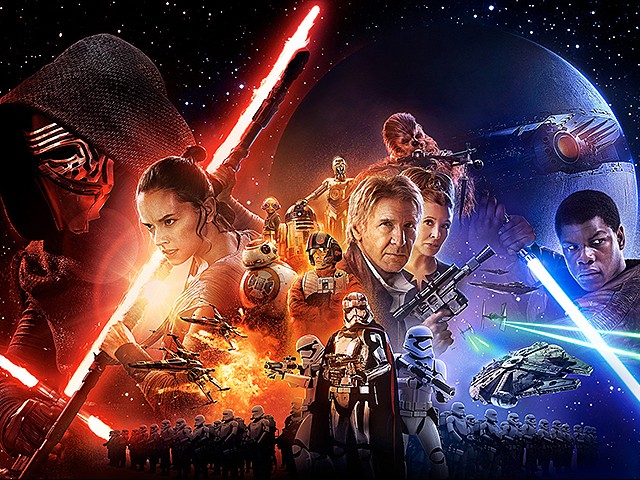
Star-Wars-Force-Awakens-Poster-640x480

If you don’t know what this is, then I don’t even know where to begin.

Star Wars!

No, I didn’t go to the premiere in Israel, though I read a great review about it. It was a pretty big deal here.  And I have to say that I’m glad people went out and made a fuss.  Terrible things continue to occur in the streets, but come hell or high water, nothing stops Star Wars.  (It did actually rain a lot recently, so the high water remark was not just a throw-away line.)

The great thing about being in Israel for the premiere is that we saw it before you all did! (Neener, neener, neener!)

I will see it, but I may wait a while because the idea of a hugely crowded theater kind of turns me off.  On the other hand, Star Wars.  No spoilers please!

And now for something completely serious.

There are a number of debates in Israel right now about many things, but one that bothers me, and one that I don’t have an answer to, is the directive issued by the Israeli Medical Association.  They said that the wounded in a terror attack should be treated in order of severity, no matter who they are.  What this means in practice is that if an attacker has more severe wounds than a victim, the attacker will be treated first.

A volunteer emergency services organization, ZAKA, has refused to comply.  They said that they will treat Jewish victims of the attack first.  Their rationale is based in Jewish teachings: “He who is merciful to the cruel will end up being cruel to the merciful.”

One of the incidents that caused the Israeli Medical Association (IMA) to make this ruling was an attack in Beer Sheva where an Eritrean ran away from the scene and everyone in the area thought he was the attacker.  So he was beaten and kicked by the bystanders and eventually died from his wounds, in part because he was ignored by the medical services personnel.

On one hand, I can see the humanity of using triage to rank all the wounds of all the people.  Who really knows with absolute certainty in the middle of chaos who the attacker was?  On the other hand, is one horrible situation the measure to use for making the rule?  How do you explain to the family of a victim of an attack that you treated the attacker first?  What if the victim is permanently disfigured or perhaps even dies while the attacker survives because of the triage decision you were forced to make?

Attackers are treated in Israeli hospitals by Israeli doctors and stay in rooms probably down the hall from their victims.  The news reports of the case in October of the 13-year-old stabber showed him in Hadassah Hospital.  In the same hospital, his victim was put in a medically induced coma and miraculously woke up (*he celebrated his bar mitzvah this week and claims to be 95% better).

I heard an interesting/troubling comment after the IMA announcement was made.  Security services may feel that they shouldn’t shoot to stop an attacker, but actually shoot to kill so that the attacker will not take a victim’s place in triage.  I’m not sure that is the intent of the ruling, but it could be a consequence.

I was also troubled by the phrasing of the ZAKA response.  I hope that they meant all victims of an attack, not just the Jewish ones.  I hope that they wouldn’t set aside an injured victim who was a Druze, Bedouin, Christian Arab, or Muslim Arab simply based on the fact that he or she isn’t Jewish.

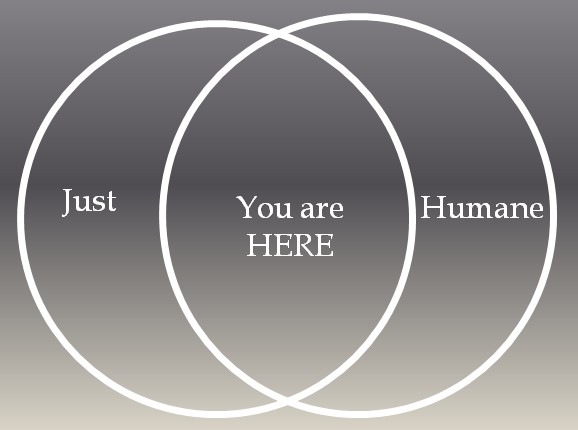
In the middle of chaos, emergency services need to know what to do, so they need some kind of directive.  But which one is “just”?  Which one is more “humane”?  There are no simple, easy answers here and we find ourselves in the gray area yet again.

ScreenHunter_01 Dec. 18 20.01

And that will do it for this week!

To those of you who are going to see Star Wars, DON’T TELL ME ANYTHING!  Thumbs up or thumbs down would be okay though.

Chanukah Special

A few fun facts about Chanukah

How do you spell it?  Chanukah, Hannukah, Hanuka, … Spell it however you want.  You just need to get the sounds right.

IMG_20151211_181908

Jewish xmas


Is Chanukah the Jewish Christmas?  No.  It’s a holiday that happens to fall around the same time of year.  But also yes.  It was never a very big deal in terms of holiday rankings, but in recent decades it became a much bigger holiday due to the overabundance of Christmas celebrations.  Jewish kids needed something fun in December as well.


What is the miracle celebrated by Chanukah?  In 168 BCE the Selucid king, Antiochus IV Epiphanes, forbade the Jews to practice their religion and desecrated the Temple.  After Judah the Maccabee succeeded in ousting the Selucids, the first order of business was to rededicate the Temple.  (Chanukah means dedication.)  They found only enough blessed oil to last one day.  But they lit it anyway and sent for more blessed oil, knowing that it would take 8 days.  And miraculously, the oil that should have lasted only one day lasted for 8 days.

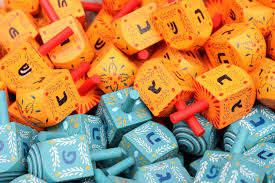
What’s a dreidel? What’s a sevivon?  They are the same thing:  a four-sided top that has 4 Hebrew letters on it.  Dreidel is Yiddish.  Sevivon is Hebrew.  The four letters ardreidele different depending on where you are in the world.  Outside of Israel, the letters are נ, ג, ה ,ש  which stand for “Nes Gadol Hayah Sham” (A Great Miracle Happened There).  Inside of Israel the letters are נ, ג, ה, פ, which stand for “Nes Gadol Hayah Po” (A Great Miracle Happened Here).

The story is that children would learn the story of Chanukah with the dreidel, but those who forbade the Jews to practice their religion would see only a children’s game.

What are the rules?  All the players ante up by putting 2 whatevers in the pot (usually candies).  The first person spins the top and wherever it falls that’s the instruction for that players turn.  נ – nothing happens.  ג – you win the whole pot. ה – you win half the pot. ש/פ – put in two.

Here’s a true Chanukah story.  I went to a Chanukah party in Israel and they wanted to play dreidel.  Out of about 20 Israelis in the room and 5-6 English-speakers, I was the only one who knew the rules.  That’s right.  A secular girl who grew up in small-town America was the only person who knew all the rules.

I attribute this to family Chanukah gatherings at my aunt and uncle’s house.  I remember at least one Chanukah when all of us kids went upstairs and set up our game in the hidden corridor between the bedrooms and we secretly played dreidel.  Moral of the story:  Everyone should have secret places and everyone should know the rules of dreidel.

Foods.  In honor of the miracle of the oil, it’s all fried, baby!  Order French fries or onion rings for Chanukah!  Deep-fried mozzarella sticks?  It’s okay; it’s for Chanukah!  Fried chicken?  Absolutely! Deep-fried snickers bar?  Now it’s just getting weird.

The real traditional foods are potato pancakes (latkes [Yiddish] or levivot [Hebrew]) and fried donuts with fillings (sufganiot).  Here in Israel, most people eat sufganiot and these days they are what you might call “fancy-schmancy.”  The basic one is filled with strawberry jam (meh.  I prefer the dulce de leche version of the basic and most of the fancy-schmancy ones.)

suf

For those of you who know about potato pancakes, you may know that one traditional way to eat them is with sour cream and applesauce.  Not so in Israel.  Whenever I have mentioned eating them this way, I get looks like I’m the crazy one.

When I was waiting at the bank this week, donuts were handed around.  It made the nearly endless wait a bit more bearable, even if it was a strawberry jam one.

What’s the real miracle of Chanukah today?  The story of Chanukah reminds us to fight for our beliefs and our way of life.  We can be proud of who we are, of our history, of our heritage, without imposing it on anyone else.

Chabad puts up a lot of public hanukiahs and lights them each night all around the world.  In Paris this week, they were discouraged from doing so.  But that isn’t the spirit of Chanukah.  They lit the hanukiah to remind us that it is always better to light a candle than to curse the darkness and from that candle many more can be lit.  Together we can banish the darkness.

paris

History and TV, what could be better?


IMG_20151204_141359


Little known fact about Israel:  Sometimes it’s colder inside than outside.  Yesterday, it was just more pleasant to sit outside.


This week was horrible and violent.  I don’t want to rehash it all here.  Instead, we’ll dial down the intensity and cover a moment in history and look at Dig, a television series that was partially filmed in Jerusalem.

Remember, remember the 29th of November

This week Israel noted the 29th of November.  Quite a few Israelis don’t know why this is a date of note nor why streets are named after it.  It’s one of those dates that gets lost in all the important national and religious dates throughout the year.  What happened, you ask?  Good question.

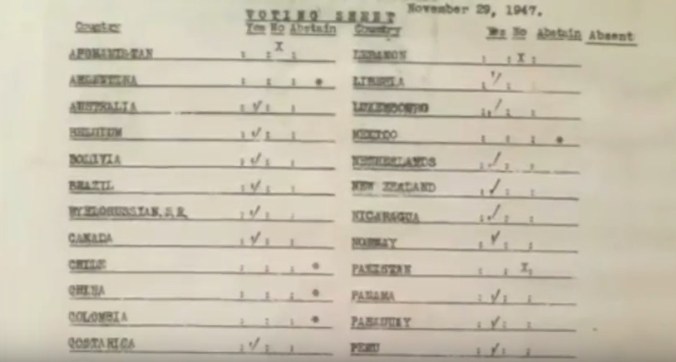
On November 29, 1947, the United Nations passed Resolution 181, which recommended that the land of British Mandatory Palestine be divided into two states.  It required that both the Jews and the Arabs agree.  The Jews agreed and the Arabs didn’t.

ScreenHunter_02 Dec. 04 19.50

LISTEN TO THE VOTE.

Resolution 181 didn’t create the State of Israel, but it recognized the need for a Jewish homeland and it was sort-of an exit strategy for the British who planned to get out of Palestine in May 1948.  When May 1948 rolled around and the British left, instead of two states co-existing, five Arab states declared war on the provisional government of Israel.

The importance of the resolution today is to remind the world that Israel has a recognized right to exist.  Israel is not a colonial power or a foreign apartheid regime.  The world recognized that the people of Israel – the Jews – have a connection to this land.  It’s not that only that they need a shelter from potential Holocausts in the future, but that this specific land is the Jews’ ancestral homeland.

Dig

Picture this:  Every Jewish conspiracy theory, rumor, and apocalyptical end-of-days theory crammed into 10 episodes and it was filmed in Jerusalem.  I liked it.  I enjoyed watching it.  (However, in the interest of full disclosure, my Israel family hated it and said it was embarrassing.)

The Israeli creator of Homeland got together with the creator of Heroes and they made some incredible television fiction.  Then they cast one of the baddies from Harry Potter as the lead (Jason Isaacs, or Lucius Malfoy) and used a bunch of Israeli actors speaking Hebrew in the streets of Jerusalem and in other locations and took us on a wild ride.

ScreenHunter_01 Dec. 04 19.44

HERE’S THE TRAILER.

The story weaves together a radical Jewish group that wants to rebuild the Temple (obviously on the site of the Temple Mount), but they need a few things, along with some signs and wonders to ensure their success.  They are cooperating with some messianic Christians, who have their special role to play.  Meanwhile, FBI agent Peter Connelly, our underdog anti-hero who is spiritually broken (Jason Isaacs), tries to solve the murder of an American citizen.  He is helped by an Israeli policeman, Golan Cohen, who, just to make things complicated, is gay.  Throw in the Essenes (Dead Sea Scrolls) who have been hidden for the past 2,000 years and the lost treasures of the Second Temple. And then toss in a touch of Jerusalem Syndrome (a real affliction where spiritual pilgrims come to Jerusalem and suddenly believe that they are biblical figures for a while) and the blood moon.

The series was filmed in Jerusalem last summer and due to the little war we had, they finished filming in Croatia.  There is one scene where they say “Oh, that’s Mishkenot She’ananim” and show a building in Croatia.  I leaped up and shouted at the screen, “No it isn’t!”

There is also the cultural hilarity.  Anyone who has ever driven in the streets of Israel knows that people honk their horns all the time. It’s a kind of noisy communication among drivers expressing a variety of emotions.  So when Peter gets in the car with Golan, Golan is always smoking and honking his horn at everyone.  Peter doesn’t like the smoke (Golan doesn’t care) and his answer to why he honks the horn all the time is “It’s relaxing! You should try it!”

I enjoy a good murder mystery (fictional, of course) and I love a good conspiracy theory.  Of course the show was a little silly and over the top.  It’s not a documentary, for heaven’s sakes.  But I have to say, with all the problems on the Temple Mount these days, the various end of days theories going around, especially lately, and all the violence in the world, I certainly hope that fiction in this case is stranger than truth.

A little this. A little that.

In terms of violence, the past week was horrible.  So instead of leading with the horrible, let’s celebrate something positive and beautiful that came out of senseless tragedy: a gigantic, wonderful wedding and everyone is invited.

Last Friday, before Paris, two people were killed on the road south of Jerusalem.  The bride’s father and her brother were on their way to celebrate with the groom on the Shabbat before the wedding.  Instead of a wedding, there was double funeral and the bride’s mother and her siblings were in the hospital.  What did the bride and groom choose to do?  They chose life.  They moved their wedding date to November 26, rented out the international convention center in Jerusalem and invited everyone in Israel to join them in celebrating their wedding.  (*Cultural aside for those cynics out there: A wedding is a celebration for the whole community and a guest’s job is to make the bride and groom happy. So it’s not about the big wedding.  It’s about giving everyone a reason to rejoice.)

ScreenHunter_02 Nov. 21 15.52

Here’s their public message and invitation.

And then there was Paris

There are plenty of people much smarter and more eloquent than me that said many things about Paris.  (My favorite was John Oliver’s extensive use of the f-word, because that really is what we are all thinking – even though it might not be considered “eloquent”).

As I read the news in Israel, I noticed one line that probably everyone else thought was superfluous, but I thought was good evidence of choosing life.  In the stadium, France was competing against Germany in a friendly football match (soccer game) and even though they heard explosions, they finished the match.  France won 2–0.

ScreenHunter_01 Nov. 20 22.15

Football not terror.

Then I was really disappointed

A few days after Paris, social media started to pile up with accusations:

  • Why only Paris?  What about Beirut?  Any Lebanese flags on Facebook photos?  How about the airplane downed in Sinai?  What about all those Russians?  Why hasn’t the media reported on anything other than Paris?
  • Israel has terrorism and innocent civilians are getting stabbed, shot, and run over every day.  Yet Israel is the aggressor?  How would you like it if the attacks in Paris were reported as “8 Muslims killed in Paris”?

As to the first, I read two interesting articles that said that said all the other violence was reported, but that readers ignored it.  On top of that, coordinated terrorist violence in Paris is not the norm and because Paris is one of the top tourist destinations in the world, people can relate to it more than, let’s say, Beirut, Sinai, or, as of yesterday, Nigeria and Mali.
(Article 1 and Article 2)

As to the second, while having some truth to it, I find it cold, callous, and in short, stomping on the people of Paris.  There is a time and place for accusations of media bias, the few days after an attack is not one of them.  We don’t have all the facts, human beings are in shock and grieving, so let’s bring up media bias?  Way to set an example of showing humanity and choosing life.

Expanding the logic of the two articles in light of Thursday’s attacks in Israel where 5 people died including an 18-year-old American, it would be disheartening to think that the world finds violence in Israel normal and that they cannot relate to Tel Aviv as a city or Israelis as people.

I’m working on my own theory.  In two words: underdog and anti-hero.  I’ll expand on this in another post.

Jonathan Pollard

He was released from prison on Thursday after serving 30 years of a life sentence for espionage (read: spying for Israel).  To some people in Israel and the US this is a Very Big Deal. They’ve been campaigning for his release for a long time saying that the sentence was wildly excessive.  Now they want him to be allowed to come to Israel – he was granted Israeli citizenship 20 years ago – but his parole requires him to stay in the US for 5 years and wear an ankle monitor.  I think the real story and all the various details will never be fully known.  We’ll have to see what happens.

Pacman in Jerusalem

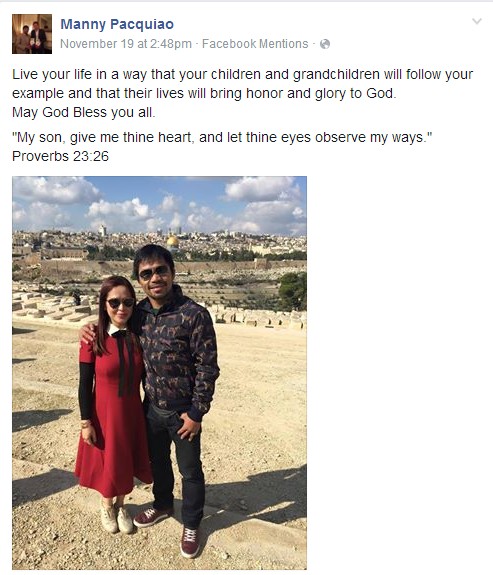
In good news of people who come to Israel even during these violent times: Manny Pacquiao, world boxing champion.  What’s his favorite city?  Jerusalem! (Of course!)

ScreenHunter_03 Nov. 21 16.03

Screen capture from Manny Pacquiao’s Facebook page.


Happy Thanksgiving!  Let’s all be grateful for our blessings and give thanks!

THANK YOU!

And now for something completely different

I don’t want to talk about the situation in Israel.  It’s not that I’m ignoring it or pretending that it’s not going on all around me, but I feel like constant attention to the news and repeatedly thinking about the events of the day is just causing a form of Post-Traumatic Stress Disorder.  The problem for Israel is that it is a collective PTSD causing itchy trigger fingers and shameful mob mania.

Instead, this is going to be about how I dealt with the stress this week.

Mandalas

I had seen mandala coloring pages and books in art stores for a while, but I wasn’t inspired enough to give it a try.  Then my friend M. invited me to a morning meditation with mandalas.  I have to admit I’m not a good meditator.  I’ve had good experiences once in a while, but I mostly suffer from what is commonly called “monkey brain.”  Thoughts pass into my mind, start making coffee and then go into an acrobatic routine.

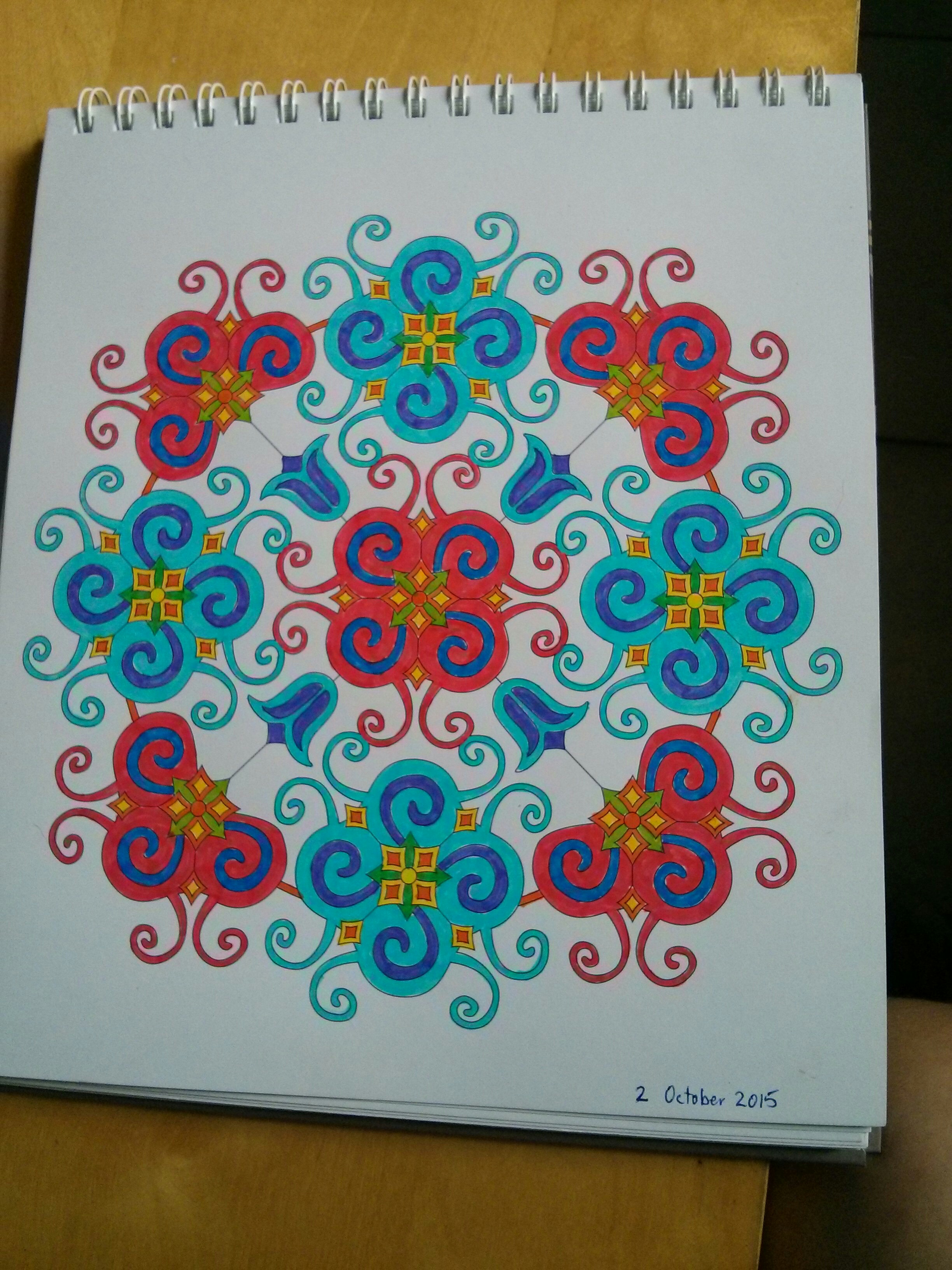
A few minutes of research on the net and I found that adult coloring is a thing.  Mandalas are also a thing.  Coloring mandalas is a growing thing.  It’s not about staying in the lines or purposefully coloring outside the lines.  It’s not about how beautiful or artistic the mandala should be / could be / would be if you had more talent. It’s about focus, being in the moment, and just enjoying the now.

So now I have my own book and various coloring implements so that I have options.

IMG_20151023_123310     IMG_20151023_123324

IMG_20151023_123336     IMG_20151023_123344

Work in progress

Work in progress

Turning back the clock

IMG_20151021_112235

The stuff on the left is what I actually bought. The stuff on the right is all the samples!

Three words:  Korean. Beauty. Products. My friend C. introduced me first to Korean dramas and now she’s brought me into the fascinating and ultimately pleasurable world of Korean beauty products.  Rather than write a treatise on the various essences, serums, toners, cleansers, and masks, suffice it to say, it seems that in the past month and a half of making a bigger effort, 5 years have disappeared from my face.

My first foray into the beauty products line was in Romania, so I’ve been using things I bought there.  This week, my first package from Korea arrived!  Yay!

Ladies night – out on the town

In honor of my birthday (a month ago), S. and C. took me out on the town last night.  (That’s right. In the middle of the knife intifada.)  We went to place called Gatsby.  It’s set up like a speak-easy, so upon entering, you are in a tiny room facing a wall-to-wall bookshelf.  With the right code words – something along the lines of “my friend is inside” or “I have a reservation” – the middle panel slides over and you get your first peek at the 1920s style bar.

Gatsby entrance

Gatsby entrance

They play the feel-good crooner oldies of the 1920s, 1930s, and 1940s.  The handsome barman is dressed like he just jumped out of a 1940s movie and has enough flair to make drinks that involve fire.  The food menu is limited and the drink menu seems to be limited to whatever Gatsby might drink.  I had a mint julep served in an iced metal cup.  S. had something called Made in Israel (would Gatsby drink that?).  C. nearly fell off her chair when they wouldn’t serve her a Cosmo, but eventually settled for a whiskey sour.  The food was stylized and delicious.  I would have taken pictures but the place was too dark.

Gatsby doesn’t serve dessert.  Where is Daisy when you really need her?  So we crossed the street to Berta’s where we had something called a Hedgehog, a chocolate indulgence that makes you forget all your problems, and an apple pie that makes you feel all warm and snuggly.  I topped it all off with a chai latte.

Hedgehog and apple pie

Hedgehog and apple pie

And what’s a night out on the town without presents?  S. and C. know me so well.  A few things to add to my relaxation regimen.  Thanks, ladies!

Tea, shortbread, and collagen serum.

Tea, shortbread, and collagen serum.

A Terrible, Horrible, No Good, Very Bad Week

If last week was bad, this week was worse.  Tuesday was a terrible day.  A glance at Facebook told me that two nearly simultaneous attacks took place in Jerusalem and two stabbings in Ra’anana (a suburb of Tel Aviv).  This is the age of instant images so there was almost immediate video and photos of the attacks.  Most of it was too graphic for me to watch.  Other days were not much better.

There is simply too much going on for me to process in any coherent way, but I would like to refer you to one article that analyzes the situation concisely and accurately.  Yesterday’s op-ed in the Wall Street Journal.

For my part, I can share my thoughts as someone who lives in Jerusalem.  I’m cautious.  I don’t go out unnecessarily.  However, I am not walking around in a paranoid frenzy.  I see people out and about.  They’re smiling.  Traffic still backs up on a particular road in my neighborhood and people still get annoyed about it and honk their horns.  Life is going on, just a bit more cautiously.

The problem with these attacks is that they are random.  You never know who might attack or when something might happen.  The sales of pepper spray are off the charts.  Self-defense courses are springing open.  Videos of what to do in case of a knife attack are available on the internet.  I’ve taken a self-defense course (before I went to Thailand) and my study of Tai Chi, believe it or not, helps me to feel a little bit more secure.

An email I received giving me links to information that can help during this wave of terror

An email I received giving me links to information that can help during this wave of terror

At the same time we’re hearing news of terrible things going on, I’m also seeing news of friends getting married, getting engaged, having happy moments with their children, sharing good times with friends.  People go out on purpose to show they are not afraid.  Life is still precious and with glasses clinking, To Life!

The political stuff

Two political points – I won’t ramble on too much about this, but I think they are important.

If you see a headline that says “Man stabs several people in the street,” you might think that the guy probably had a psychotic break.  If you see that headline a few more times and come to “Wave of stabbings occurring day after day,” you might start to wonder where the police are and what the heck is going on.  It’s a crime wave and something needs to be done.

If the headline is then “Palestinian stabs Jew,” the first thought should not be “Oh, well, alright then, he’s probably enraged about the settlements/Temple Mount/occupation/etc.”  If the stabbings in the earlier headline are troubling, the new designations should not change the shock and horror of the violence.  (“Jew stabs Palestinian” is equally horrifying and also not excused by rage over the situation.)

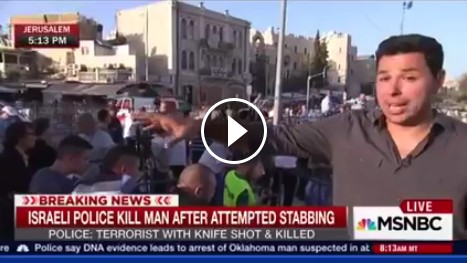
The worst is “Israeli police kill man after attempted stabbing.”  That is a headline with an agenda.  It is a true headline, but fails to mention the part where a Palestinian was the one trying to stab the police officer.  If the majority of people read only headlines, then Israel does indeed look like a violent police state.  In the screen capture below, the reporter also said that the guy was unarmed, but in stills, it is very clear that he has a knife in his hand.

Point #1: Read the article.  The headline is probably misleading.

The reporter misrepresented the situation and was corrected on air. But that doesn't change the headline.

The reporter misrepresented the situation and was corrected on air. But that doesn’t change the headline.

You might have heard about the 13-year-old boy who was mentioned by Mahmoud Abbas as a child executed in cold blood by the Israelis while he was alive and well in an Israeli hospital.  Besides the politics of that situation (we’d be here all day for that), I wonder why no one seems to be asking why a 13-year-old boy is stabbing another 13-year-old boy.

Where is the outcry about using this kid as a child soldier?  Who put the knife in his hand?  Is a 13-year-old legitimately enraged about the settlements/Temple Mount/occupation?  And if he is brainwashed to hate Jews, isn’t that a form of emotional and psychological abuse?  Who advocates for him?  Where are his human rights?

This is one kid in one situation.  I hope he is not a model for the next generation.  Palestinian activists point their fingers at Israel, blame Israel for the situation and claim that Palestinian lives are miserable, but I wonder why these same activists don’t take a nuanced approach and start asking who puts knives into children’s hands, sends them out to shed blood and encourages them to risk being shot by Israeli police.

Point #2:  The situation is complicated and there are no easy answers.  Look at the big picture.  

Let’s all have a Shabbat Shalom!  We could really use it.

Bringing guns to a knife fight

It seemed like every time I looked at Facebook this week, I saw another attack.  In the last few days there have been a significant number of knife attacks in Jerusalem and in other places around the country (Tel Aviv, Afula, Kiryat Gat, Hebron, and others).  There are a lot of people smarter and better informed than I am to answer the questions of: Why now? Is it because of the Temple Mount?  Is it because of the settlements? How should Netanyahu be handling the situation?

I don’t have those answers.  What I can do is share my thoughts on the situation as I see it and how it affects my day to day life.

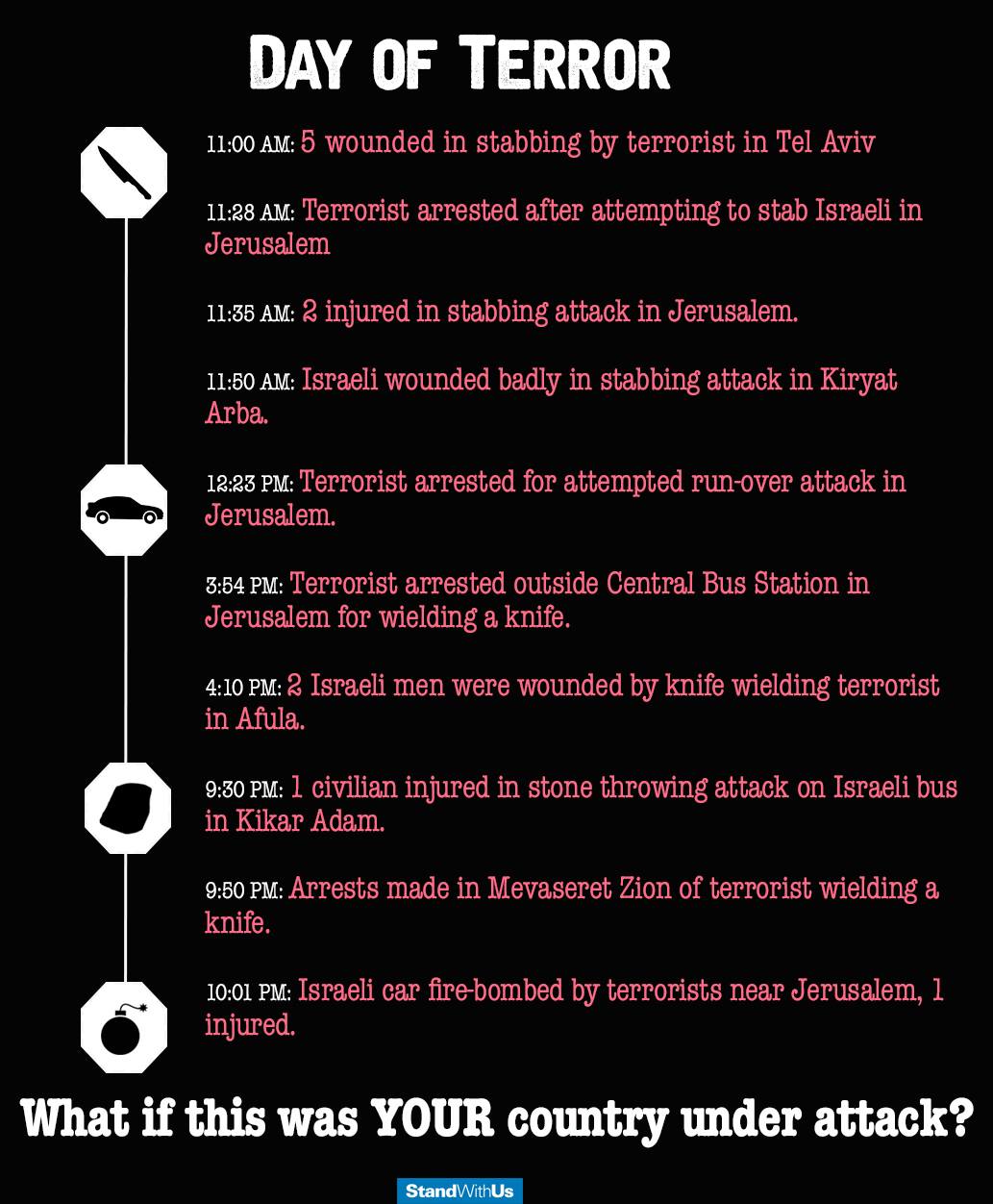
A terrible, horrible, no good, very bad day. (From the StandWithUs Facebook page.)

A terrible, horrible, no good, very bad day.
(From the StandWithUs Facebook page.)

I can honestly say that it’s scary.  But I don’t want to live my life paralyzed in fear.  I am, and will continue to be, cautious and aware of my surroundings. But in the same way that people don’t stop driving because of road rage or drive-by shootings, I’m going to go about my daily life.  I was going to have some visitors from the US and I would have gone into the Old City with them if they had decided to come.  In the end they canceled and I completely understand.  Meanwhile, this week I’ve been hearing a lot of sirens and there’s a helicopter circling regularly.

When you hear the word “stabbing,” it’s hard to imagine what that actually means.  We see it on TV and in the movies and in that imaginary world, it seems like a very survivable injury.  But then I thought about the last time I cut my finger cutting vegetables.  Sure.  It’s a tiny thing in comparison.  Then I tried to magnify the pain 100-fold or 1,000-fold.  I read a short piece written by a knife attack survivor.  She had been stabbed 13 times.  Besides the pain, the most disturbing part of her account was her description of the attacker.  What kind of dissociative state would you have to be in to plunge a knife into another human being 13 times?

Then there are the “rocks” being thrown at cars.  What’s a “rock” anyhow?  It’s not the rock that you send skipping across the water.  Make a fist.  It’s not a rock that size either.  In some cases, “rocks” are cinder blocks, the kind that you build houses with.  But not all rock-throwers are throwing cinder blocks; they’re heavy.  “Rocks” are generally about the size of a beer bottle.  Along with those rocks are actual glass bottles filled with gasoline and lit on fire.  This week I saw a video of an acquaintance of mine minutes after rocks had been thrown at his car.

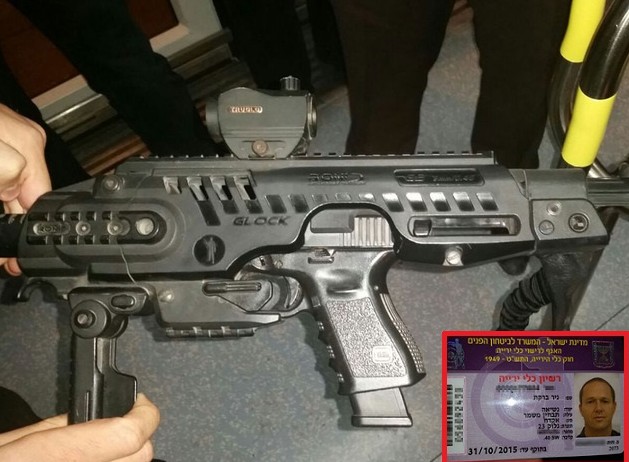
When this new wave of violence got started, our prime minister was in New York making a powerful speech in the UN and there didn’t really seem to be a policy in place.  The IDF was trying to keep a lid on a simmering pot, not very successfully.  And then, after a particularly bad day, the mayor of Jerusalem made a statement on the radio:  People with gun licenses and training should start carrying their weapons.

Say what now?

You can read his statement again, I’ll wait.  At first, I thought it was a mistake, but then it was reported in the English news and then it was backed up by the deputy minister of defense.  With the wave of knife and other violence, those people with gun licenses and training should carry their weapons and consider it a form of reserve duty.  (Nope, I’m not kidding:  HERE, HERE, and HERE.)

The mayor's converted hand gun. (Screen capture from the Times of Israel.)

The mayor’s converted hand gun and his license.
(Screen capture from the Times of Israel.)

To be fair, most men and many women serve in the military and have gun training.  It’s also not very easy to get a gun license in Israel.  On top of that, the number of Israel’s civilian gun accidents is quite low.  Israel has not turned into a Wild West town with a bunch of trigger-happy vigilantes.  I remember when a terrorist used a tractor to ram into bus in Jerusalem it was a quick-thinking, armed citizen (along with others) who shot the terrorist and saved lives.  I’m sure there are other examples.

I titled this post “Bringing guns to a knife fight” in part for the shock value, but that is actually what’s going on here right now.  The police and the army are not able to protect the citizens and we have to count on each other in these awful times.  I’m disappointed in and angry at the government and their inability to protect citizens, but one thing I know for sure is that when Israel gets attacked, we all stand together.

P.S.  I don’t want to post something about the media and the false picture they are painting outside of Israel, however, the “best” example is the BBC.

P.P.S . Things may get worse by the time I post this, but I want to leave you with a different image: As I write this, I have my door open so that I can hear the Greek music at the café across the street.  A few minutes ago, I heard rumbling engines and horns honking.  It was a motorcycle club on their Harleys flying Israeli flags and the honking was a show of support.  That is Israel.