So That Happened

On Monday a bus blew up.

I heard a lot of sirens all of a sudden just before 6pm.  At first I thought it was a VIP and his entourage.  But then there were more.  And more.

Facebook.  A friend’s comment.  “Anyone know what happened on Derech Hevron?” And then the answers started flooding in.  It wasn’t Derech Hevron.  A bus.  Was it terror?  Wait.  The police don’t want to say that yet.  Definitely bus on fire.  Second bus also on fire.  Then the evidence pointed to terror.

*Sigh*  I remember those days.  I didn’t like those days.  I don’t want those days back.

Between 6pm and 7pm I had to make a decision.  My Tai Chi class is in the same neighborhood as the bus bombing.  Should I take a bus as usual?  Class wasn’t canceled (of course), so I decided to walk.  I walked in part because I could use the additional exercise.  The chance of another bus attack was pretty small, but it’s been so long since a bus attack that I just didn’t want to get on a bus.

It took 45 minutes and I was pretty pleased with myself.

On the way back, another choice.  As I was passing the bus stop, the bus came.  I could have gotten on.  There were plenty of people taking the bus right then.  But I chose to walk.

I was happy with the accomplishment of walking to and from class.  It was a good long walk and something that I had considered doing before.  But I’m bothered by the fact that the thing that pushed me to do it was a bus blowing up.

Two days later, I had a chance to ease my bothered feelings.  I took a train and a bus to where I needed to go.  I walked in crowded areas where I needed to run my errands and life was back to normal.

Since this is Israel, “normal” right now means high alert.  Over major holidays in Israel there is a much more visible presence of security personnel and starting today and for the next 48 hours the West Bank and Gaza Strip are closed off.

I am sure that upon hearing the words “West Bank closed off” there are those who would cry “oppressive occupation” and excuse all violence against civilians as “legitimate protest.”  I disagree.  Besides nothing being “legitimate” about blowing up a bus filled with civilians, as a citizen of Israel, I expect my government and our armed forces to protect civilians.  I expect to feel secure as I walk or take a bus in my streets.  And when I look at images like this, I’m glad that security personnel are doing everything in their power to keep us safe.

bus bomb

Screen capture from HaAretz

Originally, I had plans to write a nice Friday email about my first Passover in Israel, but this week provided many other potential topics – this bus bombing, a follow-up on Western Wall/Temple Mount issues, and Prince, another icon from my childhood, passed away.  Well, it will still be Passover next Friday and I may yet write about these other things too.

Wishing everyone a peaceful Passover!

How is it Passover already?

It happens every year.  I know Passover is coming.  I see the introduction of Passover foods at the supermarket and then, BAM, it’s already here.  Passover is in a week, but people have already started and finished their major cleaning and are stocking up on Passover foods.

“Cleaning for Passover” means a lot of things to a lot of different people.  If you keep kosher, then “cleaning for Passover” means that you have cleaned all traces of bread, leavening, and any of the other forbidden grains out of your home.  Often that entails moving large appliances and being shocked at how much dirt and grime is under there, so then “cleaning for Passover” turns into a major spring cleaning effort.

Then once the house is “clean for Passover” you can’t bring any bread products into your house until after Passover.  If you’re like me, the idea of not eating bread makes me crave baguettes, sandwiches, cake, and every other flour-based product on the market.  I’m sure people manage to not eat bread (Atkin’s Diet anyone?), but around Passover, I can’t think of anything I want to eat except bread.

No bread

Some years I clean for Passover and others I don’t.  Interestingly, I found that if I don’t clean for Passover, I tend to have more ants in and around the house.  I imagine that our ancestors noticed that they had fewer bugs if they did some spring cleaning and the cleaning frenzy was conveniently timed around Passover when they weren’t supposed to have any bread products around anyway.  Coincidence?

Some thinkers take the idea of leavening into the spiritual realm.  What is bread if not substance filled with air?  How does a person who is puffed up with himself or herself appear to others?  Passover cleaning can also be done within to rid yourself of arrogance.

Another spiritual avenue gets to the heart of who you are as a person.  At first Moses didn’t have courage.  After he killed the slave master, he ran away to the desert.  He could have had a fine life, but then a burning bush spoke to him (and was not consumed).  If a burning bush tells you to go to Pharaoh to demand that he free the people of Israel, are you going to do it?  If you have a speech impediment (Moses did), do you think to yourself, “yeah, I’ll just clearly tell Pharaoh what’s what.”  Luckily, Moses had a brother (Aaron) who was willing to stand up with him and demand freedom, but Moses himself (and Aaron) had to have the courage and faith to do what needed to be done.

Standing on the shores of the Red Sea, the people of Israel bitterly complained.  They had Pharaoh’s army chasing them and the sea in front of them.  They wailed that it would be better to be slaves than die out here.  Moses assured them that the path would open before them, but they had to see it with their own eyes.  So the sea parted and they went forward.  But was it enough?  No.  After all they saw and experienced, they still felt the need for a golden calf so that they could have physical thing to worship.  Forty years in the desert would be enough time to raise up a new generation who only knew freedom, who would be courageous, and who would have faith.

sea-1034911_640

The Exodus is a Hero’s Journey for Moses as well as for the nation of Israelites.  We can be inspired and re-inspired by the story.  Each year we have the opportunity to find something new.  Are we going to find courage within ourselves?  Will we demand to see everything with our own eyes before we have faith in something?  Will we be courageous and free and then fill ourselves with our own arrogance about how fabulously enlightened we are?

In the meanwhile, I think I’ll move my refrigerator and clean underneath it.  I hope not to find anything new there, but perhaps I’ll find something that I lost in the past year.  Ah, well, that will be a spiritual story for another day.

A Trip Through the Kitchen and Down Memory Lane

I’m not a chef.  I know how to cook a few things, but I wouldn’t say that my skills in the kitchen are particularly stunning.  So why would I go to a cooking workshop?  For the company and the food, of course.

many hands
Many hands doing the work.  Plenty of spices, plenty of oil, plenty of fresh vegetables, plenty of good company.

I used my talents to do what I do best: I took raw material and massaged it into a relaxed, fluffy work of art.


​​The bread is baked on river stones in a very hot oven.  (Thanks to CB for these 3 photos.)

The truth is that throughout the evening of fun cooking adventures and fabulous dinner companions who chop vegetables better than I could ever hope to, I found myself happily remembering other cooking experiences and other dinners that were very Israeli and very special in their own ways.

Israeli food is flavorful.  Each recipe of our excellent dinner involved many “exotic” spices that are not at all exotic in Israel: sumac, turmeric, “spice store blend” – unique to every store and includes things like cardamom, cinnamon, pepper and at least three or four others that I can’t remember – both hot and sweet paprika, coarse cut black pepper, cumin, and who knows what else.  It’s also not measured by the teaspoon.  Spices in Israel flavor food by the rounded tablespoon.  Don’t be shy! Throw that stuff in there!

An ex-boyfriend of mine in Israel once described my cooking as having “delicate flavors” and with a pleading look in his eyes asked if I would mind terribly if he sprinkled half a bottle of chili sauce on it so that he could tolerate eating it.  He was (and I imagine still is) a MUCH better cook than I was.  But I learned.

As my adventuresome spirit in the kitchen expanded, I made a stir fry for this particular boyfriend and asked if he could recognize the spices I put in.  Spoiler alert: I used just about everything on the spice shelf using my nose as a guide.  It wasn’t too bad, if I do say so myself.  So he took a few bites.  Then closed his eyes and listed everything I put in there including stuff that he didn’t know the name of but knew the flavor of.  To this day, I can’t even come close to doing that.

2 pots compressed
​The first two pots.  One the left is the basis for shakshuka – very spicy! – and on the right is the basis for the meatballs with mangold leaves (something resembling Swiss chard).
meatballs compressed

The cooking workshop focused on Moroccan, Tunisian and Kurdish food using fresh, seasonal ingredients from the shuk, so as the cooking progressed, I was transported back to my former neighbors’ home for a Shabbat dinner.  The mother is Moroccan and a superb cook – and she ensured that both her sons and her daughter followed in her cooking footsteps.  She and her whole family are generously hospitable, so I had the pleasure of savoring her food in all seasons.
full stove compressed

My neighbors’ kitchen looked a lot like this on Friday afternoons.  Plenty of food for as many people as could fit at the table.  Everyone was always welcome and there was always enough.  Once I had surprise guests on Friday and I already had an invitation to the neighbors’ house.  I asked if I could bring a few more people and without thinking twice or batting an eyelash she said that they were welcome.  And even then, there was plenty.


The final result:  Full plate, happy (and full) tummy, stimulating conversation with new friends, and a pocket full of memories from years past.

Springtime Stroll in Jerusalem

While a lot of really depressing things have happened this week, this Friday post comes to you on April Fools’ Day.  So rather than try to make sense of that paradox, here’s a photo essay of a springtime walk in Jerusalem.

This week as I walked to various appointments I noticed that there was a wonderful aroma in the air and so many flowers were blooming everywhere I looked.   I didn’t take pictures at the time, so this afternoon I retraced my steps and captured some of the beauty of Jerusalem.

Community garden on Zamenhof Street, tended by volunteers from the neighborhood.

IMG_20160401_141040-COLLAGEZamenhof Street and Lincoln Street.  Funny fact:  The pronunciation of Lincoln in Hebrew doesn’t resemble the English very much.  All the letters are pronounced with an extra vowel between the last l and n – Lin-co-lin.

IMG_20160401_141325-COLLAGEOutside the Orthodox Union building.  They take care to bring lots of glorious color to the street.

IMG_20160401_142432-COLLAGENear Jabotinksy Street.  As I took the photos of the window box and the orange blossoms, a group of monks in brown robes tied with rope belts walked by speaking Italian.  Just a typical day in Jerusalem.

IMG_20160401_142714-COLLAGEGan HaShoshanim.  I was nearby, so I decided to take a detour and I’m glad I did.  Another interesting fact:  Gan HaShoshanim means rose garden, but there are no roses growing in this park.

IMG_20160401_143736-COLLAGEArlozorov Street.  Wisteria, lilacs, and many other beautiful things.

IMG_20160401_150119-COLLAGEAnd finishing my walk with a passion fruit ice cream.  I can happily confirm that it was GOOD!

IMG_20160401_152012

I hope you enjoyed this little springtime stroll.  There’s so much more to Jerusalem than the typical Old City views and while there may not have been actual roses to stop and smell, there is plenty of beauty to stop and admire.

Happy Spring!

Purim in Israel

Today and yesterday were Purim in Israel. The story of the holiday can be found in the Book of Esther.  A young Jewess wins a beauty contest to become queen and is uniquely poised to save the Jews of Persia from the very powerful Haman whose mission is to exterminate the Jews.

The story of Esther might not be your first thought if you are here in Israel on Purim.  Purim is celebrated as a cross between Halloween and April Fools’ Day.  Top items on the to-do list:  Drink A LOT and party like it’s 1999.  Give baskets of sweets to neighbors and friends (the opposite of trick-or-treat).  Pull pranks and laugh a lot.

You could liken this version of Purim with secular Easter celebrations.  Why does a bunny bring eggs in a basket?  Why does he hide them?  Why is the Easter Bunny a he?  What does a bunny have to do with Jesus rising from the dead?  Moreover, why is it that in France, Easter bells deliver eggs from Rome?  Well, I digress.

There are 4 things that you are actually supposed to do on Purim.

  1. Listen to the Book of Esther (in Hebrew, it’s Megillat Esther – you have to listen to the whole megillah)
  2. Have a festive meal where you drink a lot
    • This is where the sages suggested that you drink until you don’t know the difference between Mordechai and Haman
  3. Send gifts of food (in Hebrew, Mishloach Manot) to friends
  4. Give to the poor

You’ll note that dressing up is not mentioned and neither are pranks and jokes.

Purim is not one of those holidays where offices are closed, but workers are given the option of taking one of the two days off.  One of two days, you ask?  Purim in non-walled cities is on the 14th of Adar and Purim in walled cities is on the 15th of Adar (don’t ask, it’s complicated).  Jerusalem is considered a walled city, so we celebrate on the 15th, but since people have families outside of Jerusalem, some of them celebrate on the 14th.  Nowadays, the celebrating goes on for 2 days because it’s less confusing and a lot more fun.

ScreenHunter_01 Mar. 25 23.01

This guy’s video went viral in Israel for his awesome flight through Tel Aviv.

Back in the day, people used to dress up as characters from the Book of Esther.  No longer.  You’ll see superheroes; characters from literature, movies and TV; fantastical characters; clever visual puns; or at a minimum, people wearing funny hats or wigs.  If ever I dress up, I just plop on a tiara and call it done.  I read one article that traced the dressing up to Italian Jews following the traditions of Mardi Gras.  But the retroactively spiritual version, which I like, is that everything is hidden in the Book of Esther.  She wears the mask of a non-Jew to win the beauty contest.  God is not mentioned in the story, but the story is propelled forward by several coincidences that might be considered the invisible hand of God.

If you try to ask for hamantaschen in Israel, people will look at you funny.  The triangular, filled sugar cookie traditionally eaten for Purim is called oznei haman in Israel.  You might notice that Haman is mentioned in both cookie names, but strangely enough taschen and oznei are not the same.  Hamantaschen is the German for Haman’s pockets.  Oznei haman are Haman’s ears.  And then there is the common story that the cookie represents Haman’s hat.  But still, why are we eating anything related to Haman at all?  He’s a villain!  There’s no good answer for that, but the cookies are yummy nonetheless.

purim

There’s a joke about Jewish holidays that goes like this:  Jewish holidays can be summarized as “They tried to kill us.  They failed.  Let’s eat.”  Purim is a great example.  But it is also a reflection of day to day life in Israel and we don’t need any holidays to remember that.  So Happy Purim!  Let’s eat!

Choose LIFE – Jerusalem Marathon!

Dad will be officially remembered by friends and family tomorrow – even though he’ll be remembered by all of us all the time (with blessings to go with the memories).  I wanted to write a bit more about the mourning process – and I will – but not today.

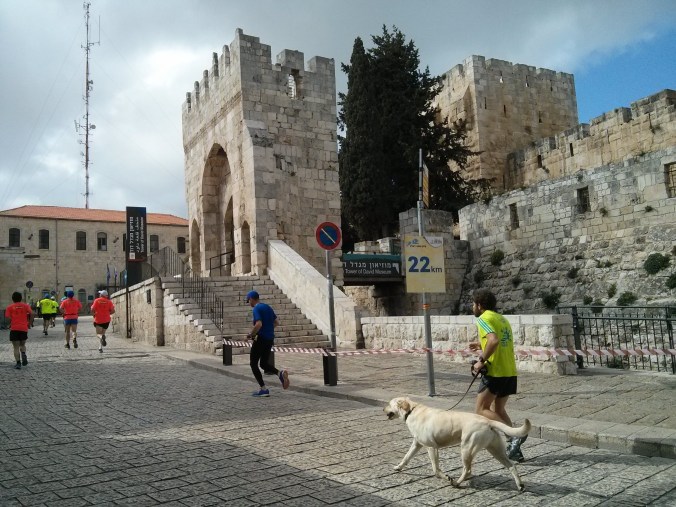
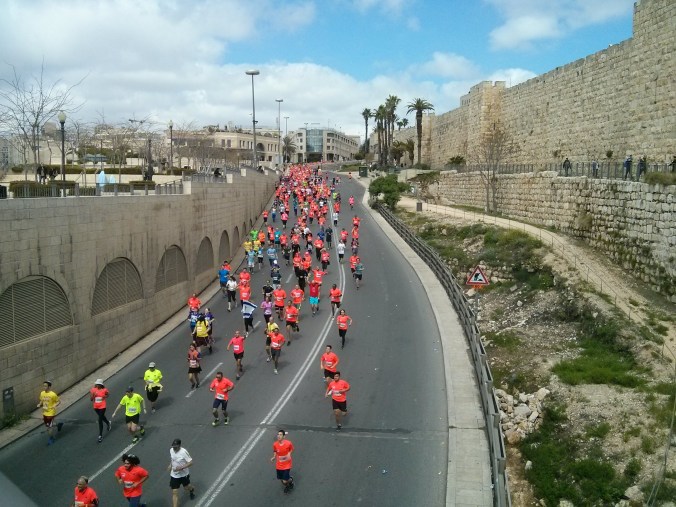
Today is my favorite day of the year in Jerusalem.  Today is the Jerusalem Marathon!  I love the fact that we close down the city to welcome people from around the world to run through the streets with smiles on their faces to celebrate life!  This year 25,000 people ran (2,500 of them from outside of Israel).  Not all ran the marathon; there were 22 km, 10 km, 5 km, and 1.7 km family fun run options.

This year Jerusalem – and all of Israel – has been facing a lot of terrorist violence in the streets, but that did not stop the marathon.  The police and army were out in full force and were a very obvious presence.  There is always significant security, but this year I noticed many, many more visibly armed soldiers, rifles at the ready.

I watched the marathon at Jaffa Gate – yes, that’s right, a number of stabbings took place there in recent weeks, but that wasn’t going to stop me.  There were fewer spectators than previous years, I’ll admit, but I did see many tourists passing by on their way to visit the Old City.

IMG_20160318_090902 (1)

From inside Jaffa Gate

I saw a lot of beautiful things today – in no particular order:

  • Blind runners were linked to guide runners so they could participate
  • Runners ran for causes and happily ran together with friends
  • There were runners in wheelchairs and those who couldn’t go on their own power had friends pushing them
  • Runners ran with their dogs

IMG_20160318_091203

  • Christians ran with flags of support for Israel
  • One man entered Jaffa Gate and took a cross from his friends to run with in the Old City (the cross was made of 1x4s, I think, was about 6 feet tall, and painted black with the phrase “Pick up your cross and follow me” on it.)
  • Other Christians handed out red roses as remembrances of those who died
  • At one point I was surrounded by a group of IDF soldiers who were passing by Jaffa Gate and at the same moment, a group of runners from a particular soldier corps ran by.  I’m not gonna lie – that was a gorgeous sight to behold!
IMG_20160318_103234

My favorite view of the marathon – Batman is cheering on the runners (directly below the Tower of David


IMG_20160318_102847

Approach to Jaffa Gate along the walls       


IMG_20160318_094159

Spiderman on a skateboard – he’s one of the guys cheering on the runners

(Link to my video – a few seconds of the marathon, for atmosphere [I hope it works. It’s my first uploaded video ever!])

Last year, I had a meaningful experience at the marathon.  I had some self-doubt about the direction I was going with my life and just crested the stairs as I arrived at Jaffa Gate, the music overwhelmed me with the lyric “Don’t you worry, don’t you worry, child. Heaven’s got a plan for you.”   Turns out there was a plan.

IMG_20160318_103608

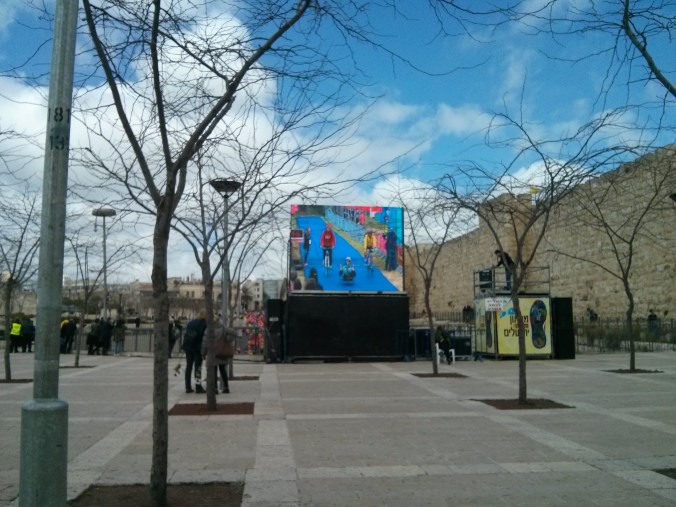
The DJ and the nearly empty plaza (people did pass through, but didn’t hang around here)

I wondered what the music would bring this year.  The DJ was the same after all.  I have to say, I feel bad for the poor guy.  He probably arrived before dawn to set up and then spent the entire morning playing music and calling out “AAAYYY, OOOHHH!!! AAAAY, OOOHHH!!!! BOKER TOV, YERUSHALAYIM!!!!  EIZEH YOFEEEEEEEE!!!!!  KOL HAKAVOD!!!!!”  I’m surprised he doesn’t get laryngitis.

I was waiting for a friend to pass by who was running the 10K.  The DJ played a remix of “Billy Jean” by Michael Jackson and I knew my friend, who is a fan of Michael’s music, would arrive within a few minutes.  And I was right!

The DJ played David Bowie’s “Let’s Dance” – “If you say run, I’ll run with you.”  Since David Bowie recently died of cancer, I felt like it was a moment for my dad – even though he was not a fan.  Another reminder of my dad was seeing the business owners around Jaffa Gate. They just did what they normally do:  drink coffee and smoke cigarettes.  Dad would have been very comfortable indeed with those guys.

I meandered around a bit longer and I thought to myself, “The music was better last year.” I hadn’t even finished the thought, and guess what?  Swedish House Mafia, “Don’t You Worry Child.” And it starts like this:

There was a time
I used to look into my father’s eyes
In a happy home
I was a king, I had a golden throne
Those days are gone
Now the memories on the wall
… And my father said, “Don’t you worry, don’t you worry, child…”

And I smiled (through a few tears, if I’m totally honest).

This week Israel ranked (again) as the 11th happiest country in the world. The study uses several guidelines and benchmarks to support the findings, but I think it only takes coming to Jerusalem on marathon day to see that this is true.  No matter what happens, we choose life.

In the end, this did turn out to be a bit about Dad, but I’d like to think it was more about the ability to celebrate life and be joyful in the moment.

Mourning in the Morning

Mourning in the Morning

Yes.  That’s a play on words. Is it appropriate? Well, in my family it kind of is. We deflect with humor.  That’s not to say that the jokes always work.

At the same time, the statement is also true.  During the day, and even late into the evening, I can distract myself and I don’t have to face the reality that Dad is gone.  But in the morning, in those moments when I’m coming out of a strange dream and I don’t know what’s real and what isn’t, I notice a hollow feeling just under my sternum.  And then I remember that Dad is gone.

Death is easy, mourning is hard

At the risk of sounding too glib, I feel like death is easy, but it’s mourning that’s hard.  We don’t understand death and we don’t know what happens, but it seems like once we’ve wrapped our minds around death, then mourning is swept under the rug.  You know, life goes on and you just have to pull yourself together.  Do what you gotta do and move on.  If you don’t move on, well, there’s something wrong and you should get some professional help.  After the trauma of death, moving on with life should be easy, shouldn’t it?

I don’t know about other religions, but the Jews have an app for that (I know, terrible).  There are a lot of traditions and rituals for all sorts of things, but the general principles of the one for mourning make a lot of sense.  The relationships that call for these mourning rituals are: mother, father, spouse, brother, sister, son, daughter.  Once the burial occurs, the family goes home and “sits shiva” for 7 days (shiva is based on the root for the word 7).  Everything stops for them – no work, no taking part in their normal lives.  The next milestone is the “shloshim” (30 days after the death).  The family goes to the cemetery for the unveiling of the headstone and has a special ceremony.  Every day for 11 months, the mourners say Kaddish (a prayer said when someone dies, which is not about death at all, but praises God).  And then on the anniversary of the death and every year after, the mourner remembers their loved one and lights a candle that lasts 24 hours.  (There are many, many other rituals and traditions, but this is not meant to be a primer on Jewish mourning.)

The basic principle here is that you are able to mourn and take note of every “first” without the person in your life – the first week, the first month, the first birthday, the first holiday, the first year.  I like the principle, but I have to admit the format doesn’t quite work for me.  Living in Israel and being 10 time zones away from my dad created a distance that is also felt in the mourning process.  I didn’t see dad every day.  I didn’t even talk to him every day or even every week.  We just talked whenever.  So the first 7 days was important to allow myself to wrap my brain around the fact that dad is gone, but I didn’t “sit shiva” in the traditional sense.  My firsts will be the first time I want to call dad and tell him about something that happened, the first Father’s Day that I have no one to call, the first time I can’t call Dad on his birthday, the first time Dad doesn’t call me on mine, the first New Year’s.  These will be the days that I feel the loss more acutely.  As for my everyday life, Dad was distant before, and now he’s just a little bit further away – without any cell service.

IMG_20160309_165720

This is a memorial candle that burns for 7 days – more on this in another post.  This picture was taken on Day 5.  I haven’t let the flame go out (even at night).

Jews also have some guidelines for those who visit the mourners.  It’s common sense, for the most part.  Be quiet.  Let the mourner start the conversation.  Listen.  Share memories of the loved one.  So while I didn’t shut down my life for a week and sit shiva in a traditional sense, I had what might be called a virtual shiva.  My friends called and let me talk about Dad and they took the time to listen.   Some shared their thoughts about how they dealt with death of their own fathers.  Facebook allowed my friends from around the world to share their condolences.  My close family in Israel came over and we shared memories about Dad.  The whole process felt much more genuine to me than having a lot of people stopping by.

Thank you to all of you who sent good wishes.
It made me feel truly loved and supported.
Big virtual hugs all around!

My own process of mourning brought into much clearer focus the aftermath of a terror attack – and we’ve had quite a few this week.  When it isn’t our loved one, we look at the political ramifications, figure out how to defend against it so it doesn’t happen again, celebrate the heroism of defenders, share briefly in the sorrow of the mourners.  After the funeral, the press moves on and so do we.  But someone actually died.  That person’s family is grieving.  They are going to go through all the firsts and that hole that was created in their lives will never be filled again.  It will heal, but there will always be a scar.

The blessing of memory

While baruch dayan emet (Blessed is the true judge) and the Kaddish help to ensure that you don’t lose faith when you’re going through such a hard time, yehi zichro baruch (May his memory be a blessing) helps you to heal the scars in your heart.  I find myself smiling at memories of my dad.  I’m happy to hear about the memories of my dad from others.  I’m slowly filling up that hollow feeling in my chest with good feelings and happy memories of my dad.  I don’t expect that the empty feeling will  go away entirely, but the memories will definitely be a blessing.

Death is a door

Nobody likes to talk about death.  There are so many euphemisms for death just so that we don’t have to say it.  Transitional: passed away, passed on, crossed over, went to the great beyond, no longer with us.  Scientific: expired (like milk?), deceased.  Fated: taken, number came up.  Weird: kicked the bucket, bought the farm.  Yesterday, my dad cashed in his chips.

RWS_Tarot_13_Death


It might be a little scary to think of Death coming as a Grim Reaper to gather your soul.  So scary that maybe immortality is better (and so say many, many TV shows and movies, especially vampire ones).


In the Tarot deck, Death seems like it would be the scariest card.  It’s Death!  But it is actually the one with the most potential.  Death means change.  One thing passes on to make room for another.  The loss is sad, but there needs to be room for something new to come into your life.


The truth is that while I like all the euphemisms – mostly because I like to play with language – I don’t think that death has to be feared.  It will happen to all of us.

Here in Israel, there are also many euphemisms for death.  Niftar comes from the root meaning “to be released.”  Halach l’olamo means “went to his world,” which, all things considered, sounds very pleasant.  There is talk of an olam ha’bah, “the next world.”

When my grandmother “went to her world” I was 8 years old and didn’t quite understand why she left her cane.  Hysterical, I shrieked, “How is she going to walk around without it?!?!”  Dad told me that where she was she didn’t need it anymore.  She was young and healthy and having a picnic in the shade of a tree with Grampa Brown, who was also healthy and young.  The tree was by a small stream.  It was a sunny, warm, pleasant day and they were happy.

In order to get to this other world, you have to go through a door.  That door is death.  We don’t really know what is on the other side of the door.  We are asked to have faith that when our souls leave the body they’ve inhabited on this earth, our pure souls, the sparks of light that we are, will go on to something else, something better, something our material minds cannot even begin to comprehend.

Of the things you say to a mourner, my favorite is yehi zichro baruch, sometimes said as zichrono livracha, which means “may his memory be a blessing.”  To me it means that every time you remember the dearly departed, there is a blessing that comes with it.  I like less baruch dayan ha’emet, which means “blessed is the true judge.”  That more or less suggests that God works in mysterious ways and we praise God even in sorrow.

Dad wasn’t an Eric Clapton fan, but “Tears in Heaven” seems appropriate.

Beyond the door
There’s peace I’m sure
And I know there’ll be no more
Tears in Heaven.

Dad, your memory is a blessing to me and all who knew you.  Holding on to those memories keeps you close to my heart.  You’ve gone through the door and I hope whatever is over there is exactly as you described it.  You have been released from this world and the pain of illness, and I’d like to imagine you are with your mom and dad having a great picnic.  When the time comes (far in the future), please be there to greet me and show me around.

DSCF0036

Me and my dad, zichrono livracha

Only in Israel moments?

Another season, another reason, for makin’ whoopee…

In the family values corner, we have a hotel ad playing on the fact that it is a leap year.  In Hebrew, they say a “pregnant year” rather than a leap year, so one hotel in Jerusalem decided that that would be the basis of their promotion.  “Make babies in our resort on February 29 and you’ll celebrate your life events at the hotel, on us.” (For the article and whole video ad see here.)

ScreenHunter_01 Feb. 26 14.28

Wedding crashers?

A couple from the US came to Israel to have their wedding and for various reasons many of their guests couldn’t attend.  Nearby another group was celebrating a bat mitzvah.  The guests of the bat mitzvah saw that the wedding lacked guests and so joined in to bring a little life to the party.  Wedding crashers, you say?  Not in Israel.  When a bride and groom are married, the guests are there to perform the mitzvah of simhat chatan v’kallah, rejoicing with the groom and the bride.  Guests provide the joyful spirit, dance with the bride and groom, give their all to make the couple happy on this very special day.  (For this story, go here.)

Hipsters in Zion

I read a blog post written by a woman who suggested that early Zionist leaders could have been hipsters.  They had pretty awesome beards.  The author went with Herzl for looks.  I don’t know what she was thinking with A.D. Gordon.

ScreenHunter_02 Feb. 26 14.45

But when I first saw the headline, I thought she meant these artist renditions.

ScreenHunter_03 Feb. 26 14.47

Hi-tech history

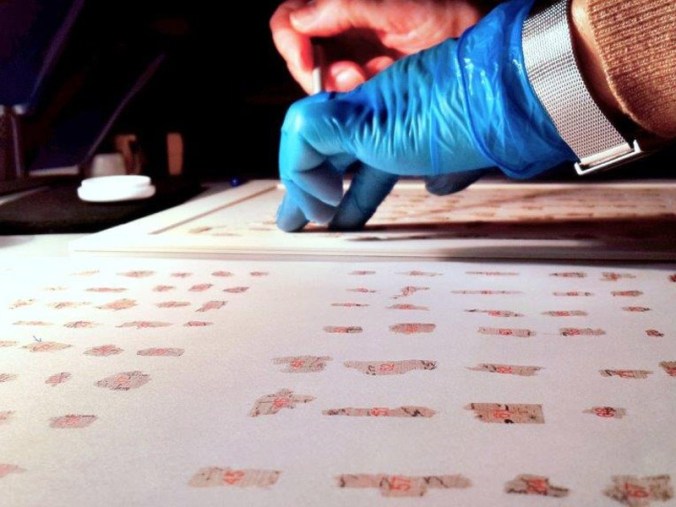
The Dead Sea Scrolls are getting even more digitized.  Just imagine:  Some guy wrote stuff down 2,000 years ago.  Those scrolls were put into pots and kept in caves.  Someone accidentally came across them and – long story, short – they ended up in a museum.  Scholars study them.  People visit them.  They were digitized and visible online to anyone with an internet connection.  This new project is upping the digital ante by making a whole new virtual environment to work in to decipher mysterious elements of the scrolls.

deadseascrolls1

Copyright: Shai Halevi – Source.

And what do you do on school field trips?

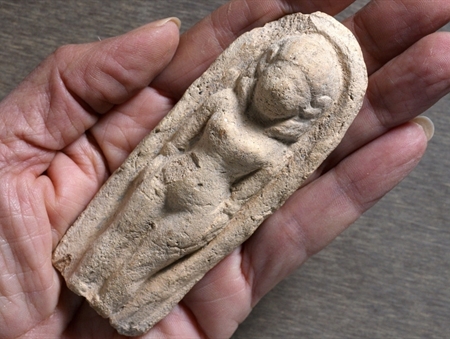
Oh, you know, find 3,400-year-old artifacts.  How about you?

Surprisingly, some of the biggest and most important finds in Israel were found by children on school trips or hiking on their own.  The nice part of the story is that the child and his family turned it in to the Israel Antiquities Authority.  He got a certificate for good citizenship and IAA officials visited his school.  Will it inspire him enough to become an archaeologist some day?  I hope so!

kid

Copyright: Clara Amit – Source.

And that was another side of Israel for this week.