Danger in Israel

It’s not terror.  There have been more deaths in Israel due to traffic accidents than terror.  I had a friend who kept track of these things (I trust him because he is a science person) and he found that even in the worst days of the Second Intifada, there were still more people killed in traffic accidents than due to terror attacks.

This week a full bus collided with a truck stopped on the side of the road on Highway 1 in Israel.  Six people died, three of them were under 18.  It’s especially horrible because the driver of the bus had already had an accident similar to this one on the same road and was suspended from driving between cities for two years.

Israel is still safer than other places in our part of the world.  (For statistics and another opinion, see this article.)  I remember being in Sinai and our driver was driving on the wrong side of the road.  When asked why, he said that this part of the road was smoother, so there was no reason for him to do damage to his car if the road was simply better on the other side.  You could see miles ahead, but it was still a bit disconcerting because he drove like he was being chased.

In Egypt, a taxi driver was taking us to the airport in the wee hours of the morning.  He didn’t have his headlights on, so we mentioned that he might want to turn them on.  He said that having them off saved gas.  (If anyone can tell me that this is true, please comment.)  Besides, there were streetlamps on the highway, so nothing to worry about.

Here in Israel, there is a different driving culture than most Americans are used to – and thankfully it’s not quite like Sinai or Egypt.  Streets are noisy.  The horn is a method of communication with your fellow drivers.  It might say, “Hey! I’m right here (in case you are not using your mirrors).”  Perhaps, “Woohoo!  I’m going through the intersection.”  Taxi drivers often use it to say, “Hey! Wanna taxi?”  It is also used aggressively, “Go!!! The light changed .3 milliseconds ago!!!”  Or “what the hell is the matter with you?!?! Why are you making a 3-point turn in the middle of the road and blocking both directions of traffic?!?!”  This last one is more common than you might think.

A video of driving on the highway in Israel.  It’s not that bad.  Really!

My Israeli driving test

When I converted my US license to an Israeli license, I was required to take at least one lesson, but I didn’t have to take the written part of the test.  In those days, English-speakers told many horror stories of awful driving tests and almost no one passed on their first try.  Additionally, in Israel you can get an “automatic only” license or “manual transmission” license that allows you to drive both standards and automatics.  I went for the manual since I knew how to drive one.  But I was worried.

You take the test in the instructor’s car, which is why it’s good to have at least one lesson so that you can get used to the car.  I arrived at the testing facility and was going to be tested with another student in the car.  The person giving the test didn’t speak a lot of English, but we decided it would be fine.  I carefully pulled out of the parking lot, taking my time and generally being over-cautious.  We get on the road and the tester says “Left!”  I was in the outside lane so I changed lanes to the inside lane.  He started yelling, “Left! Left!” and then tried to grab the steering wheel.  I used a Karate Kid wax off motion to block and shouted back “Ok.  I got it!”  He meant the left turn lane.  So I made the turn.  “Pull over.  Stop the car.”  End of test.

I was sure I had failed.  It was Friday and I wouldn’t get results until the next week, so I spent the weekend wondering how many more lessons I would need, how much it would cost, hoping that I wouldn’t fail too many times and have to take the written portion in Hebrew.  The results came out and I passed.  I guess it was because in the chaos I still had control of the car.  I didn’t question it and I won’t now.  As far as I’m concerned it’s just another miracle of the many that take place in Israel.

And if you decide to visit Israel, don’t worry about terrorism, just be sure to look both ways before crossing the street.
A simmering pot

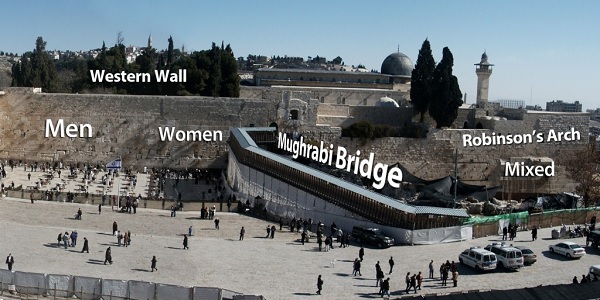
Last week Israel’s cabinet agreed to have a mixed gender prayer area near the Western Wall plaza that would be administered by Israel’s government not the (ultra-Orthodox) foundation that administers the Western Wall .

Yay for plurality! Hoorah for equality!

This is widely seen by the Jewish community outside of Israel and many inside Israel as a good thing because it feels more inclusive and is more open to the non-Orthodox communities who don’t feel connected to the Orthodox vibe of the Western Wall open air plaza. Now they have their own place. It’s close to the plaza, but at the same time they are not in each other’s faces about how they choose to commune with God.

But hang on…

First of all, this space has existed for quite a while. It’s not new. What is new is the entity that would administer it and the fact that it would be expanded. Until now, it was just a tacitly agreed upon space for Reform, Conservative, and various other streams of Judaism to gather and pray as they wish (mostly by not separating the genders).

Women of the Wall have been advocating for plurality and equality and part of the organization agreed to the mixed-gender space. The members who don’t agree feel that they should be allowed to pray in the women’s section as they wish – they don’t really want a mixed gender space. The problem they’ve been facing is that the Orthodox do not agree that a woman can be allowed to put on tefillin, wear a prayer shawl, or read from the Torah. They have fought this battle in court (and won), but have been harassed by both men and women at the wall and arrested for disturbing the peace for gathering at the Western Wall to pray.

Then there are the archaeologists who say that the new construction would damage the archaeological evidence that exists there – specifically, evidence of stones from the wall that fell during the Roman conquest.

Like any other decision, it’s complicated and there are naturally positives and negatives. Decisions get made with compromise and everyone has to give a little.

But there’s more. And this is why this article is called “the simmering pot.”

The violence (aka the knife intifada) that began last year is based on a perception that Israel is trying to change the status quo on the Temple Mount. In October 2015, UNESCO voted on a draft proposal that tried to declare the “Western Wall an ‘integral part’ of the Al Aqsa mosque compound.” That was eventually dropped, but in November Mahmoud Abbas insisted that Israel was trying to change the status quo on the Temple Mount by protecting “settlers” who were “violating” Muslim and Christian holy sites. (The “violation” being prayer. Jews are not allowed to pray on the Temple Mount and are arrested by Israeli police for doing so.) And now, with the vote on the mixed gender prayer site, the Waqf (the Jordanian authority administering the Al Haram al Sharif [Temple Mount]) has declared this vote Israel’s newest intention to change the status quo by “Judaicizing the holy site.” The “holy site” in this case being the Western Wall.

Let’s look back to September 2000. Ariel Sharon visited the Temple Mount to show that all Israelis have a right to visit the site. And then we had the Second Intifada. (Yes, that is a wild oversimplification.)

A vote for a mixed gender prayer site seems like a small thing. But this is Israel. The Western Wall supports the Temple Mount compound where the Al Aqsa Mosque and the Dome of the Rock stand. Context and interpretation are everything. And so the pot simmers on.

Tu B’Shvat Aliyah

In Hebrew aliyah translates literally as “ascend.”  It’s also the word used for immigrating to Israel.  For reasons unknown to me, the English is styled as “to make aliyah.”  I made aliyah (or I ascended) to Israel on February 8, 2002.  It wasn’t exactly Tu B’Shvat, but that year it had been the week before.

I was met at the airport by my aunt, my mother’s sister, who not only immigrated to Israel first and raised her children here, but also was in charge of bringing many more Jews to Israel in her various roles in the Jewish agency.  She took me to her house first where I showered and slept for a while.  It was a night flight and I was totally exhausted.

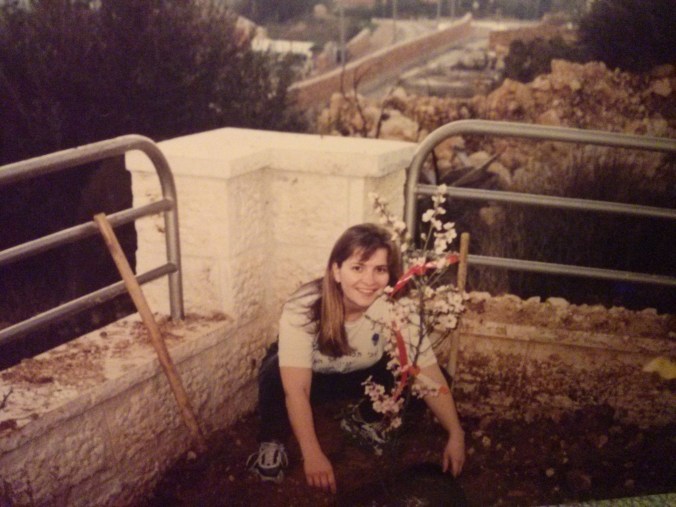
Later in the afternoon, my cousin arrived and we were all just sitting and catching up.  But then my aunt made an announcement:  We have to plant an almond tree before the sun sets.

My cousin and I set to digging and planted the tree.

IMG_20160204_231013

What do you do on your first day in Israel?  If it’s Tu B’Shvat and your name is Ilana, you plant a tree, of course!

Roots

And then something happened and that poor little tree died.  Well, you know, sometimes trees have a little difficulty adjusting to a new place.  The gardener said that was that and whattayagonnado?  So they cut it down.

And then something odd (miraculous?) happened.  It grew back.  Apparently, the roots had survived and it just rejuvenated itself from its own root system.

Birthday for the Trees

In last week’s post, I mentioned that Tu B’Shvat is the New Year for the Trees and that in Hebrew the holiday is called Chag L’Ilanot (Ilan is a tree; Ilana is the feminine version).  I make a special point of Tu B’Shvat because in 2002, it represented a new beginning for me – a new year for this Ilana.  Every year a new chapter unfolds in late January/early February; I’ve gained a year in Israel and I have a clean slate for the next year.

Even though my birthday is around the Jewish New Year and I like the feeling of January 1 as a definitive calendar page turn, I like Tu B’Shvat because I chose this new year and by the circumstance of my name, it chose me.

Epilogue

I don’t know if the tree in my aunt’s garden is still the rejuvenated one or if it was replaced.  But it actually doesn’t matter.  There is an almond tree in that corner of the garden.  Whether it is the one I planted with my own hands, the one that rejuvenated itself from its own roots, or a new tree altogether, the end result is that every version of that almond tree belongs in that place.

The snow that wasn’t, the freeze that was, and the trees


Snow in Jerusalem! Or not. 

This week Israel had a huge storm and it was very cold.  Everyone was hoping for snow and the forecast was for 5 to 6 inches of snow sticking in Jerusalem.  Israelis tend to get very excited about the idea of snow in Jerusalem.  It’s rare and even the most hard-boiled, cynical sort might smile a little at the thought of white stuff all over the city.

IMG_20160126_121028

The snowstorm that wasn’t

Then it rained.  A lot.  The forecast changed to maybe 2 to 3 inches.  And then the storm passed.  Altogether the “snow storm” part of the storm was about 30 minutes one evening.  And nothing stuck to the ground.  (Other parts of Israel that are at higher elevations did get a bit of snow.)

The day after the storm was supposed to be clear and sunny.  So all’s well that ends well, right?  Not so fast.

A word about Israeli plumbing

A lot of people have solar heaters for their water tanks so their boilers are on the roof.  For some reason (I don’t really know the whole history), water pipes are on the outside of buildings going up and down from the water tanks on the roof.  There is a chance of freezing, but it rarely gets cold enough in Jerusalem for that to happen. Until it does.

My water heater is not a solar heater with pipes leading up and down from it.  My pipes have not frozen in snow storms or in cold snaps.  Until they did.  It was a very cold morning after the storm passed and I turned on my shower to find nothing coming out of the tap.  I turned on the hot water and I had plenty of boiling hot water – too hot to bathe in.  What?!?!

It seems that the water from the main source froze in the pipes.  My neighbors, with their solar heater, had no water at all in the morning.  The neighborhood had a few pipes burst, so there was water running in the street.  The city had to turn off all the water to fix the municipal pipes, so I had no water at all for a couple of hours.  Finally, the water came back on in the afternoon.

Needless to say, I dripped the faucet last night because while it is gorgeous and sunny, it’s still dipping down around freezing at night.  Good news!  The water was running this morning!

Tu B’Shvat

Tu B’Shvat is a minor Jewish holiday that happened last week.  I hesitate to say “was celebrated” because the main thing to do on this day is plant trees and it was way too stormy for that.

Tu represents the Hebrew letters that add up to 15 and Shvat is the name of a Hebrew month.  It has ancient connections to taxing and tithing.  Anything before Tu B’Shvat is from the year before.  Anything after is considered in the new year.

Traditionally, Israelis eat a lot of dried fruit for Tu B’Shvat – dates, figs, apricots, pineapples, kiwis, and a lot of other stuff I don’t even recognize or know the names of.  Some take a more mystical/spiritual approach to Tu B’Shvat and have special dinners with symbolic foods.  Everyone in Israel knows when Tu B’Shvat takes place because all the almond trees in the country are in bloom.  It’s truly amazing to see hillsides filled with beautiful pink blossoms at the end of January.

tu-bshavt-21

It’s also generally known as the “new year for trees” or the holiday of trees.  In Hebrew that’s Chag L’Ilanot.  So to all the other Ilanas, Ilans, and any actual trees out there, Happy New Year!  Take a day off.  You deserve it!

The Silent Treatment

When I read The Great Brain as a kid, I remember being surprised by the punishment that the parents gave to their kids.  This was late 1800s Utah and spanking was perfectly normal.  Not for these kids.  These parents gave “the silent treatment” for a specified length of time. The author described it as the worst of all possible punishments.  At least with a spanking, it was over and done with.  The silent treatment made the kids feel invisible.  Oftentimes, the kids would cry with relief when the silent treatment was over because they felt like they were returned to the land of the living.

ScreenHunter_03 Jan. 23 19.46

This week Israel’s newspapers were filled with the news of a woman who was stabbed to death in her home, in front of at least one of her six children (four were her natural children and two were adopted).  She was a nurse who was learning Arabic to better communicate with her colleagues and patients.  By all accounts she was an amazing person.

And then I saw a surprising headline that asked why Dafna Meir’s murder was not reported in the international media.  We all know that “if it bleeds, it leads.”  There was plenty of blood.  We saw the pictures.  Check.  The victim is sympathetic – a mother, a wife, a nurse. Check.  It was a pretty dramatic story.  She was stabbed in front of one of her children and the manhunt went on for quite a while.  Check.

I went to Google and typed in her name and went to the news tab.  Page after page of Israeli newspapers or Jewish newspapers around the world reported the story.  But no major international news organization was reporting it.  I found one small German paper that reported it in full, but I couldn’t determine if it was a Jewish paper or not.  But it was true.  The international media ignored her.

Dafna Meir lived in Otniel, which is a small town in Judea and Samaria (you could read that also as a “settlement in the West Bank”).  She was a religious Jew.  The 15-year-old Palestinian that stabbed her was on the run (meaning that no Palestinian was injured in this attack).  So if you believe that the simplest explanation is the most likely, then we are faced with an anti-Semitic media ignoring any news that doesn’t fit into their narrative and agenda.  (Here is a very good article about this.)

The next day – while Dafna’s murderer was still at large and her funeral was taking place – a pregnant woman was stabbed by a Palestinian in her store in Tekoa (another small town in Judea and Samaria / another settlement in the West Bank).  She was not killed and the Palestinian was arrested.  Now the international media paid attention.  The attack in Tekoa and that other thing that happened the day before “represent a shift in the recent surge of violence.

The Meir family has publicly stated that they harbor no hatred against Palestinians. A Palestinian friend, who is apparently a relative of the murderer, paid a condolence call and was welcomed by the family.  Unfortunately, this bit of the story does not play into the “cycle of violence” narrative that the New York Times has put together to explain why murder in the settlements is understandable.

Conspiracy of Silence

While the simplest answer may often be the right one, some things still bother me.  How does every single editor of every major news outlet in the world decide that this story – a mother murdered in her home in front of her child – get ignored?  Can it really be that every single major international news organization blindly accepts that a woman murdered in her home is just the price she paid for living in that neighborhood and moreover that she should be ignored because she doesn’t fit the narrative that has been dictated by a certain political agenda embraced by the paper?  Did every single international journalist really shelve their humanity to serve a political agenda?

Many journalists claim to try to bring justice to underprivileged and underrepresented people.  They claim to want to shed light on the truth.  They are presented as “brave” and “unrelenting” in their pursuit of the story.  Today, I am reminded of the bitter and all too accurate pun:

If vegetarians eat vegetables, then what do humanitarians eat?

The international media’s deafening conspiracy of silence is the worst kind of punishment they can deliver.  With their silence, they ensure that Dafna Meir doesn’t exist and that their fixed narrative is unshaken.

I hope that all of us together can demand more from journalists.  Or perhaps call out the lazy and hypocritical ones.  We may even eventually find the invisible hand directing the narrative, the one that ensures that no one thinks for themselves or asks questions.

But for now, as a start, I will not be silent.

Lorax

“Music hath charms to soothe a savage beast”

In Memoriam

As I was thinking about what to write this week, I was thinking a lot about David Bowie, and then I heard the news about Alan Rickman.  Both aged 69.  Both died of cancer.  Both chose to keep their illness secret.  The news of both their deaths shocked their fans to their cores.  Both did the work that they loved until their last minute on this Earth.

David Bowie’s music is part of the soundtrack of my youth.  Alan Rickman played roles that will forever be his, marking them with his unique style.  I admire both their bodies of work and I am saddened by the news.  The arts truly suffered a significant loss this week.

But this is where things get interesting.

david-bowie-2013

David Bowie

“Music hath charms to soothe a savage beast”

When the news of David Bowie’s passing was publicized my Facebook news feed had almost no other news.  Everyone I knew and everyone they knew seemed to post sad thoughts, memories, favorite songs, favorite movie scenes, how David Bowie influenced their lives, tributes, and anything else connected to David Bowie.

In Israel this week, the political left and right are pretty much at each other’s throats right now.  But all of their noise was drowned out by David Bowie.  People who normally don’t post on Facebook posted tributes.  People from every political viewpoint posted about David Bowie.  Video of David Bowie coming to Israel in 1996 found its way online within a few hours.  Stories of David Bowie’s connection to Kabbalah made their way online.

Over the next days, I saw even more stories connecting David Bowie to everything. Society. Change. Accepting oneself.  Reinventing oneself. Fashion. Music. Art. Film. And cancer, of course.  The most unusual link was Could Big Data have saved David Bowie?

ScreenHunter_01 Jan. 15 21.56

Here is my Facebook post about David Bowie.  And that’s the point of this essay.  David Bowie transcended everything.  I even mentioned him in my recent Christmas post.  His rendition of Drummer Boy / Peace on Earth with Bing Crosby is really the story of his legacy.  The musician presented his passion and music as a gift and with that perhaps we might eventually have peace on Earth.

He played Nikola Tesla in The Prestige.  Other actors could have played Tesla, of course, but with his eyes of different colors; his forward thinking; his constant striving to reinvent himself, his music, his life; no one else should have played him except David Bowie.

tesla

In the Jewish tradition, when someone dies, we say “may his [or her] memory be a blessing.”  I think David Bowie’s memory will be a blessing for many, many people all around the world.  And at least for a few days, the world put aside their differences and united in remembering his music and art.  That sounds like a blessing to me.


Sticks and Stones … But Words …

Sticks and Stones Will Break Your Bones, But Words Will Frame Your World

After a month of holiday posts, the elephant in the room should probably be tended to.  Violence.  Yes, it is still going on.  In Israel, but everywhere else as well.

Last week, after I posted my entry to the blog, news came out of a shooting in Tel Aviv.  It was unclear at the time if it was regular violence, Islamic State-inspired terrorism, or a mentally unbalanced individual who went off the rails.  As of this writing, the perpetrator is still at large and there are still not many concrete details to be had because of a gag order on these events. (*Update: as of this posting the perpetrator was killed in a shootout with police.)

This week in Israel there is also a debate about whether torture was used during questioning of the suspects of the Duma arson attack that killed members of a Palestinian family, including an infant.  A few days ago a 21-year-old Jewish settler was indicted for murder in the case.

Then there is the odd story of the militia men in Oregon who have taken over a federal building.  I just read a news story that called them “Millennium Marlboro Men.”  Somewhere between the lyrical, romanticized descriptions of these guys, I gather the problem has something to do with land rights and freeing two guys who are in prison.

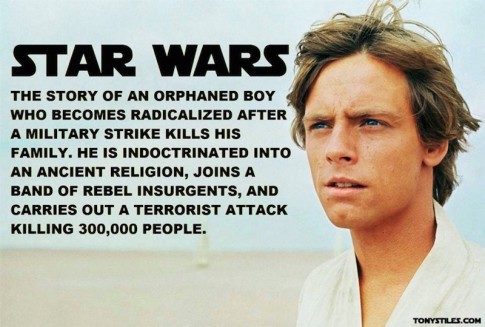
In the midst of it all, a Facebook meme and a proper opinion piece come up with the narrative that Star Wars is the story of how Luke Skywalker became a radicalized terrorist.  It’s a bit tongue-in-cheek, but there is some reasonable logic behind it, if you look at the story in a certain way.

starwars-485x327

(*Disclaimer: I don’t buy into this at all because I know that Star Wars is a Hero’s Journey story.  Hero myths are present in all cultures in the world and a “hero” is not usually a conformist.)

It’s the words that make all the difference in each story.

If the events are described as “terrorism” then it’s easy to condemn the perpetrator.  Throw in possible mental illness, well, then it’s a tragedy for all concerned and the finger of blame points at the perpetrator, but also the society that failed him (especially true in the US).  Toss around the term “Jewish terrorism” and, in Israel, the shock and shame are palpable.  iPhone-toting Marlboro Men with guns dressed in camo is straight out of the movies.  They are taking over a federal (read: Evil Empire) building for freedom.  And then our hero Luke.  He uses the Force to fire a rocket that blows up the Death Star and kills hundreds of thousands of people.  Is he in the Rebellion or is he a radicalized terrorist?

So who shapes our world?  Are we swallowing what’s given to us or are we critically thinking?  After all, the phrase “justifiable homicide” feels different than “cold-blooded murder.”  “Terror” is a lot heavier than “random shooting.”  It’s above and beyond the idea of “one man’s terrorist is another man’s freedom fighter.”  In the global society that we live in today, if someone decides that a person is a terrorist, then that can be proclaimed from the global rooftop.  Someone else can decide that same person is a freedom fighter and shouts that from the global rooftop.  Then it becomes a matter of who gets more social media followers, facts be damned.

Here’s the last news item for this week.  Shurat HaDin (an Israeli NGO) did a Facebook experiment.  They opened two pages:  one incited against Israelis and one incited against Palestinians and they uploaded a bunch of content to both.  Then they reported both.  The one that got shut down was the one inciting against Palestinians.  The one against Israelis didn’t (until the experiment was publicized).

In the end, it also matters who runs the global rooftop that you are shouting from.


New Year’s Special

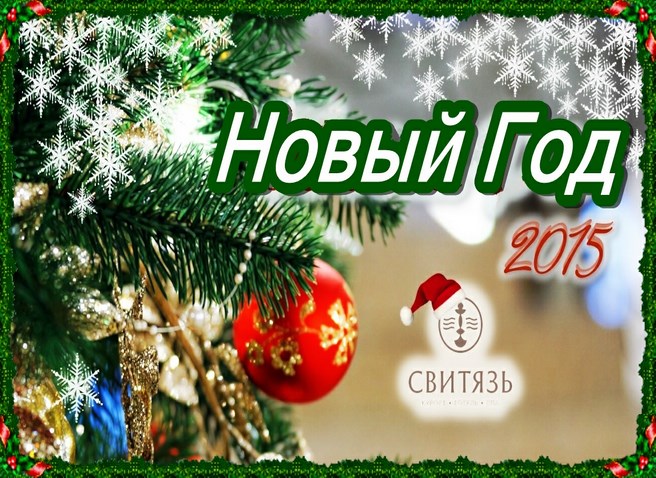
Happy New Year!  Here in Israel people celebrate it, but not like they do elsewhere in the world.  Israelis like any opportunity to throw a party and have a good time, so December 31 – called Sylvester in Hebrew (after a pope, if you can believe it) – is a convenient time for that to happen.  Israel also has the influence of immigrants from the former Soviet Republics.  New Year in the Soviet Union looks like secular Christmas – decorated trees, Grandfather Frost who brings presents, and spending time with friends and family.  But Noviy God is Noviy God and if you ask a person from the former Soviet Union they will absolutely insist that it has nothing to do with Christmas.  Apparently this year, they went all out for Noviy God.

svityaz-noviy-god-2015

Not Christmas, Noviy God.

January 1 is not a day off.  If being at the office on Christmas and dating documents 25 December is weird, being at the office and writing 1 January seems almost criminal.  But there it is.  New Year in Israel was in September.  The first of January is just new page on the calendar.

Last night the weather was not cooperating.  Torrential rain would be an understatement.  The trees outside my house were nearly blowing sideways.  There are rumors that there might be snow in the next few days too.  And yet, I was able to hear all the revelers throughout the night.  Why they would want to be out in this weather is beyond me.  I quietly rang in the New Year with a toast for good health, much happiness, and great success in 2016!

Question of the week

What is the flaw in our society that ensures only outrageous campaigns get attention?

On Christmas Eve last week I went to a lecture about the influences Palestinian youth are subjected to that are likely inspiring them to attack Jews with knives.  The short answer is that Palestinian society under the direction of the Palestinian Authority honors “martyrs,” creates children’s programming broadcast on state television giving praise to 5-year-olds with aspirations to use knives to kill Jews, and hammers home the message that Jews are the descendants of pigs and apes.  There are literally thousands of other examples of this kind of messaging in Palestinian society.

Any person in their right mind would see these things and be horrified and call it what it is: emotional and psychological child abuse.  And yet it goes on and no one talks about it.  The speaker is well-informed, intellectual, and has sound, extensive documentation of every claim and the organization has the ear of members of the Israeli government and the US government, among others, and there is hardly a whisper of condemnation.

At the same time, a debate was raging in Israeli society about a “provocative” (their word) campaign done by a Zionist organization calling attention to the fact that certain NGOs in Israel are funded by foreign governments.  The video is disturbing, no doubt, and they name names calling certain members of these NGOs “moles” or “foreign agents.”

The debate spread like wildfire over every media outlet.  Every news program discussed the “provocative” campaign and then began to question the facts.  Everyone had to have an opinion about the proposed law (to require NGOs that receive more than half of their funding from foreign governments to make it known and for their representatives who come to the Knesset to visibly identify themselves as members of these organizations).  There were even those who agreed that one targeted organization was in fact harming Israel’s image abroad and was disingenuous about its stated goals, but still were upset by the “provocative” campaign.

The targeted organization, by the way, was not suddenly the victim of a provocative campaign.  Another organization wrote a well-documented report showing that a large portion of the money this organization receives is from foreign governments, including a consortium managed in Ramallah of funds from foreign governments.  That report has been out for months and I believe there was even a press release.  But no one discussed it.  No one thought about it.  No one asked any questions.

I’m deliberately not naming organizations because the issues they raise are far bigger than a simple blog post could cover.  The point of this is to ask the question:  If the facts are out there, why do we need to have over-the-top, shock-and-awe campaigns to get any response from anyone?  Have we really slipped into a sex-sells, if-it-bleeds-it-leads global society?

On the other hand, if we want to get anything done and “go viral” do we have to bend with the fickle winds of the internet and make every issue bigger, stronger, faster, more outrageous, more outlandish, wilder, crazier, more shocking, and push the limits beyond their stretching point?  Is this what debate looks like today?

Here’s my (political) wish for 2016:  At least once in 2016, let’s move toward reasoned debate using facts and speaking with our inside voices while turning our backs on the circus that media has become.  Let’s lead by example. Each one of us can reward, at least once next year, calm, rational debate.

Happy New Year!  The best is yet to come!

Christmas Special

I like Christmas.

There.  I said it.  I’m a Jew who lives in Israel and I like Christmas.

I like the lights.  I like Christmas trees. I like Christmas carols.  Don’t get me started on Christmas cookies and gingerbread houses.

My enjoyment of Christmas follows the philosophy Dr. Seuss, one of the great philosophers of our time.  The Grinch cannot steal Christmas because it is not based on material goods.

My favorite movie for Christmas is It’s a Wonderful Life.  The message is simple: You matter.  The things that seem insignificant to you matter a great deal to someone else and could change their lives.  George Bailey is accidentally $8,000 in debt and everyone bands together to help him because without him they would not be who they are.  Not only do you matter, but we all matter to each other.

The Little Drummer Boy has nothing to give but his drumming ability.  And the gift he gives is his song and his passion.


In O. Henry’s The Gift of the Magi, the man gives up his prized watch to buy a comb for his wife’s beautiful hair and the woman gives up her beautiful hair to buy a watch chain for her husband.  It was not the gift that mattered, but the sacrifice that each was willing to make for the other.

In Dicken’s A Christmas Carol (written and all the multitude of film adaptations), Scrooge realizes that all his wealth is pointless if he is alone.  His gifts to the Cratchit family are not about buying their love or spoiling Tiny Tim.  Scrooge finally has someone to share his bounty with.  The Cratchit family matters to him and he matters to the Cratchit family.

I’ve heard that there is a “war on Christmas” in the US and I wholeheartedly agree.  But it is not the war on whether or not it is okay to greet people with a “Merry Christmas!”  The war on Christmas begins with consumerism and greed.  It continues with encouraging children to make demands of gifts without also teaching them gratitude.  It is probably not much of a coincidence that we go from the “give me candy” of Halloween to the “give me presents” of Christmas while forgetting about the “thank you” of Thanksgiving.  It breeds in the culture of the disposable that has forgotten the meaning of value.

I’m not a pre-rehabilitated Grinch or Scrooge.  I don’t think that Christmas should be all about ideals.  Have all the stuff!  Enjoy the glorious wrapping paper and the excitement of presents under the tree!  Bring out Santa’s Christmas magic for the kids and enjoy the egg nog!  But don’t forget that the real spirit of Christmas is you, the choices you make, the example you set.  Aren’t we all reminded at Christmastime “peace on earth, good will to all”?

A note about Christmas in Israel

We are not surrounded by Christmas carols in the malls.  Decorations featuring stockings, trees, or Santa are few and far between.  There are no piles of gorgeously wrapped presents next to elves and Santas awaiting children to tell them their Christmas wishes or have pictures taken with them.

But there is Christmas.  There is a significant community of Arab Christians and they do have the familiar decorations with the tree, lights, presents and family dinner.  But it’s more of a religious holiday.  Secular Christmas is not a thing in Israel.

ScreenHunter_02 Dec. 24 22.06

Though here’s NORAD’s evidence that Santa did come to Jerusalem.


Today is a regular day in Israel.  I must admit that in the early years of living in Israel, it felt weird to be at work and write 25 December on a document.  That also means that if you wish to celebrate Christmas, you have to ask for the day off and use your vacation days for it.

A Christmas Tale

A couple of evenings ago, I heard about a singing duo backed by a jazz trio who would be singing Christmas carols at a pub in town.  But they would be singing only carols that were written by Jews.  That is A LOT of songs, by the way, and most of them are the most famous and most beloved songs of Christmas: White Christmas, Winter Wonderland, Chestnuts Roasting on an Open Fire, Silver Bells, and plenty more.  (Others have written about why this is, so I won’t mention it here.)

But here’s the interesting part:  I went to the pub and I couldn’t get a seat.  It was totally packed with middle-aged, religious American Jews.  It may have been a coincidence, but the men could have passed for Santas with their beards and round bellies shaking like bowls full of jelly.  The women with their headcoverings might as well have been wearing kerchiefs.  There weren’t any reindeer available, so I just walked home.

Even though last night ‘twas the night before Christmas, Happy Christmas to all and to all a goodnight!

1 Fun Thing; 1 Serious Thing

Hmm.  What happened this week?

Star-Wars-Force-Awakens-Poster-640x480

If you don’t know what this is, then I don’t even know where to begin.

Star Wars!

No, I didn’t go to the premiere in Israel, though I read a great review about it. It was a pretty big deal here.  And I have to say that I’m glad people went out and made a fuss.  Terrible things continue to occur in the streets, but come hell or high water, nothing stops Star Wars.  (It did actually rain a lot recently, so the high water remark was not just a throw-away line.)

The great thing about being in Israel for the premiere is that we saw it before you all did! (Neener, neener, neener!)

I will see it, but I may wait a while because the idea of a hugely crowded theater kind of turns me off.  On the other hand, Star Wars.  No spoilers please!

And now for something completely serious.

There are a number of debates in Israel right now about many things, but one that bothers me, and one that I don’t have an answer to, is the directive issued by the Israeli Medical Association.  They said that the wounded in a terror attack should be treated in order of severity, no matter who they are.  What this means in practice is that if an attacker has more severe wounds than a victim, the attacker will be treated first.

A volunteer emergency services organization, ZAKA, has refused to comply.  They said that they will treat Jewish victims of the attack first.  Their rationale is based in Jewish teachings: “He who is merciful to the cruel will end up being cruel to the merciful.”

One of the incidents that caused the Israeli Medical Association (IMA) to make this ruling was an attack in Beer Sheva where an Eritrean ran away from the scene and everyone in the area thought he was the attacker.  So he was beaten and kicked by the bystanders and eventually died from his wounds, in part because he was ignored by the medical services personnel.

On one hand, I can see the humanity of using triage to rank all the wounds of all the people.  Who really knows with absolute certainty in the middle of chaos who the attacker was?  On the other hand, is one horrible situation the measure to use for making the rule?  How do you explain to the family of a victim of an attack that you treated the attacker first?  What if the victim is permanently disfigured or perhaps even dies while the attacker survives because of the triage decision you were forced to make?

Attackers are treated in Israeli hospitals by Israeli doctors and stay in rooms probably down the hall from their victims.  The news reports of the case in October of the 13-year-old stabber showed him in Hadassah Hospital.  In the same hospital, his victim was put in a medically induced coma and miraculously woke up (*he celebrated his bar mitzvah this week and claims to be 95% better).

I heard an interesting/troubling comment after the IMA announcement was made.  Security services may feel that they shouldn’t shoot to stop an attacker, but actually shoot to kill so that the attacker will not take a victim’s place in triage.  I’m not sure that is the intent of the ruling, but it could be a consequence.

I was also troubled by the phrasing of the ZAKA response.  I hope that they meant all victims of an attack, not just the Jewish ones.  I hope that they wouldn’t set aside an injured victim who was a Druze, Bedouin, Christian Arab, or Muslim Arab simply based on the fact that he or she isn’t Jewish.

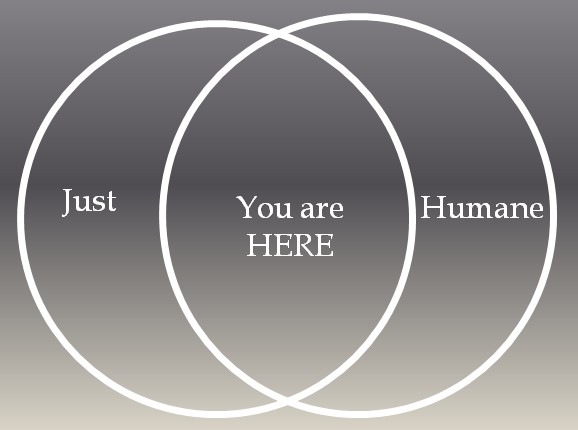
In the middle of chaos, emergency services need to know what to do, so they need some kind of directive.  But which one is “just”?  Which one is more “humane”?  There are no simple, easy answers here and we find ourselves in the gray area yet again.

ScreenHunter_01 Dec. 18 20.01

And that will do it for this week!

To those of you who are going to see Star Wars, DON’T TELL ME ANYTHING!  Thumbs up or thumbs down would be okay though.