“Alternative Facts”? Sure, I’ve heard of those!

alt-factsI just liked this headline from The Guardian

When Kellyanne Conway used this phrase this week, my first thought was that if she had any sense she would have said that it was a “different interpretation of facts.”  And then it occurred to me, “Hey, we have plenty of ‘alternative facts’ reported about us in Israel.”

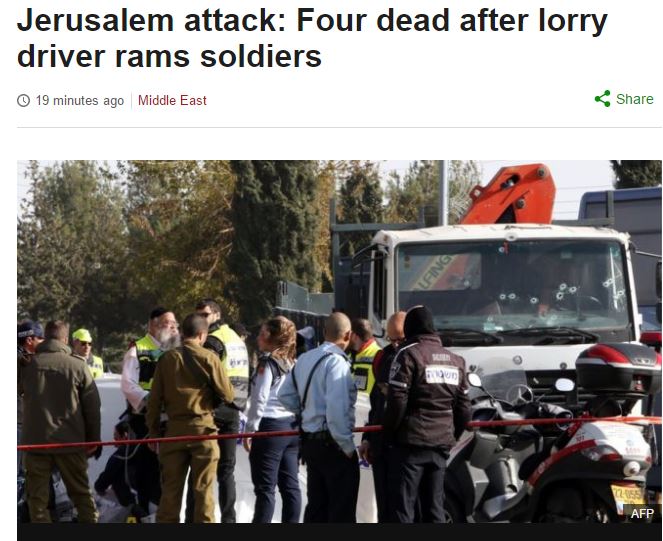
A few weeks ago 4 soldiers were run over by a truck driver on purpose in a targeted attack.  Here’s what the BBC first reported.
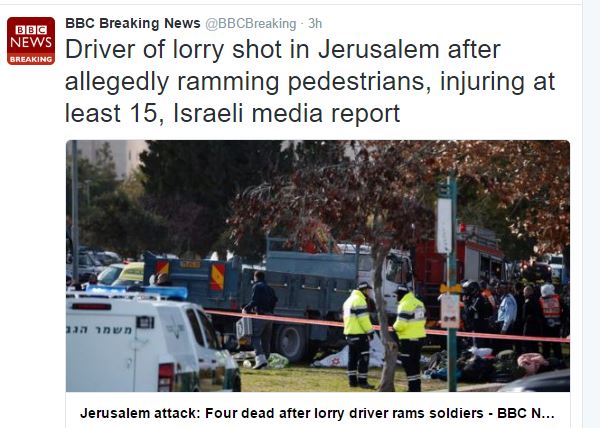
bbcScreenshot from my computer

There is actually nothing untrue in this headline.  A truck driver was shot.  It happened in Jerusalem.  There were allegations that he hit people and injured them.  And the Israeli media reported it.

But do you see the problem here?  It’s the arrangement and presentation of the facts.

Does it feel different when you see the headline this way?  Here’s their later post.
bbc3
Screenshot from my computer

Still true, but now you understand who the victims are and who the perpetrator is and that it was an attack – not an alleged attack according to others.

I’m an editor.  I work with words for a living and it matters how facts are framed.  For instance:

Four young soldiers murdered in vicious truck ramming attack.

Four killed by truck.

Truck driver runs over four soldiers.

Terrorist shot in his truck after he killed four soldiers.

Truck driver shot after fatal accident kills four.

All of these sentences have the same facts, but you feel differently about each because of how those interpretations are framed.  And yet none of them is a lie.

The most shocking example of different interpretations of facts I’ve heard of was in 2007 when a master’s student won an award for a research thesis that looked into the question of why IDF soldiers don’t rape Palestinian women.  Her conclusion – hold on to your socks – it’s because IDF soldiers are racists and dehumanize Palestinian women so they wouldn’t even want to rape them.  Let me repeat.  She WON AN AWARD for this work and Hebrew University stood behind the decision.  (Here’s an analysis of the paper done by a professor at Haifa University. Here’s a shorter article about it.)

That’s an alternative fact if ever I’ve heard one.

I’m not defending Kellyanne Conway.  I’m not defending journalists who write news stories with their own biases and agendas.  And I’m not defending the academic world.

I’m appealing to you, dear reader, to be aware.  Read multiple news sources.  Read news you don’t agree with (in moderation if you have high blood pressure).  Watch out for fake news.  Analyze and deconstruct what you read and hear.  More than anything else, hold people accountable for the words they use and how they use them.

More on history and truth from my blog:
The truth about history.

How history will remember.

UNESCO rewrites history.

Oh, Jerusalem

Today is Inauguration Day in the US.  In Israel, it’s just an ordinary Friday.  We’re running our weekly errands and preparing ourselves for Shabbat or other weekend plans.

US voters in Israel tend to vote for the president on one issue and one issue alone: how will the next president relate to Israel.  It’s a variation on the punch line, “yes, but is it good for the Jews?”  This is understandable.  We human beings care about our immediate surroundings, our families, and our close friends.  If it doesn’t affect us personally, then it’s more of an “out there” issue and not an “in here” issue.

Israel, it turns out, has the same opinion.  I ran across a video from Mayor Nir Barkat asking citizens of Jerusalem to welcome President Donald Trump as a friend and to sign a letter supporting the decision to move the US embassy to the undivided capital of Israel, Jerusalem.  I’ve spoken to other Israelis and they agree with our mayor.  I don’t think this is a minority opinion.

(It’s 1 minute and subbed in English.)

As great as Trump may be for Israel, I feel that Israel may be a bit narrow in its view and possibly short-sighted.  Leaving peace negotiations aside and all the problems in the Middle East (yes, I can do that!), if a person is insulting the leadership of other countries, nominating a cabinet that seems to be unqualified for their positions, and is divisive in his own nation – is that person actually good for Israel?

I would have to research it more, but it seems similar to Israel being one of the few countries that had dealings with South Africa at the height of Apartheid when all other countries were boycotting South Africa.  The rationale was that Israel had so few friends in the world.  Is that the case today?  Many, many Israelis would say it absolutely is.

Well, I’m not a political analyst, so I don’t know what will happen.  It remains to be seen.

I still like our mayor – he’s done a lot of great things for Jerusalem – but since I’m already questioning him, I have another complaint.

I don’t drive in Israel.  I have a license, but I don’t enjoy the experience and I live in a place where parking is almost non-existent.  It’s a lifestyle choice.  But this week, I had an unbelievable experience in traffic.

MFA was driving and I’m glad she was and not me.  I don’t know if I could have handled it.  After lunch one day, we got into the car to drive the 5-10 minutes to my house.  We got on a main road and saw that it was clearly rush hour, but still, it was only about a mile, traffic should be moving, right?  Nope.

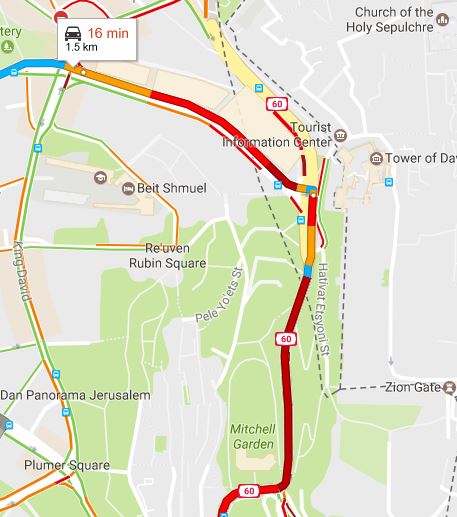
trafficThis is our route and the traffic situation as I write this post.

This main road runs under the walls of the Old City, so it’s impossible to turn off onto a side street – there are no side streets – so you are stuck.

On the way, in the opposite lane, we saw a guy violently pop his car up on a curb, leave his wife in the car, and forcibly pull another guy out of his van to let him know how much he disliked his driving.  That was tense.  Luckily, they got back into their cars and went on – whew, no fisticuffs.

We finally get to the left turn we need to take and MFA is careful not to block traffic in the intersection too much since we can’t quite get all the way into the next street.  Then we’re stuck there for a good long while.  We move about a foot in 10 or 15 minutes.

A young woman edges up close to us as if she wants to get into our lane.  This seems totally bizarre because there is no reason for her to get into our lane right here and she’s blocking cars behind her as well as merging traffic from the other side. People, including a bus driver, get out of their vehicles to yell at her and she just shrugs her shoulders at them.  Some – who are not blocked by her – are laughing because this girl clearly just doesn’t care at all.

The car in front of us moves a bit and MFA decides to be nice and let the girl in because it should loosen up all the traffic that she’s blocking.  And this girl, this crazy, crazy girl, cuts across the lane to MAKE A U-TURN!!!  She’s blocked by traffic going the other way that won’t let her in.  And at the same time, ANOTHER CRAZY GIRL taps the back of the first girl’s car and swerves around her TO ALSO MAKE A U-TURN!!!

crazy
In our car, we are both screaming.  WTF!!!

When we get to the end of the street we see that many of the problems here stem from double-parked tour buses and people blocking traffic as they try to get into the parking garage.  After we passed the last entrance to the parking garage, there was not a car in sight!  Nothing.  Completely clear roads.

I’m sure I should care about the US Embassy moving to Jerusalem, but to be honest, I think a bigger issue is this stupid traffic and selfish drivers.  Yeah, I probably seem to have narrow vision and may be short-sighted, but I’ll tell you what: When the sun is setting and the colors are changing on the gorgeous walls of the Old City of Jerusalem, I don’t want to feel murderous rage toward my fellow human beings who don’t care at all about anyone else around them.

No matter what Trump’s relationship with Israel is, he’s not going to fix traffic.

Dear Mr. Mayor, I know you need to have vision and see the big picture, but I’m too embarrassed about this traffic situation to want anyone to visit, much less move the embassy!!  Fix this first!!

Fragile / Not Fragile

Not a good coincidence.  Two days after I wrote about the history of Hill of Evil Counsel/Armon HaNatziv another awful event was added to the disasters on that hill and I’m writing about it on Friday the 13th (which actually has no meaning in Israel – you can take the girl out of the US, but you can’t take the US out of the girl).

On Sunday four soldiers, three girls and a boy, were killed by a terrorist using a truck as a weapon.

Groups of IDF soldiers come to Jerusalem on Sundays for cultural education days during their service.  You’ll see them at museums, visiting historical sites, and also at overlooks like this one.  In Israel, men and women between the ages of 18 to 22 serve in the military.  Men serve around 3 years and women serve nearly 2 years.  You can intellectually understand the numbers reflecting their ages, but you don’t realize how young they are until you see them.

My office job is at a museum and I took time to notice the soldiers who came in this week.  Their eyes are clear and innocent.  They haven’t seen serious difficulties yet.  They still have their whole futures ahead of them.  They are full of idealism and hope.  They are not yet cynical and jaded about life.

The American part of my brain still notices that every one of them carries a weapon slung across their shoulders and the Israeli part of my brain knows that this is perfectly safe. When they go into a tour of the museum they lay their weapons in a square built up like Lincoln Logs and leave one or two people to guard them.  It’s a weird feeling to pass a gun tower made up of 50 or so rifles guarded by another young person with a rifle at the ready.  This is not out of the ordinary.

Yet, these soldiers are still kids.  They are kids with targets on their backs.

In the days after the attack, I find my senses heightened.  I’m listening a lot harder. Is that a helicopter? How many ambulance sirens were there? Are those footsteps behind me?  And I’m tuned to my surroundings.  Is that a shadow? Have I seen that person before? What are they doing?

I went to the shuk the next day and ran my errands as usual, all the while keeping vigilant watch on everything around me.

The illusion of calm had been fragile.  Our will and courage to go on is not fragile.

A Hill in Jerusalem

With a hat tip to MR for telling me to write about this, I’m taking a page (well, a book really) from James Michener and will share the history of a particular hill in Jerusalem.  Today this beautiful overlook south of the Old City is called Armon HaNatziv.

map-of-armon-hanatziv

Like Michener, let’s start at the beginning of recorded time.  One of the first things to happen on this hill was Abraham telling his servants to wait for him while he and his son Isaac went to Mt. Moriah (Genesis 22:5). I’m sure I don’t need to tell you what happened then.

David’s son Absalom started a conspiracy and went to war against David.  He apparently got some bad advice somewhere to the south of the City of David.  Absalom’s tomb is in the valley below the Temple Mount (II Samuel 15-18).  So while it’s not quite on Armon HaNatiziv, it’s pretty close.

There seems to be some thought that King Solomon let his foreign wives build a temple on this hill to foreign gods.  And this turned Solomon away from the Lord.  (See I Kings:11.)

King Herod decided that he needed to get water to Jerusalem. He managed to build a water system that brought water uphill to Jerusalem from Bethlehem.  Rather than go over this big hill to the south of the city, he dug through it.

Around the same time, Judas met with some Pharisees on a hill to the south of Jerusalem where they were plotting to get rid of Jesus.  With the 30 pieces of silver he got, he bought some property on the top of the hill where he “burst open” and died.  From that point on, the place of conspiracy was known as the Hill of Evil Counsel and the place where Judas burst was called the Field of Blood. (See John 11:47-53 and Acts 1:18-19.)

In 70 CE, Jerusalem fell and Jews were flung to the four corners of the earth.  I’m sure more things happened on the hill, but we’ll jump forward in time to the British Mandatory period.

armon-hanatziv
View from Armon HaNatziv at night.

After World War I, the Ottoman lands were divided up and Britain came in to rule Palestine.  Their office was at first in Augusta Victoria, but there was this very nice place on a hill to the south of the city with an excellent view so they built their main offices there.

Yehuda Avner, z’’l, former ambassador and author of the book The Prime Ministers, wrote an article about David Ben-Gurion meeting with the British High Commissioner at their headquarters in 1937.  The British wanted Ben-Gurion to stop bringing in Jews, especially from Germany.  He felt there were plenty here already and would Ben-Gurion just halt the inflow temporarily?  Well, you can imagine how that conversation went.  And it gives you a brief insight into the fact that Jews in Europe were getting into a position of having nowhere to go.  (It’s an interesting article and worth a moment to read.)

When Jerusalem was Hebraizing names for neighborhoods they translated Government House into Hebrew and got Armon HaNatziv (the literal translation is Palace of the Governor).

In 1948, the UN was looking for an office and somehow decided to take over the British offices.  So today, the UN Observer Headquarters is on Armon HaNatziv, also known as the Hill of Evil Counsel. According to their website, though, the place is located on Jabel Mukaber – where a caliph shouted Allahu Akbar.

With the blatant bias of various UN and UN committee decisions recently (I’ve discussed the UNESCO decisions here and here), it seems like a pretty odd coincidence indeed that the UN headquarters in Jerusalem would be on a hill with so much difficult history.

(Christian sources come from here; various internet searches led me to other information; some information is just from my own knowledge; but any mistakes are my own.)

Goodbye 2016!

In the last days of the calendar year, everyone on the internet provides a review of 2016.  Lots of people this year are using the hashtag #f**k2016 (with no missing letters, of course).  I’m ready to let go of 2016 and in fact, I almost titled this post “Goodbye 2016!  Don’t let the door hit you on the way out!”  But I’m a glass half full kind of gal who looks at the world through rose-colored glasses.

I’ll admit, 2016 was not a great year.  But I wonder if it’s because, along with my dad, it seemed like so many of my childhood icons died and the internet was full of bad news, worse news and then fake news.  One of the reasons I’m not talking about Trump’s election and the recent UN vote is because I have no way to vet the news any more.  I don’t even know what’s true.  I was sure that this week’s celebrity deaths were fake too.  George Michael, Carrie Fisher, and her mom, Debbie Reynolds!?!?  WHAM, Star Wars, and Singin’ in the Rain all hit in the same week?!?!  I call conspiracy!


Living in Israel, I tend to do more of my soul accounting (heshbon nefesh) and reviewing of my year in September around Rosh HaShana and my birthday.  I have two new years to account for and it seems like a good time.  But I also do it when the calendar changes.

In 2016 I tried to let go of perfectionism.  Was I the perfect daughter/sister/aunt/cousin/niece? No.  Was every blog post this year perfect?  Clearly not.  Was every project I completed perfect?  Nope.  Did I make the perfect choice every time?  Definitely no.  Did I do anything perfectly last year?  I doubt it.  But I kept trying and I kept moving forward.  It’s pretty common knowledge that perfectionism leads to paralyzing fear – if you can’t do a thing perfectly, it’s better not to do it at all.  Letting go of perfectionism means that I am more willing to try new things and possibly fail at them, but that experience will help me grow and hopefully become a better, stronger person.

Releasing perfectionism and being aware of so many deaths is also a reminder to LIVE.  One of my favorite quotes of all time is from Auntie Mame:  “Live!  That’s the message!  Life is a banquet and most poor suckers are starving to death!”

Clip from Auntie Mame (1958) with Rosalind Russell

We don’t know what tomorrow will bring.  We have no idea what the world will be like after January 20.  We can’t trust the 24-hour news cycle driven by numbers of clicks.  All we can do for sure is wake up in the morning, be kind to the people around us, try to be good human beings, and have the best day we can.  Then, if (or when) the morning comes when you don’t wake up, you and all your loved ones will know that your last full day was a good one.

For Whom the Bell Tolls

BY JOHN DONNE

No man is an island,

Entire of itself.

Each is a piece of the continent,

A part of the main.

If a clod be washed away by the sea,

Europe is the less.

As well as if a promontory were.

As well as if a manor of thine own

Or of thine friend’s were.

Each man’s death diminishes me,

For I am involved in mankind.

Therefore, send not to know

For whom the bell tolls,

It tolls for thee.

(Do you think John Donne knew about Brexit?)

So as not to end on a death knell, here are my hopes for all of us in 2017:

Be the master or mistress of your own destiny!

Try new things – even if, and especially if, they scare you a little!

Forgive yourself!

Wake up in joy and go to sleep in satisfaction!

Strive to be the best version of yourself!

Happy New Year! 

May 2017 be the best year yet!

‘Tis the Season to Deck the Halls – or Not

This year Christmas and Chanukah are at the same time!

Christmas in Israel is not really a thing.

Is everything wrapped in green, red, silver. and gold?  Nope.

Are the streets festooned with lights of every color? Nope.

img_20161223_130850

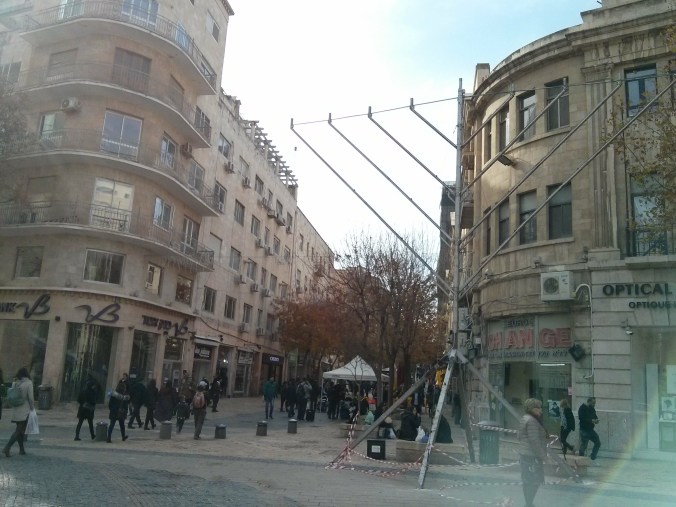
Ben Yehuda/ Zion Square.  No festooned lights, but a giant Chabad menorah

Is there a Santa booth so that parents can take pictures of their usually crying and nervous children asking for things for Christmas? Nope.

Christmas carols while shopping?  I was out today and didn’t hear a single one, so Nope.  Youtube is a good source of American Jews adding their voices to Chanukah culture.  This year’s Maccabeats offering is an homage to Hamilton.

Maccabeats – Hasmonean: A Hamilton Chanukah

(*Note to email readers: This post has a lot of pictures and video links that don’t seem to show up in the email. So come to the site to see the videos.)

Christmas cookies, Christmas fudge, gingerbread, fruit cake?  Nope, nope, nope, and thankfully nope.  We have donuts.

donuts

These are the fancy ones.  There are also yucky, I mean, plain, old-fashioned, jam-filled ones. Source

Christmas trees?  N . . .  well, I did find one at the, ahem, cough, YMCA, of course.

Are the television channels playing every snow-themed, Christmas-y movie or show ever made?  Nope.

Frosty? Nope.

Rudolph? Nope.

A Christmas Carol – any of the many versions? Nope.

It’s a Wonderful Life? Well, I like that one so I try to watch it.  I have the DVD.

The Grinch? Nope.

Well, what do you have?  Apparently, Israel decided to take on Black Friday, Even though Israel doesn’t have Thanksgiving or Christmas, advertisers decided to cash in on the shopping frenzy of December.

black-friday-2
Advertisement that I got in my email – Black Friday is spelled in Hebrew בלאק פריידי, and pronounced “black friday.” They didn’t translate it, they transliterated it.

At first I laughed because there is simply no connection to the Friday after the fourth Thursday of November in a country that doesn’t have a Christmas shopping season.  But then I was sad.  Of all the Christmas traditions to borrow, why that one?  When did Christmas become about greed?

Dr. Seuss, one of the great philosophers of our time, reminds us with How the Grinch Stole Christmas that Christmas cannot be bought in a store.  It’s not about the STUFF.  It’s about things that money doesn’t buy like:

Being with Loved Ones

Generosity of Spirit

Gratitude

Joy

Israel, in spite of the Black Friday blight, is a lot like Who-ville.  The Grinch doesn’t need to come and take all the stuff that we don’t have – the ribbons, bows, presents, trees, roast beast, etc.  What he can’t take away is lighting the candles together with friends and family. Singing songs of freedom.  Telling and retelling the stories of our forefathers standing up for their beliefs (ok, also the miracle of the oil).  I might even go so far as to say that Israel might have a little bit more Christmas spirit than other places that have replaced Christmas with greed.

Let your heart grow three sizes today and have a Merry Christmas, a Happy Chanukah, and Joyous Solstice!

The Grinch’s heart grows three sizes.


I’m a big fan of the Maccabeats, so here’s a list of their Chanukah songs in no particular order.  Start a new a Capella Chanukah tradition!

Maccabeats Shine (original song)

Maccabeats Candlelight

Maccabeats Miracle

Maccabeats  Burn

StandFour (Maccabeats) 8 Nights

Maccabeats All About the Neis

“Living in a Film”

Real life is overwhelmingly busy right now and the news is just crazy, so I’ll do what I do best and turn to fantasy.  My fantasy world exists in Korean dramas.  Yes, you read that correctly.  I really, really enjoy Korean dramas (k-drama for short).  So this post will seem like it is completely out of left field, except that I’ve titled it using Israeli slang:  חי בסרט (hay b’seret), which means “living in a film (or movie).”  Usually it refers to someone being a drama queen and having everything be overly dramatic all the time, but I’m going to use it literally.

*cultural note:  If you’ve never seen a k-drama, you can just as easily substitute rom-com, but k-dramas have some special features that adapt really well to my life in Israel.

My life is a (failed) k-drama.

When I use the term “failed,” I don’t mean it in a negative way.  It’s just that the k-drama set-up is all there and then . . . nothing happens.  So if you’ll follow my logic here: my regular life is quite uneventful but fully set up for something fantastical.  And that is a lot better than following the news and seeing what’s going on in the “real” world, which feels like someone took a page from // insert name of your favorite TV show of intrigue//.

Heroines in k-dramas often live in rooftop apartments with a great view.

I live in a rooftop apartment with a great view. (Rooftop is not to be confused with penthouse.  A rooftop apartment means that it’s a possibly illegal addition to the building and they are tiny.)

rooftopK-drama rooftop

Heroines in k-dramas often work a lot of part-time jobs and have joie de vivre.

I work on a wide variety of projects and have a lot of joie de vivre.

The cast of most, if not all, k-dramas wear coats in the house during the winter.

I’ve already explained the cold in Jerusalem, and I find I often wear my coat in the house.  (Their sets aren’t heated and they have many more coats than I do, but I think I wear my coat inside in part because my dad wore his coat in the house too.)

heirs22   heirs
Coats inside.

rihannaLyrics to Rihanna’s song “Umbrella” (this may be more familiar some readers)

Scene: Outside.  On a street corner.  Waiting for the light to change in the pouring rain.

I approached the corner thankful that I had remembered to bring my big umbrella.  I saw him standing there and the rain really started coming down just as we realized that we had a full cycle to wait before the light changed.

He was very tall, thin, wearing a well-fitting suit, but no overcoat or hat to protect his bald (shaved?) head.  I noticed that his shoulders were already wet from the rain.

As he stepped back away from the curb to avoid getting splashed, I stepped forward and shared my giant umbrella.  (Cue music!)

The top of my head was several inches below his shoulder, so I had to lift my umbrella quite high.  He was surprised as he looked down at me, and mumbled something about not minding the rain so much – but he still stayed under my umbrella.

We commented on how long the traffic cycle was until our crosswalk sign would turn green.  But mostly it was just traffic noise and the plopping of rain on the umbrella.  (Erm, awk-ward!)

Then the light changed and since his legs were so much longer than mine, he reached the other side before I did – without the shelter of my umbrella.  He wished me a “Shabbat shalom u’mevurach” (a peaceful and blessed Sabbath).

He went his way and I went mine.

And then . . . nothing.  Absolutely nothing happened.  (Unless, we have a time jump to 5 years later . . .)

umbrellaThis is not my meme.  It was just out there on the internet.

This interlude is an absolutely 100% true thing that happened to me last week.  The set up was all there and then #kdramafail.

Winter in Jerusalem

Fuzzy slippers

blankets, fleece, socks

snuggly kitty

another winter in Jerusalem

Jerusalem is located on the same latitude as San Diego.  You expect mild winters and hot summers.  So when you move here from northern climates – snow every winter, ice on the roads, negative wind chill factors – you expect to have easy winters.  And yet, if you ask around, Jerusalem winters are the coldest anyone has ever experienced.

I also think Jerusalem winters are the coldest I’ve ever experienced, even though I’m writing this sitting on my porch with the sun warming my face and with only a light fleece as a jacket.  I’m writing outside because it’s actually warmer outside than inside right now.  Winter in Jerusalem is strange and as we enjoy the daytime mild weather, we maintain that Jerusalem is the coldest place we’ve ever lived.  Here are a few of the theories.

  1. Elevation

No.  Jerusalem is only 800 meters (2,600 feet) above sea level and many of us have been to higher elevations.  Even if the wind feels like it’s blowing off of a glacier, there are no nearby glaciers.

  1. It’s the desert

Possible.  It is a known fact that deserts during the day are hot and freezing at night.  However, the actual temperature is not freezing and yet we complain more bitterly of the cold here.

weather

  1. Housing materials

Maybe.  Homes are made of poured concrete with no insulation.  Floors are covered with tile.  Their coldness is lovely during a hot summer and like living in an igloo in the winter.  To slightly counteract the ice cold tile issue, some homes have installed heating elements under the tiles so that heat is radiating from the floor.

  1. No fireplaces

I just miss a nice roaring fire.  I’ve often thought it might be nice to build a fire in the middle of my living room, but that would only be a temporary solution to an ongoing problem.

  1. Mysterious cold zones

I have walked in Jerusalem and suddenly felt an enormous chill in the air.  I have never found any explanation for this.  If you didn’t believe in ghosts before, these chilling zones might make you rethink it.

  1. It’s cultural cold

This is my theory.  In cold climates, you have the right clothes and you go from your warm home with insulation and wall-to-wall carpeting to your warm car to your warm office.  You are not feeling the cold in the same way that the cold surrounds you here.  Here you wake up in your chilly house (unless you can afford to run the electric heater all night), you put your feet on the ice cold tile when you get out of bed (slippers and area rugs minimize the chill), your hot water heater has only a certain amount of hot water (as uninsulated hot water heaters are generally on the roof to maximize solar energy), and the clothes you put on are somehow never warm enough.  As you walk to the office, it’s not so bad unless it’s raining or the wind is blowing.  The office is probably warm though, because it’s a business.  When you get home, sometimes you hang around outside until the heater warms up the space because the inside of your house feels like a walk-in freezer.

Then, once every few years it snows in Jerusalem and you forget about all your complaints because it’s just so pretty and reminds you of your childhood.  (Photos from February 2015)

November 29: Then and Now

A few years ago, I was at a Shabbat dinner with my Israeli family and my aunt opened the dinner conversation with a question:  Who knows the importance of the 29th of November?  It should have been an easy question.  After all, streets are named after the date (in Hebrew they call it Kaf Tet B’November).  A few guesses were thrown out, but no right answers.  And I answered, a bit unsure of myself, “The UN Partition Plan?”  It couldn’t be THAT easy, could it?

nov29

On November 29, 1947, the UN passed Resolution 181 that called for the partition of Palestine into a Jewish state and an Arab state.  The Jews accepted the plan and the Arabs rejected it.  In May 1948, the British left and the war began.

The historical significance is clear.  The UN recognized the Jewish connection to the land of Israel.  So when the Jews won the War of Independence and began to build a state, it was only natural to recognize the State of Israel.

It’s not surprising to me that Israelis today don’t place a lot of significance on UN Resolution 181.  The UN didn’t actually create the state, the people did.  And the UN hasn’t had a great track record on Israel since then.

This year on November 29, the UN marked “Palestine Day” and scheduled a vote on six UN resolutions against Israel.  November 29 is officially called the International Day of Solidarity with the Palestinian People per a UN resolution from 1977.  The six resolutions that were supposed to be voted on included the one ignoring the Jewish connection to the Temple mount and one calling for the return of the Golan Heights to Syria – where thousands of Palestinians have died in the civil war and where Islamic State is gaining ground.

There are those who might say that these UN resolutions are just history righting itself.  The vote in 1947 should never have happened and no Jewish connection to the land of Israel should have been recognized.

But I think a different set of questions should be asked:  Do the member states of the UN really believe that Israel should not exist?  Or perhaps Israel must be held to a different standard than other member states?  Or does a group of states have undue influence on the other members?  And if one group can exert that kind of influence, perhaps the legitimacy of the UN should be called into question.

November 29 is a notable day in history, but it’s no wonder that Israelis don’t pay attention to it.

Practicing Gratitude

It’s Thanksgiving!  This is the time when most Americans are thinking about food and football.  We had that at my house too, but my mom had a special Thanksgiving tradition.  We went around the table and said what we were thankful that year.  Sometimes we were cynical, sometimes genuine, rarely sappy or cheesy (our family doesn’t do sappy and cheesy).  Mom was always thankful for the same thing every year.  She was thankful that she came to the US and was able to give her children the freedom to make choices about their lives in a land of opportunity.  (My living in Israel seems like a rejection of the American dream, but it actually isn’t.  I made a choice and I used my opportunities to live my life to the fullest.  I am and always will be a proud American, but I chose to live in Israel.)

I want to be grateful today but I have to say it’s been a crappy week and frankly a crappy year.

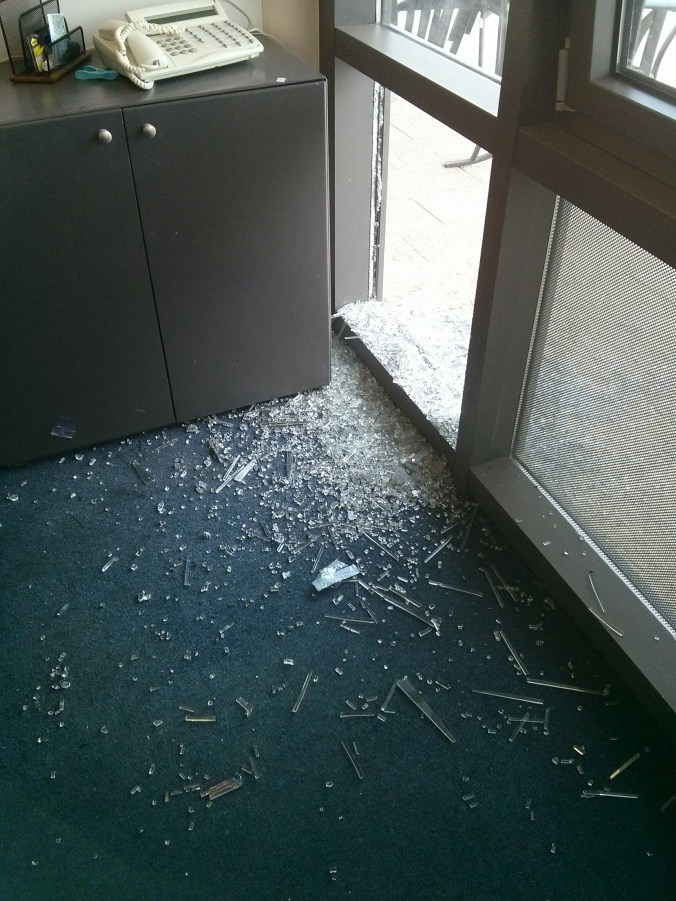
This week the office where I work was broken into.  The windows in my office and another office were smashed.  The thief – well, intruder, it seems he didn’t take anything – tore up the other office and thankfully left my office mostly untouched.  He rifled through my drawers and why he pulled out my Kleenex box, I’ll never know.  Still, it’s a basic violation of space and it felt awful.  What I’m grateful for, though, is that that he didn’t steal anything and he’s been arrested.

img_20161123_130456

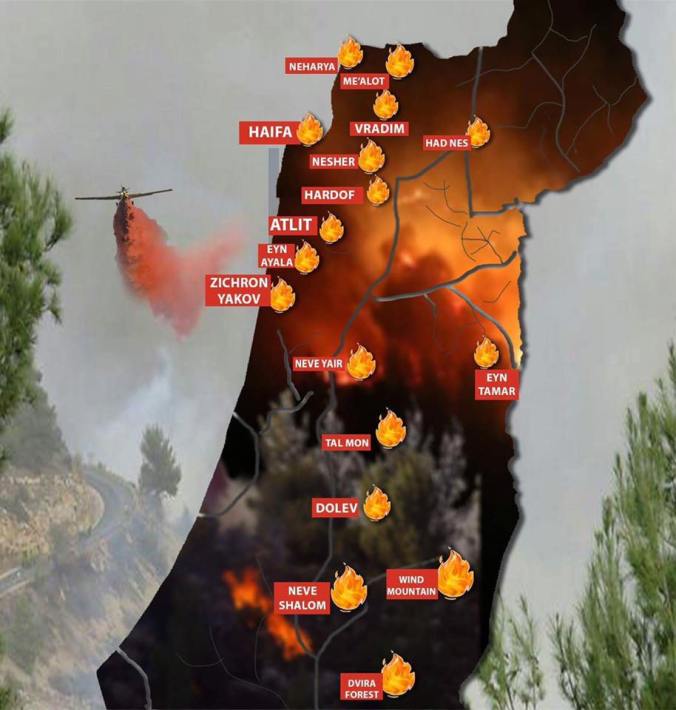
Israel is on fire – literally and figuratively.  It seems that some of the fires around the country have been arson and others are just due to the dry conditions we’re suffering right now.  Of course now it’s political.  The arson is not classified as criminal, it’s being called terrorism.  The hashtag #Israelisburning is trending in some Arab countries.  And at the same time, there are Israeli Arabs and Muslim organizations are pitching in to help out.  Fire trucks from the Palestinian authority have been dispatched to help contain the fires.  There is nothing to be grateful for when disaster strikes and when disaster becomes a political debate, but it does give people the opportunity to be generous and helpful to their fellow humans.

15192572_10154184946277689_598614414358825552_n

Source:  StandWithUs Facebook page

It is extremely dry in Israel right now.  I happen to have an electric superpower at the moment.  If I touch metal, people, my cats, or water, I get zapped.  I’m not really grateful for this, but it does give me an opportunity to remind myself that “with great power comes great responsibility.”

This year we lost many of our cultural icons.  And I lost my dad.  I’m certainly not grateful for these losses, but I am grateful for the influence they had on my life.  I’m also grateful that my dad went out pretty much on his own terms.  That’s all anyone can wish for.  I’m also grateful for the fact that death reminds us to live our lives to the fullest.  If today was your last day, would you be doing what you are doing right now?  It’s good to be reminded of that.

I think gratitude is a choice that we make.  We can be bitter, blame everyone and everything, complain until we are blue in the face, but that is just a huge waste of precious life.  Sure, it’s been a really crappy week and a generally crappy year, but I still have a lot of blessings in my life and I’m generally happy with my choices.  If today was my last day, I’d still probably be doing what I’m doing right now.  And for that I am truly grateful.