How to Travel Well

Having just returned from Paris, I had some thoughts on traveling. I have always believed that traveling makes us global citizens and shrinks the world.  Here are five tips to travel well.

Set a couple of priorities. The rest is gravy.

For this visit to Paris, my second, I decided that my top two destinations were going to be St. Chappelle and the Rodin Museum.  Everything else that I saw and did was extra.  I made sure to schedule my days around these two things and let go of whatever else I didn’t manage.  The new kiosk appointment system for climbing the towers of Notre Dame didn’t work with my schedule, and as much as I may have wanted to visit those lovely gargoyles keeping the Hunchback company, I let it go.

IMG_20170920_115815 (1)

St. Chappelle in the morning.

IMG_20170921_115847

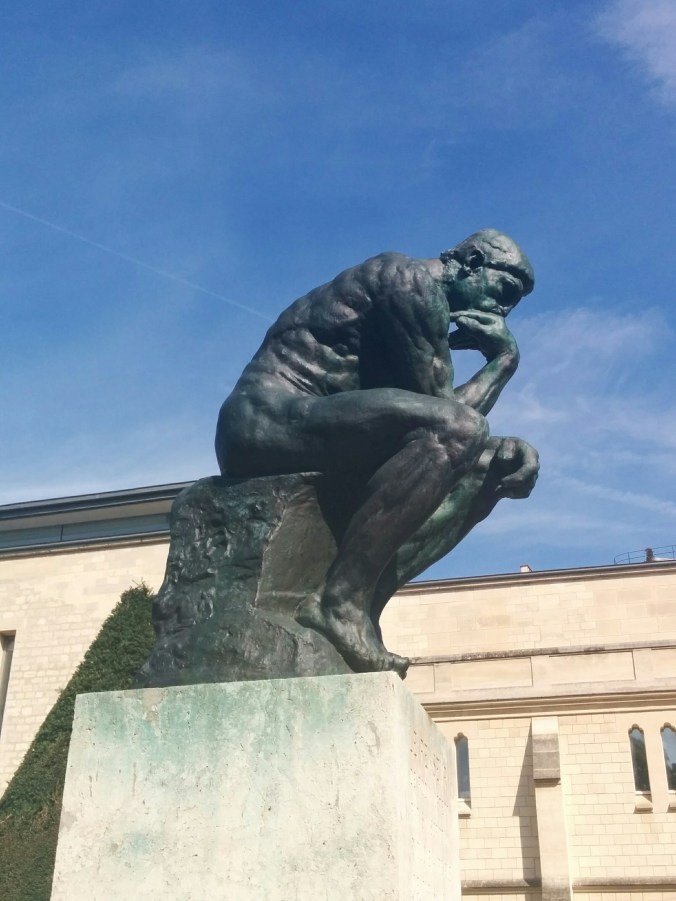
The Thinker at the Rodin Museum.

Have an open mind and be curious.

I saw many people who seemed to view Paris and all its sights as part of a tourist checklist.  Eiffel Tower. Check. Notre Dame. Check. Louvre, esp. Mona Lisa. Check. And on and on (there’s a lot to see in Paris!)  Moreover, they wanted to get through their list with all the comforts of home.

Instead, appreciate the shoe box-sized, creaky elevator in your quaint hotel.  Pay attention to your surroundings and find out what the cultural differences are between your home country and the country you are visiting.  Then accept them as part of your travel experience.  Embrace them if you like them.

Get some historical background of the place you are visiting.  Do something simple like take a walking tour in the center of the city and listen to your guide.  They function as bridges between you the visitor and the city they love.  Ask questions.  Nothing will endear you more to your hosts than asking about the city and its history.  If you like something, gush about it.
IMG_20170919_182156

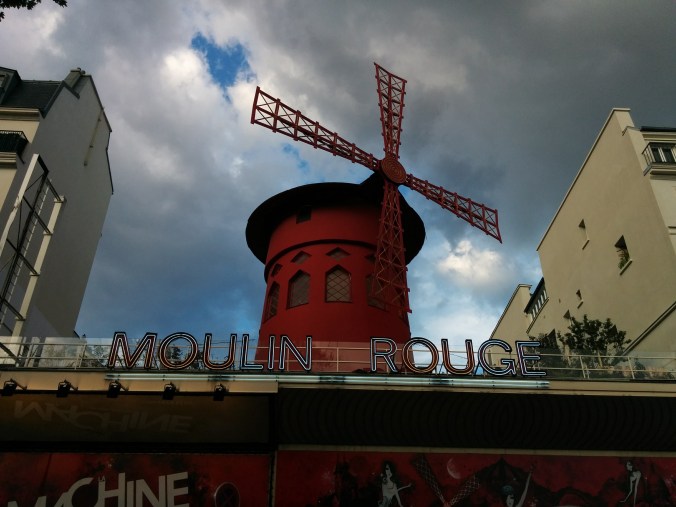
I know you thought that the Moulin Rouge was just a dance show or a musical film, but actually in French it means “red windmill.”

Buy blister patches, if needed.

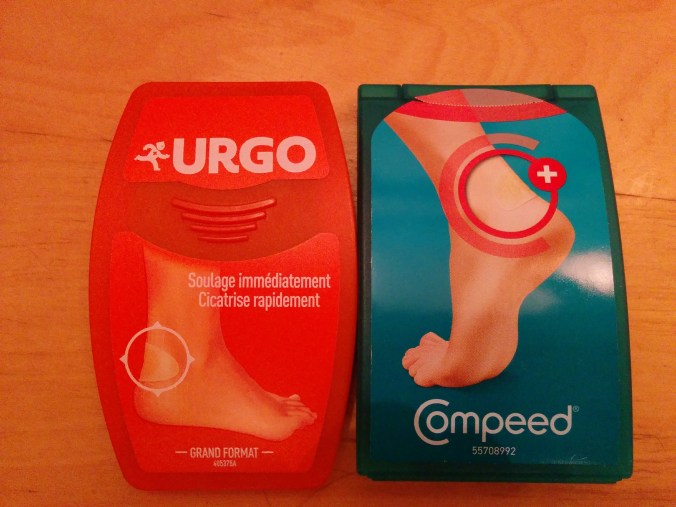
On my first day in Paris, I got a monster blister.  It could have ruined my whole trip unless I liked the idea of walking for hours with a limp and in pain.  In Europe, I’ve found these amazing things that specifically treat that annoying blister on the back of your heel.  Usually the patch can stay on for 2 to 3 days and your heel is like new.  They are kind-of expensive, but totally worth it if you have a painful blister.
IMG_20170929_191954

I have French ones and Danish ones.

Roll with it.

Sometimes things don’t work out.  It rains on your only day in the Highlands.  The statue you came to see in the museum is not on display.  The tour you show up for is only in Spanish.  These things actually happened to me.  On the Highlands tour, I met someone from China who I still keep in touch with.  I saw different versions of the missing statue and I was able to appreciate the lesser known works more because they were no longer in the shadow of the more famous one.  I walked in a lesser-known neighborhood and found an excellent Korean restaurant.

IMG_20170921_220408

Bulgogi (beef), side dishes, and Korean beer.  YUM!!

Sometimes your plan doesn’t work out, but if you roll with it, sometimes an even better plan appears.

Stay in the moment.

I read an article recently that suggested that if you take too many pictures and videos, you lose the experience in the present by trying to document it for the future (or for social media).

On one walking tour, we saw racing lights on the Eiffel Tower.  It happens every hour in the evenings and it’s really worth seeing!  I took a couple of pictures and a few seconds of film.  And then I put my camera away so that I could just enjoy it.  I noticed out of the corner of my eye a man spending the entire light show trying to get just the right shot.  Will he remember looking at the lovely lights of Paris with his wife or will he remember fussing with his camera and his wife’s framing suggestions?

15 seconds of racing lights.  Go see them for yourself!

A concluding thought for Yom Kippur

This is my late dad’s (z”l) favorite story about Yom Kippur.  The original is much longer, but this shortened version gives you the main idea.

Heavy.  The Yom Kippur prayers were heavy and try as he might, the rabbi simply could not lift them up to Heaven.  A young man came into the synagogue.  He only recently became aware of his Jewish heritage and knew only how to recite the aleph bet.  He didn’t know what day it was or what was going on, but with pure and focused intention he recited the only thing he knew.  Aleph. Bet. Gimel. Dalet. …

The rabbi noticed that the prayers were suddenly lighter.  They floated like feathers on the wind straight up to Heaven.  And he knew that is was because of the young man who prayed with all his heart in the only way he could.

As we travel the world and live as global citizens, we don’t have to be multilingual or the most knowledgeable, but if we approach the world with pure intention and genuine love, perhaps we can lift up everyone around us.
Gmar Hatima Tova! May you be inscribed

and sealed in the Book of Life! 

And for those of you who fast, may it be meaningful!

5778. Sure, why not?

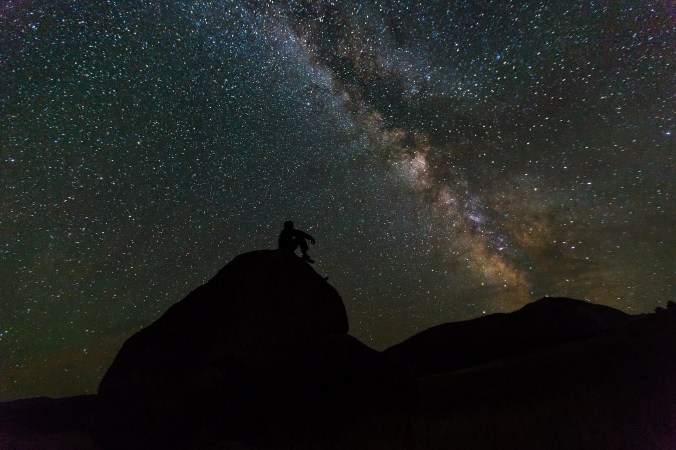
A headline caught my eye this week. Earth Is Flat as a Pita: The Israelis Who Push the Ultimate Conspiracy Theory.  I admit it. I do enjoy a fun conspiracy theory. But Flat Earth Society? Here in Israel? In this day and age? Yes, they are here and they prefer to be called “flatters.”

The moon landing was directed by Stanley Kubrick.  In fact, the moon is a hologram.  NASA is faking all the spherical earth pictures. There are no such things as satellites. The “space race” was just part of the Cold War propaganda of the US and USSR lying to each other.  We are slaves in the matrix.  Fun stuff!

milky-way-916523_1920

I had the opportunity to see The Book of Mormon on Broadway and along with everyone else, I laughed at the very detailed and specific beliefs of Mormons.  For a little taste, here’s “I Believe” from The Book of Mormon.  Interestingly, according to the lyrics, God and Jesus have planets and our singer expects to get one as well.  However, no reference is made to whether the planet would be flat.

The Book of Mormon got me thinking: Phrased in a certain way, wouldn’t all religions sound ridiculous?  For example, the basis of Judaism is that a guy went up a mountain and sat in the clouds for while. He came down with two tablets listing ten rules for living that he said were carved by the finger of God. If you believe that, why couldn’t the earth be flat?

Rosh Hashana is coming up next week and we will be starting the year 5778.  The rabbis calculated how long it has been since the world was created based on ages given the Bible, reigns of kings, and then some post-Bible history, and they came up with 5778.  Never mind that the sun was only created on the fourth day and so it seems unlikely that the three days before it were on a 24-hour cycle.  How long is God’s day anyway?

A year should be earth’s revolution around the sun.  But “flatters” believe that the sun revolves around the earth.  I wonder if they just accept the matrix version of a 365-day year.

One thing that I think everyone, no matter their beliefs, can agree on is that it is worthwhile to regularly take some time to be introspective and evaluate where you are in life and where you want to go from here.  When you look in the mirror, are you proud of the person you are?  What can you do to improve?

Every year, Jews spend a few days doing some “soul accounting” (heshbon nefesh) to have a good start to the next year and be written (probably by the finger of God) in the Book of Life.

Here’s a little video about gaining clarity in the New Year (with the mention of the planet spinning).  Never mind that there are no women in the video and who knows what break dancing has to do with clarity, but that’s a different blog post.

Wishing everyone a Shana Tova u’Metuka!

A good and sweet year! May it be a year of good health, much happiness, and great success!

*Next week I’ll be on hiatus and maybe doing a little introspection, but I’ll be back the week after.

Immigration

After the US president’s announcement that he was rescinding the DACA program, I was reminded that Israel has faced very similar issues recently and just a few days ago Israel’s High Court of Justice ruled that Israel could not forcibly deport illegal migrants.  Specifically related to DACA is the situation of children born in Israel to foreign workers.  They are not citizens of Israel, but they feel no connection to their parents’ homeland.  Yet some of these kids – under the age of 12 – may face deportation. (I don’t know if the decision of the court affects them.)

Let’s start with some definitions.  There are two ways people gain citizenship in a country:  jus soli and jus sanguinisJus soli is a Latin phrase meaning the “right of soil.” That means that if you are born within the borders of a country, you are a citizen of it.  Jus sanguinis is Latin for “right of blood” meaning that the right of citizenship is passed down from one’s parents.  The US and Israel have a mixture of both.

There is no way that a short little blog post will completely explain immigration issues in a US or Israeli context.  But I wanted to point out that Israel is also facing challenges with immigration and we all could probably learn from each other.

maze-1804499_1920

Israel’s biggest challenge is that it doesn’t actually have an immigration policy per se.  Yes, there is the Law of Return that applies to Jews who wish to come to live in Israel.  But the founders didn’t really imagine that anyone other than Jews would want to live in a postage stamp-sized Jewish country.  For decades this was generally fine.  There were some general rules, but no real policy and anomalies could be handled on a case by case basis.  After 1967, Palestinians started to work in Israel.  Then there was an influx of foreign workers and later non-Jewish refugees from Ethiopia and Sudan found their way to Israel and hoped for a better life. These people were not necessarily looking for citizenship, but a policy would have to address their rights and status.

Then the situation started to get complex.  What do you do with children of non-Jewish foreign workers – either legal or illegal – who were born in Israel, only speak Hebrew, and have built a life in Israel?  What about children of refugees born in Israel who may or may not have gotten asylum in Israel?  What about the Israeli citizens who live in south Tel Aviv and now live in a de facto refugee center because the majority of Ethiopian and Sudanese refugees live there?

Israel chose compassion first to deal with the situation of human beings in Israel, so many of the children were granted residency status, but still some were left out due to technicalities.  The issue of refugees and asylum seekers was a bit more clear cut.  If asylum or refugee status was granted then they stayed; if not, they were deported (not always to the country they fled from).

And yet, Israel still doesn’t have a formal immigration policy except for the Law of Return.  I imagine that if you want to have a Jewish and democratic state and you don’t have total agreement on who is a Jew and you haven’t decided how to deal with the question of immigration of non-Jews, having a formal policy would be nearly impossible.

So while US immigration policies may be headline news around the world, the US is by no means the only country dealing with huge questions of who can come into their country and how those decisions reflect the values of that country and its people.

Only in Israel

Shifting back to the real purpose of this blog, this post is about moments that could only happen in Israel.

Recently I got a call from my insurance company to upgrade my life insurance.  For the most part, this is a pretty standard conversation.  This kind of conversation is often hard for me because the guy always speaks so fast and listening to Hebrew on the phone with a diverse and unusual vocabulary such as illness and other life insurance-y terms is also a struggle.

call-center-1015274_1920

“Hey, slow down.  My native language is English.”

“Oh, sure.  No problem.  I’ll speak slower.” He doesn’t.

But he’s really nice about explaining things that I don’t understand.  He doesn’t translate; he explains things in simpler Hebrew.

When he gets to the parts about what my benefits will be if I get cancer or any other accidents occur, he throws in a few has v’halilas. This is a phrase that more or less means “God forbid” or “Heaven forbid.”  (There are a lot of discussions about the origin of this phrase, but suffice it to say its roots come from the Bible and other explanatory ancient texts.  But in Modern Hebrew, it’s simply understood as “God forbid.”)

“If you should, has v’halila, get an illness – and, of course, you should always be healthy, that’s the most important thing – then the policy …”

He also has to confirm that I’m currently healthy.  I say that I am and get a toda l’el (thank God).

By the end of the conversation, we’ve blessed away all potential illnesses and been grateful for good health.  And as a closing, “of course, you should be healthy, happy and live a long life.”

And this is where I fail my Israeliness test.  The common/correct response when getting good wishes heaped upon you is to respond, “Amen.” Ah, but the American in me still runs the auto-pilot and I say “thank you!”  This leads to a confused pause, but since I’ve already explained that my Hebrew isn’t that great, it’s just seen as a cultural faux pas.

The time that I did say “Amen” it seemed more appropriate.  It was the evening before a holiday and my internet went out.  I called the internet company and the Russian customer service guy tried absolutely everything to get the internet stabilized.  We must have been on the phone for an hour.  The holiday was about to come in and he had to go home at some point.  I was already at home hoping to stream TV shows during the holiday.

And then at the last minute there was a miracle.  The internet worked!  And my Russian customer service guy joyfully declared she’chechiyanu v’kiy’manu v’higianu l’zman ha’zeh! And my automatic response was “AMEN!”

[The she’chechiyanu is a prayer that you say at a joyful occasion, among other uses – (Praise and thanks to God) for giving us life, for sustaining us, and for allowing us to reach this season.]

There’s no reason for me to believe that either of these two guys on the phone were religious.  And their invocations of God in life insurance and internet service didn’t lead me to think that they were religious either.  They were just Israeli, using the vernacular of Israeli society.

And to that I say, “Amen!”

hands-68918_1280

A day late and an idea short

Confession #1: I didn’t have a good idea for a blog post this week.

lamp-1996095_1920

Confession #2: I’m exhausted.  This week completely wiped me out.

I had a few thoughts, but they aren’t fully formed ideas yet, and I was too tired to flesh them out.  But it was important to me to at least show up.

There’s always next Friday …


#EpicFailinLeadership

I visited the Dachau concentration camp in 1997.  I happened to arrive just as an English tour was starting, so I joined it and got a deeper understanding of everything that happened at Dachau.  At the end of the tour, we had a question/answer session and I don’t remember now if it was a question or if the guide brought it up himself, but we spoke about the fact that Nazism is outlawed in Germany.  Our guide said it was a mistake.

There was a noticeable rustle in the group.  Of course you should outlaw Nazism!! Nazism is an evil, repugnant, horrible ideology!! No one should be allowed to gather and plan a society based on a master race or spew hatred and bigotry!

But our guide calmly explained that forcing neo-Nazis underground did not stop the movement; it only made it harder to track.  You don’t know exactly who the leaders are or who is joining. Their websites are hosted and mirrored all over the world.  If you allow them to exist – which does not in any way condone their platform – then you know who they are, where they are, who the leaders are, what they are doing, and what they are planning.

It was a hard, bitter pill for me.  I remembered that when I was in high school a statistic went around that 25 percent of American high schoolers didn’t believe the Holocaust had even happened.  When I was in university, Holocaust deniers billed as historians were invited to speak on large, respectable campuses. And now I’m supposed to accept that freedom of speech and assembly can and should be given to people filled with vile, baseless hatred?

Twenty years later, the answer is still yes, as long as they don’t incite violence. Not because Nazis have anything to add to society or the common good, but because they are visible.  WE. KNOW. WHO. THEY. ARE.

What is right, not what is legal

You know who doesn’t get to engage in this debate?  The President of the United States.  Why?  Because his job is to stand up for what is right, not quibble about what is legal.  His job is to unite the nation and if the only people who applauded his statements were members of the KKK, neo-Nazis, and white supremacists, he is NOT doing the job of the president.  It doesn’t take much brainpower to write a statement that condemns neo-Nazis and racists, denounces violence and hatred, still allows for freedom of expression (no matter how abhorrent), and brings the nation together.

I hope the president would sing a different tune if some “good guys” “with permits” peacefully intone “Jews will not replace us” while walking with torches through the neighborhood that Jared and Ivanka Kushner live in. Does he imagine that his grandchildren would be spared by these “good guys” “defending their heritage” just because he’s their grandfather?

Doesn’t get a pass either

You know who else doesn’t get a pass to keep silent or make weak statements? The Prime Minister of Israel.  Most pundits in Israel think that Netanyahu didn’t make a statement about Charlottesville (until 3 days later, and it was weak and non-specific) because he wanted to stay in the good graces of the president.  I can’t imagine that the office of the prime minister didn’t have a single person in it who could suggest reframing the issue so that Netanyahu could denounce neo-Nazis, racists, and white supremacists marching in Charlottesville while at the same time reaching out to American Jews. If the good graces of the president are wrapped in white cloaks and decorated with burning crosses, shouldn’t we be rethinking the policy?

Neither the president nor the prime minister has shown a shred of leadership this week and it is disgusting, but not really surprising.

So it’s up to us

I wasn’t able to find evidence for this apocryphal story I heard when I was a kid, but there are other places in Idaho and Montana where similar stories can be found.  But I like this version.

In Hayden Lake, Idaho, the Aryan Nation had a 20-acre camp where they trained their new recruits.  They wanted to have a parade down the main street on Adolf Hitler’s birthday.  It might have happened once, maybe even twice. Then one man decided that he didn’t want to see the Aryan Nation marching down the main street of his town. So he got the parade permit for that day and for the whole week.  The law was that they could only have one parade per day and as long as he did something resembling a parade, he got the permit.  So he marched as a one-man band down the street to cheers from the townspeople who supported him.  And then he did it the next year and the next.  And so on.

The factual epilogue to Hayden Lake is that a car drove a little too close to their compound, and they beat the driver and the passenger (a mom and her son).  So the mom and her son took the Aryan Nation to court and won.  The Aryan Nation lost their compound in the $6 million settlement and had to leave the area. The compound was turned into a peace park.

The point of both stories is that it doesn’t have to take violence to defeat neo-Nazis, white supremacists, and the KKK.  It takes us banding together to say, “No, not in our town.” Meeting violence with violence begets more violence.  Is there another way first?

together-2450081_1920

Showing up

I’ll leave you with Pastor Martin Niemöller’s poem, which remains relevant today.

First they came for the Socialists, and I did not speak out—
Because I was not a Socialist.

Then they came for the Trade Unionists, and I did not speak out—
Because I was not a Trade Unionist.

Then they came for the Jews, and I did not speak out—
Because I was not a Jew.

Then they came for me—and there was no one left to speak for me.

On Power

I saw this quote in an article this week.

Dumbledore to Harry:

It’s a curious thing, Harry, but perhaps those who are best suited to power are those who have never sought it.  Those who, like you, have leadership thrust upon them, and take up the mantle because they must, and find to their own surprise that they wear it well.

We have politicians, not leaders.

We have elected officials, not public servants.  

We’ve been seeing this over and over again in the US and in Israel.  Trump is facing an impaneled grand jury set to deal with the Russia investigation and Netanyahu is facing his own potential indictments for corruption with a former chief of staff turning state’s witness.  It’s not a good time for either the US or Israel.

The common saying is “Power corrupts; absolute power corrupts absolutely.” It’s usually used against people who try to gain absolute power, but I think we tend to forget that any amount of power has the potential to corrupt.  We see these corruption scandals and we shout from the rooftops, “Why? Why would they [fill in the crime]?”  The answer is not a complex psychological evaluation of each individual person.  The answer is they do these things because they think they can get away with it.  They do them because they can.

Of course we must resist and say “No!” But we have to do it without getting drunk on our own power, drowning in our viral videos, or sharpening knives of snarky anonymity. That power too can corrupt.

What can we do?

Vote. Obviously.  It would be better to vote with our consciences, for someone we actually believe in rather than the lesser of two evils. Elect officials that represent the best parts of ourselves.

I know. We lack good candidates. Who wants to be a leader today? Who wants to be a public servant? People want six-figure salaries, great benefits (especially health insurance in the US), and plenty of vacation time to get away from all their responsibilities.

“Be the change you wish to see in the world.” – Gandhi

The truth is that we can’t change other people.  We can only change ourselves.

Maybe if more people decided that “if it bleeds, it leads” was awful and voted with their money to not support news outlets that operate that way and choose instead to support responsible journalism, we would get real, informative, considered news.

Maybe if we made media choices based on human values, we wouldn’t encourage snark, insults, bias, xenophobia, and clever meanness on every form of media.

Are we drawn to a Cult of Personality, or are we choosing our representatives based on their vision for the future?

“It’s not dark yet. But it’s getting there.” – Bob Dylan

Bob wasn’t talking about society with this lyric, but it’s appropriate. Until more people make better choices, we are going to have politicians, not leaders. We are going to have elected officials, not public servants.  We will value people who are famous for being famous, not smart people who want to make the world better.  And we will worship anonymously in the Cult of Snark and take no responsibility for anything since it’s always someone else’s fault.

Unless.

Unless I’ve inspired you. And you can inspire someone else. And that person can inspire someone else. Then maybe, just maybe, politicians will lead, elected officials will serve the public, people will be famous for real accomplishments, and we can all be nicer to one another.

Free to be you and me in Jerusalem

I’m buried in non-blog-related work, but I decided that I still wanted to take time to write this week because I am constantly amazed by Jerusalem.

This week there were two big gatherings in Jerusalem.  On Tuesday, 1,200 Jews entered the Temple Mount on the fast day of 9 Av, which among other things marks the destruction of both Temples.  This is the most that have ever entered the site on that day.

And a few days later, 22,000 people marched in Jerusalem’s Gay Pride Parade that ended with a rally in Independence Park. (They expected 4,000; I read last night it was 14,000; and this morning it was 22,000.)

The Temple Mount and Independence Park are separated by about a 25-minute walk.

The people participating are possibly miles and eons apart in their beliefs.  Or are they?  This year’s Pride theme was “LGBTQ and Religion.”

The thing is that you can be who you are and still be part of the vibrant city of Jerusalem. There’s a place for everyone here.

Free to be you and me and we can be ourselves in Jerusalem

On the cusp of a slippery slope

In spite of what you see on the news, I still feel quite safe in Jerusalem. However, I’m not crazy and I won’t be reporting live from the Temple Mount.

PANO_20170217_135529 (1)

Unless you’ve been too wrapped up in the drama at the White House, you might have noticed that the Temple Mount has been in the news lately.  This post won’t be a point by point explanation of that, nor will I get into all the vitriol.  The salient facts are:

  • On July 14, two Druze border police officers were gunned down near the Lions’ Gate by terrorists who had homemade guns hidden in the compound of the Temple Mount aka the Haram al Sharif.
  • Jews consider the Temple Mount the holiest site in Judaism. Muslims consider the Haram al Sharif the third holiest site in Islam.
  • Jews and other non-Muslims are only allowed to enter through one gate and I believe they have to go through security (it’s been a long time since I’ve been there). Muslims have access to several gates and undergo spot checks at most.
  • Israel is responsible for the security and the Waqf, a Jordanian organization, administers the site. So when Israel put up security measures (metal detectors and cameras), the Waqf refused to enter and called on all Muslims to boycott the site.
  • Muslims prayed outside the compound, but it was not all “Kumbaya” and strumming guitars in the name of peace, love, and understanding.
  • Israel took down all the security measures and the Waqf still was not satisfied and Palestinian leaders were calling for a “day of rage.” But as of this writing on Friday, prayers on the Temple Mount ended peacefully – though there were plenty of clashes elsewhere.
  • I’m leaving out the attack on the Israeli embassy in Jordan, and the murders of three family members by a knife-wielding terrorist in their house, among other things, which are apparently directly linked to the anger about the security measures.

I’d like to jump out of the 24-hour news cycle and try to look at the big picture.  I’ve written about the UNESCO decisions before (here and here) and I continue to be troubled.

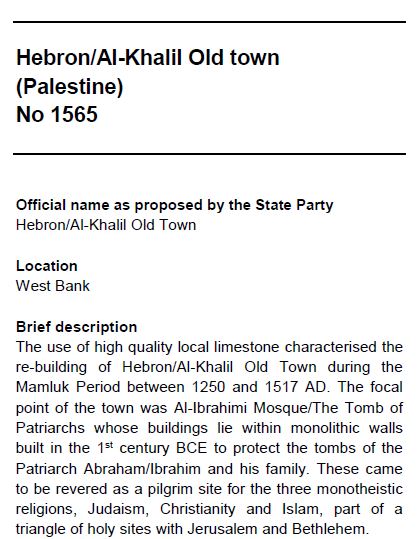
  • I finally found the hundreds of pages of documentation on the Hebron decision and in skimming them, I did not find anything that was blatantly false. One questionable element was that Hebron is in a country called Palestine.

Text 3

Screen capture

  • Israel is always slamming these decisions of World Heritage Sites in Danger and I wondered how sites get nominated. Why doesn’t Israel nominate sites?
    • I found out that a state that has signed on to the World Heritage Convention can nominate sites within its boundaries. Both Israel and Palestine are states that are recognized to have signed on to the convention.
    • That means that in spite of Israel’s Knesset law annexing and unifying Jerusalem, Jordan is the nominating country for the Old City of Jerusalem (though it is listed without a country).
    • In that case, Hebron should technically also be nominated by Jordan, yet the documentation shows that it is nominated by “Palestine.”
    • Alternatively, shouldn’t either one of the parties disputing the territory be allowed to nominate?
    • In both cases, Jerusalem and Hebron are not recognized as being in Israel.
  • The Hebron decision, by the way, was schedule for next year, but they moved it to this year under special circumstances. It seems like UNESCO is de facto recognizing that Hebron is in the boundaries of a country called Palestine, thus recognizing both the country and its general borders.  They also recognize Nazareth, Bethlehem, and Battir as part of Palestine too.  As far as I know, there has not yet been a final status agreement between the parties on where the borders would be should Palestine be created in the disputed territory on the west bank of the Jordan River.

Jerusalem and its Walls are a UNESCO World Heritage Site in Danger.  In skimming the conservation report for 2017 prepared by Jordan and Palestine for UNESCO, Israel is accused of breaking the “status quo” all the time.  So two weeks ago, putting in security measures violated the status quo, which is a strict constructionist view of how to maintain the status quo.  The security measures weren’t there in 1967, thus they should not be there now.  Security is trumped by the politics of the status quo.

Text 1

Screen capture from the conservation report

Here’s my final point about the status quo and why we have to be so much more diligent about paying attention to UNESCO.  Buried in a footnote on page 39 of the conservation report is this:

Under the terms of the Status Quo on holy sites, a decree fixed the Ottoman Sultan in 1757 and codified in more detail by a British government Commission in 1922, 1929 and 1933 the Wall is a Muslim Waqf property and the Waqf owns the Buraq Wall and the Buraq Plaza in front of the wall. In these decrees, Jews have the right to stand on the pavement in front of it and pray. (Emphasis added.)

Text 2

This is what is considered the “status quo.”

So according to documents accepted by UNESCO – the United Nations Educational, Scientific, and Cultural Organization – Jerusalem is not in Israel, the Cave of the Patriarchs is an excellent example of first century CE architecture, and the Western Wall is the western wall of the compound of the Haram al Sharif. Oh, and Jews and Christians might have some connections there.

By the way, next week is Tisha B’Av, a day on the Hebrew calendar that marks the destruction of both Temples among other major tragedies for the Jewish people.  I guess we’ll have to see what happens next Tuesday.

Links for more information

Breakdown of what’s happening on the Temple Mount – op-ed.

Old City of Jerusalem listed under Jerusalem – not under any country – and noted that it is nominated by Jordan.

Hebron/Al Khalil Old Town listed in Palestine.


According to Plan

Yesterday I woke up with a plan.  I was going to leave work a little bit early and see a matinee double feature (Spiderman and Baby Driver).  Why?  Why not?  I’m stressed and it a little escapism wouldn’t hurt.

But that’s not at all what happened.  Moreover, everything that did happen served a better purpose.

First, I found out that my perfect scheduling was not working out.  The second movie was suddenly not playing at the expected time.  Every other day, yes.  Today, no.  Ok.  I’ll roll with it.  Maybe I’ll just see one movie and maybe, if I’m lucky, it was just a mistake in the schedule.

I’m working along, in the flow, and suddenly it’s past the time I planned to leave.  One last email to answer and I have to make a stop to pick up a book.  Oof!  Maybe I’ll take a taxi.

No, I decide to wait for the bus.  Maybe I’m not supposed to go to these movies today.  What about a later movie?  Hey, Dunkirk is playing a bit later.  Let’s see.  The bus comes within minutes and I’m on the way.  I get to the office to pick up the book and if I get in and out quickly, I can take a taxi.

Nope.  I meet with the person who has the book I need and I meet other members of my virtual editing team, which is really nice since we are only in contact online and this is real human contact in a relaxed, non-work-focused conversation.  Dunkirk starts without me.

Now I’ve given up the double feature plan and I remember that there is a good shawarma place a block away.  I buy one and get back to the bus stop just as my bus pulls up.  Home, Jeeves!

hero-schawarma-laffa

Illustrative picture of shawarma, food of the gods

While I’m stuffing my face with shawarma at home, I turn on my computer to get started on work and find that my mouse is broken.  My beloved cat swatted it off the couch in the morning and it was apparently one time too many.  I cannot work without a mouse, so after the shawarma lands in my tummy I decide to go out a get a new mouse.  And then I remember I should go to the bank (the tangent about banking in Israel can be summed up in a word: annoying!) and it just so happens that the timing is perfect.

IMG_20170715_184740

Oh, she looks innocent, but her spirit name is Mouse Killer

I get to the office supply store and they don’t have my snazzy mouse, but I got one that’s half the price and a spare that was even cheaper. After a miraculously quick stop at the bank, I’m standing at a light deciding which way to go; my decision is made when the light turns green directing me down Ben Yehuda Street.

And I stroll to the odd radio that I missed in previous walks in the area.

IMG_20170720_164448

I don’t know.  Your guess is as good as mine

And I meander along walking off the heavy shawarma.

I get home and I feel … good.  I hadn’t run away to a dark movie theater to hide from my stress, but instead made positive real-life connections, got a new mouse, went to the bank, and got some exercise. Every step along this path was made exceptionally easy and every time I tried to invoke my hiding plan, there was an obstacle. Clearly, letting go of my own plan and allowing this better plan to play out was better for me.

This isn’t quite on the level of “Woman plans, God laughs,” but sometimes we all have to accept that once in a while there are unexplainable forces pushing and pulling us in various directions.  We are, of course, all masters and mistresses of our own destinies and there are times to strive against obstacles and go for what you want.  But then there are other times when the choice is simply to say “Yes” and let the rest flow.

Epilogue: Remember when I bought two mouses?  That seemed odd at the time.  I mean, who buys two mouses for themselves? But it turned out that the half-price mouse isn’t sensitive enough and I actually ended up using the even cheaper spare.

“I love it when a plan comes together.”