It’s not in the scope of this blog to talk about the Trump administration, but – say what??!!
I wanted to write about the UNESCO decision on Hebron, but I didn’t have time to fully research the topic. Also, I cannot find the actual text of the decision on the UNESCO site. I don’t want to quote secondary sources on it, if I can avoid it. That should also tell you something about the decision.
The Temple Mount is in the news again and not in a good way. Again, more research is needed before I would want to comment.
So I’m only going to write about the most important thing that is happening today:
Happy Birthday Mom!
What would you have told this young version of yourself?
You will move to another country (the third!) and learn another language (the third!), you’ll have two more children (boys!), you’ll have a hand in raising many children in your daycare, you’ll be a teacher, you’ll be a violinist in a symphony orchestra, you’ll be a world traveler, you’ll be curious about politics and will always strive to learn more, and you’ll be a grandma (twice over!).
This week I took two evenings to sprint through the Jerusalem Light Festival. I’m always so proud of Jerusalem and especially our city administration for coming up with interesting and fun cultural events.
This year’s walking paths for the Light Festival went from the southern-facing Zion Gate up to the northern-facing Damascus Gate (yes, the infamous Damascus Gate). Tours within the Old City meandered through the Christian quarter and the Jewish quarter. It felt to me like there was an attempt to tie the two halves of the city together, but it didn’t quite work. I saw quite a few Arabs and a few Jews and tourists when I ventured to the Damascus Gate, but the main crowds were to the south and I saw many Arabs, Jews and tourists there too.
Let me just say something also about the crowds. The phrases “sweaty crush of humanity,” “barbarian horde,” “madding crowd,” and “oppressive multitudes” come to mind. I’m getting flashbacks of mosh pits from my university days, but not in a good way. It’s as if you plan for an elegant reception with light refreshments and the guests come bringing all their friends. They are ravenous, eat everything in sight with both hands and then demand more.
Still, I’m glad that Jerusalem is putting in the effort. Now the crowds just need to do the same. Here are a few lovely highlights from as much of the Light Festival as I could bear.
Damascus Gate as a platform for other gates.
A film presentation on the wall near Jaffa Gate. It used the texture and shape of the walls to make the film more dynamic. Well done!
Explorations of light that have nothing to do with the walls.
The walls as a platform and, if you look closely,
the crush of humanity, I mean, people enjoying the festival.
You know when you have an argument with a loved one about something and it turns into a really ugly fight and later you realize that this huge fight was not even about whatever you were fighting about? It’s actually about something deeper in your relationship. I think that’s what’s happening this week among the Jewish People with regard to the Kotel (the Western Wall).
The Israeli press noted that the decision happened and moved on.
A little background
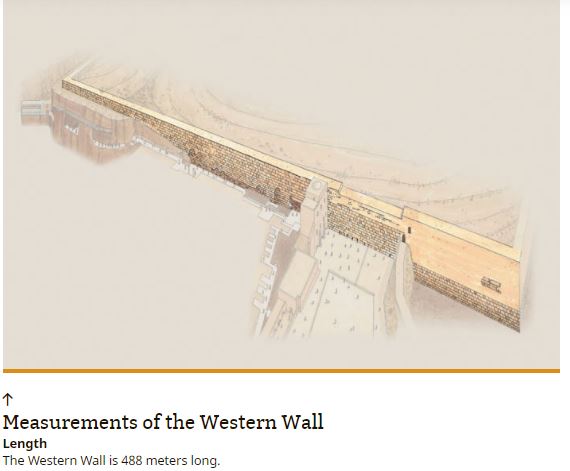
What is the Kotel actually? It is an exposed remnant of the retaining wall that holds up the Temple Mount complex, where the Dome of the Rock and Al-Aksa now stand. It is *not* a remnant of the Temple itself.
Why do Jews face Jerusalem to pray? Jews pray toward where the Temple once stood; they are not praying to a retaining wall. People place prayers in the Wall, but the Spirit of the Lord does not actually reside there. He just picks up His messages from time to time.
When did the Plaza become a synagogue? In 1967, when Jerusalem was reunified, the alleyway that was in front of the exposed section was expanded and became the Western Wall Plaza. That small section of the retaining wall was conveniently located and it was turned into an open-air Orthodox synagogue (it was not a synagogue before).
How holy is it? Based on the logic of holiness bestowed upon the Western Wall, every part of the retaining wall should be considered equally holy: the southern wall (I’ve seen people praying there), the eastern section (on the Mount of Olives side), the Via Dolorosa (the first few Stations of the Cross starting at the Lion’s Gate), the route of the Tunnel tours, and even a little alley called “The Little Kotel,” which is apparently even closer to where the Temple stood.
So what’s the question? Why should anyone demand that an open-air Orthodox synagogue near an exposed section of a retaining wall accommodate Reform and Conservative practice? To my knowledge, no one has blasted into the Great Synagogue in Jerusalem and demanded that it be converted to accommodate Reform and Conservative practices. There is a Conservative synagogue across the street and everyone seems to be fine with that.
Perhaps we should ask a different question? Why is there any kind of synagogue at all? Why not just keep the practice of individual contemplation and personal prayer for all people of all denominations of all religions?
The bottom line
This kerfuffle is not really about access to the Kotel. Just like the fight you had last week with your loved one wasn’t about who would put the dishes in the dishwasher and how you always do it wrong.
This is about acknowledgement and acceptance.
It could start with the rabbinical authority in Israel acknowledging that there are other visions of Judaism – they may need to negotiate about the different ideas of halakha (Jewish law) – but they should also try to square it a bit more closely with the Law of Return (anyone with a Jewish grandparent on either side is entitled to Israeli citizenship, which is not the halakhic definition of a Jew).
Jews living outside of Israel will also have to accept that Jews living in Israel have their own ideas about how to run the country and preserve holy sites and that donations to Israel and putting your name on buildings doesn’t actually bestow the right to dictate policy here.
Fiddler on the Roof starts with Tradition (video above) and by the end a few things get changed in line with the times. But we keep our balance, like a fiddler on the roof!
My radical proposal
The question of acknowledgement and acceptance is real and I don’t want to minimize it. It is symbolized in the questions of access to the Western Wall and that is indeed legitimate.
However, the bigger issue facing all of the Jewish people is that UNESCO continuously and repeatedly calls the Western Wall Plaza “The Al-Buraq Plaza” and calls the Temple Mount only by its Muslim name. If we want to continue our internal family discussions about access to the Western Wall, we need to ensure that it remains a Jewish site. And we must also remember that the Temple Mount – where Jews are forbidden to pray and are arrested for doing so – is the actual holy site.
Signs of summer are starting to show up in Jerusalem. The city put up these fun mini-umbrellas on Yoel Solomon Street.
Later in the evening I stepped out again to see the mini-light show on the walls of the Old City.
And then I walked through Mamilla on the way home. And it was crowded! It seemed to be an equal mix of Jews, Arabs and tourists.
The crowds are worth pointing out. A week ago, a young police officer was killed by a terrorist at Damascus Gate, a northern gate. Mamilla is near Jaffa Gate, a western gate. They aren’t that far apart with only the Christian and Muslim Quarters separating them from each other. Also, it’s Ramadan. And yet – it’s nearly 10pm and the streets are full.
Jerusalem is beautiful at night and I’m so glad that our mayor and the city council have made it both possible and aesthetically pleasing to be out and about in the city. We don’t quake in fear in the face of terrorism. The minute we do, they win.
Jerusalem is known as the city of light. And for good reason!
Next week we will host the “Light Festival, Jerusalem,” so expect more pictures of the beautiful walls of the Old City from Zion Gate in the south up to Damascus Gate in the north featuring light installations by artists from all around the world.
Israel is known around the world as “the start-up nation” and for the most part the title is apt. Israelis come up with great ideas all the time and have the chutzpah to push through obstacles to get it done.
And then you face some bureaucratic idiocy or a convoluted system or bizarre traffic flow issue (this happens more than you might think!), and you wonder how this country even functions day to day. This week, I was reminded how annoying dealing with the bank is.
In a perfect world, my bank card should have arrived by mail and then I would have activated it and moved on with my life. But it didn’t come. My card expired and the new one hadn’t arrived. I spent 40 minutes on hold to get hung up on when my turn finally came up. Then – taking a page from the start-up nation – I used the call-back feature, so that they would call me when my turn came up again, only to find out that I have to go to my branch to request a new card.
Have you been to the bank in Israel? It’s so high-tech you hardly know what to do with yourself. You can use your card (or other ID) to get a number that will send you to the proper section of the bank for your service. Everyone stares up at the screens with various numbers on them: A104, F387, Y212, O187, M085. You have no idea how many people are ahead of you. You look around at the 30-40 people already there who might be ahead of you, or perhaps you get a magic number that lets you jump the line.
I had to coordinate my schedule because bankers’ hours in Israel are simply absurd. I arrive and get to one service only to be told that I have to have another service. I don’t need another number, they can just transfer it. Woo hoo!
Finally I’m at the counter and the girl pays attention to everything else except me and my request: another client beside me, the clerks and their questions for other clients, a phone call for another client that she makes while I’m standing there. It goes on and on! A bell rings and like Pavlov’s dog she gets up mid-sentence and starts collecting cash with a back-handed apology.
Me at the bank
Finally, I explain the situation and get my new card ordered. It will be at the bank in a week.
The bank opens at 4:00pm and I arrive at 4:05pm. There are probably 50-60 people there! How did they get in and get their numbers in 5 minutes? Surprisingly, I didn’t wait long. I got my card to find out that it’s entirely new. It’s as if my card was stolen and a new one issued. I ask what happens to my accounts attached to the old card – electric bills, internet, phone, etc. “Hmm, well they say on the card.” “Even though it’s expired?” “Oh (exaggerated) it’s expired! Well, it should be no problem to transfer everything over.” “Ok. Let’s do that.” “Oh, we don’t do that. You have to go to a personal banker.” Anyway, long story short, it doesn’t happen at the bank. They have no control over it. And the credit card company is closed. This will be a mystery until next week.
But all of this started with the mail. Let’s not forget the idiotic postal service! It used to be an amazing system. Nowadays mail is delivered twice a week, if that. There are stories (urban legends?) that lawyers have missed court dates because the documents came late.
So my card was essentially “stolen” by bad postal service and then I had to jump through hoops to get a new card that may or may not require me to set up all my payments again.
Hello, is this the Start-Up Nation? Perhaps you might consider a slightly less annoying way to handle the mail and banking?
And as I was dealing with all this silliness, I suddenly remembered that the deadline for filing taxes for US citizens living overseas was Thursday. Don’t even get me started on that one!
This week’s post is a spoiler-filled reaction to Wonder Woman. If you haven’t seen it, do! In terms of a review, I give it two thumbs up. If you haven’t seen it, read no further unless you don’t mind spoilers.
Ok. You were warned and if you are here, then let the spoilers begin. First, let me just say that there were a lot of other important milestones this week that I could write about – 50 years since the Six-Day War and reunification of Jerusalem, the anniversary of Israel’s bombing of the nuclear reactor in Iraq – but I don’t feel like it. I want to write about all the things I liked about Wonder Woman. And since the star is Israeli, it fits the theme of this blog.
Gal Gadot is a down-to-earth, proud Israeli. She’s currently the darling of Israel and people are pointing out the fact that she was Miss Israel and represented Israel in the Miss Universe pageant in 2004, she served in the military and is not shy about saying so and supporting IDF soldiers serving in Israel. On top of that, she’s a mom and even filmed some post-production shots of Wonder Woman while she was pregnant.
I loved the fact that all the women on the island where Diana grew up had accents allowing Gal to speak English with her (slight) Israeli accent. Robin Wright, the original Princess Bride, came up with a pretty good accent too. For me, a girl who loves The Princess Bride, it was so empowering to see the Princess Bride finally be strong enough to be in charge of her own destiny and be the greatest general the Amazons had ever known.
I loved the fact that the star, the director, and the villain were all women. Dr. Poison was not an active villain though. There were no narcissistic monologues and she wasn’t in charge of the plan of destruction. She had her German general who supported her, but also patronized her and used her. She created a super-serum (along with her poisons) and gave it to him to strengthen him. She could have strengthened herself, but instead she gave her power to a man.
I loved the fact that the male side characters had no back story. I know. That sounds a little mean, but just think about other superhero movies. Side characters exist to serve the story of the main character. Steve Trevor, the love interest, is a spy, clearly has some unresolved issues with his dad, and has probably had some interesting adventures. But they don’t serve Diana Prince’s story, so out they go. The other members of the team are introduced, but we have no idea why Charlie has PTSD, how did Sami learn all those languages, and why did an American Indian go to Europe? Doesn’t serve the story, so it doesn’t matter.
I loved the fact that this movie takes place in World War I. World War II has become a bit overdone as a setting. But everyone seems to have forgotten that World War I was “the war to end all wars.” Mustard gas was used in World War I and is nothing short of chemical warfare. And it turns out that the Germans used it in Belgium against the Allies in World War I. So Wonder Woman’s setting gets points for some level of historical accuracy. (As an aside, Wikipedia mentions that ISIS is currently using it in Syria, so it’s still something to worry about today.)
More than anything else I liked the way Wonder Woman fits into my idea of feminism. I don’t want to be compared to a man. I want to be the best woman I can be. I don’t need to measure myself against a man’s accomplishments. Don’t get me wrong – definitely equal pay for equal work, votes, pants, and all the basic human equalities. But men and women are different and I think it’s okay to embrace what makes us uniquely either feminine or masculine. Wonder Woman does exactly that. Diana Prince is secure in who she is, finds her own strength within herself, and ignores societal restrictions that disempower her simply because she’s a woman. And at the same time, she is idealistic, she loves babies, she is feminine yet not sexualized, and she falls in love. In none of those characteristics is it necessary to add “in comparison to a man.” This was brought most into light in the “No Man’s Land scene.” Soldiers are stuck in the trenches and can’t make any progress to get to the village. No man would enter, but Wonder Woman strides forth. Because of who she is and her own sense of what is right, she leads the others and wins the day.
Wonder Woman is a superhero movie with the required explosions, awesome slow motion fight scenes, stories about gods and goddesses, and plenty of fantasy. But in comparison to other superhero movies (which I love, by the way), I finally feel like this is *my* superhero movie: a strong Israeli woman using superpowers based in love against violence and war.
Fourteen years in Jerusalem and almost every year I witnessed the sunrise on Shavuot at the Kotel. And this year, I didn’t go. I just wasn’t feeling it.
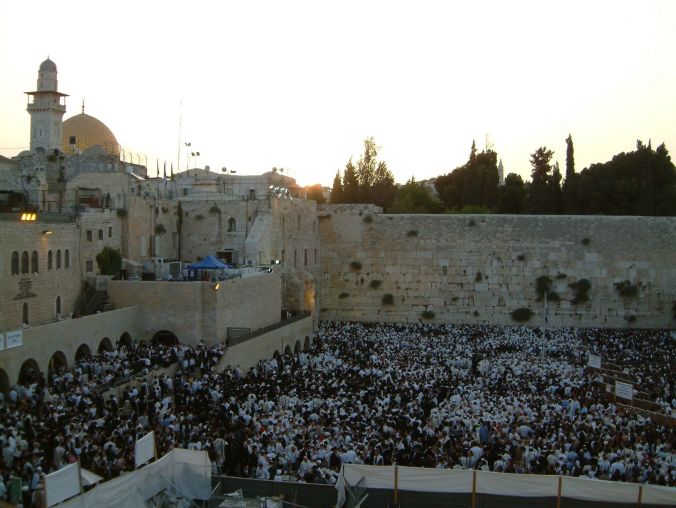
Here is an amazing picture from 2008. I can promise you it looks more or less like this every year.
The first time I went to the Kotel on Shavuot to witness religious Jews sing sunrise prayers after a night of Torah study, I felt my heart expand with pride and a wave of joy washed over me hearing all the voices raised in song. The singing was not coordinated among the groups and yet it wasn’t a cacophony. It represented the full spectrum of diversity in the Jewish community – each group sang the same prayer, but in their own rhythm, in their own time. It was beautiful!
Not every year was so awe-inspiring, but on the whole, I enjoyed either staying up all night or waking up at 4:30am to witness the morning prayers welcoming the new day.
But I didn’t do it this year and I feel okay about it (even if it sounds like the lady doth protest too much).
One of the things I appreciate about living in Israel is that I’ll always have Shavuot off. This is a holiday I knew nothing about when I lived in the US. I would have only known about it if I was religious in some way and connected to a synagogue. It is possible in the US to connect to being Jewish without attending synagogue, but it is a lot harder.
Besides a lack of knowledge, if I wanted to recognize Shavuot in some way in the US, I would have to take a vacation day or a personal day from work. When I was working at the University of Washington many years ago, I requested Yom Kippur off. My boss asked if I was going to synagogue and fasting. I said that I wasn’t planning to. She was confused and questioned my taking a personal day for it. In Israel, I never have to have that kind of conversation ever again.
Living in Israel, I know that Shavuot is the holiday that commemorates the Jewish people receiving the Torah on Sinai. Since Passover, people have been counting up to this day – seven weeks (shavuot means weeks).
All dairy products are on sale because Jews traditionally don’t eat meat on this holiday. No one is actually entirely clear about why this is, but there are a few explanations.
Shavuot is one of the three pilgrimage holidays. In the olden days, Jews came to Jerusalem to make various kinds of offerings at the Temple on Passover, Shavuot, and Sukkot. Today, Jews go to what’s left of the Temple, the Kotel, and pray at sunrise on Shavuot.
I didn’t go to special classes to learn this stuff. I still don’t go to synagogue. I asked my friends, colleagues, and neighbors, and they told me. Here in Israel it is common, cultural knowledge.
Living in a Jewish state, all the Jewish holidays are national holidays, so I get the day off. I can or I may study all night or go to the Kotel at sunrise, but I am not obligated to. I don’t have to answer to anyone about how I connect to being Jewish. It’s an odd paradox, I suppose, but being Jewish to me is my culture, my heritage, my history, my people. The mantle of religious Judaism doesn’t fit me comfortably. In short, it’s easier for me to feel Jewish in Israel because I don’t have to be religious.
So, not going to the Kotel on Shavuot? No big deal. I ate cheesecake. Isn’t that enough?
We spent the week celebrating Jerusalem Day, which this year marked 50 years since the reunification of Jerusalem. The parade went right by my house!
Oh, right! The President of the United States visited Israel.
There’s plenty of analysis and deconstruction of his visit all over the internet, and I can’t really add anything very enlightening. I can say that if my only view of him was how he presented himself to the Israeli media, I would say that he did pretty well. He went to the Western Wall – the only sitting president to have done so – and that says a lot to us here in Israel.
Trump, I think, also gets points for taking such a difficult foreign trip. Air Force One is the only plane that has gone from Saudi Arabia directly to Israel and our media took note of it.
Granted there were a few faux pas. When Trump called terrorists “losers,” I thought back to my 11th grade English teacher who always reminded us to “elevate our vocabularies.” I chuckled to myself when Trump mispronounced the name of the king of Saudi Arabia – he’s Salman, not Solomon. I was more surprised that he mispronounced Elie Wiesel’s name.
While the US watched to make sure Trump didn’t misstep during such a potentially diplomatically dangerous trip, we here in Israel had our own problems. We have a guy who is called “Israel’s Trump” and he wears the name with pride. Somehow he ended up in the greeting line at the airport – it was a question as to how he got there since the government says he wasn’t invited and he says that he was. And then he took a selfie with the president of the United States. A SELFIE! *FACE PALM*
It became an instant meme in Israel.
Paratroopers at the Western Wall in June 1967, which is a nice link to Jerusalem Day. Source.
Trump originally wanted to speak from Masada, but due to the heat and the fact that Marine One isn’t allowed to land in the middle of a UNESCO archaeological site – not to mention where would everyone sit? – he went Yad Vashem as most leaders do. Strangely, his main speech was at the Israel Museum not the Knesset. It turns out that Israel couldn’t guarantee respectful behavior of the members of Knesset, so they decided to have a select crowd at the Israel Museum instead.
The prime minister’s wife, Sarah Netanyahu, was quite chatty and seemed to be in everyone’s business, not to mention making her own little faux pas, but perhaps it was because Bibi Netanyahu wasn’t feeling very well. A few days after the visit, Bibi went to the hospital for a little procedure to deal with some kidney stones.
With minefields of potential embarrassments and diplomatic danger zones at every turn on both sides, the trip to Israel went surprisingly well. (I guess since then Trump’s trip has taken a turn for the worse, but that’s beyond the scope of this post.)
Final thought: As an outsider to politics, Trump isn’t doing things the way they’ve always been done. He cares little for diplomatic protocol and seems to speak without a filter. While I’m personally not a fan of Trump, I can see some benefit to flipping diplomacy on its head. It’s also pretty risky and has the potential to create diplomatic fiascoes. But in Israel, this time, Trump’s variation from the norm seemed to work.
When I started, I’m not sure that I imagined that I would consistently post every week and eventually get to a 3-digit number. But here we are!
People from 50 different countries have visited my blog (and thank you very much for dropping by!).
It’s no surprise that most of my visitors come from Israel and the US (in that order). Countries on the list that surprised me are Kenya, Azerbaijan, and Pakistan.
The top 10 countries are:
Israel
US
France
UK
Germany
Romania
Poland
Canada
New Zealand
Japan
My most popular post was the one I wrote about Tai Chi in Israel. It was popular because my Tai Chi school posted it on their site and it got a lot of attention (compared to my other posts). It had 305 views from around the world.
The 100th post is a milestone that made me think about what I want to do with this site. Perhaps I should just close it. After all, I don’t get a lot of readership and I just write for myself really. But that line of thought didn’t feel right. I don’t want to get famous and have a viral blog. I do want to try to commit to writing more and about different things. So far this blog has been about life in Israel, but I have many other interests and I want to explore writing about those.
In honor of my 100th post and to symbolize my increased commitment, I’ve upgraded my blog to a WordPress “personal” blog, so that I could have my own domain name.
Over the next few weeks, I’ll consider what it is that I want to accomplish with the next 100 posts and where I’d like to be at #200.
This blog started with emails to my friends and family about life in Israel and that primary mission won’t change, but I do want to expand my content a bit.
I have even considered going back and rewriting a few posts – although that may be just a writing exercise for myself and those revisions won’t show up here.
I have a lot to think about. The first step was just making the commitment and I’ve done it.

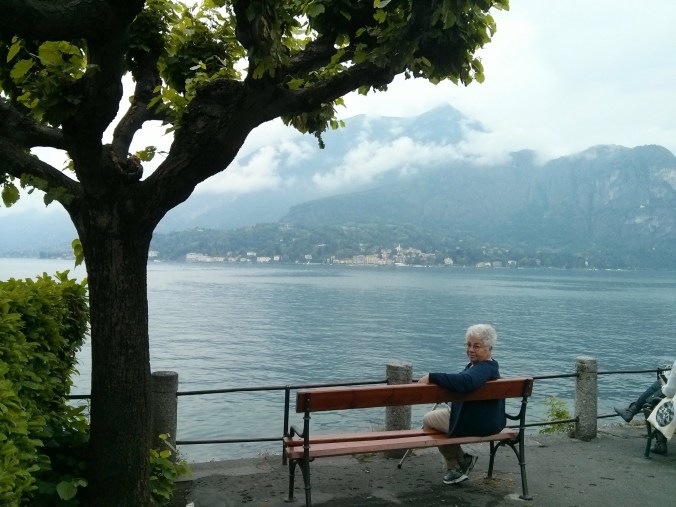




 Me at the bank







 Lake Como
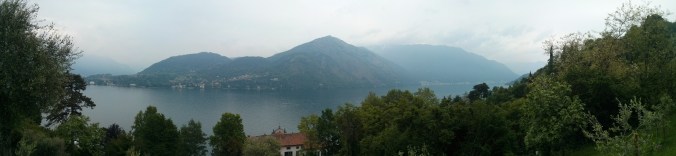 Lake Como from Villa Carlotta
 The Write Place (for me)