Bringing guns to a knife fight

It seemed like every time I looked at Facebook this week, I saw another attack.  In the last few days there have been a significant number of knife attacks in Jerusalem and in other places around the country (Tel Aviv, Afula, Kiryat Gat, Hebron, and others).  There are a lot of people smarter and better informed than I am to answer the questions of: Why now? Is it because of the Temple Mount?  Is it because of the settlements? How should Netanyahu be handling the situation?

I don’t have those answers.  What I can do is share my thoughts on the situation as I see it and how it affects my day to day life.
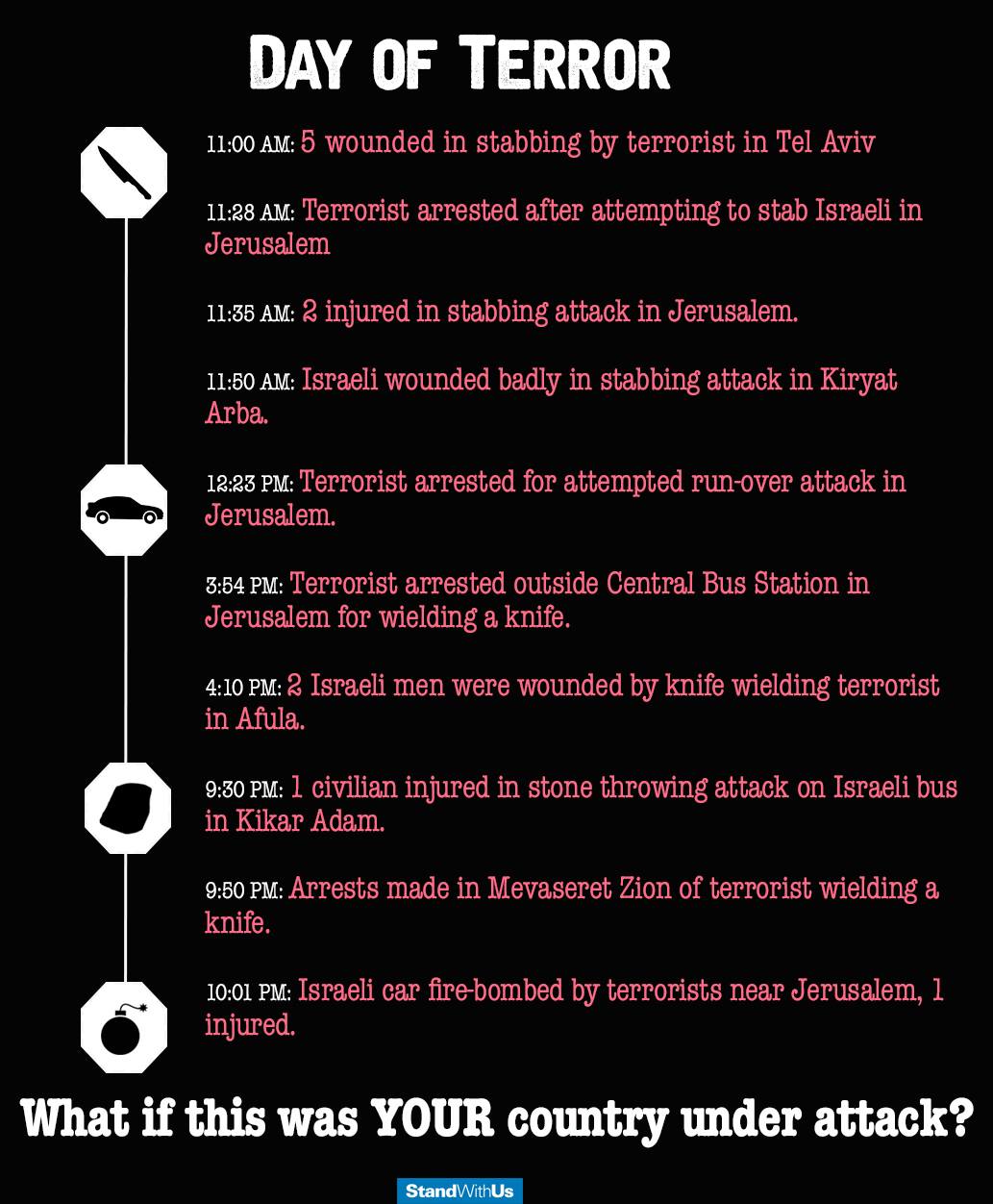
A terrible, horrible, no good, very bad day. (From the StandWithUs Facebook page.)

A terrible, horrible, no good, very bad day.
(From the StandWithUs Facebook page.)

I can honestly say that it’s scary.  But I don’t want to live my life paralyzed in fear.  I am, and will continue to be, cautious and aware of my surroundings. But in the same way that people don’t stop driving because of road rage or drive-by shootings, I’m going to go about my daily life.  I was going to have some visitors from the US and I would have gone into the Old City with them if they had decided to come.  In the end they canceled and I completely understand.  Meanwhile, this week I’ve been hearing a lot of sirens and there’s a helicopter circling regularly.

When you hear the word “stabbing,” it’s hard to imagine what that actually means.  We see it on TV and in the movies and in that imaginary world, it seems like a very survivable injury.  But then I thought about the last time I cut my finger cutting vegetables.  Sure.  It’s a tiny thing in comparison.  Then I tried to magnify the pain 100-fold or 1,000-fold.  I read a short piece written by a knife attack survivor.  She had been stabbed 13 times.  Besides the pain, the most disturbing part of her account was her description of the attacker.  What kind of dissociative state would you have to be in to plunge a knife into another human being 13 times?

Then there are the “rocks” being thrown at cars.  What’s a “rock” anyhow?  It’s not the rock that you send skipping across the water.  Make a fist.  It’s not a rock that size either.  In some cases, “rocks” are cinder blocks, the kind that you build houses with.  But not all rock-throwers are throwing cinder blocks; they’re heavy.  “Rocks” are generally about the size of a beer bottle.  Along with those rocks are actual glass bottles filled with gasoline and lit on fire.  This week I saw a video of an acquaintance of mine minutes after rocks had been thrown at his car.

When this new wave of violence got started, our prime minister was in New York making a powerful speech in the UN and there didn’t really seem to be a policy in place.  The IDF was trying to keep a lid on a simmering pot, not very successfully.  And then, after a particularly bad day, the mayor of Jerusalem made a statement on the radio:  People with gun licenses and training should start carrying their weapons.

Say what now?

You can read his statement again, I’ll wait.  At first, I thought it was a mistake, but then it was reported in the English news and then it was backed up by the deputy minister of defense.  With the wave of knife and other violence, those people with gun licenses and training should carry their weapons and consider it a form of reserve duty.  (Nope, I’m not kidding:  HERE, HERE, and HERE.)
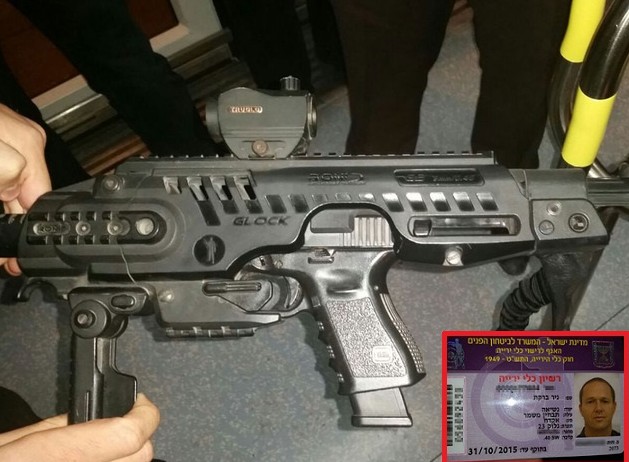
The mayor's converted hand gun. (Screen capture from the Times of Israel.)

The mayor’s converted hand gun and his license.
(Screen capture from the Times of Israel.)

To be fair, most men and many women serve in the military and have gun training.  It’s also not very easy to get a gun license in Israel.  On top of that, the number of Israel’s civilian gun accidents is quite low.  Israel has not turned into a Wild West town with a bunch of trigger-happy vigilantes.  I remember when a terrorist used a tractor to ram into bus in Jerusalem it was a quick-thinking, armed citizen (along with others) who shot the terrorist and saved lives.  I’m sure there are other examples.

I titled this post “Bringing guns to a knife fight” in part for the shock value, but that is actually what’s going on here right now.  The police and the army are not able to protect the citizens and we have to count on each other in these awful times.  I’m disappointed in and angry at the government and their inability to protect citizens, but one thing I know for sure is that when Israel gets attacked, we all stand together.

P.S.  I don’t want to post something about the media and the false picture they are painting outside of Israel, however, the “best” example is the BBC.

P.P.S . Things may get worse by the time I post this, but I want to leave you with a different image: As I write this, I have my door open so that I can hear the Greek music at the café across the street.  A few minutes ago, I heard rumbling engines and horns honking.  It was a motorcycle club on their Harleys flying Israeli flags and the honking was a show of support.  That is Israel.

Let’s prove Hobbes wrong

One of the things I dislike about the media is the idea of “if it bleeds, it leads.”  Reading the news in any country, one might think that Thomas Hobbes was right, life really is “solitary, poor, nasty, brutish and short.”  I actually wanted to write about Sukkot, the Christians who are visiting Israel right now for the Feast of the Tabernacles, the parade that marched through the streets of Jerusalem showing love for Israel and making a joyful noise, and the fact that I have had what I consider one “perfect day” after another.

And then my Facebook wall filled up with the news of two national tragedies.  I was troubled.

Tragedy 1:  Students were shot in class.  Christians seemed to be the targets.

Tragedy 2:  A Jewish couple was shot in their car travelling on a highway.  Their four children were in the back seats.

People died, but that’s not the story.  Eventually, we will hear about the victims, but the filler of the stories will be the politics.  Sides will be taken and the people who died and their families will be footnotes in some other story that other people are telling.

Where is the humanity?

One story took place in Oregon.  It will be about gun laws and probably about mental illness and societal breakdown.  The other story took place here – even naming the location is political.  That story will be about place and the question of terrorism versus “justified” rage.  In one story, the victims will fade into the background, wallpaper for a story about a guy who lost it and went on a rampage (I suppose).  In the other story, the victims will be either glorified or it will be suggested that they “deserved it” because of where they chose to live.

And again I ask, where is the humanity?  Human beings lost their lives today.  Families were shattered.  The race to find out how to spin the story to suit a particular narrative is beyond distasteful, it’s disgusting.

You probably know which story took place where.  But I purposefully didn’t point it out.  The reason is that I would like you, dear reader, to consider your response if you didn’t know where the stories took place.

I hope you would have the same reaction to both tragedies.  People were murdered in cold blood.  The victims were killed by gunmen who didn’t agree with their beliefs.  They were not fighting a war.  They were human beings going to school and driving on a road.  If we haven’t totally lost our humanity, the politics should not matter.

I especially want to applaud the local sheriff in Oregon, John Hanlin, who said that he will not say the name of the shooter.  The victims – may their memories be a blessing – deserve better than to be forever linked with their killer.

My thoughts and prayers are with the families of the victims of these tragedies.  The hole in their lives will never be filled by the politics.  Let us also find our own humanity and in some small way prove Hobbes wrong.

ScreenHunter_03 Oct. 02 19.06

Life doesn’t have be solitary, poor, nasty, brutish, and short.  Together, let’s try to reject the bleeding leads.  Let’s celebrate life.  Live joyfully.  Love, or at least respect, one another.  It’s possible, but we will have to find our humanity first.

At the Kotel on Yom Kippur

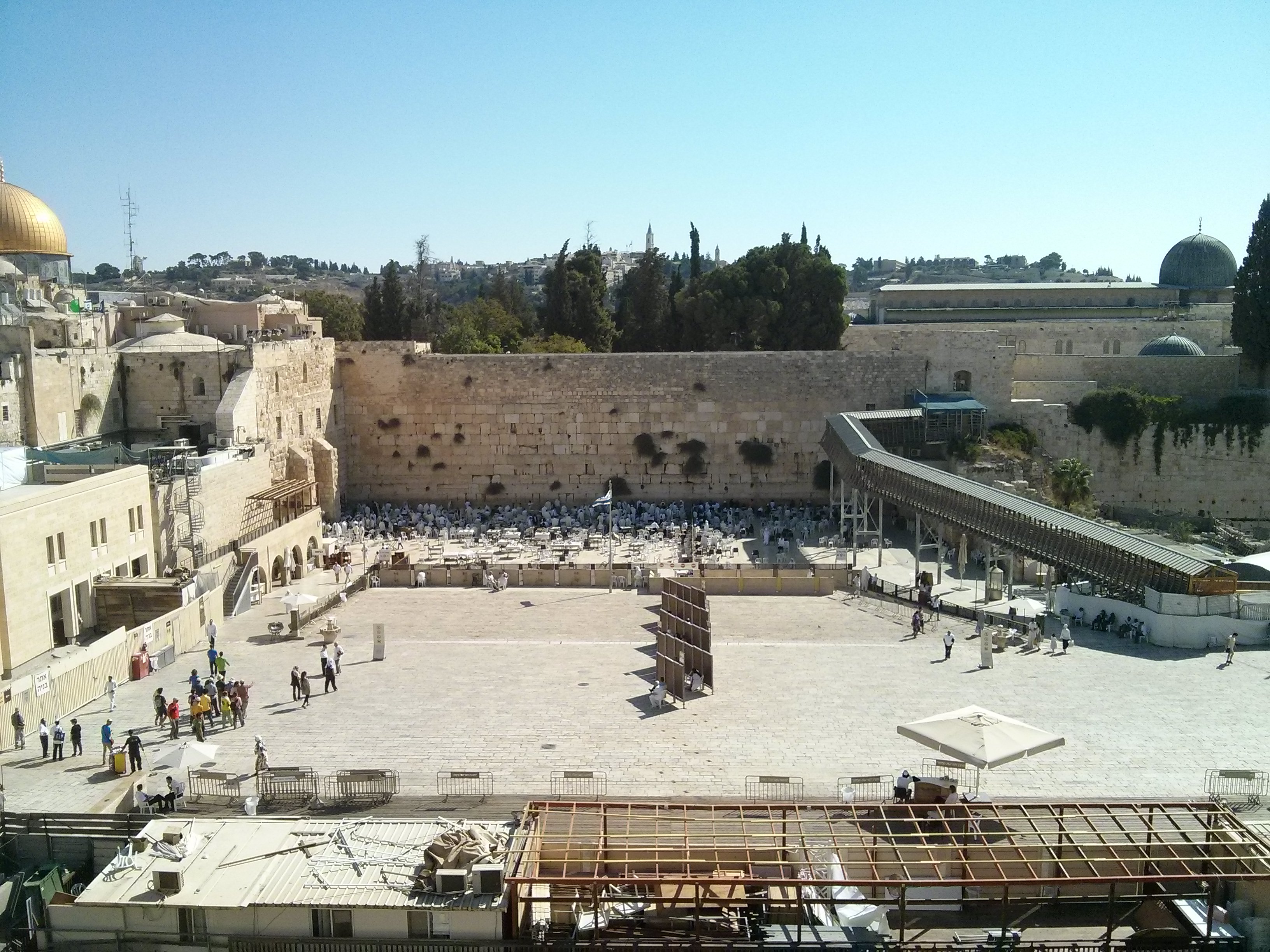
It’s my tradition to go to the Western Wall (the Kotel) on Yom Kippur in the morning before it gets too hot and too crowded.  I use this special time to be grateful for all the blessings in my life and think about the upcoming year.  I try to limit my asking for requests for other people.

Here’s what I saw and experienced:

  • It’s always hot on Yom Kippur – no matter the weather the day before or after.
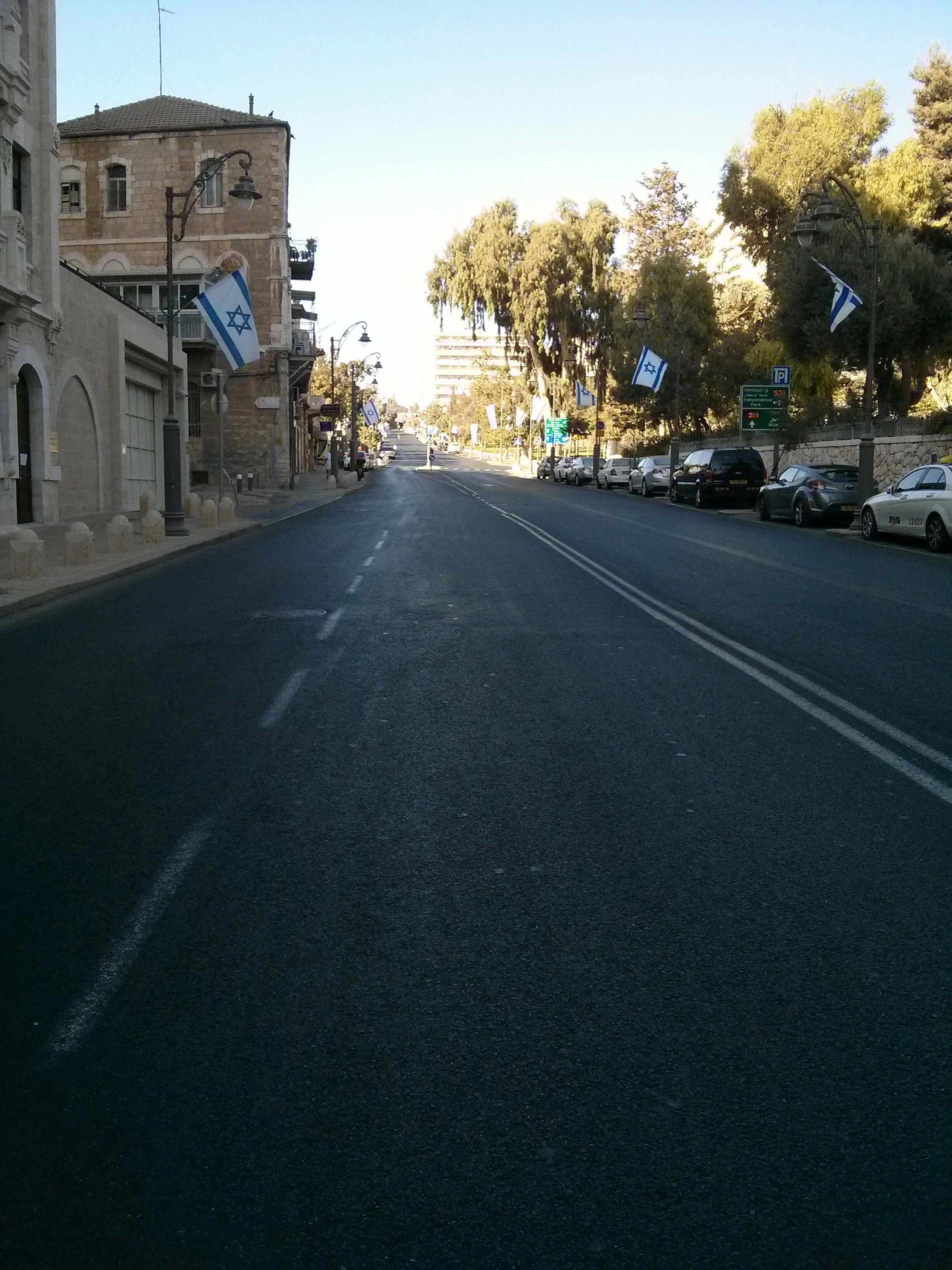
  • The streets were gorgeously quiet and empty.
Yom Kippur 8:45am

Yom Kippur 8:45am

Overlooking the valley outside the walls of the Old City 9am

Overlooking the valley outside the walls of the Old City 9am

  • When I arrived at the women’s section, I saw two female soldiers praying, in uniform and with their guns.  Later one of them went up to the wall and said a few prayers, with her gun.
  • At the wall, the woman to my left was praying in a romance language (Italian, Spanish?) quite loudly.  I heard her say “gracias a Dios,” which seemed fine, and then “benedictus Christos.”  Hmm.  Probably not Jewish.
  • The woman to my right was reading a bible in Chinese.  Status unknown.
  • When I sat down, I looked around more carefully.  More than half of the people there were drinking water and didn’t quite fit.
Bird's eye view 10am

Bird’s eye view 10am

  • When I left, there were large tourist groups – with their cameras – entering the Western Wall plaza.
  • I wondered if all these non-Jews thought that God was only answering calls at the Kotel on Yom Kippur; perhaps the connection wasn’t as good at other holy locations.
  • I didn’t see as many people in the Jewish quarter as I expected, but it might have been too early.
Not the Jewish quarter.  This is Jaffa Gate at 9am.

Not the Jewish quarter. This is Jaffa Gate at 9am.

  • There was a police presence.  At around 9am, it was calm and relaxed.  By 10am the Border Police were stationed with a much stronger presence.  (It hasn’t been calm, so they were expecting trouble.  In the end, it was a quiet day.)

I completed the fast and even though I didn’t spend the entire day in reflection, I did feel renewed and ready to start a new year.

I promised a post about my trip in Romania, but I had such a great time that I think the trip would be better served in several short entries (coming soon!).

Until then, Shabbat Shalom!  May we all have some peace and quiet, renewal and reflection.  And birthday cake.  We should all have some cake.

Yom Kippur and the Revolution

Upon arriving in Timisoara, Romania, this week, my first visit was to the Museum of the 1989 Revolution. I remember the events of 1989, but somehow I had forgotten that Romania was also one of the countries that overturned its government.  I learned a lot, earned a few points with my hosts, and saw Timisoara in a whole new light.  This was the birthplace of their revolution.

Timisoara

Timisoara

Since Yom Kippur is next week and I wanted to write about that too, I thought about how the two things fit together.

The 1989 revolution started with a small demonstration with something like 20 people who didn’t want their priest to be arrested.  One thing led to another until the Opera House in Timisoara became the headquarters of the revolution and the frenzy of it all swept across Romania.  Change begins with a small action; sometimes it’s hard and painful, but hopefully things will be better afterwards.  There are no guarantees.  You just have to believe in the cause and keep moving forward with your hopes and dreams to guide you toward something better.

Yom Kippur is not so different.  Yom Kippur is the 10th day of reflection at the beginning of the Jewish New Year.  The religious tradition is that for 9 days, you make peace with your fellow human beings.  On the 10th day, you make peace with God.  On Yom Kippur you fast for 25 hours (no drinking either!) and you dedicate yourself fully to prayer, reflection, and confession.   By the end you are an empty vessel ready to start anew.  For the next year, you start small and try to fill up your vessel self with something better.

In my own attempt to make peace with my fellow human beings, let me apologize for any slights or insults.  If I hurt you in any way, I’m sorry. I know that a general blanket apology pales in comparison to a real and personal apology, and I’m sorry for that too.

This year Yom Kippur falls on my birthday.  While I’m not looking forward to fasting on my birthday, perhaps this is an interesting coincidence that serves as a reminder that every year begins anew, with a clean state, full of potential, a chance to refill my newly emptied vessel self with something better.

G’mar Hatima Tova! (May you be written in the Book of Life!)

***

Next week I’ll write about my visit to Timisoara.  I still have 2 days left of my trip.

9/11 and Rosh HaShana

Today is 9/11.  Of course I remember September 11, 2001, and we should take a moment to commemorate those whose were robbed of the rest of their lives by a major terror attack.  Let this sad day remind us all that none of us knows what the future will bring.  Let’s be kind to one another today.

For me 9/11 is directly linked to the High Holidays.  Next week it’s the Jewish New Year.  Rosh HaShana (literally, the head of the year) is a two-day holiday that is usually in September or October.  I won’t get into the religious details and questions; you can look those up yourself.

Rosh HaShana is the beginning of a 10-day period that will end with Yom Kippur (the Day of Atonement).  In English, these days are called The Days of Awe.  In Hebrew they are called the much scarier yamim nora’im (The Terrible Days).  It’s traditional to take a spiritual accounting (heshbon nefesh) of the past year – determine if you did well, where you can improve, make some adjustments for the upcoming year.  It’s more than the January New Year’s resolutions that go out the window on January 2nd.  Not so the spiritual accounting of Rosh HaShana.  It’s not about losing weight and taking care of your health.  This spiritual accounting is internal and focusing on becoming a better person.

“Aharei ha-chagim!”

The bureaucratic joke in Israel is that if you have a project starting at any time in September it will likely be pushed off to “aharei ha-chagim” (after the holidays).  However, this is not after the two-day holiday of Rosh HaShana.  Not even after Yom Kippur ten days later.  No, “aharei ha-chagim” means after Sukkot is over.  In Israel if you start anything in September, you can count on at least a 3-week delay.  Because there are so many holidays and kids are out of school (even though they only started last week), the entire country grinds to a halt and everyone is on vacation (again!).

On one hand, there is something really powerful about taking the time to reflect on the year that passed and look to the future; or, more likely, taking the time to be with your family during the holidays.  The rhythm of life in Israel allows for both (without mandating either one).

On the other hand, this is 3 weeks of sanctioned procrastination.  “Acharei ha-chagim” can be used for just about anything.  All your big plans and aspirations?  Meh.  Leave them until later.  Perhaps some real soul-searching is going on in these 3 weeks and it might be a legitimate way to pause and take a breath.  But who can honestly say that they are taking the full 3 weeks to do an internal spiritual cleanse?

And so we come back to 9/11.  What is the spiritual message that I heard in this tragedy?  You never know when the end will come.  Around this time I ask myself:  Is my spiritual accounting up to date?  Was I kind enough?  Did I let the important people in my life know that I care about them and they matter to me?  Was I true to myself?  If today was my last day, would I have regrets? Am I procrastinating or am I regrouping? What can I do to make tomorrow/next year better?

Well, I don’t want to end on such a blue and morbid note.  Rosh HaShana is a happy holiday!  We are given the opportunity to clean our slates and start fresh.  So let me wish you all a Happy New Year!  A Shana Tova u’Metuka (a good and sweet year)!

How I learned to stop worrying and love technology

I was originally going to title this week’s post “Summer’s over: Back to the war, I mean, school.”  That more or less sums up this week in Israel.  Kids went back to school on September 1.  Then there were rockets fired from Gaza (fyi, they landed in Gaza).  Five American yeshiva students took a wrong turn into Hebron and were nearly lynched (a Palestinian protected them and they were rescued by the IDF). A law was passed that has a clause in it that forbids journalists from including their opinion in newscasts.  They may take that to the Supreme Court, but it is certainly an interesting development.

All in all, it was a crazy week in Israel.

I don’t have kids.  I don’t live near Gaza or Hebron.  I’m not a journalist, so I’ll state my opinion if I want to.  Instead, this week I jumped on a fascinating, amazing technological wonder.

Anyone who knows me would never describe me as an early adopter.  I got a smart phone after everyone I knew already had one.  I got a tablet only after at least half the people I knew told me how great it was.  Truth be told, I like pen and paper.

And yet.

I like Korean dramas (k-drama).  Those dramas led me to Korean pop music (k-pop).  I don’t speak Korean, so I have to find streaming sites that include subtitles.  Those searches led to sites in English about Korean pop culture.  And those led me to the fabulous world of Korean technology.

This week I downloaded an app on my phone that lets popular Korean musicians and actors broadcast live via the internet directly to their fan base and interact with them by responding to viewer comments in real time.  As of today, 51 artists have their own channels – though it doesn’t mean they all have broadcasts yet – and the list is growing.

The most important icon on my phone right now

The most important icon on my phone right now

The broadcasts are saved and most of them are eventually subtitled.  A couple of my favorites have their own channels already and I’m hooked.

But what’s really amazing to me is the whole phenomenon.  This is interactive reality TV speaking to a generation of kids who swim in technology (and me, though I’m not a kid who swims in technology).  Korean artists tend to be well-mannered and incredibly sweet and so it seems there is a genuine desire to connect personally with their fan base and this is the newest, slickest, most personalized way to do it.  Facebook, Twitter, Instagram, and other apps I’ve probably never heard of are left in the dust when your favorite actor/musician is having FaceTime with millions of fans simultaneously.

Think about this:  A famous band (choose your generation’s most famous) fills a theater, a stadium, a giant field.  They go on a world tour.  They sell albums.  They are on TV and radio, get fan mail, interact with fans on the internet in various formats.

Now picture this:  The lead singer of a famous Korean band broadcasts for 30 minutes and the broadcast is saved (and subtitled within a day).  Within 2 days the broadcast has received over 23 million hearts (you can send more than one) and over 800 thousand comments.  In that particular broadcast, the lead singer asked people to send their phone numbers and he actually called two fans and chatted with them.

Obviously, the real-time personal connection to everyone in the world simultaneously will help the bands and actors make a gazillion dollars.  This is the natural next level of fan service.  And at the same time, this conveniently located app on my phone is a TV channel with a schedule and video-on-demand.

Will this be a revolution in interactive real-time viewing?  Who knows.  This app has only been out for a short while.  All I know for sure is that it is a hell of a lot more fun than watching the news in Israel.

Summer in Jerusalem

Ah, Jerusalem!  Just about everyone wants to visit Jerusalem at least once in their lives.

I forget that sometimes because I live in the center of Jerusalem.  From my rooftop perch, I look over the valley of downtown Jerusalem and I still find myself surprised to look down and see crowds walking around.  What are all these people doing in my neighborhood?  Oh, right.  Jerusalem.

But Jerusalem is a city like any other and the people who live here want stuff to do that has nothing to do with holy sites, educational activities, or even tourist attractions.  Our mayor, a secular businessman (who is an all-around awesome guy), encourages all kinds of fun city events.  It just so happens that a lot of them are delivered to my doorstep.

The Beer Festival was held in the park across the street on Wednesday and Thursday.  While the beer was not actually delivered to my door, the music floated over so that I could prop the door open, sit in the comfort of my home, and listen to well-known Israeli bands playing just across the way.  For FREE!

If I decide to actually leave the house, I could visit Jaffa Street Night Market on Thursdays. The idea is apparently inspired by the night markets of Chiang Mai, Thailand (been there!), Las Ramblas in Barcelona (been there!), and Covent Garden in London (haven’t been there yet!).  It’s touted as the first in Israel and will eventually be quite big, just over a kilometer long or.75 miles.

I’ve been sick this week, so I didn’t manage to get to the Beatles Tribute that was supposed to happen this afternoon on the rooftop of one of the downtown hostels.  They wanted to recreate the Beatles playing on the Apple Studios roof in London.

And still there are the usual things to do in the city:  movies screened in outdoor locations, there are cultural shows at the First Train Station (along with Lego Land and a zillion other things for kids to do), I’ve heard that the Metropolitan Opera will be screened at the Cinemateque.  Friends, this is not the Jerusalem you remember from 20 years ago.  Frankly, it’s not the Jerusalem you remember from 5 years ago.

Here on my little rooftop, I sometimes forget that I even live in a city.  From my window, I see trees.  Somehow the city noise floats away from my apartment.  And yet, this amazing city is all around me.  I must remember to go down and visit from time to time.

Matisyahu and the BDS of Spain

Here’s one verse from Matisyahu’s song “One Day

One Day - Matisyahu

One Day – Matisyahu

All my life I’ve been waiting for
I’ve been praying for
For the people to say
That we don’t wanna fight no more
There will be no more wars
And our children will play

Matisyahu was invited to participate in a reggae festival in Spain and then he was told that his participation would be cancelled unless he provided an unequivocal statement supporting the creation a Palestinian state.  Huh?

Matisyahu is Jewish, but he’s American, not Israeli.  And he was the only person asked to provide a political statement in order for him to participate in the festival.  The festival buckled to threats by the BDS (Boycott, Sanctions, Divestment) movement in Spain who threatened to disrupt the festival.

There was an international reaction and El Pais wrote a strong op-ed against the festival’s action and the BDS movement.  A couple of days later, the festival reinvited Matisyahu with apologies.  I didn’t see any recent posts about whether or not he’s going to accept and play the festival. (UPDATE at the bottom of the page.)

That’s the short version of what happened.  There is a lot more that could be said about the event itself and certainly a lot more that can be said about the BDS movement in general.  I just want to shine a light on two things:

  1. Threats of violence are not the way to bring about true peace;
  2. If the BDS movement is focused on Israel, why are they targeting an American Jew and if they want to help Palestinians, why are they silent about Palestinians who are suffering in Syria (for example)?

I’m an advocate of voting with your feet or spending your money to further your beliefs.  If you have an issue with Israel’s policies, then by all means boycott.  I think it’s a great expression of freedom.

But here’s the problem.  If the BDS movement wants to encourage people to boycott, why exactly are they doing it by threatening violence?  There are plenty of stories of singers who canceled their concerts in Israel because their lives or families were threatened.  (See here, here, here.) What version of peace, love, and understanding includes death threats?

Playing the devil’s advocate, let’s say that the violence represents their call for a revolution.  Aren’t they actually replacing one allegedly oppressive regime with another?  Believe like us or we will destroy you and your family.  Really?  That’s how you want to change the world?

Those in the BDS movement that reject violence are still disingenuous.  They claim to want to raise awareness of the plight of Palestinians.  Apparently, they only care about Palestinians in Israel because I haven’t heard any outrage whatsoever regarding bombings of Palestinian villages (refugee camps) in Syria.

Let’s get back to Matisyahu.  Take a look again at his lyrics.  “Don’t wanna fight no more . . . no more war . . . our children will play.”  The BDS movement in Spain says cancel his performance or we will seriously disrupt the festival.  The festival buckles under pressure and requests a single performer to make a political statement about a country he doesn’t even live in.  Who is really advocating for a better world?  Who is looking at the bigger picture and asking us to go outside of ourselves and embrace life and peace?  It’s not the BDS or the embarrassed festival organizers.  I suggest that they explore the meaning of hypocrisy.

It’s time for a champion
Soothe the soul of the land
Mend the heart from the sea and the sand
‘Til the sun comes up again

Sunshine” by Matisyahu

Sunshine - Matisyahu

Sunshine – Matisyahu

Matisyahu and his music are the champions.  Choose life.  Choose peace.  Vote with your feet and your dollars for something worthwhile that truly makes the world a better place.

UPDATE 22 AUG 2015: Matisyahu will be performing at the festival.
UPDATE #2 23 AUG 2015: Matisyahu sang one of his most famous songs, “Jerusalem,” while facing down protesters waving Palestinian flags in the front rows of the audience.
UPDATE #3 4 SEPT 2015: Matisyahu played at the final day of the Jerusalem Sacred Music Festival in the Old City of Jerusalem.

Obladee-Obladah

Life goes on.  And so it does in Israel.  We’ve had terrible events, we are having on-going debates about the future of our country, ISIS is standing at our gates, Iran, well, who knows what’s going on there.  And yet.

My first flatmate in Israel taught me one of the most important things I’ve learned about life in Israel.  Keep living.  In those days, buses and cafes were blowing up.  You learned that one or two sirens passing by was fine, but if you heard a third, there had been an attack.  He never let attacks on public places ever stop him from going anywhere.  My newly arrived self thought it would just be better to stay home and stay away from public places.  He wouldn’t let me and I am so grateful that he didn’t.

A few days after the Hillel Café bombing in Jerusalem, I was supposed to meet a friend for coffee.  He thought perhaps I would want to cancel.  “Are you kidding?  We are absolutely not cancelling.  We are going to Emek Refaim and we are going to have coffee in whatever café is open.”  He was surprised, but if I wasn’t afraid to go out, then he shouldn’t be either, right?

To this day, he still remembers that coffee in an empty café on a nearly empty street.  I think we even ordered dessert.

Israelis are resilient – not crazy.  There is usually a day or two of caution and then life returns to its usual rhythm.  People may be more alert, but they are not staying home cowering in fear.

This week in Jerusalem there was a Thai evening at the train station.  It was packed with people including many children.  The international arts and crafts fair started this week and I assume it was packed as usual.  Last night there was a night market on Jaffa Street.  I was too tired to go, but I still have a chance next week.  In short, this is life in Jerusalem in August.

Thai Drama

Thai Drama

Standing room only!

Standing room only!

In preparing for this post, I took a look at headlines to find out what happened this week.  There was the usual: Iran, Temple Mount, UN, Russia, Greece.  But then I saw this little headline near the top of the page.  “Yerushalmi Café Culture.”  Turns out it’s about my local café!  Even with all the “big” news, there is a place for a write-up about a sweet little café.  The small things matter.  The small joys are what make life worth living.

So I’ll end here with two quotes that I think sum up this week’s email:

“A life lived in fear is a life half lived.” – from the film Strictly Ballroom

Still Here by Langston Hughes

Been scarred and battered.
My hopes the wind done scattered.
Snow has friz me,
Sun has baked me,

Looks like between ’em they done
Tried to make me

Stop laughin’, stop lovin’, stop livin’–
But I don’t care!
I’m still here!

Wishing you all a Shabbat shalom and in the spirit of the most famous Jewish toasts, L’chaim!  To life!

Determined to find the positive

Synchronicity or bust

When nothing seems to help, I would go and look at a stonecutter hammering away at his rock perhaps a hundred times without as much as a crack showing in it. Yet at the hundred and first blow it would split in two, and I knew it was not that blow that did it, but all that had gone before together. — Jacob A. Riis 

One of the blogs I read is called Zen Pencils.  His tag line is “cartoon quotes from inspirational folks.”  You should go see his blog because it is great (zenpencils.com).  This week the inspirational quote was this one and it really helped me get through the week.   Personally, I’m still dealing with the bureaucratic issues I’ve been complaining about for weeks.  Expect an op-ed about this in the future.  But I think this quote is also about Israel.

After the terrible events last week, Israel has witnessed a lot of debate, finger-pointing, self-flagellation, and every point of view has been publicized about every angle of the issues.  I don’t want to summarize all that here.  Instead, I want to bring out the positive things that I saw this week that give me hope that we can get through these difficult times together.  Each one is a hammer tap.  Each one has the potential to be the 101st blow.

Bubbles are better than blood

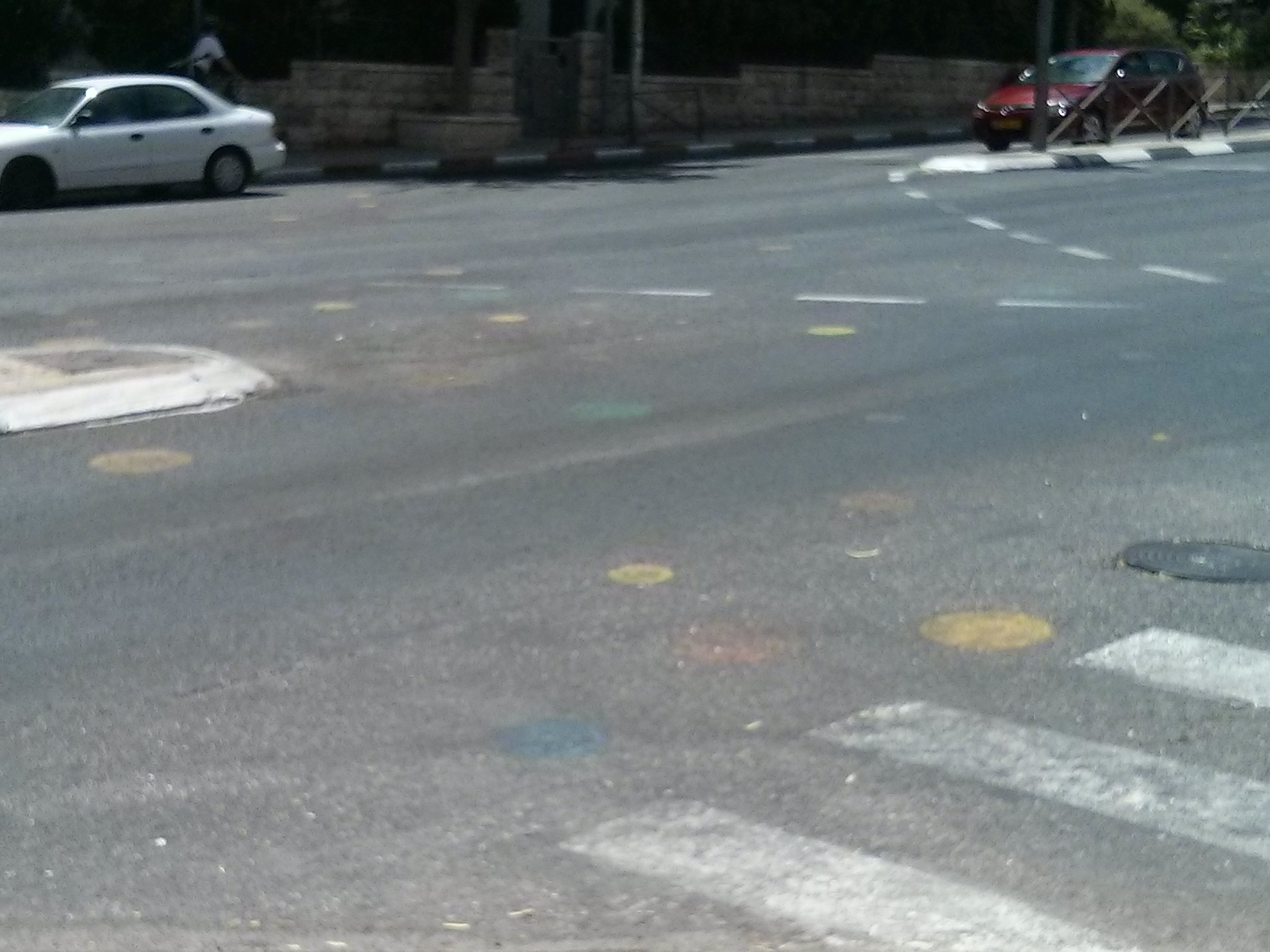
Some brilliant person took the initiative in the middle of the night to paint bubbles over the blood stains left in the street where the stabbing took place.  I saw the post on Facebook saying that they wanted to celebrate life with symbols of hope.  Here’s my picture taken this morning (a few days after painting).

Bubbles

Bubbles

Zionist Bedouins

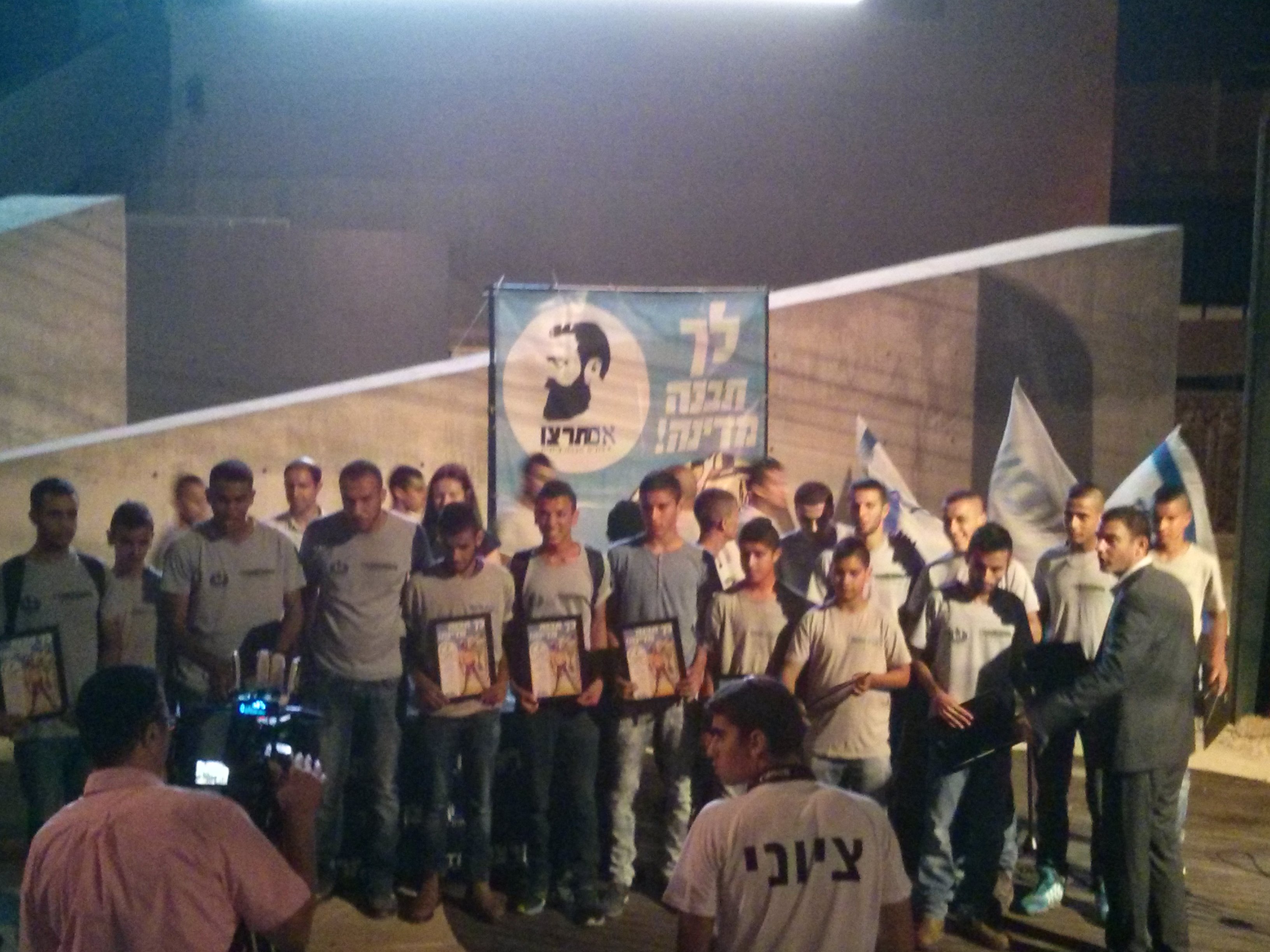
Last night I went to the annual event of a Zionist organization I do work for.  One of the honorees was a Bedouin youth organization called Aharai (lit. “after me” or “follow me”) that prepares these kids for enlistment in the IDF.  There were about 40 kids who came to represent their organization.  When their organizer spoke after receiving the award, he told a story of a Holocaust survivor who came to speak to their group.  The kids gave her a bouquet of flowers and promised her that they would not let another Holocaust happen to the Jewish people.  Everyone gave them a standing ovation.

Receiving their well-deserved recognition

Receiving their well-deserved recognition

To me, this is what Zionism is all about.  Israel is a state that is built as the homeland for the Jewish people, but Israel must also embrace and protect all of its citizens, even and especially when they aren’t Jewish.  It’s not easy for the Bedouins to join the IDF.  Let’s face it.  There is prejudice in the army.  But they also have to face the rest of the Muslim community who feel it is a betrayal for them to serve in the IDF.  But they do it anyway because they want to defend their country, this country, the homeland of the Jewish people, the Jewish and democratic state.