Leonard, my Dad, and the Darkness Leading to the Light

Leonard Cohen died last week at the age of 82.  He had a lot of Israeli fans and so it’s been big news around here.  (Yes, there is news about the other guy, but it seems to be a “wait and see” situation.)  Leonard Cohen gave a concert in Israel in 2009 and my colleagues at the office talked about it like it was yesterday.  Another colleague let me listen to his newly purchased Leonard Cohen CD, his very last studio album, released on Cohen’s birthday September 22, 2016.

Israelis like Leonard Cohen because he speaks their language.  I don’t mean Hebrew exactly.  I mean a cultural language that may not speak to other audiences the same way.  One of his most famous songs, “Hallelujah,” can be admired by anyone.  But the stories within it of David and Bathsheba and Samson and Delilah and their tortured love stories speak to those who know the stories and who are philosophers and questioners deep in their hearts.  Like Leonard Cohen.  And like my dad.

Leonard Cohen may have dabbled in Zen Buddhism, but he was a Jew through and through, and I think that’s what Israelis like the most about him.  No matter his journey, he’s still one of us.

The first song on the new album is called “You Want it Darker.”  Everyone is talking about it now because in it he essentially tells God that he is ready to die using the biblical phrase “heneni” – here I am (here’s a great article about it from September).  I happened upon an 11-minute video published this week by Rabbi Jonathan Sacks (former chief rabbi in the UK) linking Leonard Cohen’s song to the Torah portion this week.  It’s excellent and worth your time.

Rabbi Sacks explores the fact that Leonard Cohen uses the chorus “heneni” in the same way that Abraham does in the Torah.  This week’s portion is the story of Abraham taking Isaac to be sacrificed.  When God calls to Abraham, Abraham answers “heneni.”  He also points out that the lyrics echo the prayer for the deceased that mourners say (called Kaddish) and that Cohen is saying Kaddish for himself. Cohen noted in his last interview that he was ready to go.  He had his house in order and said: “Spiritual things, baruch Hashem”—thank God—“have fallen into place, for which I am deeply grateful.”  (Audio here.)

I mentioned last week that Dad regretted not being able to be here to see the results of the election.  Now I wonder what he would have made of Leonard Cohen’s last song.  Dad was angry at God at the end – it’s still a little unclear to me exactly why, but he said it a lot.  I don’t think he meant it in a personal way.  I don’t think he was angry at God for giving him cancer, but he was angry in a larger sense.  The world is pretty crazy right now and I think Dad blamed God for making people this way (it’s also possible that he blamed people for making God this way, but that would be at least a two-hour tangent in a conversation with Dad).

And here we have Leonard Cohen saying, yes, the world is pretty crummy and I’m ready to check out of the Chelsea Hotel permanently.  Here I am, Lord.  I wonder if that thought would have given Dad some peace.  The first verse would have spoken directly to Dad, I think, and he might have felt that the rest of the song was worth listening to and thinking about.

If you are the dealer, I’m out of the game
If you are the healer, it means I’m broken and lame
If thine is the glory then mine must be the shame
You want it darker
We kill the flame

Listen here:

As far as I know, Dad was not a fan of Leonard Cohen, but Dad was a questioner and a philosopher at heart.  He was curious and from time to time deeply spiritual.  I hope that Dad and Leonard will get a chance to meet wherever they are and talk about these big ideas.  I imagine that they’re probably smoking cigarettes, drinking coffee, and talking late into the night.  I’m sure there will be plenty of circular tangents and maybe even a few answers to their long-held questions.

Cover of the album

img_20161117_111431Dad and Leonard Cohen didn’t look alike, but the echoes are there.

Spaghetti Westerns

Dad and I used to watch old movies together.  Memories from my childhood include the movie theater, the cable channels American Movie Classics (AMC) and Turner Broadcasting System (TBS), and lots of black and white movies.  Dad woke me up in the middle of the night once to watch the original of The Hunchback of Notre Dame.  I remember that as he shook me awake he told me then that it was the original with Lon Chaney.  Why he didn’t just record it, I’ll never know, but I was seven or eight, it was 3am and the memory has always stayed with me.  (The original Hunchback features Charles Laughton.  Dad got it wrong.)

This week I went to see the new version of The Magnificent Seven.  I don’t think that Dad and I ever saw the 1960s version, and I’m sure that we never saw the original Kurosawa version.  But as I watched the film, my mind was suddenly flooded with memories of watching westerns with my dad.  The one I remember that we watched a few times was Once Upon a Time in the West, with Henry Fonda as a villain and Charles Bronson as a man seeking justice (or vengeance?).

magnificent_seven_xxlg

once-upon

Once Upon a Time in the West trailer

The day after the election, the Cinemateque was playing A Fistful of Dollars with Clint Eastwood.  This Sergio Leone spaghetti western was a scene by scene homage to another Kurosawa film, but to me it was another way to connect with my dad, so I went.  It was especially poignant to me that this film was played after the election because in one of the last conversations I had with Dad, he told me that he regretted that he wouldn’t be able to live until November.  He wanted to know how this crazy election would turn out.  Honestly, I don’t know what he would have thought about the results.  But one thing is for sure, he would have had a lot to say about it.

dollars

A Fistful of Dollars trailer

Watching old westerns stirs up American pride in me.  It occurs to me that the stories we tell ourselves are the mythologies of our culture.  Instead of stories told around the fire, passed down verbally from generation to generation, we have books and movies.  These characters speak to us in a deep and profound way.  For me, westerns are infused with individualism, self-reliance, pride in making a life on the frontier, a spirit of adventure, and courage.  This is what I feel is good about America.

The hero tends to be a man from nowhere, maybe without a name.  He blows into town and shakes up the status quo, which is exactly what the townspeople need, but are afraid of.  He’s cool.  He says what needs to be said.  He doesn’t care who he offends.  He operates with his own set of morals and principles.  But in order to get the change they desire, the townspeople need him and want him to do what they can’t do.

But the hero isn’t the guy you take home to meet your parents. He doesn’t stay around and take on the job of sheriff.  He doesn’t get elected mayor.  He does what has to be done and then he leaves.

Hollywood is trying to change this hero myth by making movies about teamwork (The Avengers, X-Men) and responsible leadership (“with great power comes great responsibility”), but the hero in the western is larger than life and America still admires him.

Epilogue

Trump is president-elect.  Leonard Cohen died.  We are in a cycle of supermoons.  We definitely live in interesting times.

A strange thing happened today.  I looked out my door and a pink balloon landed on my balcony.  The wind blew it around a bit and it hesitantly approached my door.  The next thing I know, it’s bouncing into my house.  Nothing is certain, but maybe, just maybe, it will all be ok.

img_20161112_105100

Miracles and Wonders?

A few years ago my brother came to visit me in Israel and on the day he was going to fly out we went on a tour of the Old City.  The first stop was the Western Wall and he decided to buy a kippa rather than wear a borrowed one to go up to the wall.  For some reason, he decided to continue wearing it.  We couldn’t go up to the Temple Mount because visiting hours had been in the morning, but we did go to the Church of the Holy Sepulchre.

“Aren’t you going to take that off before we go into the church?” I asked.

“No.  Why?  Can’t I wear it?”

“Well, it’s a little odd to visit a church wearing a kippa, but I guess it’s ok.”

So we wandered through the many chapels of the church and finally made our way to what is said to be the actual burial place of Jesus.  There was a line to get into the shrine, but my brother decided he wanted to see it.

“Seriously, you should really take the kippa off now.”

“Why?  Nobody is saying anything.  Are they going to stop me from going in?”

“Urm…well, no.  But no kippa-wearing Jew would go into the Shrine.”

But in he went.  No one said a word to him and no one gave him a second glance.  I don’t know if it was the fact that I’d taken on a cautious Jerusalem mentality, or if it was just the fact that my brother was an American tourist.  I think it’s pretty safe to say that my brother is one of the few people, if not the only person, wearing a kippa who went into Jesus’s burial shrine.

aedicule_which_supposedly_encloses_the_tomb_of_jesus-lr1

By Jlascar – https://www.flickr.com/photos/jlascar/10350934835/, CC BY 2.0, https://commons.wikimedia.org/w/index.php?curid=34030982

(Small aside: Not everyone agrees that this is the right place.  There are those who say it’s in a garden near the Damascus Gate and still others who say there’s a family grave in the neighborhood of Talpiot.)

With the US election next week and the Chicago Cubs winning the World Series, people might not have heard that Jesus’s tomb in the Church of the Holy Selpulchre was opened this week.  Yep.  That Jesus.

There are two great articles in National Geographic about it and a few amazing pictures.  See here, and here (this one has video!).

The fact that the tomb was opened and is being explored and restored is frankly miraculous.  Absolutely nothing can happen in the Church of the Holy Sepulchre without all the sects agreeing on it.  The “immovable ladder” is a symbol of the lack of agreement.  This is a ladder that stands on a ledge that cannot be removed because the sects are unable to agree about it.

OLYMPUS DIGITAL CAMERA

By Seetheholyland.net – Church of the Holy SepulchreUploaded by Ekabhishek, CC BY-SA 2.0, https://commons.wikimedia.org/w/index.php?curid=21249405

In the end, they all agreed because the tomb had suffered some water damage and they finally got some money to undertake the repairs.

Given the centuries of discord among the sects in the church and the UNESCO resolutions in the past few weeks, it’s especially interesting to mention who holds the keys to the Church of the Holy Sepulchre.  The key was given to two Muslim families starting 1,400 years ago and to this day the families still hold the key and open the door every day.

But then I wondered if Muslims consider the site sacred too, since Jesus is a prophet in Islam.  They do, but they pray in the Mosque of Umar instead of in the church.

The Patriarch offered a place for him to pray in the church and laid out a straw mat but Umar (may Allah be pleased with him) refused, explaining to the Patriarch, “Had I prayed inside the church, the Muslims coming after me would take possession of it, saying that I had prayed in it.”  Tradition has it that he picked up a stone, threw it outside and prayed at the spot it landed. The present Mosque of Umar was built over this place by Salahuddin Ayyubi’s son Afdhal Ali in 1193 CE. (Quoted from source.)

The Christians are in agreement, the Muslims protect the heritage, so just maybe there’s hope for the Temple Mount.  We live in a land of miracles and wonder.  Anything is possible!

In the Beginning, Again

Monday was the final day of the holidays, Thursday it rained for the first time this autumn, and tomorrow we’ll change our clocks.  Autumn has arrived in Israel.  I do miss the changing colors of the season, but Israel has its own charms.  Fall and winter are greener and brighter (and wetter!) than summer.  Spring, as everywhere, is the season of awakening.

We’ve come to a new year with Rosh Hashana, we cleared our spiritual account with Yom Kippur, we reminded ourselves that everything is temporary during Sukkot, and as a final preparation for the upcoming year, we start reading the Torah again from the beginning.

reading-torah

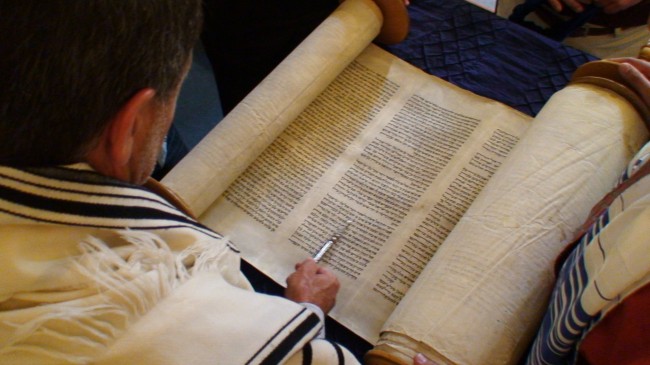
Every week a portion of the Torah is read along with a relevant passage from the Prophets.  The Torah refers only to the Five Books of Moses; the whole of the Bible is referred to as the Tanakh, an acronym of Torah, Nevi’im (Prophets), Ketuvim (Writings).  The Torah portion is read aloud in the synagogue and studied during the week.  This goes on for the whole year and at the end of Sukkot, they begin again.

A cynic’s view is that you have to have something to do every week.  But the more philosophical view is that every time you read the passages, you learn something new or have a new insight or see in a new way how it applies in your life.  The value is in the process of learning, not in the reading itself.

The Torah in the synagogue is a scroll.  It’s hand-written with a quill on parchment by a specially trained person who writes the Torah with full focus, intention, and concentration.  It really is a work of art.  However, unlike a book, you can’t just flip back to the beginning.  The most interesting and amazing Simhat Torah (the name of this holiday) I spent was at Hillel.  We unrolled the whole Torah and looked at the beauty of this work of art unrolled completely on several long tables.  We sang some joyous songs and then we rolled it back up.  The tradition is to read the last words of the Torah and then after it’s rolled back up, read the beginning lines.  It’s feels less like an end and a beginning, but rather like the completion of a circle.

“Circle of Life” – The Lion King (yep, I went there)

***

UNESCO, Again

In other events that happen over and over, UNESCO had another vote this week on the resolution on the Old City of Jerusalem and the “Al-Aqsa Mosque/Al-Haram Al-Sharif.”  This version still does not use the phrase “The Temple Mount” and removed the phrase saying that Jerusalem was important to the three monotheistic religions.

It passed, again.  I don’t think that reading and re-reading the text will give us any new understandings of the intent of the document.  However, keeping with the theme of circles, we can be sure that “what goes around comes around.”

Jerusalem Lovefest, I mean, Parade

After last week’s UNESCO vote, the Jerusalem Parade is extremely well-timed.  There will be a new vote on the UNESCO resolution, but it feels like rumblings rather than outright condemnations of an obviously biased document.

During Sukkot, Jerusalem is filled with both Jewish and Christian tourists from all around the world.  The streets are filled with families, restaurants have sukkahs (booths) outside, and there is a festival atmosphere throughout the city during the whole week.

For many years, I thought the parade was primarily a Christian thing, but it turns out that the first parade was in 1955 during Passover.  Then after 1980 when the Christian Embassy was founded in Jerusalem the parade evolved into what we have today.  The parade begins with Israeli groups – banks, insurance companies, army units, corporate groups, and others – and then the Christian groups from around the world join in.

The Christian groups are often singing songs in Hebrew to show their support.  Not being Hebrew-speakers they tend to choose the ones with simple and repetitive lyrics, but strong messages.  “Am Israel, Am Israel, Am Israel, Chai!” (The people of Israel live!) “Havenu Shalom Aleichem” (We wish you peace) “Ya’aseh Shalom, Shalom Aleinu v’Al Kol Israel” (May He bring peace, peace to us and all Israel).

Here are a few pictures from the parade.  I chose them based on the ones that turned out rather than any other criteria.

The Chinese took the phrase “Go Big or Go Home” to heart and had the biggest flags and banners and also brought along the Ark of the Covenant with trumpeting angels.

img_20161020_163341

Hungary had its own group, but the Gipsy nation came on its own.

All the northern countries were represented, but these were two signs I caught.

All around the world is not an exaggeration:  Fiji, New Zealand, Bolivia, Thailand, Taiwan, Zambia, Kenya, South Africa, France, Germany, UK, Ireland, US, Canada, and more and more and more.

My wish for this holiday season is that all these people would call their UN representatives and let UNESCO know that they came to Israel to strengthen their Jewish and Christian connections to the land.

*Note:  Christians are not allowed to proselytize in Israel.  They are not permitted to hand out any religious material at all.  So this event is a surprisingly non-political, non-religious event that is very simply an expression of support and love for Israel the country, not its government or policies.

UNESCO Rewrites History

Mom told me a story once about her mother and how she had once been a history teacher in the Soviet Union.  She was helping her students prepare for a big exam and reminding them how a certain general was a “hero of the people.”  During the week of preparations, this general became an “enemy of the people,” so all the questions about him were changed to reflect his new status.  Grandma was disillusioned and changed careers to become an accountant.

That was the Soviet Union then.  This is now.

This week a UNESCO resolution is trying to rewrite history and suggest that Jews and Christians have no connection to the Old City of Jerusalem.  I mentioned the resolution in a blog post in July and discussed very briefly the postmodern idea of “narratives of history” in May.

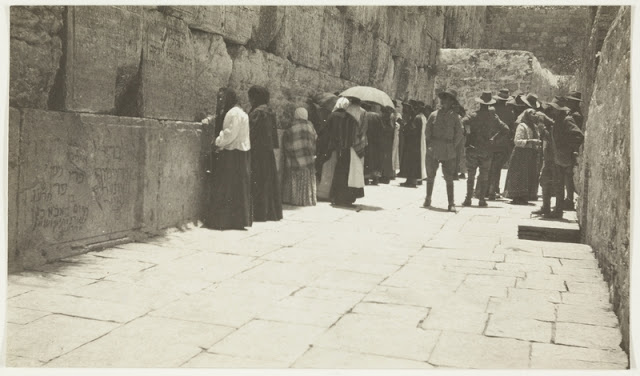
The main problem (among many others) with the resolution is that it purposely eliminates or minimizes the Jewish names of the holy sites:  Al-Aqsa Mosque/Al-Haram Al-Sharif is never referred to as the Temple Mount and Buraq Plaza is the name for the “Western Wall Plaza” (quotation marks in original).  Full text is reprinted here.

The “Buraq Plaza” of 1916-1917 – not much of a plaza and not a Muslim site.

nsw-aussie-soldiers-at-kotel

Source

The Office of Foreign Affairs posted this on their Facebook page to highlight the changing of history aspect of the purposeful elimination of names.

14633363_10154057522256317_3844728892048890717_o
Prime Minister Binyamin Netanyahu issued a statement that said:

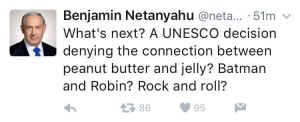
To say Israel has no connection to the Temple Mount is like saying that China has no connection to the Great Wall of China or that Egypt has no connection to the pyramids. With this absurd decision, UNESCO has lost the modicum of legitimacy it had left.

And he followed it up with this tweet.

tweet
In my opinion, the most worrisome thing is the vote.  The resolution was approved in committee 24 for and 6 against, with 26 abstentions.  The countries that stood up to vote against this resolution were: Estonia, Germany, Lithuania, The Netherlands, United Kingdom and United States.  I applaud their strength!  I wonder about the countries that abstained.  They chose not to vote yes, but could not bring themselves to vote no.  Abstaining doesn’t mean they get to pretend this resolution didn’t happen.

UNESCO’s Director-General issued a lukewarm statement mentioning that all three monotheistic religions have a connection to the Old City, but did not cancel or condemn the resolution.

In response, Israel’s government has suspended cooperation with UNESCO at this time.  And rightly so.

Being a UNESCO Heritage Site used to be a badge of honor.  But if UNESCO can vote on and pass resolutions that skew and twist history to suit a particular agenda, doesn’t it call into question all of UNESCO’s decisions and resolutions?  Is UNESCO a new totalitarian regime telling us what history is?

Yom Kippur – A Crash Course

What is the greeting for Yom Kippur?

The traditional greeting for Yom Kippur, which can be used between Rosh HaShana and Yom Kippur, is Gmar chatima tova.  The words translate to finish, seal, and good.  Chatima is also used in modern Hebrew for a signature.  What people understand when they hear this phrase is “may you be sealed in the Book of Life.”

Yom Kippur sounds pretty serious.  Why is that?

Yom Kippur is the tenth day of the month of Tishrei.  Rosh Hashana, the New Year, is on the first and second of the month.  Between these two holidays Jews are supposed to take a spiritual accounting, a cheshbon nefesh, of their actions in the past year.  During the ten days, you have an opportunity to make things right between yourself and other people.  On Yom Kippur, your actions for the past year are weighed and you have to get square with God.  At the end of the day, your name will be inscribed either in the Book of Life or the Book of Death.

I’ve heard that Kol Nidre is sung to a beautiful and haunting melody.  What does it mean?

Kol nidre means “all promises.”  This haunting, spiritual, moving melody is the tune at the start of the Yom Kippur service that basically uses legal language to nullify all promises made before God.

A cultural aside: Orthodox Jews in Israel often commit to something and follow it up with the phrase bli neder.  This absolves them of the promise that would be among the vows that are cancelled in the Kol Nidre service.

Kol Nidre holds a very interesting place in US movie history.  Al Jolson’s The Jazz Singer was one of the first “talkies.”  In the opening scene we are shown a synagogue with everyone preparing for Yom Kippur.  The cantor is saddened that his son did not come to sing Kol Nidre with him and then we hear the voice of Cantor Yossele Rosenblatt singing Kol Nidre.

Here’s a clip of one of the final scenes where Al Jolson himself sings Kol Nidre.

What is Israel like on Yom Kippur?

Quiet.  Even if people don’t do anything for Yom Kippur themselves, they respect the solemnity of the day and don’t drive.  Everything is closed in the Jewish areas.  (I don’t personally know if stores and restaurants are open in the Arab neighborhoods, but I have seen a few cars driving around on Yom Kippur and plenty of tourists in the Old City.)

I have friends that take pictures of themselves sitting in the middle of normally busy highways that on Yom Kippur are totally empty.  Children in Jerusalem ride their bikes in the middle of the street.

Air quality in Israel is measurably improved on Yom Kippur due to the complete shutdown of transportation. Even Israeli air space is closed.

I can’t statistically prove it but it seems to me that no matter how cold it may have been in the days before Yom Kippur, it is always hot on Yom Kippur.  It’s a 25-hour full fast – no eating and no drinking – and it is so much harder to fast when it’s hot.  By 4pm, everyone is listless and even in the synagogues they are counting the minutes until the fast is broken.  It is in these last hours when you feel that your soul is really on trial.

***

Let me take this opportunity to apologize for any wrongs I may have committed, or wrong information I may have provided.  I apologize for any offense my blog posts may have caused.  I also want to apologize for writing long posts and not always editing properly.

Gmar Chatima Tova!

Me and Shimon

Lots of people posted pictures of meeting Shimon Peres z’’l after he passed away last Wednesday.  I met him too, but unfortunately, I don’t have a picture of it.

Shimon Peres was the last of the generation of pioneer leaders in Israel.  To honor his legacy, Israel shut down most of Jerusalem for the past day and a half along with the highway corridor to the airport so that 70 or more world leaders could attend the funeral.  It’s been very quiet in Jerusalem today except for the sirens letting us know an entourage was passing by and the helicopters flying around on patrol.  The King David Hotel apparently had to move their paying guests to other locations so that they could, as per tradition, host all the world dignitaries.  As I passed by there yesterday I saw that the whole front was tented and police barricades were already in place.

As I mentioned, I met Shimon Peres once and it was kind of a funny story.  A friend was in Israel and I was able to use my connections to get us a visit to the Knesset – not the regular tour, but back where the politicians’ offices were.  Since my friend studied Middle East politics this was the best possible thing I could have possibly organized for him.  I was actually a bit amazed at how star-struck he was, but he said that all of his reading in university was by and about the people walking around in the corridors in front of his eyes.  It would be like a character from a novel coming to life and being willing to chat with you.  I hadn’t been in Israel long, but long enough to become cynical about the star power of politicians.  They’re just regular people, after all.

We were lounging around on some couches in a central area and along came Binyamin Netanyahu, at this time still just a member of Knesset.  My friend ran up to him to shake his hand.  I noted that the three security guards evaluated my friend’s threat level and decided that in spite of appearances he was a harmless fan.  My friend was a bit disappointed in the meeting because it was so fleeting and the handshake wasn’t perfectly executed.  But still.  Netanyahu.  Check!

There were other rock star politicians to meet and my friend ran up to them and shook all of their hands.  The Knesset session was about to open so we got up to head out.  As we passed some stairs, Shimon Peres and his one security guard were coming up.  My friend instantly stuck out his hand and leaned forward, “Mr. Peres, it’s such an honor to meet you!”  I gave the security guard a look letting him know that this guy was perfectly harmless.

Shimon Peres asked him who he was and what brought him to Israel and the Knesset.  My friend answered, but Shimon Peres was suddenly more interested in who I was so my friend somewhat reluctantly introduced me as the person who got him this backstage pass to Israeli political Lollapallooza.  Shimon Peres turned to me and put out his hand.  I shook it and told him in Hebrew that I had recently made aliyah and I lived in Jerusalem.  I don’t remember what he said, but I do remember that his voice was low, rumbling, and a bit hypnotic.  And the handshake kept going on – a good, solid, well-executed, but slightly overlong handshake.  By this time, Shimon Peres had turned away from my friend and was speaking only to me.  I saw out of the corner of my eye that my friend was a tiny bit jealous that this particular rock star had moved on to someone who was not such a superfan like he was.  Then the moment was broken by the security guard reminding Mr. Peres that he had to go into the Knesset chamber.

And then Shimon Peres was gone.

The final person to enter the Knesset hall was Ariel Sharon, who was prime minister at the time.  I suddenly worried that my friend would try to run up to Ariel Sharon and so I turned to him and said, “For the love of God, whatever you do, don’t run up to Sharon.  His security detail is not going to be very understanding and they’ll probably kill you.”  Dejectedly, he agreed to the logic, but we were close enough to see him walk by into the chamber with his band of at least eight security guards.  He was a speedy walker and surprisingly short.

And then we were alone in the waiting area.

My friend has gone on to meet many other political rock stars, but on this day, we met Shimon Peres and Peres was more interested in me.

435px-shimon_peres_by_david_shankbone

Shimon Peres 1923-2016

Shimon Peres also had a great sense of humor.  Here’s a YouTube video of his job hunt after being president of Israel.

***

Wishing everyone a Shana Tova u’Metuka! 

May the Jewish year 5777 be filled with joy, good health, great success, and may we all be written and sealed in the Book of Life!

Airbnb: Cultural connection or comedy of errors?

I used Airbnb while visiting Denmark and I had a great experience!  Airbnb allows people to rent out their homes or rooms in their homes to travelers.  Hosts are allowed to decline travelers so, unlike a hotel, there is a sense of control about who comes into your home, and it can be a good way to make extra money from your property.  Travelers can choose from among many hosts and choose the situation that best suits their needs.

reading-1142801_1280

As a traveler, it’s nice to come “home” after a long day of touring.  Hotels are fine and generally comfortable, but there is a feeling of anonymity or uniformity.  It was also fun to see how Danes live.  They are surprisingly minimalist – though perhaps that’s an Airbnb characteristic – I didn’t see clutter or unnecessary stuff around.  Shoes off at the door and beds are surprisingly warm and smooshy (there’s an extra 5-inch sleeping pad on the bed).  I felt as though I experienced the real Denmark, not just the façade shown to tourists, and I liked that a lot.

As much as I like the idea of Airbnb, I don’t think I’ll become a host.

When I went to Brazil I loaned my apartment to friends (who I didn’t know) of a friend.  While there I got an email from my cousin that said “Something funny happened with your apartment.”  Since I had only recently moved in and I was on the other side of the planet, I couldn’t imagine a single thing that could happen in my apartment that could be considered remotely “funny.”  My cousin told me the short version of the story:  the guests had some comical misunderstanding and then the situation was sorted.  Ha! Ha!  All’s well that ends well!

When I got home, I found a lovely note and a gift from the couple and it seemed that all was indeed well.

Then I heard the whole story from my friend who had asked for the favor in the first place.  My cousin had given the couple the keys and explained how to get to my apartment.  They went in, left their suitcases, and continued their touring day.  They came home late in the evening to find another couple in the apartment and the police.  It seemed to them an absurd, double-booking situation.  How could I have double-booked them?  Who are these people in the apartment anyway?  Why are the police there?  The travelers were distraught and upset because it was the evening of a holiday and they knew they couldn’t find another place, not to mention that they didn’t speak Hebrew and couldn’t understand what was happening.

Turns out it wasn’t my apartment.

The actual apartment owners had come home late in the evening and found strange suitcases in their living room.  They debated for a bit as to what to do since it didn’t seem to be a dangerous situation, but still they decided to call the police.  These were after all “suspicious objects” in the middle of their apartment and they had no idea how they got there or to whom they belonged.

The travelers had no one to call but our mutual friend in England.  There were all kinds of shouting and wondering how a double-booking could have happened and weren’t arrangements made?  Somehow, it was not clear to the travelers that the couple in the apartment owned it, nor that it was not my apartment at all!  Our mutual friend in England didn’t know exactly where my apartment was, and couldn’t understand how the travelers could be anywhere but my apartment.  And there was the fact that the keys worked in the lock.  Finally, someone figured out that they should call my cousin. By then it was 1:00am.   Luckily she answered and explained to the couple whose apartment was invaded where my apartment was and exactly how to get there.

There was nothing more for the police to do – no crime was committed and it was obviously a series of misunderstandings – so they left.  The travelers were installed in the correct apartment and the apartment owners could go back to their own home that was finally cleared of unexpected guests.

I heard later that the apartment owners became friendly with the travelers and even invited them for coffee.  I didn’t know the apartment owners because I was new to the complex and even though I tried to find them, I couldn’t figure out where the travelers had gone wrong in the instructions and where the other apartment was.  I don’t know where it is to this day.

Home invasion, suspicious objects, the police, and any number of misunderstandings, comical or otherwise, seem like too much trouble.  I think I’ll pass up being an Airbnb host.

Greetings from Denmark!

This week I’m in Denmark.  I thought it might be hard to relate my Danish experience to Israel, but it turns out that Denmark does have a few connections to Israel.

Land of Israel’s winter desserts

Always a fan of dessert, I had forgotten that the legend about Krembo is that it originated in Denmark.  Krembo is sold only in the winter (mostly because in summer it would just turn into a gooey mess on the grocery store shelf).  It’s a chocolate-coated, fluff-filled, sweet mess on a thin cookie.  Here in Denmark, it’s called a Flødebolle and you can buy them any time.  There are differences though.  Here they can add coconut on the coating and they use a wafer for the base, fancy ones use marzipan.  Israel has vanilla and mocha, but here they have vanilla and strawberry.

krembo

I went to the bakery to get a treat after dinner and I bought a sugar-coated fried donut.  Then I took a bite and realized, “Oh, it’s a sufganiah!”  But here they call them a Berliner.  It’s not originally Danish, but apparently you can get them year-round.

berliner


Kibbutz volunteers

In Israel it’s not uncommon to meet someone who volunteered on a kibbutz.  I didn’t expect to meet two Danes who were volunteers within two days.  On the plane to Denmark, I sat next to a man and his son and in the course of the conversation, I found out that the father had volunteered on a kibbutz in the north 20 years ago.  This was his second visit this year and he hoped to come again in December.  He visits his kibbutz and has fond memories of it.

I arrived at my conference and while talking to the organizer he came out with a few words of Hebrew.  He spent 3 months volunteering on a kibbutz in the Negev.  At 22, he’s already a multilingual, open-minded, curious individual.  I’m a bit jealous that he’s fluent in Danish, English, Greek, German and Hungarian with a few words in other languages.  I guess it’s never too late to improve on my one and a half languages.

These volunteers tend to go to kibbutzim to have adventures and an unusual experience.   They aren’t Jewish and are not Zionists.  It’s just that no other place in the world has this kind of volunteer experience.

Here are a few highlights from my trip so far 

img_20160913_230718

Fancy Danish Krembo

pano_20160915_141233

“Your Rainbow Panorama” at the Aarhus museum

A look out the windows on and on the floor

Appreciating the curve

Open-air museum with houses from all around Denmark reconstructed exactly as they had been in their original locations

img_20160914_080825

It’s very green here!