Dire Straits Experience in the Sultan’s Pool

This week I had the absolute pleasure of seeing the Dire Straits Experience at the Sultan’s Pool in Jerusalem (with thanks to my friend LC for suggesting it).

I didn’t remember all the songs (and to be fair, I’m not a die-hard Dire Straits fan). But the Mark Knopfler feel was there – the voice, the guitar solos, the unique style.  One of the members of the Dire Straits Experience was in Dire Straits and mentioned that the last time he was in Jerusalem was in 1985 and he was so glad to be back in this special city.

The last time I saw a concert in the Sultan’s Pool was also in 1985.  I went with my cousin to see a popular Israeli band, Mashina.  I was so impressed that my aunt bought me the record (and yes, I do mean the LP vinyl black round thing you play on a record player).  There was a US kids group too, but I don’t remember anything about them.  Most everyone was there to see Mashina.

machina

We don’t get a lot of big names in Jerusalem.  We only just upgraded our stadium, but I’m not sure anyone really wants to play in it because Jerusalem is complicated.  Louis C.K. recently came to Jerusalem for a show, but his comedy tends to be complicated and we have a lot more native English speakers in Jerusalem than in Tel Aviv.

We have more small venues.  One of the best is the Sultan’s Pool.  In ancient times, it was a reservoir and in fact, an arch with a faucet and an inscription in Arabic still stands to remind us of the history.  Now it’s an open-air amphitheater under the walls of the Old City.

img_20160906_202201

Between ancient times and modern times, or more specifically, between 1948 and 1967, the Sultan’s Pool was no-man’s-land.  Jordanian snipers sat on the walls of the Old City and guarded the border that ran through the valley.

I think it’s interesting that the Sultan’s Pool is the top of the valley called Guy Ben Hinnom.  Slurring the words together you get the vocalization of “gehinom” or the Jewish equivalent of purgatory.  The Bible mentions the valley (guy) of Ben Hinnom as a place of child sacrifice (II Kings 23:10; Jer. 7:31 and 32:35).  And yes, from 1948 to 1967, the border (aka the Green Line) ran through this valley.

The saxophonist, who had played with Dire Straits in Jerusalem in 1985, mentioned that they’ve played in many different countries in a variety of political situations, but it was music that brought everyone together.  And he’s right.  Today, we’ve turned the no-man’s-land gehinom into a valley filled with music.

Here’s a video of a few collected clips that I took at the concert.  The quality isn’t great, but it gives you the experience of the Experience.  At the very end, I passed a street musician – a haredi guitarist – and it sounded like he had been inspired by the concert.

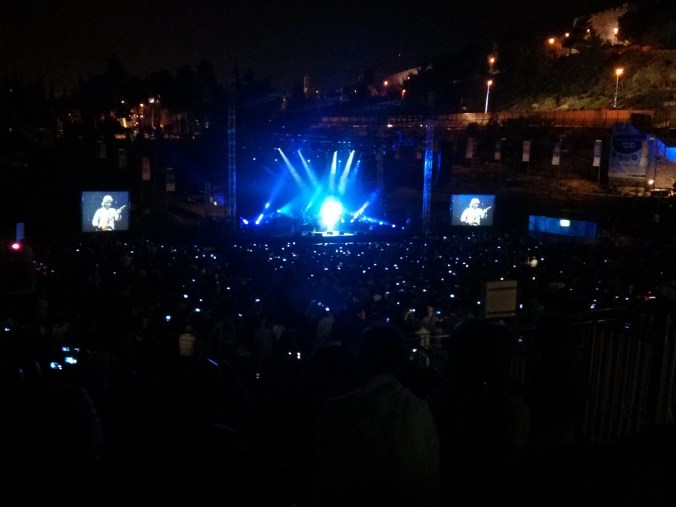
I was far away from the stage – and now I’m a little bit sad that they didn’t play “So Far Away.”
img_20160906_221353

Concerts today – pictures of people taking pictures/video with their phones!

Still the light show was fun!  The noise curfew is at 11:00pm and so after 2.5 hours, we said Good Night to the Dire Straits Experience.

img_20160906_222615

“So Far Away” – Dire Straits

Aharei ha’chagim / After the holidays

Parents all over Israel breathed a collective sigh of relief as they sent their kids to school on Thursday, September 1.

after the holidays
Another phenomenon that began on approximately the same day was the throwing around of the phrase “aharei ha’chagim” (after the holidays).  The “holidays,” starting this year on October 2, are: Rosh Hashana, the Jewish New Year; Yom Kippur, the Day of Atonement; and Sukkot, an 8-day festival that includes building temporary shelters outside.  Jewish holidays are national holidays so in this 3-week period there are a lot of days off, children are home from school, and it’s hard to get anything done.

One of the rhythms of life in Israel is for people to put off new projects until after the holidays, but this national procrastination often starts about a month before the holidays actually begin.  This can sometimes delay projects for up to two months!  The holidays are usually in September, so after the slow-down of August, people are busy trying to catch up at work.  They don’t want to start anything new.  So it’s a pretty common conversation among workers to discuss some new project in September and the agreed-upon start date is “aharei ha’chagim.”

The only comparable scenario that I can think of in the US is if you have an idea for something new on December 20, it’s pretty easy to say that you’ll discuss it after the first of the year because you have to get through Christmas and New Year’s.  It’s a slight exaggeration, but imagine the slow-down if any project you pitched in November was delayed until after Thanksgiving, Christmas, and New Year’s.

Aharei ha’chagim can also be used sarcastically at other times of the year.  If someone is constantly delaying a project, it would be perfectly appropriate to ask, “Oh, and when will you be getting started on that? Aharei ha’chagim?” I imagine that it could be used by a parent to their teenager, “When did you plan to clean your room? Aharei ha’chagim?”

Aharei ha’chagim is most often used around the holidays in September, but it is also used before the Passover holiday in the spring. Passover is 8 days long and about 2 weeks before people might start delaying projects to aharei ha’chagim.

Stepping back to look at the big picture, I see aharei ha’chagim as part of the intensity of life in Israel, not a lazy delaying tactic.  In Israel, you work hard during the week and during the year and then rest completely and unplug from the world during Shabbat and holidays.  You finish everything you have on your list before the holidays, rest and rejuvenate during the holidays, and then give 100% effort to something new aharei ha’chagim.

August in Israel

When people talk about the quality of life in Israel, they are not talking about the variety of things you can buy or the overabundance of choice in all things.  Quality in Israel is intangible.  I often mention rhythms of life – for example, businesses are closed on Saturdays and Jewish holidays are part of the national calendar, which means people can be home with their families, out in nature, or just take a day for themselves.

“Be fruitful and multiply” (Genesis 1:28)

God may have given the command, but he didn’t consider childcare in the twenty-first century and how all people, no matter their job, should be able to spend time with their children.

And so we come to August in Israel.  Daycares shut down in August.  All of them.  This allows daycare providers to have a vacation to spend time with their own children.  However, since we live in a modern society that doesn’t just shut down in August, parents have to look for alternate solutions.

Israel has a booming day camp business in August.  Every kind of day camp you can think of can be found catering to most age groups.  If you can’t afford camp (and many people can’t) the other option is to take your vacation days in August.  Parks are filled with families; I’ve seen mostly ultra-religious families with their half-dozen or more children.  I remember when I was a kid in the US, you could take yourself to the local pool and cool off in the summer.  Jerusalem doesn’t have outdoor public swimming pools and the indoor pools require expensive memberships, so you see many kids playing in public fountains.  Independence Park has a water feature that looks like a stream and there are dozens of children playing in it every day with families nearby picnicking on the grass.

Downtown Jerusalem is crowded and I hear mostly Hebrew in the streets (unlike other times when I hear a lot of English and French). Families take advantage of cool Jerusalem evenings and stroll late into the night with their children.  “Bedtime” must be when the kids collapse because it is certainly not 8pm.

Those not taking vacation days in August or sending their kids to camp look for other solutions.  Some people can rely on their parents to take care of the kids (often they joke that this is “Grandma Camp”), but others have to juggle other options.  August is “take your child to work” month.  I’m working in an office these days and since it’s August, I’m getting to meet everyone’s kids.  This is completely normal and accepted; both mothers and fathers bring kids to the office (usually only one and not every day so as not to totally disrupt the office environment).

On the surface, August seems unnecessarily complicated.  People have to work.  That’s how a modern, capitalist society functions, right?  So, if you want people to work and have children, then daycare should be available.  Let’s say instead that the value is not just having children, but actually spending time with your family.  Then August starts to make sense because it imposes a work/life balance.  Quality of life doesn’t mean an easy life.  Often it is the things you work the hardest for that give you the most value.

***

I had the chance this week to see Shakespeare’s Macbeth in the park – with lots of kids, who enjoyed it for the most part.  No sets, minimal costume, no mics, and the audience moves around to different locations in the park with the scene changes.  Over the years, I’ve seen Richard III, A Midsummer Night’s Dream, and Macbeth.  It’s not Broadway or the West End, but it’s Shakespeare and it’s fun!

Love is in the air – Tu B’Av

It’s today!  For lack of a better reference, Tu B’Av is Jewish Valentine’s Day.  The name is simply the date (tet vav = ט’ו = 15, pronounced too; Av is the Hebrew month).  It’s actually much older than Valentine’s Day and is shrouded in mystery, apparently.  In the olden days – the Second Temple Period – unmarried women in borrowed white dresses would go out to the fields and dance under the full moon of the 15th of Av.  Unmarried men would go out and choose a bride.  The borrowed white dresses ensured a level playing field for the women and men chose their brides based on personality rather than status.

Today, Israel has borrowed the romantic ideas of Valentine’s Day in the US, so chocolates are flying off the shelves and flowers are sold by the ton.  It’s considered a great day to get married, so venues are booked far in advance.

In a previous post, I wrote about Jerusalem’s Love Map .  Checking it again today, there are many more hearts and stories.

Jerusalem map

And since no one else in the world can see our special Google Doodle, here are some images (though they are actually tiny romantic animations).

doodle 2Doodledoodle 3

I’m compelled to share one hilarious element of the Google Doodle.  They spelled the holiday wrong.  When you click on it to get more information, the first site is the Google Doodle site, everything else is related to the show Ab Fab or it has to do with abdominal exercises. So if you want to find out more about Jewish Valentine’s Day, don’t be Google and spell it To Be’Ab, spell it Tu B’Av and get the right search results.

And finally, I leave you with the song that inspired the title, from one of the best movies ever, Strictly Ballroom.  Remember, a life lived in fear is a life half-lived!

Tisha B’Av and Dad’s birthday

On Sunday it will be Tisha B’Av – translated as the 9th of the Hebrew month of Av – and Israel will slow down a bit.  The 9th of Av is an unusual day in the Jewish calendar.  It commemorates the destruction of both Temples.  It’s a fast day and considered to be a day of mourning.  But many people in Israel kind of ignore it.  Employers offer it as one of the several days a person can choose to take off for religious purposes.  So a lot of people are still working – and according to religious laws, a person is allowed to work even if they are fasting.

For skeptics who wonder how it could be that both Temples were destroyed on the same day, well, it’s mostly a matter of odds.  In ancient times, you usually didn’t gather your armies in winter – Israel isn’t in the tropics, so we do have a winter – which eliminates at least 4 or 5 months.  In spring, you gather your armies and then you have to get to where you want to go, in this case Jerusalem.  By the time the end of July or early August rolls around, there’s a good chance you’ll reach your goal.  And because the Jewish calendar is lunar, the 9th of Av moves around.  So it’s possible that the First Temple fell on July 31 and the Second Temple fell on August 9, but they would still both be the 9th of Av. There are also those who go through history and point out all the terrible things that happened to the Jews on the 9th of Av.  Two often-cited examples are the expulsions of the Jews from Spain and England.

In Israel there are groups that march around the outside of the walls of the Old City and those who will likely ascend the Temple Mount on Sunday.  I hope it will be uneventful, but you never know.  The atmosphere in Israel is always combustible.

The day after the 9th of Av is Dad’s birthday.  Actually, I’m not sure how to say that correctly.  The day is still Dad’s birthday, but since he is no longer with us, maybe it’s more correct to say it in the past tense.  To me, it’s still in the present tense.  Monday is Dad’s birthday.  It will also be one of the “firsts” in the mourning year – the first time that I can’t call my Dad on his birthday.  His number is still in my phone, but it won’t connect, and for a minute I might say to myself, “Oh, he’s in a place where he doesn’t have cellular service.”  And that will be true.  Then I’ll have to remember that he won’t be answering at all.  That will be hard.

Like Tisha B’Av, it will be a mournful day, but one in which I’ll still work and I’ll keep moving forward.  As we all do even if our Temples, literal or symbolic, are destroyed.

fire-989869_1280

Toilet tanks of Memory Lane

This week I got a new toilet tank.  I know.  That doesn’t sound so earth-shattering or life-changing.  And it isn’t.  But this toilet tank triggered a few memories and those are usually worth writing about.  It’s especially well-timed because this is the first post in the second year of my blog (hooray!) and the toilet tank reminded me of how I got to Israel in the first place.

IMG_20160805_184109

Back in February 2001, I began kibbutz ulpan on Kibbutz Ma’agan Michael.  Half the day I would study Hebrew and half the day I would work somewhere on the kibbutz.  I began my kibbutz life in the kitchen and I was put in charge of the dairy cart – cottage cheese, soft white cheese (like sour cream), sliced cheese, and whatever other dairy products were available.  Needless to say, I couldn’t even look at dairy products after a while, much less eat them.  This was a great weight loss plan!

Ma’agan Michael is a rich kibbutz with multiple income streams including tropical fish, edible fish, bananas, cactus fruits, and a few other small industries.  But their big moneymaker is Plasson.  They make plastic plumbing parts and ship them all over Israel and internationally.

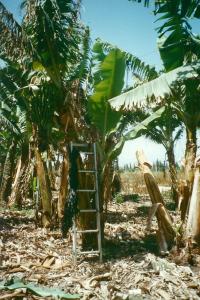
After my stint in the kitchen and noticeable weight loss, I begged to be outside, so I transferred to the banana fields.  I knew how to drive a manual transmission so I was an asset as a tractor driver.   But when it was too hot, we weren’t allowed to work outside and I spent one, possibly two, days at the Plasson factory.  We were put to work putting plastic rings (washers) of different shapes and sizes into a plastic bag.  We did it BY HAND!!!  Seriously, it was the longest day of my life.  I’m not really cut out for factory work.  But I did my job and I have a memory tucked away of once having worked at Plasson.  So every time I see a Plasson toilet tank, I think of my time on the kibbutz.

The truck and one of the tractors that I drove.

Banana tree

Tying bunches of bananas.

Looking back now, I can see that the 5 months on the kibbutz was a transitional time for me.  Life was not really moving forward the way I had envisioned.  Taking a time-out on the kibbutz gave me the opportunity to truly see it.  Moreover, I unexpectedly felt very drawn and connected to Israel and my Jewish heritage.  I had been to Israel many times before, but I never felt like this.

I went back to the US that July and had a difficult summer trying to figure out what I was going to do.  And then 9/11 happened.  Watching the chaos and trying to comprehend the tragedies unfolding on my television screen made me realize that life is short and I would not accept a “life of quiet desperation.”

For my 29th birthday the year before, I jumped out of an airplane – freefall for 5,000 feet (1,500 meters), parachute for 5,000 feet.  For my 30th birthday a few weeks after 9/11, I jumped out of a life that no longer made me happy.  Life in Israel was my parachute.

sunset

Some of the best sunsets in the world are at Ma’agan Michael!

***

Environmental side note:

In Israel – and probably a lot of other places – we have two flushing options.  The small button is for small flushes and the big button is for when you need a big flush.

IMG_20160805_184131

Move over Paris, Jerusalem is the City of Love

In the evening I opened the window to let in some fresh air after sitting in air conditioning all day.  Suddenly I heard loud buzzing and gargantuan hornets were flying around trying to get in my window.  I ran around screaming and waving my arms.  After pulling myself together I leapt to the window and shut it.  Looking out the window, I saw that there is a hornets’ nest inside my neighbor’s wall.  Yikes!  I’m keeping my window closed for now!

This little story is a metaphor for how I feel about the news in the last few weeks.  So after running around, screaming, and waving my arms, I’m shutting my metaphorical window on the news and am going to write about something else entirely. Something nice.

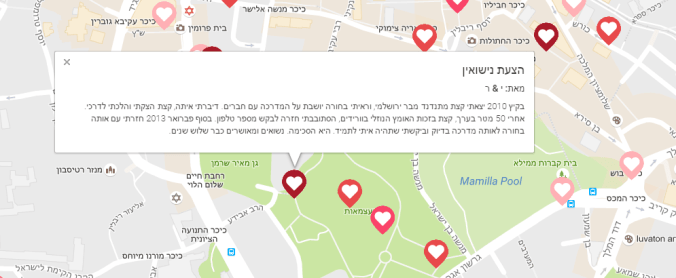
In a few weeks, we are going to be having a holiday of love called Tu B’Av.  It’s not exactly the commercialized Valentine’s Day of the US, but it has some similarities.  In preparation, the city of Jerusalem launched a website allowing people to pin hearts to a map of Jerusalem and tell their love story.  (I’m giving the whole link because I like the name of the site: http://www.jerusalemlovemap.co.il/)

love map

The various shades of pink and red reflect different kinds of stories: first meeting, first date, marriage proposal, perfect date, and, in a twist on romance, the last kiss.

I clicked through some of the stories and here are two that I liked.

Think romance is dead?  Not here.

Proposal

By E. and R.

In summer 2010, I was a little wobbly after leaving a Jerusalem bar and saw a woman sitting on the sidewalk with her friends.  I talked to her and pestered her a little and went on my way.  After 50 meters, thanks to a little liquid courage in my veins, I turned back to ask for her phone number.  At the end of February 2013, I came back with the same girl and asked her to be with me forever.  She agreed.  We’re married and happy for the past three years.

love story

And then there is the humorous.

First meeting

By Anonymous

Unbelievably, we met in a car accident on the Begin Highway.  My car was a total loss and was not drivable.  She drove me home after we exchanged information.  I did not have the heart to sue for an insurance claim, but used her number to invite her on a date.  We’re happily married today and laugh when we pass by the garage.

car accident

I think this idea is marvelous.  It’s cutting edge and a fabulous use of social media.  (Have I mentioned recently how much I like our mayor?)  All the citizens of Jerusalem are thinking about love stories instead of violence and attacks.  Jerusalem can be the city of love; we just have to get together and make it so.

Be excellent to each other

I’m on hiatus this week, but what a week to take a break!

This week the Jerusalem March for Pride and Tolerance took place in Jerusalem.  After the murder that took place last year at the parade, this year’s parade was held under massive police security and 25,000 people attended.

The bubbles that were painted over the blood stains at the intersection where Shira Banki z”l was stabbed were repainted this year in her memory.

Many, many issues revolve around the parade and Jerusalem, but when I try to bring it down to basic principles, it seems pretty simple to me.

be excellent

Even Bill and Ted get it

How History will remember

There’s a theory that the same amount of bad things are happening in the world as there ever were, but now that we live in a global village and the media coverage is instantaneous, we simply hear about it sooner and more often.  I’m not sure that is true, but I do wish that we would demand that the media stop functioning on a 24-hour news cycle that drops stories as soon as something bloodier comes along.  The terror attack in Nice is today’s top story, but how quickly will we move to the next thing?  France plans to mourn for 3 days.  Will we?  Or will something else catch our attention?

candles-224563_1280

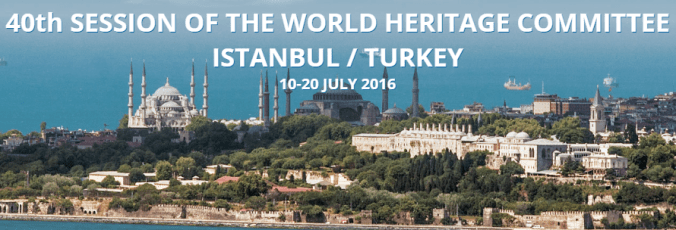
Headline scanning means that we’ll only catch the big stories and so seemingly little stories get swept aside.  I imagine that very few people know that the UNESCO World Heritage Committee is meeting in Istanbul, Turkey, this week.

Istanbul
I am not an expert on the workings of UNESCO and this is not meant to be deep research.  I just want to point out a few facts and try to put them into context.  I’ve provided links at the end of the post.

UNESCO – United Nations Education, Science and Cultural Organization – was on the news radar in Israel in April because of a draft resolution that subtly denied Jewish connections to the Temple Mount and the Western Wall.  The headlines were pretty bold, but when I went to the document itself (which no news site linked to) it refers to Israel as “Israel, the Occupying Power,” does not once use the term “Temple Mount” but only “Al-Aqsa Mosque/Al-Haram Al-Sharif,” and mentions the “Buraq Plaza ‘Western Wall Plaza’.”  This draft didn’t pass – of 58 votes, 33 were for, 17 abstentions, 6 against (the other 2 were not in attendance).  Another draft related to the Old City and its Walls uses the same terminology, except refers to “Buraq Plaza (Western Wall Plaza).”

At the conference this week the item was pulled off the agenda at the last minute because of the uncertainty of the votes and it’s pretty unlikely that the resolutions will pass.  So, no big deal, right? Well, I’m not so sure about that.

The present is the future’s past

As a historian, I’m thinking about researchers going through documents at some unspecified time in the future.  Let’s say, at least 150 years from now.  UNESCO doesn’t decide what history is, but as the arbiter of World Heritage Sites and a name that suggests global neutrality, how will historians see these documents in the future?

First of all, if you go through the documents, you will find references to Jerusalem in the “Arab States” section of the agenda.  Other geographical designations are Europe and North America, Latin America and Caribbean, Africa, Asia and Pacific.

Screenshot agenda
As an academic editor, I know that quotation marks are used for quotations, of course, but they are also used as a substitute for the words so-called, which suggest a distance from the term.  Above, I’m using quotation marks because I’m quoting the text.  Within the resolution, the only reason to use quotation marks (also known as scare quotes, I don’t know why) is to say the so-called Western Wall Plaza.  If you say the words so-called in front of anything, your voice naturally picks up a sarcastic tone.  It’s even more sarcastic if you make air quotes with your fingers.  So here we have a UNESCO draft resolution that gives Arabic names with capital letters, but Jewish names with quotation marks or in parentheses.

How we got from there to here

There may be those that say, “Well, you know, that big golden dome is up there now and possession is 9/10ths of the law.”  Since the Jordanian Waqf administers the site and forbids Jews to pray there, I think that point is moot.  Even subtly rejecting any Jewish connection is simply changing history.  Before Islam, there were two Jewish Temples that stood on that site.  Without the Temple, Jesus would have had no place to overturn the tables and attack the money lenders.  Titus’ Arch in Rome would have no story to tell.  Millions of Jews coming to Israel to visit a bunch of stones, a retaining wall actually, would also seem a bit weird if they lack a connection.

The point I want to make is that it matters now and today how we respond.  US Jews were very happy to have a mixed-gender prayer site created at the Western Wall, but in the big picture isn’t it a more important issue if UNESCO votes to effectively erase the Jewish connection to any part of the area?  Can UNESCO be allowed to vote on the narrative of history? If we decide to lay out narratives next to each other, we can say that there is indeed a Muslim connection to the site (third holiest site), but we must say that there is a Jewish (most important site) and Christian (Jesus’ final days) connection to the site.

What will our researcher find 150 years in the future when looking through the UNESCO documents? I hope she finds a multi-colored patchwork of truth and not obvious propaganda.

Epilogue:  The UNESCO response to Daesh (ISIS/ISIL) bombing parts of Palmyra, a World Heritage Site in Syria, was that the head of UNESCO did declare the acts war crimes, but after UNESCO experts went in, their preliminary finding was that it wasn’t as bad as they thought.  A language comparison of the two resolutions is enlightening.  Daesh is just Daesh, not an Occupying Power or anything else.  Their actions are condemned, but Israel’s actions are strongly condemned, firmly deplored, deeply decried, and disapproved.

Draft resolution on the Al-Haram Al-Sharif and its surroundings.

Decision on Jerusalem and its Walls from 2015.

Report on the vote in April.

Possible revision to the drafts.

An in-depth review of the issue.

Draft resolution on Palmyra.

Press release on Palmyra.

Downtown Jerusalem

Optimizing

I wasn’t going to bring this up, but my phone froze while I was trying to take pictures in town today. So, like with any computer, turn it off, turn it back on.  Then my phone decided to optimize 131 apps.  I certainly don’t use 131 apps, do I?  Urg.  So annoying!!

Optimizing 131 apps apparently takes a REALLY long time.  So I stood in the shade with my overheated phone in my hand.  Every time I checked, a two or three more apps optimized.  Should I just go home and come back later?  Should I overreact and throw my phone into a wall?  I got a fruity popsicle and calmed down.  I decided to walk around while I waited for my phone’s soul to come back from its journey in the Underworld.

Downtown today was filled with students raising money for their various summer camps.  It was a mobile bake sale.  Religious people were giving away Shabbat candles to women and helping men wrap tefillin.  I passed at least five street musician groups in the space of one city block. Every few steps there was a different vibe – oldies, Israeli, Spanish, ballads, and more.  Phone still optimizing.

I went into a bookstore and had a revelation.  I was browsing and found two books that caught my interest and realized that whatever the algorithm is that brings up ads and suggestions on my computer would have never suggested these books to me.  Going out into the world helps me to change the parameters of my algorithm and see things I might not usually see.  Staying in and expecting to have my preferences handed to me on a silver platter just encourages me to have selective vision.  There’s a whole world of things that I know nothing about simply because I’ve never seen them before and they’re all out there just waiting for me to open my eyes and see them.  Whoa!

Finally, my phone apps were optimized and so was I.

Join me downtown!

I don’t know what the municipality has in mind for downtown, but so far I like it!  This week the overhead decorations are celebrating different countries and cultures around the world.  I’m sure I didn’t find them all, but here’s today’s selection.

Streets of the World

I happened upon some amazing murals down one of the streets.

This is also a good opportunity to share the pictures I took during Passover.  The municipality brought artists to the center of town to create 3-D art.  Some really worked, others didn’t, but it was fun to go around and discover the artwork.  (I needed a map, Google maps with GPS, and two days to find them all.)

For those who want to see all the pictures in more detail, here’s a slideshow. 

This slideshow requires JavaScript.