Move over Paris, Jerusalem is the City of Love

In the evening I opened the window to let in some fresh air after sitting in air conditioning all day.  Suddenly I heard loud buzzing and gargantuan hornets were flying around trying to get in my window.  I ran around screaming and waving my arms.  After pulling myself together I leapt to the window and shut it.  Looking out the window, I saw that there is a hornets’ nest inside my neighbor’s wall.  Yikes!  I’m keeping my window closed for now!

This little story is a metaphor for how I feel about the news in the last few weeks.  So after running around, screaming, and waving my arms, I’m shutting my metaphorical window on the news and am going to write about something else entirely. Something nice.

In a few weeks, we are going to be having a holiday of love called Tu B’Av.  It’s not exactly the commercialized Valentine’s Day of the US, but it has some similarities.  In preparation, the city of Jerusalem launched a website allowing people to pin hearts to a map of Jerusalem and tell their love story.  (I’m giving the whole link because I like the name of the site: http://www.jerusalemlovemap.co.il/)

love map

The various shades of pink and red reflect different kinds of stories: first meeting, first date, marriage proposal, perfect date, and, in a twist on romance, the last kiss.

I clicked through some of the stories and here are two that I liked.

Think romance is dead?  Not here.

Proposal

By E. and R.

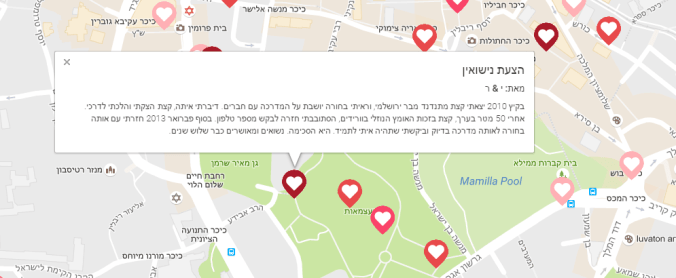
In summer 2010, I was a little wobbly after leaving a Jerusalem bar and saw a woman sitting on the sidewalk with her friends.  I talked to her and pestered her a little and went on my way.  After 50 meters, thanks to a little liquid courage in my veins, I turned back to ask for her phone number.  At the end of February 2013, I came back with the same girl and asked her to be with me forever.  She agreed.  We’re married and happy for the past three years.
love story

And then there is the humorous.

First meeting

By Anonymous

Unbelievably, we met in a car accident on the Begin Highway.  My car was a total loss and was not drivable.  She drove me home after we exchanged information.  I did not have the heart to sue for an insurance claim, but used her number to invite her on a date.  We’re happily married today and laugh when we pass by the garage.

car accident

I think this idea is marvelous.  It’s cutting edge and a fabulous use of social media.  (Have I mentioned recently how much I like our mayor?)  All the citizens of Jerusalem are thinking about love stories instead of violence and attacks.  Jerusalem can be the city of love; we just have to get together and make it so.

Be excellent to each other

I’m on hiatus this week, but what a week to take a break!

This week the Jerusalem March for Pride and Tolerance took place in Jerusalem.  After the murder that took place last year at the parade, this year’s parade was held under massive police security and 25,000 people attended.

The bubbles that were painted over the blood stains at the intersection where Shira Banki z”l was stabbed were repainted this year in her memory.

Many, many issues revolve around the parade and Jerusalem, but when I try to bring it down to basic principles, it seems pretty simple to me.

be excellent

Even Bill and Ted get it

How History will remember

There’s a theory that the same amount of bad things are happening in the world as there ever were, but now that we live in a global village and the media coverage is instantaneous, we simply hear about it sooner and more often.  I’m not sure that is true, but I do wish that we would demand that the media stop functioning on a 24-hour news cycle that drops stories as soon as something bloodier comes along.  The terror attack in Nice is today’s top story, but how quickly will we move to the next thing?  France plans to mourn for 3 days.  Will we?  Or will something else catch our attention?

candles-224563_1280

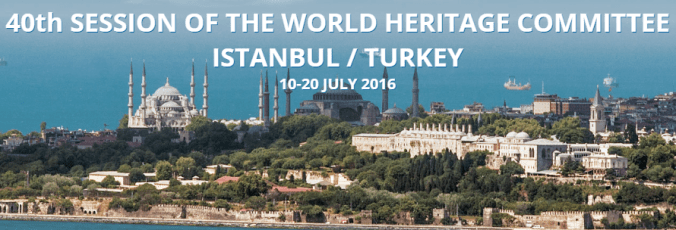
Headline scanning means that we’ll only catch the big stories and so seemingly little stories get swept aside.  I imagine that very few people know that the UNESCO World Heritage Committee is meeting in Istanbul, Turkey, this week.

Istanbul
I am not an expert on the workings of UNESCO and this is not meant to be deep research.  I just want to point out a few facts and try to put them into context.  I’ve provided links at the end of the post.

UNESCO – United Nations Education, Science and Cultural Organization – was on the news radar in Israel in April because of a draft resolution that subtly denied Jewish connections to the Temple Mount and the Western Wall.  The headlines were pretty bold, but when I went to the document itself (which no news site linked to) it refers to Israel as “Israel, the Occupying Power,” does not once use the term “Temple Mount” but only “Al-Aqsa Mosque/Al-Haram Al-Sharif,” and mentions the “Buraq Plaza ‘Western Wall Plaza’.”  This draft didn’t pass – of 58 votes, 33 were for, 17 abstentions, 6 against (the other 2 were not in attendance).  Another draft related to the Old City and its Walls uses the same terminology, except refers to “Buraq Plaza (Western Wall Plaza).”

At the conference this week the item was pulled off the agenda at the last minute because of the uncertainty of the votes and it’s pretty unlikely that the resolutions will pass.  So, no big deal, right? Well, I’m not so sure about that.

The present is the future’s past

As a historian, I’m thinking about researchers going through documents at some unspecified time in the future.  Let’s say, at least 150 years from now.  UNESCO doesn’t decide what history is, but as the arbiter of World Heritage Sites and a name that suggests global neutrality, how will historians see these documents in the future?

First of all, if you go through the documents, you will find references to Jerusalem in the “Arab States” section of the agenda.  Other geographical designations are Europe and North America, Latin America and Caribbean, Africa, Asia and Pacific.

Screenshot agenda
As an academic editor, I know that quotation marks are used for quotations, of course, but they are also used as a substitute for the words so-called, which suggest a distance from the term.  Above, I’m using quotation marks because I’m quoting the text.  Within the resolution, the only reason to use quotation marks (also known as scare quotes, I don’t know why) is to say the so-called Western Wall Plaza.  If you say the words so-called in front of anything, your voice naturally picks up a sarcastic tone.  It’s even more sarcastic if you make air quotes with your fingers.  So here we have a UNESCO draft resolution that gives Arabic names with capital letters, but Jewish names with quotation marks or in parentheses.

How we got from there to here

There may be those that say, “Well, you know, that big golden dome is up there now and possession is 9/10ths of the law.”  Since the Jordanian Waqf administers the site and forbids Jews to pray there, I think that point is moot.  Even subtly rejecting any Jewish connection is simply changing history.  Before Islam, there were two Jewish Temples that stood on that site.  Without the Temple, Jesus would have had no place to overturn the tables and attack the money lenders.  Titus’ Arch in Rome would have no story to tell.  Millions of Jews coming to Israel to visit a bunch of stones, a retaining wall actually, would also seem a bit weird if they lack a connection.

The point I want to make is that it matters now and today how we respond.  US Jews were very happy to have a mixed-gender prayer site created at the Western Wall, but in the big picture isn’t it a more important issue if UNESCO votes to effectively erase the Jewish connection to any part of the area?  Can UNESCO be allowed to vote on the narrative of history? If we decide to lay out narratives next to each other, we can say that there is indeed a Muslim connection to the site (third holiest site), but we must say that there is a Jewish (most important site) and Christian (Jesus’ final days) connection to the site.

What will our researcher find 150 years in the future when looking through the UNESCO documents? I hope she finds a multi-colored patchwork of truth and not obvious propaganda.

Epilogue:  The UNESCO response to Daesh (ISIS/ISIL) bombing parts of Palmyra, a World Heritage Site in Syria, was that the head of UNESCO did declare the acts war crimes, but after UNESCO experts went in, their preliminary finding was that it wasn’t as bad as they thought.  A language comparison of the two resolutions is enlightening.  Daesh is just Daesh, not an Occupying Power or anything else.  Their actions are condemned, but Israel’s actions are strongly condemned, firmly deplored, deeply decried, and disapproved.

Draft resolution on the Al-Haram Al-Sharif and its surroundings.

Decision on Jerusalem and its Walls from 2015.

Report on the vote in April.

Possible revision to the drafts.

An in-depth review of the issue.

Draft resolution on Palmyra.

Press release on Palmyra.

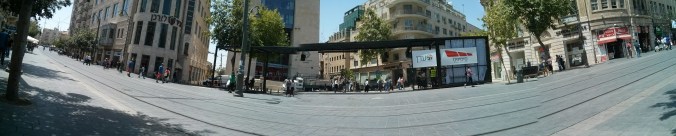
Downtown Jerusalem

Optimizing

I wasn’t going to bring this up, but my phone froze while I was trying to take pictures in town today. So, like with any computer, turn it off, turn it back on.  Then my phone decided to optimize 131 apps.  I certainly don’t use 131 apps, do I?  Urg.  So annoying!!

Optimizing 131 apps apparently takes a REALLY long time.  So I stood in the shade with my overheated phone in my hand.  Every time I checked, a two or three more apps optimized.  Should I just go home and come back later?  Should I overreact and throw my phone into a wall?  I got a fruity popsicle and calmed down.  I decided to walk around while I waited for my phone’s soul to come back from its journey in the Underworld.

Downtown today was filled with students raising money for their various summer camps.  It was a mobile bake sale.  Religious people were giving away Shabbat candles to women and helping men wrap tefillin.  I passed at least five street musician groups in the space of one city block. Every few steps there was a different vibe – oldies, Israeli, Spanish, ballads, and more.  Phone still optimizing.

I went into a bookstore and had a revelation.  I was browsing and found two books that caught my interest and realized that whatever the algorithm is that brings up ads and suggestions on my computer would have never suggested these books to me.  Going out into the world helps me to change the parameters of my algorithm and see things I might not usually see.  Staying in and expecting to have my preferences handed to me on a silver platter just encourages me to have selective vision.  There’s a whole world of things that I know nothing about simply because I’ve never seen them before and they’re all out there just waiting for me to open my eyes and see them.  Whoa!

Finally, my phone apps were optimized and so was I.

Join me downtown!

I don’t know what the municipality has in mind for downtown, but so far I like it!  This week the overhead decorations are celebrating different countries and cultures around the world.  I’m sure I didn’t find them all, but here’s today’s selection.

Streets of the World

I happened upon some amazing murals down one of the streets.

This is also a good opportunity to share the pictures I took during Passover.  The municipality brought artists to the center of town to create 3-D art.  Some really worked, others didn’t, but it was fun to go around and discover the artwork.  (I needed a map, Google maps with GPS, and two days to find them all.)

For those who want to see all the pictures in more detail, here’s a slideshow. 

This slideshow requires JavaScript.

Tai Chi in Israel

While the world raged around us, about 200 people met in a high school gymnasium in Ramat Gan that served as an oasis of calm.  This week I attended Gashko, the national meeting of all the practitioners of Cheng Ming style Tai Chi.  In June every year, the main teacher of this style comes from Taiwan to work with all of us to help perfect our form.

logo-text

To me, Tai Chi is a form of moving meditation.  The movements are slow, deliberate, and precise.  There are many styles of Tai Chi and it is considered a martial art.  The movements do have real world applications, but the purpose of the practice is not to spar or compete with your fellow practitioners.  Rather it is to learn and practice the principles and implement them in your own life.

I haven’t been to a Gashko for a long time, but since I had just finished learning the 100-movement form, I was prepared to work on minor adjustments and corrections of my form.

IMG_20160629_172054

Pass me a big slice of Humble Pie!  Yum!

On the first day, I started practicing with everyone and I quickly came to the realization that while I thought I knew the form, it turns out that every single movement could use some adjustments.  Now under normal circumstances, when you find out that you actually don’t know nearly as much as you thought you did, you might face some embarrassment, frustration, or any of a variety of negative emotions.  No so at Gashko.

One of the principles is to be both self-confident and humble – not an easy task.  So I was confident in knowing the order of the movements, but I humbly looked for correction.  I heard one person say, “I’ve been practicing for 25 years and I learned something new today!”  Well, I’ve been practicing for 2.5 years and I learned so much my brain got overloaded!

The nicest people in Israel

If everyone in Israel practiced Tai Chi, Israel would become the nicest country in the world.  Really!

IMG_20160629_171908

The teachers are so kind and supportive and meet you wherever you are in your life and in your practice.  While they are teaching you the movements of the form, they are somehow also uplifting you to be a better, stronger person without actually saying a word.  Honestly, it can’t be described; it can only be experienced.

Cheng Ming in Israel

One of the hallmarks of this style of Tai Chi in Israel is that it is gender separated.  While I’m not a fan of gender separation in most things, I do appreciate it in sports.  Also, when you practice martial arts with only women, the energy is quite different.

Apparently, the founder of this style in Israel, who learned from the master in Taiwan, returned to Israel and became religious.  So in Israel this style of Tai Chi is, for the general classes, philosophically neutral, gender separated, and at Gashko we have a men’s side and a women’s side of the gym.  Many practitioners are clearly religious and very comfortable with this style of Tai Chi.  The more advanced classes, though, are not gender separated.  (In other countries where this style is practiced, there is no gender separation, as far as I know.)

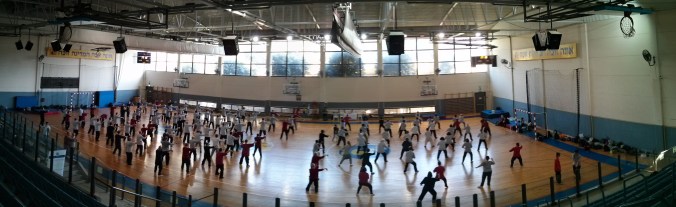
PANO_20160629_171920

The slower the better

One of the most amazing experiences for me at Gashko was the hour-long form.  When I practice at home or in class, the form takes about 20–25 minutes.  So just imagine about 200 people in a gym moving at a third of the speed that they normally do, all of us totally focused on the form, filled with self-confidence and humility, and radiating with calm, soothing energy.

Even if you don’t know Tai Chi, do something at a third of the normal speed – wash dishes, walk down your hallway, drink tea, whatever.  Then you truly get a taste of what “being in the moment” actually feels like.

Working with the master

In working on some real-world applications of Tai Chi, we were doing pair work and I had a few questions.  Just at that moment Master Wang appeared and showed me and my partner how to do an arm twist to the back followed by a knee to the butt.  It was a little unusual for him to be working with the women – he did bring a woman Master with him as well.  But here we were, Master Wang twisted my arm and kneed me in the butt.  Twice!  Quite an honor, I must say!  (Interestingly, I did go flying, but it didn’t hurt at all.)

IMG_20160630_202903

Master Wang

Tired. Not tired.

After the first day of about six hours of Tai Chi and a four-hour commute, I collapsed at home.  How on earth I would get through two more days?  But the next morning I woke up and I felt . . . good.  So I did it again.  Less collapsing on the evening of the second day.  And the morning of the third day, I still felt . . . good.  I have no soreness at all and physically, I feel sort of energized.  My brain, on the other hand, is massively overloaded with new things, corrections to the form, and memories of an amazing experience called Gashko.

(If you’re curious to learn more, here’s a link to the US site:  http://www.chengmingusa.com/home. The Israeli site is in Hebrew: http://www.taichi.co.il/.)

A few blurry images from the closing ceremony

Haikus for Solstice

sun-29249_1280

Heavy themes, long posts

Time to change it up a bit

Haikus for Solstice


Hot. So very hot.

Brain fog, sticky naps, TV

Oops. It’s 2 AM.

lavender-1117275_1280

Sage and lavender

Roasting in the summer heat

Jerusalem scents


lemonade-932199_1280

Hot days and cool nights

Summer in Jerusalem

Lemonade with mint


River down my back

Solving the water shortage

Single-handedly


thermometer-789898_1280

Fahrenheit versus

Celsius. 14 years here

And I still convert.


Solstice and full moon

Longest day and crazy night

That explains a lot


Brexit, Trump, and guns

Maybe move to Israel?

It’s so much calmer.

“It’s better to light one candle than curse the darkness”

JD east of edenMy favorite James Dean movie is East of Eden.  The story moved me so much that I decided to read the book by John Steinbeck.  I had the pleasure of visiting the National Steinbeck Center in Salinas, CA, where I learned that Steinbeck considered East of Eden the culmination of his life’s work.  He struggled with it all his life because he wanted to truly understand the fundamental ability to choose light or darkness.


God said to Cain, “If you do well, shall you not be accepted? But if you do not do well, sin is crouching at the door. It desires to dominate you, but you must rule over it.” (Genesis 4:7)  Steinbeck’s East of Eden tells us that no matter what happens, you always have a choice.

The power to choose

There’s so much awful news: Tel Aviv, Orlando, the Stanford rape case, a British MP gunned down, and plenty more that I don’t know about.  In each case someone made a choice to do evil; they chose darkness.

Debates are raging right now about why these tragedies happened. I’m not qualified to give an opinion about changes that need to be made in society and I’m not going to try.  This post is about the power to choose.

Choosing compassion

The family of a police officer saw someone running from the scene of the Tel Aviv terror attack.  He was badly shaken and could hardly speak.  They brought him in and gave him water.  The officer ran to the scene and when he saw that the detained shooter was dressed exactly like the man in his house, he rushed back, fearing the worst.  Indeed, the family had sheltered the second shooter.  The officer arrested him in the living room.

This family chose to help someone who looked to be in shock.  Without a doubt, the situation could have ended tragically, but instead we have an example of what compassion to one’s neighbors looks like.

Unsung heroes

At Stanford, two Swedish graduate students pulled the rapist off of his victim and held him down until police arrived.  The victim was completely unconscious, could not defend herself, and likely would not have been able to remember the events of what happened in order to bring her attacker to justice.

It was late at night.  The two students could have passed by and done nothing.  Instead, they chose to protect a young woman in a horrible situation.

Choosing to stand together

Sometimes you can’t save the person in danger, but you can stand beside the mourners.  Two stories I came across – and surely there are many more – remind us that it’s fine to “Je suis …” and change your profile pictures, but actions are so much more powerful.

A rabbi brought members of his congregation to grieve with mourners of the Orlando terror attack.  Just showing up was enough.

A flight crew found out that a passenger was on her way to her grandson’s funeral.  He was one of the victims in Orlando.  All the passengers wrote notes and when they deplaned, every person stopped to personally give their condolences.

Shavuot in Israel – Standing together

This week also marked Shavuot in Israel.  Shavuot is the fiftieth day after Passover and marks the date that the Israelites received the Ten Commandments at Sinai.  It’s a pilgrimage holiday meaning that when the Temple stood, people came to offer sacrifices.  Today, we aren’t offering sacrifices, but we still stand together, raise our voices in song, and choose life.

IMG_20160612_052607


Here’s a video I took while watching the sunrise on Shavuot at the Western Wall

From a single candle, thousands can be lit

When I watch the sun rise over the people and hear them singing, I know that the world is going to be okay.  Some people choose to do evil.  This is a fact and we see plenty of evidence of it.  But more people choose to do good.  More people choose light.  Sure, there may be moments .of regret, but every day we have a choice.  We can choose light and keep choosing it until we break down the power of darkness.

Wishing all the fathers a Happy Father’s Day!

And remembering my Dad z’’l

Does the Messiah like techno music?

I couldn’t imagine how I would piece together the events of this week in Israel.  On Sunday we celebrated the reunification of Jerusalem and there was a fabulous flag-waving parade on my street.  Sunday evening was also the eve of Ramadan and, in spite of some friction caused by the parade marchers, it seemed that we might have that elusive “quiet” that everyone is always talking about.  Then on Wednesday, 4 people were brutally gunned down and 16 people injured in a terrorist attack in a café in Tel Aviv.  This act was applauded by Hamas and celebrated with joy in the streets of Hebron.  How does a week like that even make sense?

I walked to the shuk today and in the middle of the Friday afternoon chaos, I heard the thumping bass and upbeat tunes of the NaNaNachmans.  (Ok.  They aren’t really called NaNaNachmans, but that’s what a few of my friends called them and for me the name stuck.)  And then I knew what to write about.

Who are the NaNaNachmans?

I would define them as modern-day mystics.  They are followers of Rabbi Nachman of Breslov (1772–1810).  They pray for the redemption of the world and the coming of the messiah.  What marks them in the streets of Israel are the slow-moving vans playing techno religious music while the NaNaNachmans dance in the street.  They often wear white beanies with the phrase Na Nach Nachma Nachman M’Uman on them.

Na Nach Nachma Nachman M’Uman to my ear sounds a little like a mantra.  The full words at the end can be translated as Nachman from Uman (his burial site) or Nachman the Believed.  All over Israel this phrase is very common graffiti; I suppose because it’s meant to be a song of redemption and will hasten the arrival of the messiah.

What do the NaNaNachmans have to do with anything?!?

Several vans were part of the parade.  I don’t know what it is but the NaNaNachmans tend to have the strongest, clearest, highest quality speakers.  Their music is heard near and far, possibly reaching the heavens.

Here’s my video of two NaNaNachman scenes that I happened to catch on video.

It’s the second song that caught my attention.  Not just because it’s got a great techno beat and a repetitive chorus.  It was the words of the chorus.  Here’s my translation.

There’s hope

If we sing together

There is faith stronger than all the fear

We won’t fall, we won’t tremble

Because we are not alone

We have Hashem the One.

Here’s a link to Benny Friedman’s official video.  The guy singing is not the guy you might imagine putting together a techno song, but he is a guy who looks like he’s praying for the coming of the messiah.

And that’s it.  Benny nailed it.  We’re all in this together.  We stand up and sing with faith and without fear.  Whether you are religious or not, you, me, and all of us are not alone.

So we’re going to celebrate life and march proudly as Israelis.  And when our citizens are cut down in violence and hate, we’re going to pick ourselves up and go on – with justice, not vengeance.

I know. It’s not so simple … but maybe it should be.

This is a holiday weekend; we’re going to go the Western Wall and watch the sunrise on Shavuot (Saturday to Sunday) to commemorate receiving the Torah on Mt. Sinai.  So here’s a good opportunity to remember the message of the Torah as passed down from Rabbi Hillel – short enough for a tweet, even before Twitter:

Do not do to your neighbor what is hateful to you.  That is the whole Torah; the rest is commentary.

Observation:  The streets of Jerusalem

I wanted to try something a little different this week. I sat in a few different squares in downtown Jerusalem and watched people.  What I saw and heard was a symphony.

PANO_20160602_112653

Panorama of Zion Square

Laughter

I saw a Korean Catholic couple, a priest and a nun, walking on Jaffa Street completely engrossed in conversation.  I wondered if they hadn’t taken vows, would they be dating?  Perhaps they were so happy simply because they were here in the holy city of Jerusalem.

The Chorus

The gaggles of girls, who appear to be religious and often roam in groups of five, are a phenomenon.  They tend to have long, dark, curly hair, skirts that come down to their knees, and blouses that cover their shoulders.  The phrase “same, same, but different” comes to mind.

Two-Part Harmony

Guys travel in pairs.  They tend to complement one another.  A tall guy has a short friend.  A guy with long hair will have a friend with a buzz cut.

Duets

I saw many couples on the street.  Older ones came to town together to run errands.  Young couples – either just friends or hoping for more – came to sit together under a tree for an hour.  The young religious marrieds have their own formula.  They walk along with what appears to be their first child in a stroller and it’s always the dad pushing it.  The mom sometimes seems nervous about it, but she’s genuinely happy that he’s taking a role.

Soloists

Cello

There are a lot of street sweepers in Jerusalem because the municipality is committed to keeping the streets clean.  They are dressed in blue coveralls and always wear yellow Day-Glo vests. They push around a green plastic garbage bin that is about 4 feet tall and work with a broom and long-handled dustpan.

This particular street sweeper caught my eye, I think, because of his rimless glasses.  He wore his collar stylishly up, was unshaven (I don’t know if it was scruff for style or just the 24-hour beard cycle), and the hair on his head matched the length of his beard.  He was intensely conscientious in his work, with quick and purposeful movements, but appeared to be deep in thought.  I wondered if after his morning shift cleaning streets he went home to write his manifesto, “On the Social Aspects of the Dirtiness of the Street,” or a play called “To Clean or Not to Clean,” or something cheerful like “The Unbearable Lightness of Cigarette Butts.”

Electric Guitar

Another often-seen pair are the security forces on a motorcycle.  It was explained to me once that the front guy is the driver and the guy on the back is the shooter, which allows them to act quickly in case of an emergency.  They ride on powerful BMW motorcycles with noise-reducing mufflers and wear black helmets, black motorcycle jackets, and black cargo pants (which seems crazy in the 90+ degree heat).

The pair that I saw were riding back and forth on Jaffa Street.  They were chatting through the headsets in their helmets, but keeping an eye on everything around them.  The guy in front was focused on driving and the guy in back had a rifle slung across his chest and visible in the back was a silver pistol tucked into his waistband.  Later, I saw them stop for lunch at a burger place, because of course that’s what they would eat.

And so many more

The albino girl, the street musician, the Russian tourist chatting up a bottle-blond who also happened to speak Russian, the wanna-be punk who looked like he probably played bass in a band that played small venues, the odd, smiley religious guy who was hot strolling down the street so he rolled up his pant legs above his knees to show off scrawny white legs, or the worker setting up the stalls for the evening market who measured the spaces down to the last inch.

Jerusalem is a symphony, we just have take a moment to listen.

Legends of the Ari: Truth and faith

This story has many versions, but the basic outline is generally the same.

There once was a rabbi in Tzfat (Safed) who gave a sermon about the loaves of bread in the tabernacle.  A baker was so inspired by this that he went home and baked additional loaves of Shabbat challah and put them in the Aron Kodesh (the cupboard where the Torah scrolls are kept) as a gift to God.

challah-bread-1215013_1280

A poor man who helped clean the synagogue came to sweep after prayers and stood before the Aron Kodesh and prayed to God for help to feed his family for Shabbat.  He opened the Aron Kodesh and found the bread inside.  It was a miracle!

The next morning when the Aron Kodesh was opened at services, the baker saw that the loaves had been taken and he was overjoyed.  God accepted his gift!

This went on week after week for many years.

Finally, the rabbi saw the baker put the loaves in the Aron Kodesh and shouted at him: “Why are you putting bread in there?”  The baker answered, “I’ve been doing this for many years and God accepts my gift every week.”  “You’re an idiot!  Do you think God eats challah?”  The baker was embarrassed, but they decided to hide and see what happened.

The poor man came to clean and then stood before the Aron Kodesh praying.  He opened it and took the loaves.  The rabbi popped out and said, “Aha!  What are you doing?”  The poor man said, “I’m taking the challah that God has provided for me.”  “You’re an idiot!  Do you think God bakes?”

The Ari heard the story and gave his ruling:  The rabbi was in the wrong.  The two men did what they did with pure and loving faith and the rabbi destroyed it.  He asked the two men to continue the tradition – the baker would provide the bread to honor God and the poor man would accept it with gratitude to God.  The rabbi had been ill at the time of his original sermon, but had been given a reprieve because he had inspired such faith in the two men.  Now that he had broken their faith, his illness was returned to him.

Usually this story is told to inspire faith, to suggest divine intervention, and to reveal the wisdom of the Ari.  I’m going to turn that interpretation sideways to link this story with last week’s post.

We need to have facts and objective truths (the rabbi), otherwise “history” becomes story, legend, or myth (the two men’s narratives of weekly miracles).  External recorded facts (the bread was provided by the baker and taken by the poor man) provide the framework to question or confirm our narratives and this eventually brings us to a deeper and more profound understanding (our paths cross for a reason and we should continue to do good even if the reason is human and not divine).  Then we can truly learn from history and will not be doomed to repeat it.

Why bring up the Ari this week?

This week we celebrated Lag B’Omer.  Most Israelis don’t really know the history of the holiday, but what they do know is that one of the traditions is to light bonfires and celebrate into the night.

fire-432478_1280

Hundreds of thousands of people travel to Mt. Meron near Tzfat to participate in a huge bonfire at the grave of Rabbi Shimon Bar Yochai, the author of the Zohar.  The Zohar is the primary text for the study of the Kabbalah.  The Ari (the Lion) is the nickname for Rabbi Isaac Luria, one of the greatest Kabbalist scholars of all time.