How History will remember

There’s a theory that the same amount of bad things are happening in the world as there ever were, but now that we live in a global village and the media coverage is instantaneous, we simply hear about it sooner and more often.  I’m not sure that is true, but I do wish that we would demand that the media stop functioning on a 24-hour news cycle that drops stories as soon as something bloodier comes along.  The terror attack in Nice is today’s top story, but how quickly will we move to the next thing?  France plans to mourn for 3 days.  Will we?  Or will something else catch our attention?
candles-224563_1280

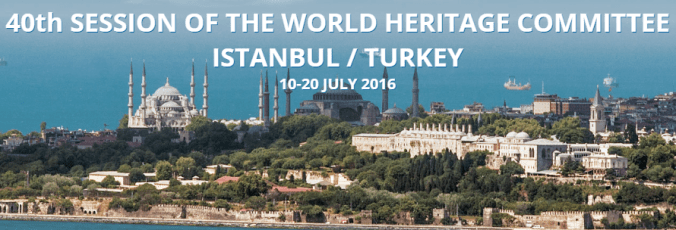
Headline scanning means that we’ll only catch the big stories and so seemingly little stories get swept aside.  I imagine that very few people know that the UNESCO World Heritage Committee is meeting in Istanbul, Turkey, this week.
Istanbul
I am not an expert on the workings of UNESCO and this is not meant to be deep research.  I just want to point out a few facts and try to put them into context.  I’ve provided links at the end of the post.

UNESCO – United Nations Education, Science and Cultural Organization – was on the news radar in Israel in April because of a draft resolution that subtly denied Jewish connections to the Temple Mount and the Western Wall.  The headlines were pretty bold, but when I went to the document itself (which no news site linked to) it refers to Israel as “Israel, the Occupying Power,” does not once use the term “Temple Mount” but only “Al-Aqsa Mosque/Al-Haram Al-Sharif,” and mentions the “Buraq Plaza ‘Western Wall Plaza’.”  This draft didn’t pass – of 58 votes, 33 were for, 17 abstentions, 6 against (the other 2 were not in attendance).  Another draft related to the Old City and its Walls uses the same terminology, except refers to “Buraq Plaza (Western Wall Plaza).”

At the conference this week the item was pulled off the agenda at the last minute because of the uncertainty of the votes and it’s pretty unlikely that the resolutions will pass.  So, no big deal, right? Well, I’m not so sure about that.

The present is the future’s past

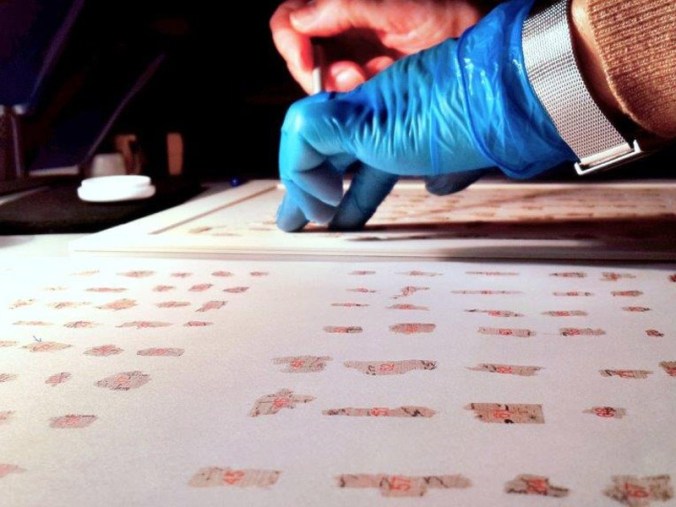
As a historian, I’m thinking about researchers going through documents at some unspecified time in the future.  Let’s say, at least 150 years from now.  UNESCO doesn’t decide what history is, but as the arbiter of World Heritage Sites and a name that suggests global neutrality, how will historians see these documents in the future?

First of all, if you go through the documents, you will find references to Jerusalem in the “Arab States” section of the agenda.  Other geographical designations are Europe and North America, Latin America and Caribbean, Africa, Asia and Pacific.

Screenshot agenda
As an academic editor, I know that quotation marks are used for quotations, of course, but they are also used as a substitute for the words so-called, which suggest a distance from the term.  Above, I’m using quotation marks because I’m quoting the text.  Within the resolution, the only reason to use quotation marks (also known as scare quotes, I don’t know why) is to say the so-called Western Wall Plaza.  If you say the words so-called in front of anything, your voice naturally picks up a sarcastic tone.  It’s even more sarcastic if you make air quotes with your fingers.  So here we have a UNESCO draft resolution that gives Arabic names with capital letters, but Jewish names with quotation marks or in parentheses.

How we got from there to here

There may be those that say, “Well, you know, that big golden dome is up there now and possession is 9/10ths of the law.”  Since the Jordanian Waqf administers the site and forbids Jews to pray there, I think that point is moot.  Even subtly rejecting any Jewish connection is simply changing history.  Before Islam, there were two Jewish Temples that stood on that site.  Without the Temple, Jesus would have had no place to overturn the tables and attack the money lenders.  Titus’ Arch in Rome would have no story to tell.  Millions of Jews coming to Israel to visit a bunch of stones, a retaining wall actually, would also seem a bit weird if they lack a connection.

The point I want to make is that it matters now and today how we respond.  US Jews were very happy to have a mixed-gender prayer site created at the Western Wall, but in the big picture isn’t it a more important issue if UNESCO votes to effectively erase the Jewish connection to any part of the area?  Can UNESCO be allowed to vote on the narrative of history? If we decide to lay out narratives next to each other, we can say that there is indeed a Muslim connection to the site (third holiest site), but we must say that there is a Jewish (most important site) and Christian (Jesus’ final days) connection to the site.

What will our researcher find 150 years in the future when looking through the UNESCO documents? I hope she finds a multi-colored patchwork of truth and not obvious propaganda.

Epilogue:  The UNESCO response to Daesh (ISIS/ISIL) bombing parts of Palmyra, a World Heritage Site in Syria, was that the head of UNESCO did declare the acts war crimes, but after UNESCO experts went in, their preliminary finding was that it wasn’t as bad as they thought.  A language comparison of the two resolutions is enlightening.  Daesh is just Daesh, not an Occupying Power or anything else.  Their actions are condemned, but Israel’s actions are strongly condemned, firmly deplored, deeply decried, and disapproved.

Draft resolution on the Al-Haram Al-Sharif and its surroundings.

Decision on Jerusalem and its Walls from 2015.

Report on the vote in April.

Possible revision to the drafts.

An in-depth review of the issue.

Draft resolution on Palmyra.

Press release on Palmyra.

Tai Chi in Israel

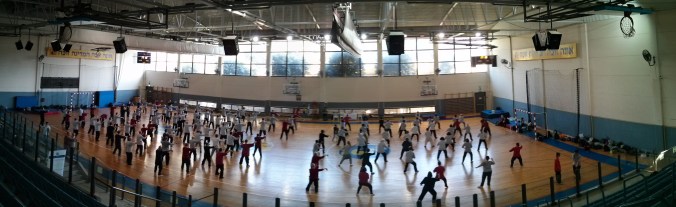
While the world raged around us, about 200 people met in a high school gymnasium in Ramat Gan that served as an oasis of calm.  This week I attended Gashko, the national meeting of all the practitioners of Cheng Ming style Tai Chi.  In June every year, the main teacher of this style comes from Taiwan to work with all of us to help perfect our form.

logo-text

To me, Tai Chi is a form of moving meditation.  The movements are slow, deliberate, and precise.  There are many styles of Tai Chi and it is considered a martial art.  The movements do have real world applications, but the purpose of the practice is not to spar or compete with your fellow practitioners.  Rather it is to learn and practice the principles and implement them in your own life.

I haven’t been to a Gashko for a long time, but since I had just finished learning the 100-movement form, I was prepared to work on minor adjustments and corrections of my form.

IMG_20160629_172054

Pass me a big slice of Humble Pie!  Yum!

On the first day, I started practicing with everyone and I quickly came to the realization that while I thought I knew the form, it turns out that every single movement could use some adjustments.  Now under normal circumstances, when you find out that you actually don’t know nearly as much as you thought you did, you might face some embarrassment, frustration, or any of a variety of negative emotions.  No so at Gashko.

One of the principles is to be both self-confident and humble – not an easy task.  So I was confident in knowing the order of the movements, but I humbly looked for correction.  I heard one person say, “I’ve been practicing for 25 years and I learned something new today!”  Well, I’ve been practicing for 2.5 years and I learned so much my brain got overloaded!

The nicest people in Israel

If everyone in Israel practiced Tai Chi, Israel would become the nicest country in the world.  Really!

IMG_20160629_171908

The teachers are so kind and supportive and meet you wherever you are in your life and in your practice.  While they are teaching you the movements of the form, they are somehow also uplifting you to be a better, stronger person without actually saying a word.  Honestly, it can’t be described; it can only be experienced.

Cheng Ming in Israel

One of the hallmarks of this style of Tai Chi in Israel is that it is gender separated.  While I’m not a fan of gender separation in most things, I do appreciate it in sports.  Also, when you practice martial arts with only women, the energy is quite different.

Apparently, the founder of this style in Israel, who learned from the master in Taiwan, returned to Israel and became religious.  So in Israel this style of Tai Chi is, for the general classes, philosophically neutral, gender separated, and at Gashko we have a men’s side and a women’s side of the gym.  Many practitioners are clearly religious and very comfortable with this style of Tai Chi.  The more advanced classes, though, are not gender separated.  (In other countries where this style is practiced, there is no gender separation, as far as I know.)

PANO_20160629_171920

The slower the better

One of the most amazing experiences for me at Gashko was the hour-long form.  When I practice at home or in class, the form takes about 20–25 minutes.  So just imagine about 200 people in a gym moving at a third of the speed that they normally do, all of us totally focused on the form, filled with self-confidence and humility, and radiating with calm, soothing energy.

Even if you don’t know Tai Chi, do something at a third of the normal speed – wash dishes, walk down your hallway, drink tea, whatever.  Then you truly get a taste of what “being in the moment” actually feels like.

Working with the master

In working on some real-world applications of Tai Chi, we were doing pair work and I had a few questions.  Just at that moment Master Wang appeared and showed me and my partner how to do an arm twist to the back followed by a knee to the butt.  It was a little unusual for him to be working with the women – he did bring a woman Master with him as well.  But here we were, Master Wang twisted my arm and kneed me in the butt.  Twice!  Quite an honor, I must say!  (Interestingly, I did go flying, but it didn’t hurt at all.)

IMG_20160630_202903

Master Wang

Tired. Not tired.

After the first day of about six hours of Tai Chi and a four-hour commute, I collapsed at home.  How on earth I would get through two more days?  But the next morning I woke up and I felt . . . good.  So I did it again.  Less collapsing on the evening of the second day.  And the morning of the third day, I still felt . . . good.  I have no soreness at all and physically, I feel sort of energized.  My brain, on the other hand, is massively overloaded with new things, corrections to the form, and memories of an amazing experience called Gashko.

(If you’re curious to learn more, here’s a link to the US site:  http://www.chengmingusa.com/home. The Israeli site is in Hebrew: http://www.taichi.co.il/.)

A few blurry images from the closing ceremony

Legends of the Ari: Truth and faith

This story has many versions, but the basic outline is generally the same.

There once was a rabbi in Tzfat (Safed) who gave a sermon about the loaves of bread in the tabernacle.  A baker was so inspired by this that he went home and baked additional loaves of Shabbat challah and put them in the Aron Kodesh (the cupboard where the Torah scrolls are kept) as a gift to God.

challah-bread-1215013_1280

A poor man who helped clean the synagogue came to sweep after prayers and stood before the Aron Kodesh and prayed to God for help to feed his family for Shabbat.  He opened the Aron Kodesh and found the bread inside.  It was a miracle!

The next morning when the Aron Kodesh was opened at services, the baker saw that the loaves had been taken and he was overjoyed.  God accepted his gift!

This went on week after week for many years.

Finally, the rabbi saw the baker put the loaves in the Aron Kodesh and shouted at him: “Why are you putting bread in there?”  The baker answered, “I’ve been doing this for many years and God accepts my gift every week.”  “You’re an idiot!  Do you think God eats challah?”  The baker was embarrassed, but they decided to hide and see what happened.

The poor man came to clean and then stood before the Aron Kodesh praying.  He opened it and took the loaves.  The rabbi popped out and said, “Aha!  What are you doing?”  The poor man said, “I’m taking the challah that God has provided for me.”  “You’re an idiot!  Do you think God bakes?”

The Ari heard the story and gave his ruling:  The rabbi was in the wrong.  The two men did what they did with pure and loving faith and the rabbi destroyed it.  He asked the two men to continue the tradition – the baker would provide the bread to honor God and the poor man would accept it with gratitude to God.  The rabbi had been ill at the time of his original sermon, but had been given a reprieve because he had inspired such faith in the two men.  Now that he had broken their faith, his illness was returned to him.

Usually this story is told to inspire faith, to suggest divine intervention, and to reveal the wisdom of the Ari.  I’m going to turn that interpretation sideways to link this story with last week’s post.

We need to have facts and objective truths (the rabbi), otherwise “history” becomes story, legend, or myth (the two men’s narratives of weekly miracles).  External recorded facts (the bread was provided by the baker and taken by the poor man) provide the framework to question or confirm our narratives and this eventually brings us to a deeper and more profound understanding (our paths cross for a reason and we should continue to do good even if the reason is human and not divine).  Then we can truly learn from history and will not be doomed to repeat it.

Why bring up the Ari this week?

This week we celebrated Lag B’Omer.  Most Israelis don’t really know the history of the holiday, but what they do know is that one of the traditions is to light bonfires and celebrate into the night.

fire-432478_1280

Hundreds of thousands of people travel to Mt. Meron near Tzfat to participate in a huge bonfire at the grave of Rabbi Shimon Bar Yochai, the author of the Zohar.  The Zohar is the primary text for the study of the Kabbalah.  The Ari (the Lion) is the nickname for Rabbi Isaac Luria, one of the greatest Kabbalist scholars of all time.

Holocaust Remembrance Day (5 May 2016) – Yom HaShoah

Every year we stop everything and stand for two-minute national siren to remember six million Jews who perished in the Holocaust.  For 24 hours television stations broadcast Holocaust stories and interviews.  Radio stations play somber music.  Restaurants and entertainment venues are closed.  During the siren, drivers pull over to the side of the road and get out of their cars.  Busses stop and often passengers get off to stand for the siren.  Walkers stop in the street.  It is a national pause to take the time to remember.

A video from this year taken on Highway 1 between Jerusalem and Tel Aviv.

In Israel, national and religious holidays start at sunset the evening before.  On the eve of Holocaust Remembrance Day, I witnessed an incredible sunset.  It was so stunning not only for the colors in the sky, but it seemed to change the quality of the air.  The air seemed to be infused with pink and gold and so full of magic that you might even be able to scoop some into a jar to save for later.

This slideshow requires JavaScript.

In all the years I’ve been in Israel, I’ve never had the chance to be in a public street for the siren.  The siren is at 10am and usually people are at work.  If no official ceremony is held, people will stand up at their desks.  Places where there are official gatherings, people will stand together and often will have a short remembrance ceremony.   I’ve experienced both.  But this year, I happened to be out in the street.  I didn’t take a video or photos because I wanted to participate, not observe from behind the safety of a lens.

Still, I saw some things:

  • A few minutes before 10am, I could feel people start to slow down and start to gather in the square.  They knew what was coming.
  • A woman brought her own package of Kleenex and was prepared for her emotional response.  She shared her Kleenex afterwards with someone who hadn’t expected to have such an emotional reaction.
  • Of the 50–60 people that I could see in the square, everyone stopped what they were doing and stood, except 3 people who continued walking.  Two were a Muslim couple and what I guess to be an Arab man.
  • Several Muslim women (marked by their headcoverings) stopped and stood solemnly with everyone else.
  • Time stands still.  And then when the siren ends, the world starts moving again as if released from a pause.

What I notice in myself is that at first the two-minute siren seems so incredibly long.  And then if I think about it in depth, how could it possibly be long enough?

I feel mixed emotions.  First, I’m sad because this is a remembrance for the light of six million human beings snuffed out due to hatred, along with millions of others who were also crushed under the wave of fear, ignorance, and hatred.  But then, incongruously, I’m happy.  All of us in this square, and actually the whole country, are standing together on this day to honor the memory of the fallen.  “Never Forget!” is not just a phrase, but is an active choice made by every person who stops, stands, and remembers.  I remember not only for myself, but for the people standing next to me, and they remember not only for themselves, but also for me and their neighbors.  During this powerful two minutes, Israel stands together.  Not just in theory or with words, but with an active choice to pause and stand together.

***

There are those who say that Israel exists because of guilt over the Holocaust.  The UN vote on 29 November 1947 was a short two years after the end of the World War II, so there may be some truth to that.  Whatever guilt there may have been, it still required a lot of political campaigning to get the votes.  The result was not a foregone conclusion.

But can we or should we say that Israel has to exist so that a Holocaust will never happen again?  A Jewish homeland has to exist so that if Jews are suddenly unsafe or expelled, they will at least have a place to go?  There is, of course, a grain of truth to that.  The flip side of that logic is that if Jews are safe in the world, then there is no need for Israel to exist.

Rather than focus on the Holocaust as the reason for Israel to exist, which leads to a victim mentality, it is far more positive and a source of strength to say that Israel exists due to an historic connection to the land itself, the place in the world where the Jews as a nation trace their history.  The Holocaust must always be remembered, but it should not be the defining point of Jewish history or Israeli history.  The memory of the victims must always be honored, but it was the survivors who built the modern state of Israel.

From Passover, we move to Holocaust Remembrance Day, then we will go to Soldier’s Remembrance Day, and then Independence Day.  It is a symbolic journey from slavery, to near annihilation, to fighting for the land, and finally to freedom.

So That Happened

On Monday a bus blew up.

I heard a lot of sirens all of a sudden just before 6pm.  At first I thought it was a VIP and his entourage.  But then there were more.  And more.

Facebook.  A friend’s comment.  “Anyone know what happened on Derech Hevron?” And then the answers started flooding in.  It wasn’t Derech Hevron.  A bus.  Was it terror?  Wait.  The police don’t want to say that yet.  Definitely bus on fire.  Second bus also on fire.  Then the evidence pointed to terror.

*Sigh*  I remember those days.  I didn’t like those days.  I don’t want those days back.

Between 6pm and 7pm I had to make a decision.  My Tai Chi class is in the same neighborhood as the bus bombing.  Should I take a bus as usual?  Class wasn’t canceled (of course), so I decided to walk.  I walked in part because I could use the additional exercise.  The chance of another bus attack was pretty small, but it’s been so long since a bus attack that I just didn’t want to get on a bus.

It took 45 minutes and I was pretty pleased with myself.

On the way back, another choice.  As I was passing the bus stop, the bus came.  I could have gotten on.  There were plenty of people taking the bus right then.  But I chose to walk.

I was happy with the accomplishment of walking to and from class.  It was a good long walk and something that I had considered doing before.  But I’m bothered by the fact that the thing that pushed me to do it was a bus blowing up.

Two days later, I had a chance to ease my bothered feelings.  I took a train and a bus to where I needed to go.  I walked in crowded areas where I needed to run my errands and life was back to normal.

Since this is Israel, “normal” right now means high alert.  Over major holidays in Israel there is a much more visible presence of security personnel and starting today and for the next 48 hours the West Bank and Gaza Strip are closed off.

I am sure that upon hearing the words “West Bank closed off” there are those who would cry “oppressive occupation” and excuse all violence against civilians as “legitimate protest.”  I disagree.  Besides nothing being “legitimate” about blowing up a bus filled with civilians, as a citizen of Israel, I expect my government and our armed forces to protect civilians.  I expect to feel secure as I walk or take a bus in my streets.  And when I look at images like this, I’m glad that security personnel are doing everything in their power to keep us safe.

bus bomb

Screen capture from HaAretz

Originally, I had plans to write a nice Friday email about my first Passover in Israel, but this week provided many other potential topics – this bus bombing, a follow-up on Western Wall/Temple Mount issues, and Prince, another icon from my childhood, passed away.  Well, it will still be Passover next Friday and I may yet write about these other things too.

Wishing everyone a peaceful Passover!

A Trip Through the Kitchen and Down Memory Lane

I’m not a chef.  I know how to cook a few things, but I wouldn’t say that my skills in the kitchen are particularly stunning.  So why would I go to a cooking workshop?  For the company and the food, of course.

many hands
Many hands doing the work.  Plenty of spices, plenty of oil, plenty of fresh vegetables, plenty of good company.

I used my talents to do what I do best: I took raw material and massaged it into a relaxed, fluffy work of art.


​​The bread is baked on river stones in a very hot oven.  (Thanks to CB for these 3 photos.)

The truth is that throughout the evening of fun cooking adventures and fabulous dinner companions who chop vegetables better than I could ever hope to, I found myself happily remembering other cooking experiences and other dinners that were very Israeli and very special in their own ways.

Israeli food is flavorful.  Each recipe of our excellent dinner involved many “exotic” spices that are not at all exotic in Israel: sumac, turmeric, “spice store blend” – unique to every store and includes things like cardamom, cinnamon, pepper and at least three or four others that I can’t remember – both hot and sweet paprika, coarse cut black pepper, cumin, and who knows what else.  It’s also not measured by the teaspoon.  Spices in Israel flavor food by the rounded tablespoon.  Don’t be shy! Throw that stuff in there!

An ex-boyfriend of mine in Israel once described my cooking as having “delicate flavors” and with a pleading look in his eyes asked if I would mind terribly if he sprinkled half a bottle of chili sauce on it so that he could tolerate eating it.  He was (and I imagine still is) a MUCH better cook than I was.  But I learned.

As my adventuresome spirit in the kitchen expanded, I made a stir fry for this particular boyfriend and asked if he could recognize the spices I put in.  Spoiler alert: I used just about everything on the spice shelf using my nose as a guide.  It wasn’t too bad, if I do say so myself.  So he took a few bites.  Then closed his eyes and listed everything I put in there including stuff that he didn’t know the name of but knew the flavor of.  To this day, I can’t even come close to doing that.

2 pots compressed
​The first two pots.  One the left is the basis for shakshuka – very spicy! – and on the right is the basis for the meatballs with mangold leaves (something resembling Swiss chard).
meatballs compressed

The cooking workshop focused on Moroccan, Tunisian and Kurdish food using fresh, seasonal ingredients from the shuk, so as the cooking progressed, I was transported back to my former neighbors’ home for a Shabbat dinner.  The mother is Moroccan and a superb cook – and she ensured that both her sons and her daughter followed in her cooking footsteps.  She and her whole family are generously hospitable, so I had the pleasure of savoring her food in all seasons.
full stove compressed

My neighbors’ kitchen looked a lot like this on Friday afternoons.  Plenty of food for as many people as could fit at the table.  Everyone was always welcome and there was always enough.  Once I had surprise guests on Friday and I already had an invitation to the neighbors’ house.  I asked if I could bring a few more people and without thinking twice or batting an eyelash she said that they were welcome.  And even then, there was plenty.


The final result:  Full plate, happy (and full) tummy, stimulating conversation with new friends, and a pocket full of memories from years past.

Only in Israel moments?

Another season, another reason, for makin’ whoopee…

In the family values corner, we have a hotel ad playing on the fact that it is a leap year.  In Hebrew, they say a “pregnant year” rather than a leap year, so one hotel in Jerusalem decided that that would be the basis of their promotion.  “Make babies in our resort on February 29 and you’ll celebrate your life events at the hotel, on us.” (For the article and whole video ad see here.)

ScreenHunter_01 Feb. 26 14.28

Wedding crashers?

A couple from the US came to Israel to have their wedding and for various reasons many of their guests couldn’t attend.  Nearby another group was celebrating a bat mitzvah.  The guests of the bat mitzvah saw that the wedding lacked guests and so joined in to bring a little life to the party.  Wedding crashers, you say?  Not in Israel.  When a bride and groom are married, the guests are there to perform the mitzvah of simhat chatan v’kallah, rejoicing with the groom and the bride.  Guests provide the joyful spirit, dance with the bride and groom, give their all to make the couple happy on this very special day.  (For this story, go here.)

Hipsters in Zion

I read a blog post written by a woman who suggested that early Zionist leaders could have been hipsters.  They had pretty awesome beards.  The author went with Herzl for looks.  I don’t know what she was thinking with A.D. Gordon.

ScreenHunter_02 Feb. 26 14.45

But when I first saw the headline, I thought she meant these artist renditions.

ScreenHunter_03 Feb. 26 14.47

Hi-tech history

The Dead Sea Scrolls are getting even more digitized.  Just imagine:  Some guy wrote stuff down 2,000 years ago.  Those scrolls were put into pots and kept in caves.  Someone accidentally came across them and – long story, short – they ended up in a museum.  Scholars study them.  People visit them.  They were digitized and visible online to anyone with an internet connection.  This new project is upping the digital ante by making a whole new virtual environment to work in to decipher mysterious elements of the scrolls.

deadseascrolls1

Copyright: Shai Halevi – Source.

And what do you do on school field trips?

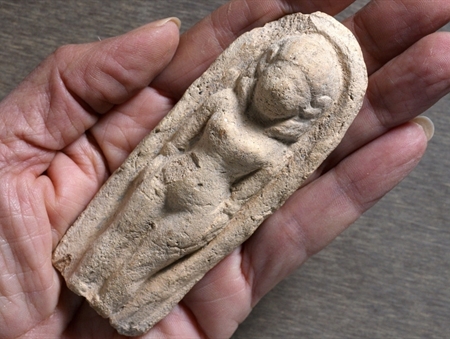
Oh, you know, find 3,400-year-old artifacts.  How about you?

Surprisingly, some of the biggest and most important finds in Israel were found by children on school trips or hiking on their own.  The nice part of the story is that the child and his family turned it in to the Israel Antiquities Authority.  He got a certificate for good citizenship and IAA officials visited his school.  Will it inspire him enough to become an archaeologist some day?  I hope so!

kid

Copyright: Clara Amit – Source.

And that was another side of Israel for this week.

Danger in Israel

It’s not terror.  There have been more deaths in Israel due to traffic accidents than terror.  I had a friend who kept track of these things (I trust him because he is a science person) and he found that even in the worst days of the Second Intifada, there were still more people killed in traffic accidents than due to terror attacks.

This week a full bus collided with a truck stopped on the side of the road on Highway 1 in Israel.  Six people died, three of them were under 18.  It’s especially horrible because the driver of the bus had already had an accident similar to this one on the same road and was suspended from driving between cities for two years.

Israel is still safer than other places in our part of the world.  (For statistics and another opinion, see this article.)  I remember being in Sinai and our driver was driving on the wrong side of the road.  When asked why, he said that this part of the road was smoother, so there was no reason for him to do damage to his car if the road was simply better on the other side.  You could see miles ahead, but it was still a bit disconcerting because he drove like he was being chased.

In Egypt, a taxi driver was taking us to the airport in the wee hours of the morning.  He didn’t have his headlights on, so we mentioned that he might want to turn them on.  He said that having them off saved gas.  (If anyone can tell me that this is true, please comment.)  Besides, there were streetlamps on the highway, so nothing to worry about.

Here in Israel, there is a different driving culture than most Americans are used to – and thankfully it’s not quite like Sinai or Egypt.  Streets are noisy.  The horn is a method of communication with your fellow drivers.  It might say, “Hey! I’m right here (in case you are not using your mirrors).”  Perhaps, “Woohoo!  I’m going through the intersection.”  Taxi drivers often use it to say, “Hey! Wanna taxi?”  It is also used aggressively, “Go!!! The light changed .3 milliseconds ago!!!”  Or “what the hell is the matter with you?!?! Why are you making a 3-point turn in the middle of the road and blocking both directions of traffic?!?!”  This last one is more common than you might think.

A video of driving on the highway in Israel.  It’s not that bad.  Really!

My Israeli driving test

When I converted my US license to an Israeli license, I was required to take at least one lesson, but I didn’t have to take the written part of the test.  In those days, English-speakers told many horror stories of awful driving tests and almost no one passed on their first try.  Additionally, in Israel you can get an “automatic only” license or “manual transmission” license that allows you to drive both standards and automatics.  I went for the manual since I knew how to drive one.  But I was worried.

You take the test in the instructor’s car, which is why it’s good to have at least one lesson so that you can get used to the car.  I arrived at the testing facility and was going to be tested with another student in the car.  The person giving the test didn’t speak a lot of English, but we decided it would be fine.  I carefully pulled out of the parking lot, taking my time and generally being over-cautious.  We get on the road and the tester says “Left!”  I was in the outside lane so I changed lanes to the inside lane.  He started yelling, “Left! Left!” and then tried to grab the steering wheel.  I used a Karate Kid wax off motion to block and shouted back “Ok.  I got it!”  He meant the left turn lane.  So I made the turn.  “Pull over.  Stop the car.”  End of test.

I was sure I had failed.  It was Friday and I wouldn’t get results until the next week, so I spent the weekend wondering how many more lessons I would need, how much it would cost, hoping that I wouldn’t fail too many times and have to take the written portion in Hebrew.  The results came out and I passed.  I guess it was because in the chaos I still had control of the car.  I didn’t question it and I won’t now.  As far as I’m concerned it’s just another miracle of the many that take place in Israel.

And if you decide to visit Israel, don’t worry about terrorism, just be sure to look both ways before crossing the street.

A simmering pot

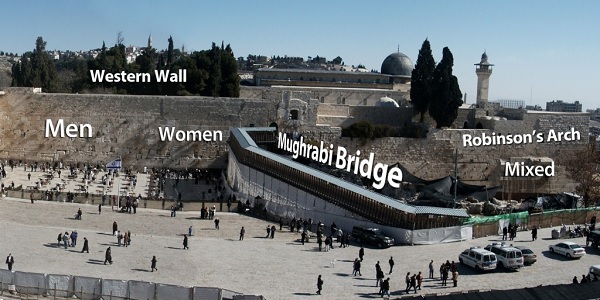
Last week Israel’s cabinet agreed to have a mixed gender prayer area near the Western Wall plaza that would be administered by Israel’s government not the (ultra-Orthodox) foundation that administers the Western Wall .

Yay for plurality! Hoorah for equality!

This is widely seen by the Jewish community outside of Israel and many inside Israel as a good thing because it feels more inclusive and is more open to the non-Orthodox communities who don’t feel connected to the Orthodox vibe of the Western Wall open air plaza. Now they have their own place. It’s close to the plaza, but at the same time they are not in each other’s faces about how they choose to commune with God.

But hang on…

First of all, this space has existed for quite a while. It’s not new. What is new is the entity that would administer it and the fact that it would be expanded. Until now, it was just a tacitly agreed upon space for Reform, Conservative, and various other streams of Judaism to gather and pray as they wish (mostly by not separating the genders).

Women of the Wall have been advocating for plurality and equality and part of the organization agreed to the mixed-gender space. The members who don’t agree feel that they should be allowed to pray in the women’s section as they wish – they don’t really want a mixed gender space. The problem they’ve been facing is that the Orthodox do not agree that a woman can be allowed to put on tefillin, wear a prayer shawl, or read from the Torah. They have fought this battle in court (and won), but have been harassed by both men and women at the wall and arrested for disturbing the peace for gathering at the Western Wall to pray.

Then there are the archaeologists who say that the new construction would damage the archaeological evidence that exists there – specifically, evidence of stones from the wall that fell during the Roman conquest.

Like any other decision, it’s complicated and there are naturally positives and negatives. Decisions get made with compromise and everyone has to give a little.

But there’s more. And this is why this article is called “the simmering pot.”

The violence (aka the knife intifada) that began last year is based on a perception that Israel is trying to change the status quo on the Temple Mount. In October 2015, UNESCO voted on a draft proposal that tried to declare the “Western Wall an ‘integral part’ of the Al Aqsa mosque compound.” That was eventually dropped, but in November Mahmoud Abbas insisted that Israel was trying to change the status quo on the Temple Mount by protecting “settlers” who were “violating” Muslim and Christian holy sites. (The “violation” being prayer. Jews are not allowed to pray on the Temple Mount and are arrested by Israeli police for doing so.) And now, with the vote on the mixed gender prayer site, the Waqf (the Jordanian authority administering the Al Haram al Sharif [Temple Mount]) has declared this vote Israel’s newest intention to change the status quo by “Judaicizing the holy site.” The “holy site” in this case being the Western Wall.

Let’s look back to September 2000. Ariel Sharon visited the Temple Mount to show that all Israelis have a right to visit the site. And then we had the Second Intifada. (Yes, that is a wild oversimplification.)

A vote for a mixed gender prayer site seems like a small thing. But this is Israel. The Western Wall supports the Temple Mount compound where the Al Aqsa Mosque and the Dome of the Rock stand. Context and interpretation are everything. And so the pot simmers on.

Tu B’Shvat Aliyah

In Hebrew aliyah translates literally as “ascend.”  It’s also the word used for immigrating to Israel.  For reasons unknown to me, the English is styled as “to make aliyah.”  I made aliyah (or I ascended) to Israel on February 8, 2002.  It wasn’t exactly Tu B’Shvat, but that year it had been the week before.

I was met at the airport by my aunt, my mother’s sister, who not only immigrated to Israel first and raised her children here, but also was in charge of bringing many more Jews to Israel in her various roles in the Jewish agency.  She took me to her house first where I showered and slept for a while.  It was a night flight and I was totally exhausted.

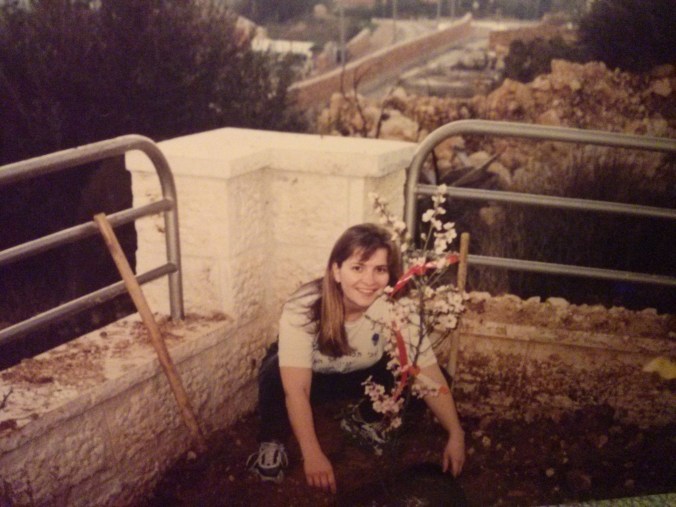
Later in the afternoon, my cousin arrived and we were all just sitting and catching up.  But then my aunt made an announcement:  We have to plant an almond tree before the sun sets.

My cousin and I set to digging and planted the tree.

IMG_20160204_231013

What do you do on your first day in Israel?  If it’s Tu B’Shvat and your name is Ilana, you plant a tree, of course!

Roots

And then something happened and that poor little tree died.  Well, you know, sometimes trees have a little difficulty adjusting to a new place.  The gardener said that was that and whattayagonnado?  So they cut it down.

And then something odd (miraculous?) happened.  It grew back.  Apparently, the roots had survived and it just rejuvenated itself from its own root system.

Birthday for the Trees

In last week’s post, I mentioned that Tu B’Shvat is the New Year for the Trees and that in Hebrew the holiday is called Chag L’Ilanot (Ilan is a tree; Ilana is the feminine version).  I make a special point of Tu B’Shvat because in 2002, it represented a new beginning for me – a new year for this Ilana.  Every year a new chapter unfolds in late January/early February; I’ve gained a year in Israel and I have a clean slate for the next year.

Even though my birthday is around the Jewish New Year and I like the feeling of January 1 as a definitive calendar page turn, I like Tu B’Shvat because I chose this new year and by the circumstance of my name, it chose me.

Epilogue

I don’t know if the tree in my aunt’s garden is still the rejuvenated one or if it was replaced.  But it actually doesn’t matter.  There is an almond tree in that corner of the garden.  Whether it is the one I planted with my own hands, the one that rejuvenated itself from its own roots, or a new tree altogether, the end result is that every version of that almond tree belongs in that place.