I’m buried in non-blog-related work, but I decided that I still wanted to take time to write this week because I am constantly amazed by Jerusalem.
This week there were two big gatherings in Jerusalem. On Tuesday, 1,200 Jews entered the Temple Mount on the fast day of 9 Av, which among other things marks the destruction of both Temples. This is the most that have ever entered the site on that day.
In spite of what you see on the news, I still feel quite safe in Jerusalem. However, I’m not crazy and I won’t be reporting live from the Temple Mount.
Unless you’ve been too wrapped up in the drama at the White House, you might have noticed that the Temple Mount has been in the news lately. This post won’t be a point by point explanation of that, nor will I get into all the vitriol. The salient facts are:
On July 14, two Druze border police officers were gunned down near the Lions’ Gate by terrorists who had homemade guns hidden in the compound of the Temple Mount aka the Haram al Sharif.
Jews consider the Temple Mount the holiest site in Judaism. Muslims consider the Haram al Sharif the third holiest site in Islam.
Jews and other non-Muslims are only allowed to enter through one gate and I believe they have to go through security (it’s been a long time since I’ve been there). Muslims have access to several gates and undergo spot checks at most.
Israel is responsible for the security and the Waqf, a Jordanian organization, administers the site. So when Israel put up security measures (metal detectors and cameras), the Waqf refused to enter and called on all Muslims to boycott the site.
Muslims prayed outside the compound, but it was not all “Kumbaya” and strumming guitars in the name of peace, love, and understanding.
Israel took down all the security measures and the Waqf still was not satisfied and Palestinian leaders were calling for a “day of rage.” But as of this writing on Friday, prayers on the Temple Mount ended peacefully – though there were plenty of clashes elsewhere.
I’m leaving out the attack on the Israeli embassy in Jordan, and the murders of three family members by a knife-wielding terrorist in their house, among other things, which are apparently directly linked to the anger about the security measures.
I’d like to jump out of the 24-hour news cycle and try to look at the big picture. I’ve written about the UNESCO decisions before (here and here) and I continue to be troubled.
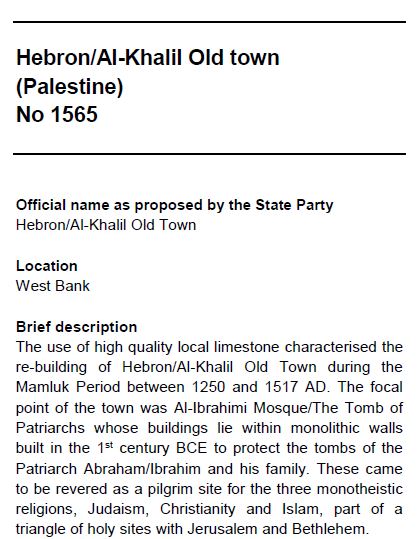
I finally found the hundreds of pages of documentation on the Hebron decision and in skimming them, I did not find anything that was blatantly false. One questionable element was that Hebron is in a country called Palestine.
Screen capture
Israel is always slamming these decisions of World Heritage Sites in Danger and I wondered how sites get nominated. Why doesn’t Israel nominate sites?
That means that in spite of Israel’s Knesset law annexing and unifying Jerusalem, Jordan is the nominating country for the Old City of Jerusalem (though it is listed without a country).
In that case, Hebron should technically also be nominated by Jordan, yet the documentation shows that it is nominated by “Palestine.”
Alternatively, shouldn’t either one of the parties disputing the territory be allowed to nominate?
In both cases, Jerusalem and Hebron are not recognized as being in Israel.
The Hebron decision, by the way, was schedule for next year, but they moved it to this year under special circumstances. It seems like UNESCO is de facto recognizing that Hebron is in the boundaries of a country called Palestine, thus recognizing both the country and its general borders. They also recognize Nazareth, Bethlehem, and Battir as part of Palestine too. As far as I know, there has not yet been a final status agreement between the parties on where the borders would be should Palestine be created in the disputed territory on the west bank of the Jordan River.
Jerusalem and its Walls are a UNESCO World Heritage Site in Danger. In skimming the conservation report for 2017 prepared by Jordan and Palestine for UNESCO, Israel is accused of breaking the “status quo” all the time. So two weeks ago, putting in security measures violated the status quo, which is a strict constructionist view of how to maintain the status quo. The security measures weren’t there in 1967, thus they should not be there now. Security is trumped by the politics of the status quo.
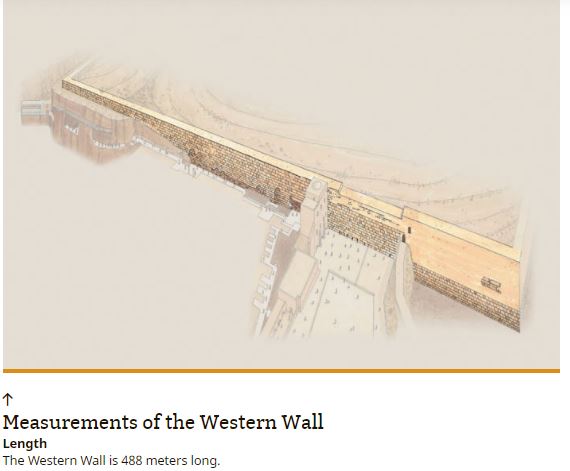
Screen capture from the conservation report
Here’s my final point about the status quo and why we have to be so much more diligent about paying attention to UNESCO. Buried in a footnote on page 39 of the conservation report is this:
Under the terms of the Status Quo on holy sites, a decree fixed the Ottoman Sultan in 1757 and codified in more detail by a British government Commission in 1922, 1929 and 1933 the Wall is a Muslim Waqf property and the Waqf owns the Buraq Wall and the Buraq Plaza in front of the wall. In these decrees, Jews have the right to stand on the pavement in front of it and pray. (Emphasis added.)
This is what is considered the “status quo.”
So according to documents accepted by UNESCO – the United Nations Educational, Scientific, and Cultural Organization – Jerusalem is not in Israel, the Cave of the Patriarchs is an excellent example of first century CE architecture, and the Western Wall is the western wall of the compound of the Haram al Sharif. Oh, and Jews and Christians might have some connections there.
By the way, next week is Tisha B’Av, a day on the Hebrew calendar that marks the destruction of both Temples among other major tragedies for the Jewish people. I guess we’ll have to see what happens next Tuesday.
This week I took two evenings to sprint through the Jerusalem Light Festival. I’m always so proud of Jerusalem and especially our city administration for coming up with interesting and fun cultural events.
This year’s walking paths for the Light Festival went from the southern-facing Zion Gate up to the northern-facing Damascus Gate (yes, the infamous Damascus Gate). Tours within the Old City meandered through the Christian quarter and the Jewish quarter. It felt to me like there was an attempt to tie the two halves of the city together, but it didn’t quite work. I saw quite a few Arabs and a few Jews and tourists when I ventured to the Damascus Gate, but the main crowds were to the south and I saw many Arabs, Jews and tourists there too.
Let me just say something also about the crowds. The phrases “sweaty crush of humanity,” “barbarian horde,” “madding crowd,” and “oppressive multitudes” come to mind. I’m getting flashbacks of mosh pits from my university days, but not in a good way. It’s as if you plan for an elegant reception with light refreshments and the guests come bringing all their friends. They are ravenous, eat everything in sight with both hands and then demand more.
Still, I’m glad that Jerusalem is putting in the effort. Now the crowds just need to do the same. Here are a few lovely highlights from as much of the Light Festival as I could bear.
Damascus Gate as a platform for other gates.
A film presentation on the wall near Jaffa Gate. It used the texture and shape of the walls to make the film more dynamic. Well done!
Explorations of light that have nothing to do with the walls.
The walls as a platform and, if you look closely,
the crush of humanity, I mean, people enjoying the festival.
You know when you have an argument with a loved one about something and it turns into a really ugly fight and later you realize that this huge fight was not even about whatever you were fighting about? It’s actually about something deeper in your relationship. I think that’s what’s happening this week among the Jewish People with regard to the Kotel (the Western Wall).
The Israeli press noted that the decision happened and moved on.
A little background
What is the Kotel actually? It is an exposed remnant of the retaining wall that holds up the Temple Mount complex, where the Dome of the Rock and Al-Aksa now stand. It is *not* a remnant of the Temple itself.
Why do Jews face Jerusalem to pray? Jews pray toward where the Temple once stood; they are not praying to a retaining wall. People place prayers in the Wall, but the Spirit of the Lord does not actually reside there. He just picks up His messages from time to time.
When did the Plaza become a synagogue? In 1967, when Jerusalem was reunified, the alleyway that was in front of the exposed section was expanded and became the Western Wall Plaza. That small section of the retaining wall was conveniently located and it was turned into an open-air Orthodox synagogue (it was not a synagogue before).
How holy is it? Based on the logic of holiness bestowed upon the Western Wall, every part of the retaining wall should be considered equally holy: the southern wall (I’ve seen people praying there), the eastern section (on the Mount of Olives side), the Via Dolorosa (the first few Stations of the Cross starting at the Lion’s Gate), the route of the Tunnel tours, and even a little alley called “The Little Kotel,” which is apparently even closer to where the Temple stood.
So what’s the question? Why should anyone demand that an open-air Orthodox synagogue near an exposed section of a retaining wall accommodate Reform and Conservative practice? To my knowledge, no one has blasted into the Great Synagogue in Jerusalem and demanded that it be converted to accommodate Reform and Conservative practices. There is a Conservative synagogue across the street and everyone seems to be fine with that.
Perhaps we should ask a different question? Why is there any kind of synagogue at all? Why not just keep the practice of individual contemplation and personal prayer for all people of all denominations of all religions?
The bottom line
This kerfuffle is not really about access to the Kotel. Just like the fight you had last week with your loved one wasn’t about who would put the dishes in the dishwasher and how you always do it wrong.
This is about acknowledgement and acceptance.
It could start with the rabbinical authority in Israel acknowledging that there are other visions of Judaism – they may need to negotiate about the different ideas of halakha (Jewish law) – but they should also try to square it a bit more closely with the Law of Return (anyone with a Jewish grandparent on either side is entitled to Israeli citizenship, which is not the halakhic definition of a Jew).
Jews living outside of Israel will also have to accept that Jews living in Israel have their own ideas about how to run the country and preserve holy sites and that donations to Israel and putting your name on buildings doesn’t actually bestow the right to dictate policy here.
Fiddler on the Roof starts with Tradition (video above) and by the end a few things get changed in line with the times. But we keep our balance, like a fiddler on the roof!
My radical proposal
The question of acknowledgement and acceptance is real and I don’t want to minimize it. It is symbolized in the questions of access to the Western Wall and that is indeed legitimate.
However, the bigger issue facing all of the Jewish people is that UNESCO continuously and repeatedly calls the Western Wall Plaza “The Al-Buraq Plaza” and calls the Temple Mount only by its Muslim name. If we want to continue our internal family discussions about access to the Western Wall, we need to ensure that it remains a Jewish site. And we must also remember that the Temple Mount – where Jews are forbidden to pray and are arrested for doing so – is the actual holy site.
Signs of summer are starting to show up in Jerusalem. The city put up these fun mini-umbrellas on Yoel Solomon Street.
Later in the evening I stepped out again to see the mini-light show on the walls of the Old City.
And then I walked through Mamilla on the way home. And it was crowded! It seemed to be an equal mix of Jews, Arabs and tourists.
The crowds are worth pointing out. A week ago, a young police officer was killed by a terrorist at Damascus Gate, a northern gate. Mamilla is near Jaffa Gate, a western gate. They aren’t that far apart with only the Christian and Muslim Quarters separating them from each other. Also, it’s Ramadan. And yet – it’s nearly 10pm and the streets are full.
Jerusalem is beautiful at night and I’m so glad that our mayor and the city council have made it both possible and aesthetically pleasing to be out and about in the city. We don’t quake in fear in the face of terrorism. The minute we do, they win.
Jerusalem is known as the city of light. And for good reason!
Next week we will host the “Light Festival, Jerusalem,” so expect more pictures of the beautiful walls of the Old City from Zion Gate in the south up to Damascus Gate in the north featuring light installations by artists from all around the world.
One of my favorite things about Jerusalem is that everywhere you go you find layers upon layers of human history. It’s a lot like geological layering, but in human history each layer has a story. I liked writing the Michener history of The Hill of Evil Council and was planning to do that this week, but I’m going to come at it from a slightly different angle.
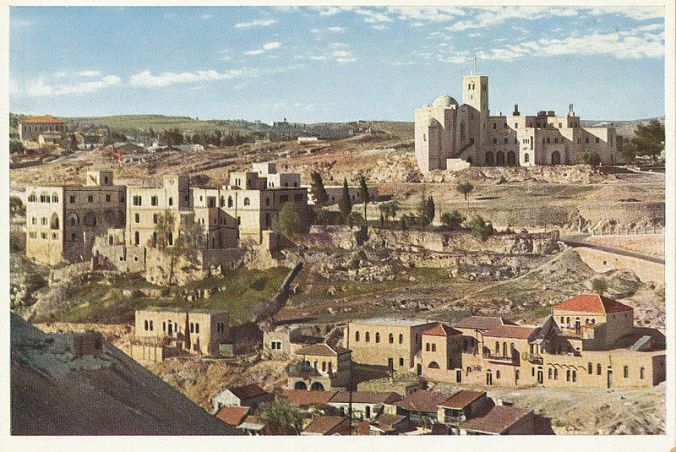
My office has what might be called a backyard. It’s an archaeological site, but still it’s a space between us and St. Andrew’s Scottish Church. Even now, if you didn’t know what you were looking at, it would look like someone had carved into the rock and made a few flat surfaces and cleared some space in the middle. Unfortunately, I don’t have a good picture of it, but that’s not really what this post is about anyway.
Just below the domes of the church – upper right of the image – is the archaeological site. (Postcard from 1930 when the church was completed.)
In short, it’s a First Temple Period burial cave. In 1979, Gabriel Barkay excavated the site and found evidence of a burial cave, Roman coins to suggest that the 10th Legion had been there during the siege of Jerusalem in 70 CE, and mosaics from a Byzantine-era church. The cave had collapsed because it had been used as a weapons cache during the Ottoman period and most likely something exploded accidentally causing the cave to fall in. In Jerusalem, that’s a pretty typical backyard.
Once the archaeological team decided they had cleared the site, they brought kids in for field trips to do some amateur archaeological digging. They brought in a group of 12-13-year-old boys and among them was one nudnik. A nudnik is a Yiddish word meaning an annoying pest of a person. I don’t think it’s quite as harsh as it sounds in English.
Anyway, the nudnik is aggravating Barkay and he sends the kid down into a hole and tells him to brush the floor and make it as clean as possible. The kid, being a nudnik and a boy, gets bored and finds a hammer. Rather than brush the floor, he starts hammering it.
Our nudnik comes back to Barkay and tells him that he found something. Barkay is completely incredulous. They go down and realize that the “floor” was a false floor – or possibly the ceiling fell in and created the illusion of a floor. Barkay gathers his team and they dig and find one of the biggest and most significant archaeological hauls in Israel. Lots of jewelry, bones, trinkets, pottery, and most significantly, two tiny scrolls of silver that have verses from the Bible written on them in script that dates from the late First Temple Period (650 BCE – 587 BCE). On the silver scrolls were written what is known as The Priestly Blessing (“May the Lord bless you and keep you…”).
These scrolls are the oldest artifacts ever found with biblical text on them and they are 400 years older than the Dead Sea Scrolls. (Don’t worry. They are in the Israel Museum now.)
MORAL OF THE STORY 1: Don’t underestimate a nudnik! Imagine that one of the greatest archaeological finds in Israel stood undisturbed for 2,500 years. None of the thousands of people who built on that hill ever found this treasure. No soldiers, no tomb raiders, no shepherds, no archaeologists. It was a nudnik kid!
MORAL OF THE STORY 2: Looks can be deceiving. A rocky hillside that functions as a backyard is actually the site of one of the greatest treasure troves found in Israel!
As I was walking to the Western Wall this morning it occurred to me that I live in one of the most special places on earth. The Old City of Jerusalem is just part of my neighborhood, so I often forget to take a moment and enjoy my surroundings.
After a rainy and cold week, the sun was shining this morning. It was the perfect day to deliver a small note to the Western Wall on behalf of a friend and take the opportunity to say a few words of gratitude for all the blessing I have in my life.
A note for a friend (the blue-green one)
Looking up
Panorama
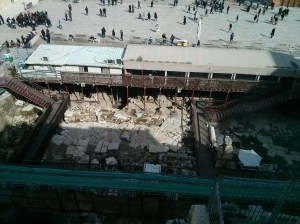
Recent excavation at the Western Wall Plaza of a Roman era street
Today is Inauguration Day in the US. In Israel, it’s just an ordinary Friday. We’re running our weekly errands and preparing ourselves for Shabbat or other weekend plans.
US voters in Israel tend to vote for the president on one issue and one issue alone: how will the next president relate to Israel. It’s a variation on the punch line, “yes, but is it good for the Jews?” This is understandable. We human beings care about our immediate surroundings, our families, and our close friends. If it doesn’t affect us personally, then it’s more of an “out there” issue and not an “in here” issue.
Israel, it turns out, has the same opinion. I ran across a video from Mayor Nir Barkat asking citizens of Jerusalem to welcome President Donald Trump as a friend and to sign a letter supporting the decision to move the US embassy to the undivided capital of Israel, Jerusalem. I’ve spoken to other Israelis and they agree with our mayor. I don’t think this is a minority opinion.
As great as Trump may be for Israel, I feel that Israel may be a bit narrow in its view and possibly short-sighted. Leaving peace negotiations aside and all the problems in the Middle East (yes, I can do that!), if a person is insulting the leadership of other countries, nominating a cabinet that seems to be unqualified for their positions, and is divisive in his own nation – is that person actually good for Israel?
I would have to research it more, but it seems similar to Israel being one of the few countries that had dealings with South Africa at the height of Apartheid when all other countries were boycotting South Africa. The rationale was that Israel had so few friends in the world. Is that the case today? Many, many Israelis would say it absolutely is.
Well, I’m not a political analyst, so I don’t know what will happen. It remains to be seen.
I still like our mayor – he’s done a lot of great things for Jerusalem – but since I’m already questioning him, I have another complaint.
I don’t drive in Israel. I have a license, but I don’t enjoy the experience and I live in a place where parking is almost non-existent. It’s a lifestyle choice. But this week, I had an unbelievable experience in traffic.
MFA was driving and I’m glad she was and not me. I don’t know if I could have handled it. After lunch one day, we got into the car to drive the 5-10 minutes to my house. We got on a main road and saw that it was clearly rush hour, but still, it was only about a mile, traffic should be moving, right? Nope.
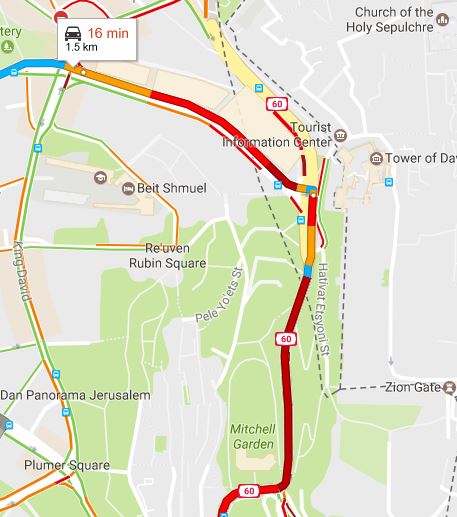
This is our route and the traffic situation as I write this post.
This main road runs under the walls of the Old City, so it’s impossible to turn off onto a side street – there are no side streets – so you are stuck.
On the way, in the opposite lane, we saw a guy violently pop his car up on a curb, leave his wife in the car, and forcibly pull another guy out of his van to let him know how much he disliked his driving. That was tense. Luckily, they got back into their cars and went on – whew, no fisticuffs.
We finally get to the left turn we need to take and MFA is careful not to block traffic in the intersection too much since we can’t quite get all the way into the next street. Then we’re stuck there for a good long while. We move about a foot in 10 or 15 minutes.
A young woman edges up close to us as if she wants to get into our lane. This seems totally bizarre because there is no reason for her to get into our lane right here and she’s blocking cars behind her as well as merging traffic from the other side. People, including a bus driver, get out of their vehicles to yell at her and she just shrugs her shoulders at them. Some – who are not blocked by her – are laughing because this girl clearly just doesn’t care at all.
The car in front of us moves a bit and MFA decides to be nice and let the girl in because it should loosen up all the traffic that she’s blocking. And this girl, this crazy, crazy girl, cuts across the lane to MAKE A U-TURN!!! She’s blocked by traffic going the other way that won’t let her in. And at the same time, ANOTHER CRAZY GIRL taps the back of the first girl’s car and swerves around her TO ALSO MAKE A U-TURN!!!
In our car, we are both screaming. WTF!!!
When we get to the end of the street we see that many of the problems here stem from double-parked tour buses and people blocking traffic as they try to get into the parking garage. After we passed the last entrance to the parking garage, there was not a car in sight! Nothing. Completely clear roads.
I’m sure I should care about the US Embassy moving to Jerusalem, but to be honest, I think a bigger issue is this stupid traffic and selfish drivers. Yeah, I probably seem to have narrow vision and may be short-sighted, but I’ll tell you what: When the sun is setting and the colors are changing on the gorgeous walls of the Old City of Jerusalem, I don’t want to feel murderous rage toward my fellow human beings who don’t care at all about anyone else around them.
No matter what Trump’s relationship with Israel is, he’s not going to fix traffic.
Dear Mr. Mayor, I know you need to have vision and see the big picture, but I’m too embarrassed about this traffic situation to want anyone to visit, much less move the embassy!! Fix this first!!
Jerusalem is located on the same latitude as San Diego. You expect mild winters and hot summers. So when you move here from northern climates – snow every winter, ice on the roads, negative wind chill factors – you expect to have easy winters. And yet, if you ask around, Jerusalem winters are the coldest anyone has ever experienced.
I also think Jerusalem winters are the coldest I’ve ever experienced, even though I’m writing this sitting on my porch with the sun warming my face and with only a light fleece as a jacket. I’m writing outside because it’s actually warmer outside than inside right now. Winter in Jerusalem is strange and as we enjoy the daytime mild weather, we maintain that Jerusalem is the coldest place we’ve ever lived. Here are a few of the theories.
Elevation
No. Jerusalem is only 800 meters (2,600 feet) above sea level and many of us have been to higher elevations. Even if the wind feels like it’s blowing off of a glacier, there are no nearby glaciers.
It’s the desert
Possible. It is a known fact that deserts during the day are hot and freezing at night. However, the actual temperature is not freezing and yet we complain more bitterly of the cold here.
Housing materials
Maybe. Homes are made of poured concrete with no insulation. Floors are covered with tile. Their coldness is lovely during a hot summer and like living in an igloo in the winter. To slightly counteract the ice cold tile issue, some homes have installed heating elements under the tiles so that heat is radiating from the floor.
No fireplaces
I just miss a nice roaring fire. I’ve often thought it might be nice to build a fire in the middle of my living room, but that would only be a temporary solution to an ongoing problem.
Mysterious cold zones
I have walked in Jerusalem and suddenly felt an enormous chill in the air. I have never found any explanation for this. If you didn’t believe in ghosts before, these chilling zones might make you rethink it.
It’s cultural cold
This is my theory. In cold climates, you have the right clothes and you go from your warm home with insulation and wall-to-wall carpeting to your warm car to your warm office. You are not feeling the cold in the same way that the cold surrounds you here. Here you wake up in your chilly house (unless you can afford to run the electric heater all night), you put your feet on the ice cold tile when you get out of bed (slippers and area rugs minimize the chill), your hot water heater has only a certain amount of hot water (as uninsulated hot water heaters are generally on the roof to maximize solar energy), and the clothes you put on are somehow never warm enough. As you walk to the office, it’s not so bad unless it’s raining or the wind is blowing. The office is probably warm though, because it’s a business. When you get home, sometimes you hang around outside until the heater warms up the space because the inside of your house feels like a walk-in freezer.
Then, once every few years it snows in Jerusalem and you forget about all your complaints because it’s just so pretty and reminds you of your childhood. (Photos from February 2015)
After last week’s UNESCO vote, the Jerusalem Parade is extremely well-timed. There will be a new vote on the UNESCO resolution, but it feels like rumblings rather than outright condemnations of an obviously biased document.
During Sukkot, Jerusalem is filled with both Jewish and Christian tourists from all around the world. The streets are filled with families, restaurants have sukkahs (booths) outside, and there is a festival atmosphere throughout the city during the whole week.
For many years, I thought the parade was primarily a Christian thing, but it turns out that the first parade was in 1955 during Passover. Then after 1980 when the Christian Embassy was founded in Jerusalem the parade evolved into what we have today. The parade begins with Israeli groups – banks, insurance companies, army units, corporate groups, and others – and then the Christian groups from around the world join in.
The Christian groups are often singing songs in Hebrew to show their support. Not being Hebrew-speakers they tend to choose the ones with simple and repetitive lyrics, but strong messages. “Am Israel, Am Israel, Am Israel, Chai!” (The people of Israel live!) “Havenu Shalom Aleichem” (We wish you peace) “Ya’aseh Shalom, Shalom Aleinu v’Al Kol Israel” (May He bring peace, peace to us and all Israel).
Here are a few pictures from the parade. I chose them based on the ones that turned out rather than any other criteria.
The Chinese took the phrase “Go Big or Go Home” to heart and had the biggest flags and banners and also brought along the Ark of the Covenant with trumpeting angels.
Hungary had its own group, but the Gipsy nation came on its own.
All the northern countries were represented, but these were two signs I caught.
All around the world is not an exaggeration: Fiji, New Zealand, Bolivia, Thailand, Taiwan, Zambia, Kenya, South Africa, France, Germany, UK, Ireland, US, Canada, and more and more and more.
My wish for this holiday season is that all these people would call their UN representatives and let UNESCO know that they came to Israel to strengthen their Jewish and Christian connections to the land.
*Note: Christians are not allowed to proselytize in Israel. They are not permitted to hand out any religious material at all. So this event is a surprisingly non-political, non-religious event that is very simply an expression of support and love for Israel the country, not its government or policies.





 Just below the domes of the church – upper right of the image – is the archaeological site. (Postcard from 1930 when the church was completed.)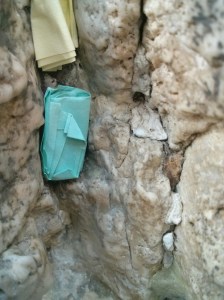


 This is our route and the traffic situation as I write this post.


 The Write Place (for me)